
Learning Styles: Types, Tips & What Research Says
Learning styles are frameworks that describe how people prefer to take in and process information. The most popular model is VARK, which stands for Visual, Aural, Read/Write, and Kinesthetic. While knowing your learning style can help you study smarter, research shows that most people learn best through a mix of methods. Use your style as a guide, not a strict rule.
Have you ever noticed that you remember something better after drawing a diagram, rather than just reading about it? Or maybe you recall information more easily after hearing it explained out loud? That is the idea behind learning styles.
Learning styles describe the different ways people prefer to receive and understand new information. Understanding your learning style can help you study more effectively, stay focused, and feel more confident in school or work. In this guide, you will learn what learning styles are, the main types, how to find yours, and how to use that knowledge to study better.
What Are Learning Styles?
Learning styles are theories in educational psychology that explain how different people prefer to absorb, process, and remember information. Not everyone learns the same way. Some people remember things better when they see a chart. Others need to hear information spoken aloud. Some prefer to take detailed notes, while others need to get hands-on and try things for themselves.
These differences in learning preferences are what researchers call learning styles. The idea has been part of education for decades and continues to shape how teachers plan lessons and how students set up their study habits. Multiple models exist, but the VARK model is by far the most widely used and recognized in schools and training programs today.
What Is the VARK Model?
The VARK model was created by educator Neil Fleming in 1987 and refined with colleague Colleen Mills in 1992. The name VARK stands for four sensory modalities that describe how learners prefer to take in information. Fleming developed the VARK questionnaire, a short self-assessment tool that helps people understand their preferred learning approach.
Here is a quick overview of the four VARK types:
- Visual: Prefers diagrams, charts, graphs, and spatial layouts
- Aural: Learns best through listening, speaking, and discussion
- Read/Write: Thrives with written text, lists, and detailed notes
- Kinesthetic: Needs hands-on practice, movement, and real-world examples
Each of these four types represents a different way of receiving and processing new information. Most people have a natural lean toward one or two of them.
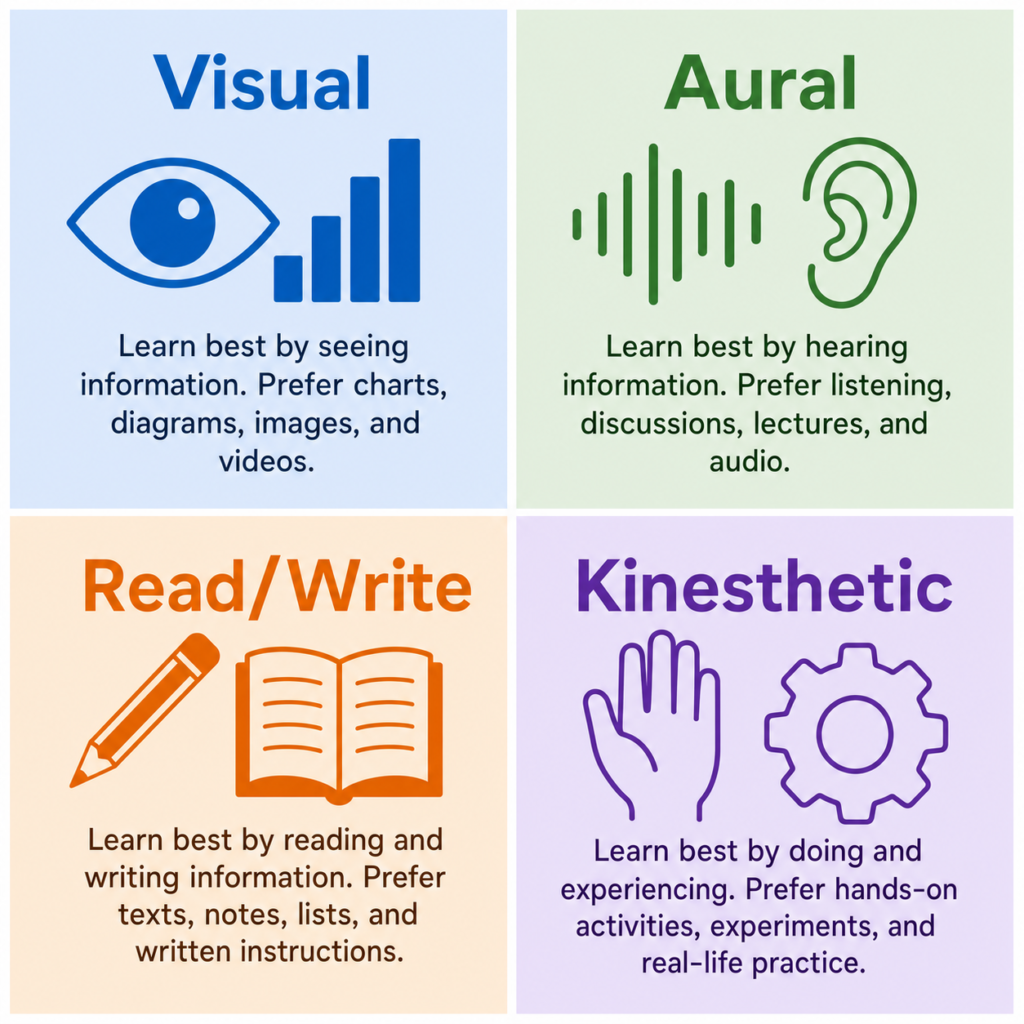
The VARK model: four sensory learning preferences identified by Neil Fleming.
Visual Learners
Visual learners prefer to see information laid out in a way they can look at and study. This does not mean watching videos. In the VARK model, “visual” refers to visual representations of information like flowcharts, mind maps, color-coded notes, diagrams, and graphs.
If you are a visual learner, try these study tips:
- Draw diagrams or mind maps when learning new topics
- Use color-coded highlighters to organize your notes
- Turn written information into charts or visual summaries
- Sketch out processes step by step before writing them out
Visual learners often do well in subjects that use graphs, timelines, or maps because those formats match how their brains prefer to organize new knowledge.
Aural (Auditory) Learners
Auditory learners take in information best through sound and speech. They tend to enjoy lectures, group conversations, and explaining ideas out loud. Hearing information repeated or discussed helps it stick.
Helpful study strategies for aural learners include:
- Record lectures and play them back while reviewing notes
- Join a study group and talk through concepts with others
- Read your notes aloud or explain topics to a friend or family member
- Use songs, rhymes, or rhythms to memorize facts
Aural learners often find that studying in complete silence is actually less effective for them. A quiet background voice or soft music can sometimes help with focus.
Read/Write Learners
Read/write learners prefer information delivered through written words. They do best when they can read textbooks, write out notes, create glossaries, and organize information in lists. This learning style fits well with traditional classroom formats.
Study tips for read/write learners:
- Rewrite notes in your own words after each class
- Create summaries of each chapter or lesson
- Make numbered lists and written outlines of key concepts
- Write out definitions for every new vocabulary word
Read/write learners tend to remember information best when they have written it out at least once, even if they never go back to reread those notes.
Kinesthetic Learners
Kinesthetic learners need to physically do something to truly understand it. They learn by touching, building, experimenting, and practicing in real situations. They may struggle to sit still during long lectures.
According to VARK data, kinesthetic is the most common single-preference style, with about 22.8% of respondents identifying it as their primary mode.
Study tips for kinesthetic learners:
- Use physical models, flashcards, or building activities when reviewing material
- Take breaks and move around between study sessions
- Connect what you are learning to real-life examples or experiences
- Look for lab work, field trips, or role-play opportunities in class
Kinesthetic learners often do well in science labs, vocational training, and performance-based subjects because those environments naturally support hands-on cognitive learning.
Are There Other Learning Style Models?
The VARK model is the most commonly used, but it is not the only one. Several other frameworks describe different learning styles and cognitive preferences. Here is a quick comparison of the most well-known models:
| Model | Number of Types | Key Focus |
| VARK (Neil Fleming) | 4 | Sensory input preferences |
| VAK (simplified) | 3 | Visual, Auditory, Kinesthetic only |
| Multiple Intelligences (Howard Gardner) | 8 | Different cognitive strengths and talents |
| Kolb’s Experiential Learning | 4 | Thinking vs. doing, reflecting vs. experiencing |
| 7-Style Model | 7 | Adds logical, social, and solitary to VAK |
One important thing to note: multiple intelligences and learning styles are not the same thing. Howard Gardner introduced the theory of multiple intelligences to describe different types of talent and cognitive ability, such as musical intelligence, spatial reasoning, and interpersonal skills. Learning styles describe how you receive information. They come from different theories and serve different purposes.
David Kolb’s Experiential Learning Cycle is another respected framework. It focuses less on sensory preference and more on whether a learner prefers to think through ideas abstractly or learn by direct experience. This model is especially popular in corporate training and adult education settings.
How Do You Find Out Your Learning Style?

Taking a short quiz can help you identify your preferred learning style.
You can identify your learning style by taking the free VARK questionnaire at vark-learn.com, which asks 16 multiple-choice questions about how you handle real-life learning situations. You can also reflect on which study methods have helped you most in the past, whether that is visual diagrams, listening to explanations, reading notes, or hands-on activities.
Here are a few self-reflection questions to guide you:
- When someone gives you directions, do you prefer a map, a verbal explanation, written instructions, or walking the route yourself?
- Do you remember lectures better when you take notes, listen closely, draw diagrams, or join in activities?
- When you study for a test, what method works best for you?
One important thing to know: many people score as multimodal on the VARK questionnaire. This means they have strong preferences in two or more categories. Research shows that about 56.1% of learners naturally use multimodal strategies, which means this is completely normal.
Aural learners especially benefit from talking through material with peers. When you discuss a topic out loud with classmates, you activate both your aural and social learning strengths at the same time. You can explore how guided group discussions work in a learning environment to see how this approach fits your style.
Do Learning Styles Actually Work? What the Research Says
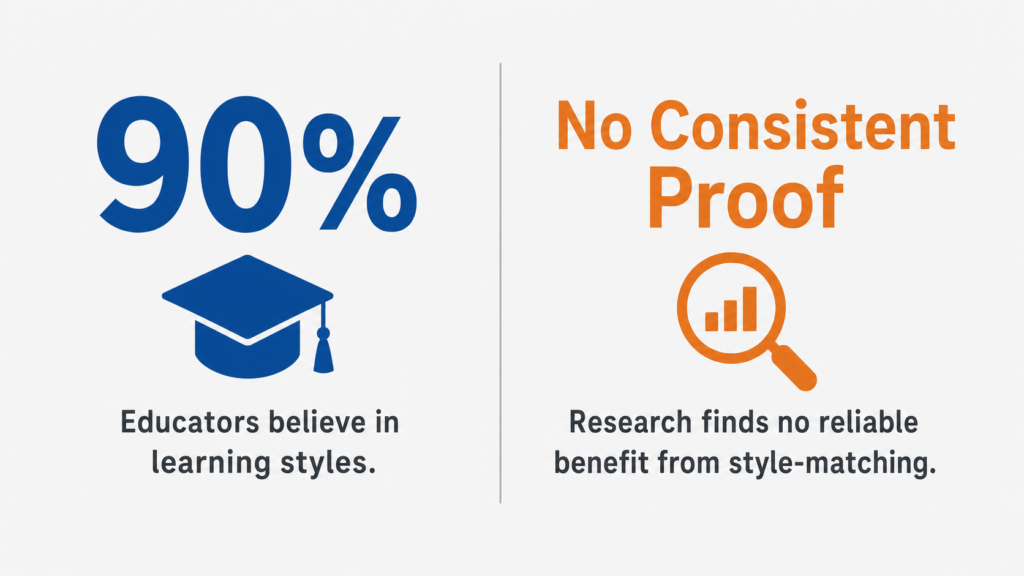
Research shows a gap between educator belief and scientific evidence on learning styles.
This is one of the most important questions in modern education, and the honest answer is: it depends on how you use them.
People do have real preferences for how they receive information. About 79% of college students agree that they learn better in their preferred style. And roughly 90% of educators worldwide believe in addressing different learning preferences in the classroom. That is a powerful sign that this concept resonates with real experience.
However, researchers have raised serious concerns about the “meshing hypothesis.” This is the idea that matching instruction directly to a student’s stated learning style will improve their academic performance. Meta-analyses, which are large reviews of many studies at once, have not found consistent evidence that this matching actually produces better results.
What the research does support is this: varied, multimodal instruction benefits all learners, regardless of their stated preference. Students who experience a mix of visual, verbal, hands-on, and written activities tend to retain information more deeply than those taught in only one mode. The practical takeaway is simple: use your learning style as a starting point for self-awareness, not as a ceiling that limits how you or your teachers approach learning.
How Can Students Use Learning Styles to Study Better?
Now that you understand your style, here is how to put it to work in your daily study routine. These strategies are organized by learning styles for students, but remember that combining methods from more than one category is often the most effective approach.
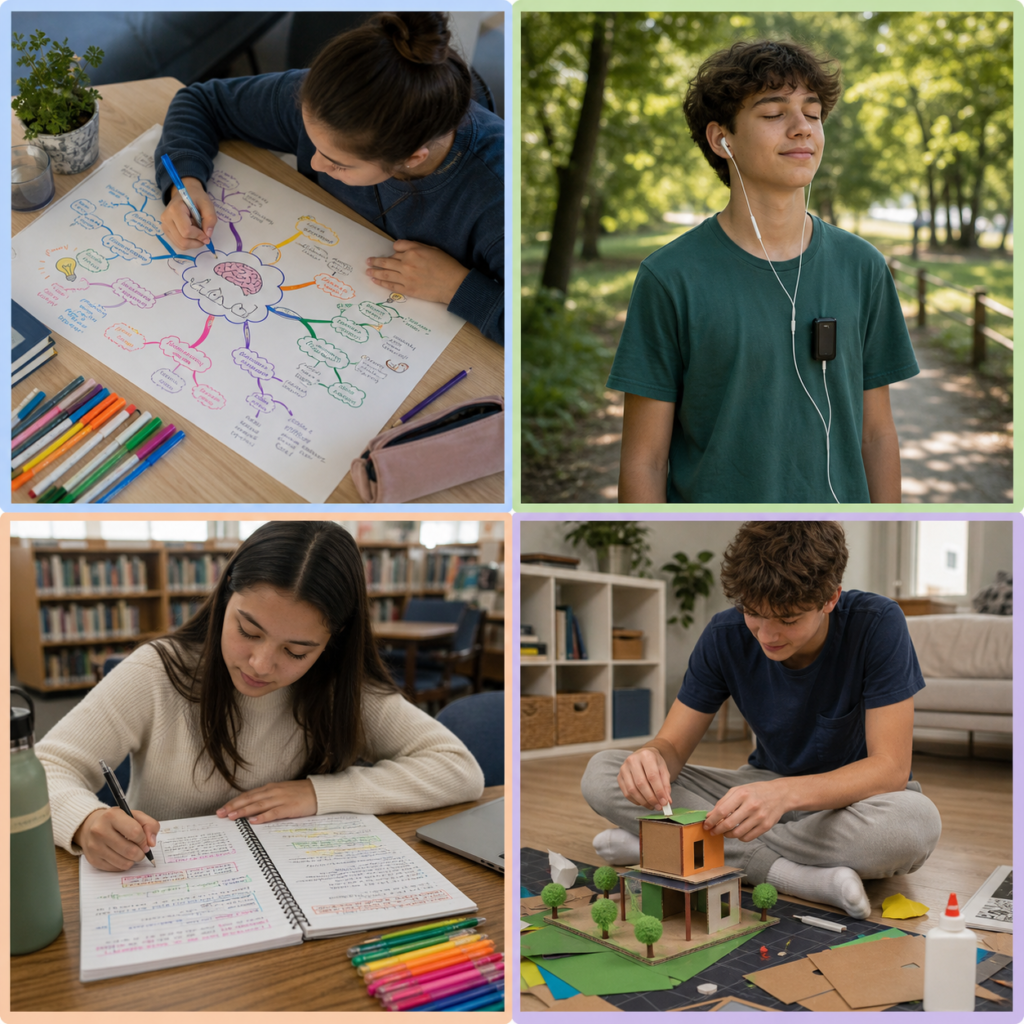
Different learning styles call for different study strategies.
For visual learners:
- Create color-coded outlines and mind maps before studying
- Turn textbook chapters into visual diagrams before writing summaries
- Use apps that allow you to draw and annotate notes
For aural learners:
- Form or join a study group that meets regularly to talk through material
- Record yourself explaining key concepts and listen back before a test
- Use text-to-speech tools to have your notes read aloud to you
For read/write learners:
- Write a one-page summary of each topic in your own words
- Make structured outlines with bullet points before and after reading
- Keep a vocabulary journal for each subject
For kinesthetic learners:
- Use physical flashcards you can sort and rearrange
- Find real-world examples for every concept you study
- Take short movement breaks every 25 to 30 minutes
Not sure of your style yet? Mix two or three of these strategies. Most people are multimodal learners, and using a combination of methods almost always produces better results than relying on just one. Understanding how group discussion teaching supports different learning types is another powerful way to strengthen your approach, especially for aural and kinesthetic learners who benefit from active participation. You can read more about how group discussion is used as a teaching method to see how it supports diverse learners in real classrooms.
How Do Teachers Apply Learning Styles in the Classroom?
Teachers do not need to identify every student’s learning style and create individual lesson plans for each person. That approach is not realistic or necessary. Instead, the most effective classroom strategy is to vary instructional methods so that all learners are reached at different points throughout the lesson.
About 90% of educators worldwide believe that addressing different learning preferences improves student engagement. The modern, research-backed framework that aligns with this belief is Universal Design for Learning, or UDL. UDL is a teaching approach developed to make education accessible and effective for all types of learners by offering multiple means of representation, engagement, and expression.
Here are practical classroom strategies that support different learning styles:
- For visual learners: Use slideshow presentations, diagrams, infographics, and visual timelines
- For aural learners: Include verbal explanations, class discussions, read-alouds, and recorded content
- For read/write learners: Assign written summaries, note-taking tasks, essays, and reading assignments
- For kinesthetic learners: Incorporate lab work, group projects, demonstrations, and role-play activities
One powerful classroom strategy that supports multiple sensory modalities at once is structured group discussion. When students discuss ideas together, they hear information (aural), organize it in writing (read/write), and apply it socially (kinesthetic). The advantages of group discussion in learning show exactly why this method is so effective for reaching multiple learning styles at once.
Keep Exploring Your Learning
Understanding your learning style is one of the most useful things you can do as a student or educator. It gives you a starting point for building study habits that actually work. Whether you are a visual, aural, read/write, or kinesthetic learner, each style has real strengths you can build on.
The most important thing to remember is that learning styles are a tool, not a box. Use yours as a guide to set up study sessions, pick your methods, and engage with material in the way that clicks for you. Then stay curious and keep experimenting with new approaches.
Explore our study strategies and teaching guides to take the next step in building your best learning routine.
Frequently Asked Questions
Can two people have the same learning style but still learn differently?
Yes, absolutely. Even within the same style category, individual learners differ in pace, background knowledge, motivation, and environment. Learning style is just one factor in how a person learns. Personality, prior experience, and the specific subject being studied all play a role in how someone takes in and retains information.
Is the VARK model used in workplaces as well as schools?
Yes, widely. The VARK model is used in K-12 schools, higher education, corporate training programs, and instructional design. HR professionals use it to design onboarding and professional development programs, while teachers use it to plan varied lessons. Its simplicity makes it easy to apply in many different settings.
Does technology change how we think about learning preferences?
Modern AI-powered adaptive learning platforms do not rely on self-reported styles. Instead, they track real performance data and adjust content delivery based on how a student is actually responding. This is a more evidence-based approach than style-matching, though it still recognizes that different learners need different formats. You can explore how group discussion works alongside technology in modern classrooms to see how digital tools support diverse learners in today’s schools.
What is the difference between a learning style and a study habit?
A learning style refers to your preferred way of receiving information, such as visually or through hands-on practice. A study habit is a behavior or routine you use when preparing for class or a test. Your learning preferences can inform which study habits work best for you, but they are not the same thing. Consistent study habits like spaced repetition and self-testing are beneficial for all learning styles regardless of type.
How is a panel discussion different from a regular group discussion in education?
A panel discussion involves a small group of informed speakers who discuss a topic in front of a larger audience, while a regular classroom group discussion involves all participants equally. Panel discussions are more structured and tend to suit read/write and aural learners who benefit from hearing well-organized expert perspectives on a topic. You can learn more about the panel discussion method and how it is applied as an instructional tool in education.
At what age do children start showing a clear learning style preference?
Most educational researchers suggest that learning preferences begin to emerge in early childhood, around ages 5 to 7, but they are not fixed or permanent. Preferences can shift as children grow, gain experience across different subjects, and develop new cognitive skills. Younger children typically benefit most from kinesthetic and visual approaches because their brains are wired for active, sensory-based exploration.