Lesson Planning: A Complete Guide for Teachers Who Want Better Results
Lesson planning is the process teachers use to map out what students will learn, how instruction will unfold, and how understanding will be assessed before class begins. A strong lesson plan includes clear learning objectives, well-chosen instructional activities, materials, an assessment strategy, and a logical time sequence. Teachers who plan systematically cover curriculum more consistently, reduce classroom management issues, and improve student outcomes. Following a structured 5 to 7 step process aligned to a proven instructional model gives every lesson a clear beginning, middle, and measurable end.
Teachers spend between 10 and 15 hours every week on planning, preparation, and curriculum work. Yet most schools only provide around 4.4 hours of dedicated planning time within the school day. That gap is real, and it is felt every single week.
Lesson planning should not be the reason teachers stay up past midnight. When you have a clear process, the right framework, and an understanding of what every strong lesson plan must include, planning becomes faster and your teaching becomes sharper.
This guide walks you through exactly what lesson planning is, why it matters, what belongs inside every plan, how to build one step by step, which planning models are worth knowing, and what mistakes to avoid.
What Is Lesson Planning?
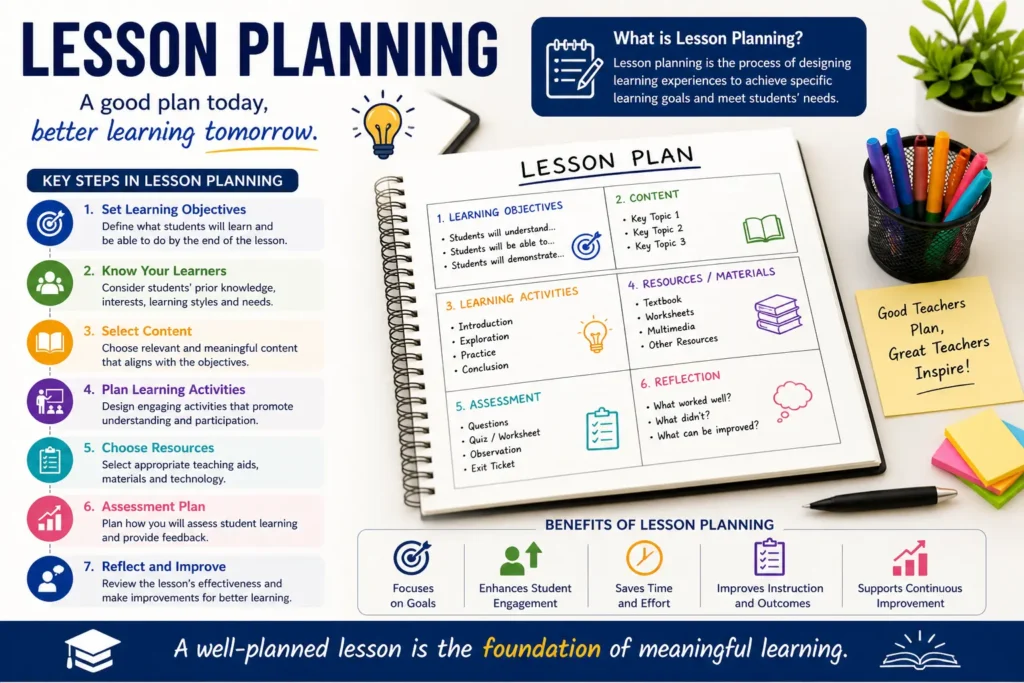
Lesson planning is the structured process a teacher uses to prepare for a single class session. It turns a broad curriculum standard into a clear, teachable sequence of activities. Think of it as a road map: it tells you where you are starting, where you are going, and how you are getting there.
A lesson plan is not just a list of activities. It is a working document that connects your learning outcomes to your instructional methods and then to your assessment strategy. Everything in it should have a reason for being there.
According to the OECD, teachers spend roughly half of their total working time on tasks outside of direct instruction, including planning and preparation. That makes lesson planning one of the most time-consuming parts of a teacher’s job, which is exactly why doing it well matters so much.
Why Does Lesson Planning Matter for Teachers?
Good lesson planning is the foundation of effective teaching. When you plan carefully, your students experience lessons that feel organized, purposeful, and worth their time. When planning is skipped or rushed, even experienced teachers struggle to keep students engaged.
Research from the SMU Centre for Teaching Excellence shows that structured learning guidance actively increases the rate of student learning by reducing frustration and confusion during class. A well-built lesson gives students a clear path forward instead of leaving them guessing what comes next.
Nearly half of all teachers say that lesson planning is the most valuable non-teaching activity they do each week. That is not a surprise. A strong plan:
- Keeps your instruction on track and pacing consistent
- Reduces behavioral issues because students are always engaged with a purposeful task
- Makes it easier to meet the needs of all learners through differentiated instruction
- Helps you align every classroom activity with curriculum standards
- Gives you something concrete to reflect on and improve after each class
What Are the Key Components of a Lesson Plan?
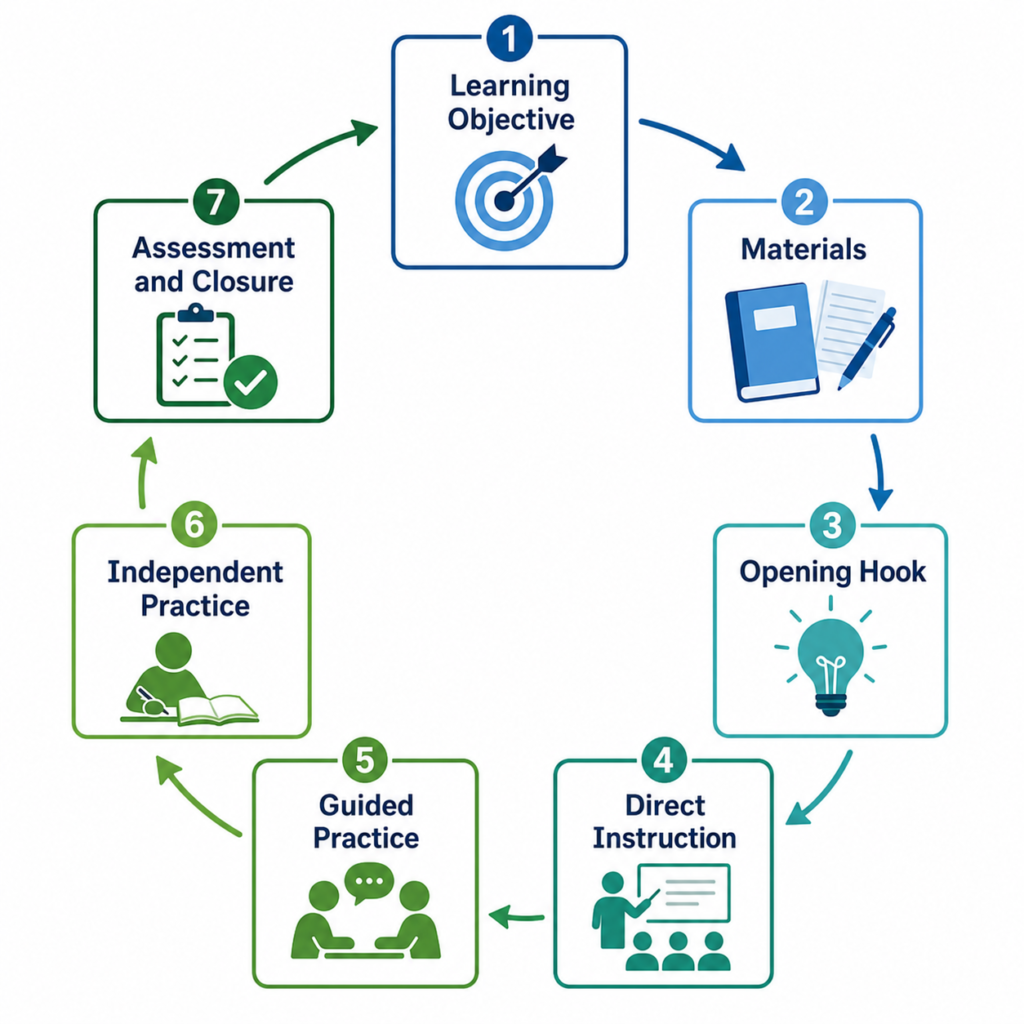
A strong lesson plan typically includes seven core components: a clear learning objective, a list of required materials, an opening hook or warm-up, direct instruction steps, guided and independent practice activities, an assessment method, and a closure activity. Together these elements ensure the lesson has a beginning, middle, and measurable end.
Here is what each component does:
- Learning Objective: What students will know or be able to do by the end of class. Every other part of the plan connects back to this.
- Materials and Resources: Everything you and your students will need, from printed handouts to digital tools to physical supplies.
- Opening Hook or Warm-Up: A short activity that activates prior knowledge and focuses student attention on the new topic.
- Direct Instruction: The segment where the teacher explains, models, or demonstrates the new concept clearly.
- Guided Practice: Students work through the concept with teacher support before trying it independently.
- Independent Practice: Students apply the skill or concept on their own, giving you data on who has mastered it.
- Assessment and Closure: A method to check for understanding, such as an exit ticket, question prompt, or short quiz, followed by a summary of what was learned.
How Bloom’s Taxonomy Shapes Your Learning Objectives
Writing strong learning objectives is one of the hardest parts of lesson planning for new teachers. Bloom’s Taxonomy gives you a practical tool for this. It organizes thinking skills into six levels: remember, understand, apply, analyze, evaluate, and create.
The level you choose shapes the entire lesson. A lesson asking students to “list the causes of the Civil War” (remember) looks very different from one asking them to “evaluate which cause had the greatest long-term impact” (evaluate). Matching your objective to the right Bloom’s level keeps your activities and assessments aligned with your actual instructional goal. For a deeper look at how to apply this in the classroom, explore how Bloom’s Taxonomy supports lesson design.
How Do You Create a Lesson Plan Step by Step?
Creating a lesson plan starts with identifying the learning standard or objective, then choosing appropriate content and activities, then sequencing them into a logical classroom flow. Teachers finish by planning an assessment to measure understanding. Most effective lesson plans follow a 5 to 7 step process that moves from objective-setting through delivery to evaluation.
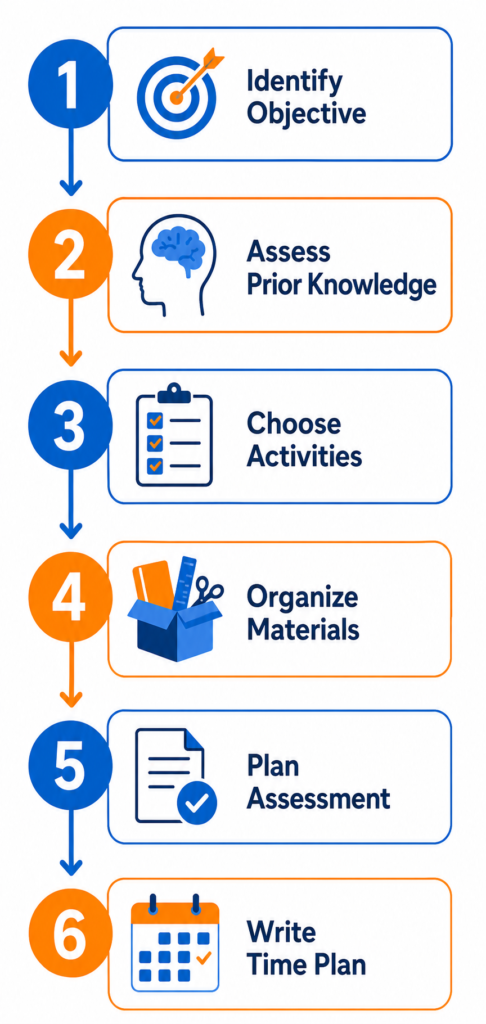
Follow these six steps every time you sit down to plan:
Step 1: Identify Your Learning Objective
Start with what students should know or be able to do by the end of the lesson. Tie this directly to a curriculum standard or grade-level expectation. Use an action verb from Bloom’s Taxonomy to make the objective specific and measurable.
A clear objective sounds like this: “Students will be able to identify three causes of World War I using evidence from primary sources.” A vague objective sounds like this: “Students will learn about World War I.” The specific version gives both you and your students a target to aim for.
Step 2: Assess Prior Knowledge
Before you plan activities, think about what your students already know and what they might struggle with. Anticipating student questions and misconceptions at the planning stage saves you time during delivery. Ask yourself: What gaps might they bring into this lesson? What background knowledge do they already have that I can build on?
Step 3: Choose Your Instructional Strategies and Activities
This is where you decide how you will teach the content. Will you use a direct instruction model, a collaborative group task, a hands-on experiment, or a problem-based scenario? Your chosen approach should match the learning objective and the needs of your students. For a full breakdown of planning approaches available to teachers, the guide on instructional approaches to lesson planning walks through each option in detail.
Step 4: Select and Organize Your Materials
List every resource you will need before class begins. This includes printed materials, digital tools, manipulatives, videos, and any equipment. Preparing materials in advance prevents the mid-lesson scramble that breaks student concentration and eats up instructional time.
Step 5: Plan Your Assessment
Decide how you will know if students have met the objective. Formative assessment options include exit tickets, think-pair-share checks, quick quizzes, whiteboard responses, and observation checklists. Plan this step before class, not after, so your instruction actively prepares students for the check-in at the end.
Step 6: Write a Time Plan
Assign a realistic time estimate to each part of the lesson: warm-up, direct instruction, guided practice, independent practice, and closure. Most teachers underestimate how long transitions and discussions take. Build in a two to three minute buffer between activities so you are not rushing through the closing when the bell is close.
What Are the Most Common Lesson Planning Models?
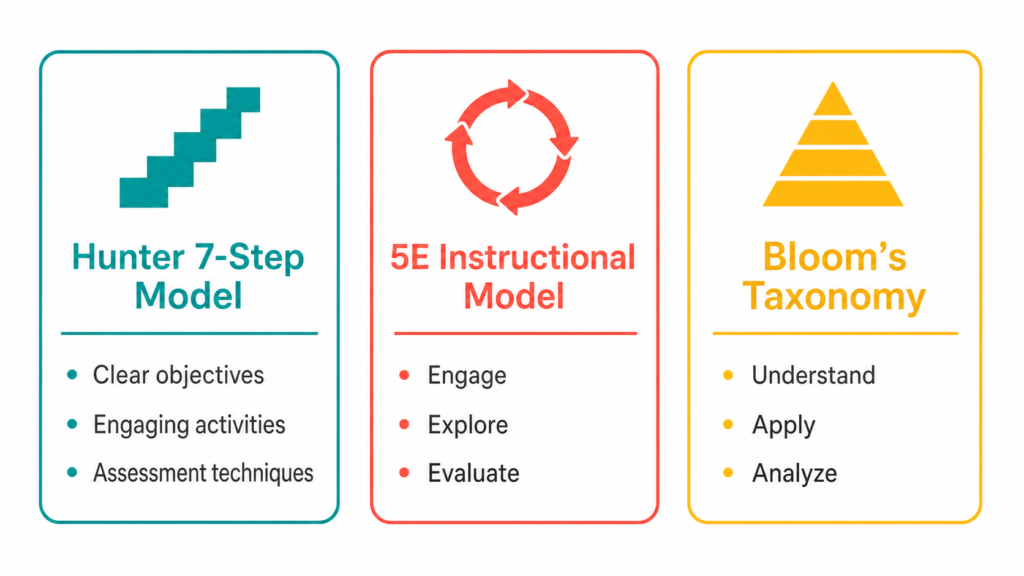
Three models dominate lesson planning in K-12 education: Madeline Hunter’s 7-step model, the 5E Instructional Model, and Bloom’s Taxonomy-aligned planning. Each offers a different structure. Hunter focuses on direct instruction sequence, the 5E model suits inquiry-based learning, and Bloom’s Taxonomy helps teachers calibrate the cognitive level of their objectives.
| Model | Core Steps | Best For | Grade Level Fit |
|---|---|---|---|
| Madeline Hunter (7-Step) | Objective, Anticipatory Set, Direct Instruction, Guided Practice, Independent Practice, Alternative Instruction, Assessment | Direct instruction; structured classrooms | K-12 all levels |
| 5E Instructional Model | Engage, Explore, Explain, Elaborate, Evaluate | Science; inquiry-based and project learning | Middle and high school |
| Bloom’s Taxonomy Aligned | Remember, Understand, Apply, Analyze, Evaluate, Create | Writing objectives; calibrating cognitive rigor | All levels; all subjects |
Madeline Hunter’s 7-Step Model is one of the most widely used frameworks in K-12 education. It begins with a clear objective and an anticipatory set, which is a hook designed to activate interest and prior knowledge. The lesson then moves through direct instruction, guided practice, and independent practice before closing with an assessment. This model works especially well for skill-based subjects like math and writing where sequential practice is important.
The 5E Model is popular in science and inquiry-based classrooms. Students Engage with a problem, Explore it through hands-on activity, Explain what they discovered, Elaborate by applying it to new situations, and then Evaluate their understanding. If you are interested in building student-centered plans grounded in discovery learning, the constructivist lesson plan approach brings this model to life with practical examples.
Bloom’s Taxonomy is less a standalone lesson structure and more a calibration tool. It helps teachers ensure that their objectives, activities, and assessments all operate at the same cognitive level. A lesson objective at the “analyze” level should not have activities that only require students to “remember.”
Robert Gagne’s 9 Events of Instruction is another framework worth knowing. Like Hunter’s model, it emphasizes sequencing instruction in a way that mirrors how the brain processes and stores new information, moving from gaining attention all the way through enhancing retention and transfer.
What Are the Most Common Lesson Planning Mistakes?
Even experienced teachers fall into these traps. Knowing them in advance is the fastest way to improve your lesson planning process.
- Vague learning objectives: Writing “students will understand fractions” instead of “students will be able to add fractions with unlike denominators.” Fix: Always use a measurable action verb.
- Packing in too much content: Trying to cover five concepts in one 45-minute lesson. Fix: Focus on one core objective per lesson and teach it deeply.
- Skipping the assessment step: Planning activities without planning how you will check for understanding. Fix: Design your exit check before you plan your activities, not after.
- Ignoring differentiated instruction: Writing one plan that only works for students at the middle skill level. Fix: Build in at least one scaffold for struggling students and one extension for those who finish early.
- Forgetting transitions: Not accounting for the time it takes to move between activities or hand out materials. Fix: Add two to three minutes per transition into your time plan.
- Failing to connect to prior knowledge: Starting a new concept without activating what students already know. Fix: Build a two-minute warm-up or question prompt that bridges the old and the new.
Understanding what makes a plan strong goes beyond just avoiding mistakes. Reviewing the characteristics of effective lesson plans helps you build a mental checklist you can apply every time you sit down to plan.
How Long Should Lesson Planning Take?
There is no single right answer, but the research gives us useful benchmarks. Teachers average 10 to 15 hours per week across all planning and preparation tasks, while schools typically provide only about 4.4 hours of dedicated planning time during the contracted school day.
For a single lesson, experienced teachers typically spend 20 to 45 minutes. New teachers often need 60 to 90 minutes per lesson until routines and templates become second nature.
A 2025 K-12 pilot study found that teachers using AI-assisted planning tools cut their weekly planning time from 11.4 hours down to 5.3 hours without reducing lesson quality. Technology is not replacing the teacher’s judgment, but it is handling the repetitive structural work that eats up planning hours.
Three practical ways to reduce planning time without cutting quality:
- Use a consistent template. A reusable lesson plan format means you never start from a blank page. You fill in the sections, not redesign the structure.
- Plan in units, not individual lessons. Mapping a full two-week unit at once gives you a bird’s-eye view of pacing and prevents repetition across lessons.
- Reuse and refine. A plan you taught last year is a starting point, not a finished product. Adjust the objective, update the examples, and improve the assessment based on what you learned the first time.
Final Thought
Planning well is one of the most powerful things you can do for your students and for your own confidence in the classroom. Every lesson that runs smoothly, every student who stays engaged, and every objective that gets met starts with a teacher who took the time to plan with purpose.
Ready to put this into practice? Download a free lesson plan template from CleverPortalus to start building your next lesson today. Or explore related guides on teaching methods and classroom management to make your lessons even more engaging and effective.
FAQ
Is lesson planning only for new teachers?
No. Experienced teachers benefit from lesson planning just as much as beginners do. The format and depth may change over time, but the core practice of mapping objectives, activities, and assessments before class helps all teachers stay organized, paced, and purposeful. Veteran teachers often plan faster but they still plan.
What is the difference between a lesson plan and a unit plan?
A unit plan covers a multi-week sequence of lessons built around one broad topic or standard. A lesson plan zooms into a single class session within that unit. Think of the unit plan as the chapter outline and the lesson plan as the detailed script for one page of that chapter. Both are necessary for organized, coherent teaching across a term.
Can a lesson plan be changed after you start teaching it?
Yes, and it often should be. A lesson plan is a guide, not a rigid script. If students grasp a concept faster than expected, you can move ahead. If they are struggling, you can slow down, revisit, or switch strategies mid-lesson. A good plan actually makes it easier to adapt because you always know where you are in the sequence and what you can skip or extend.
How do I know if my lesson plan actually worked?
Look at your assessment data first. Did most students meet the learning objective? If fewer than 70 to 80 percent of students demonstrated mastery, the lesson may need to be retaught with a different instructional strategy. Reflection notes written immediately after class, while the experience is fresh, are one of the most powerful tools for improving future plans.
What is the best lesson plan format for elementary school teachers?
Elementary teachers often find success with shorter, visually organized plans that include a clear objective, a simple list of materials, a sequence of three to four activities with time estimates, and one or two assessment methods like an observation checklist or exit ticket. The structure matters less than the clarity. If a substitute teacher could pick up your plan and run the lesson, it is well written.
Do lesson plans need to be long to be effective?
No. A strong lesson plan can fit on one page if the objective is clear, the activities are well chosen, and the assessment is defined. Length is not a measure of quality. Overloaded plans with too many activities and too much detail can actually make delivery harder because teachers spend class time reading instead of teaching. Keep your plan practical, skimmable, and usable in real time.
How is AI changing the lesson planning process for teachers today?
AI tools are increasingly used to generate draft lesson structures, suggest differentiation strategies, and create discussion prompts. The 2025 K-12 pilot mentioned earlier showed planning time cut nearly in half with AI support. The key is using AI as a first draft starting point, not a finished product. Teachers still need to review, adjust, and personalize every plan to match their students, classroom context, and curriculum standards.