The Importance of Educational Goals: Why Every Student Needs a Clear Direction
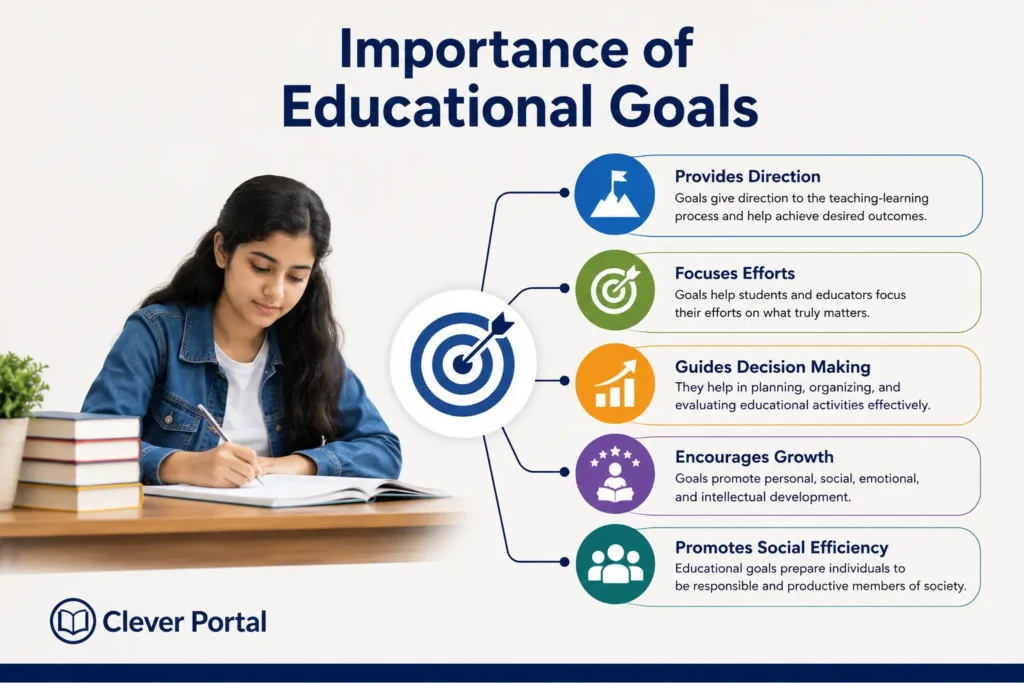
Educational goals give students a clear target to work toward. They build motivation, improve self-discipline, and directly raise academic performance. Research shows that students who set specific, written goals are far more likely to succeed in school and in life. Whether you are a student, teacher, or parent, understanding why educational goals matter is the first step toward turning learning plans into real results.
Setting goals in school might sound simple. But the difference between students who thrive and students who struggle often comes down to one thing: direction. When I look at what separates high-performing students from those who fall behind, I keep coming back to the same finding. Students who know what they are working toward show stronger effort, better attendance, and higher grades than those without a clear focus.
A study by Dr. Gail Matthews at Dominican University found that students and professionals who write down their goals are 42% more likely to achieve them. Those who also share progress with someone else achieve 40% more than those who keep goals to themselves. That is a meaningful gap, and it starts with the basic act of setting a goal.
In this article, I will explain what educational goals are, why they matter, and how they shape student success at every stage of learning.
What Are Educational Goals?
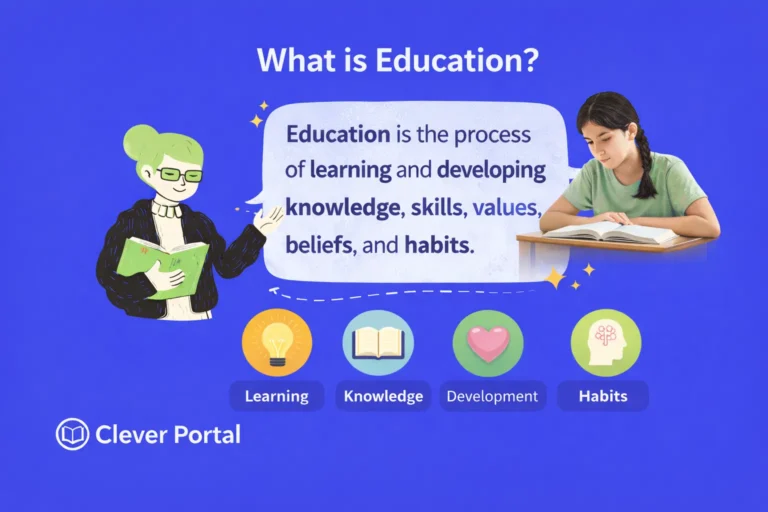
Educational goals are the targets a learner sets to guide progress through school, training, or any form of study. They answer one simple question: where are you trying to go?
It helps to understand how goals relate to two similar terms. The aims of education are the broad, philosophical purposes of learning, like developing critical thinkers or preparing students to contribute to society. You can read more about these in our full guide on the aims of education. Learning objectives are narrow, specific steps, like scoring 80% on a test or finishing a chapter by Friday. Educational goals sit in between. They are concrete enough to be meaningful but broad enough to cover a full semester, year, or academic journey.
Goals exist at three levels:
- Student level: Personal academic targets, like improving math grades or completing a research project on time
- Teacher level: Instructional targets, like helping all students master a unit before the next assessment
- Institutional level: School-wide targets, like raising graduation rates or improving reading scores across grade levels
Why Are Educational Goals Important?
Educational goals are important because they turn vague intentions into focused effort. Without a goal, studying becomes passive. With a clear goal, every study session has a purpose.
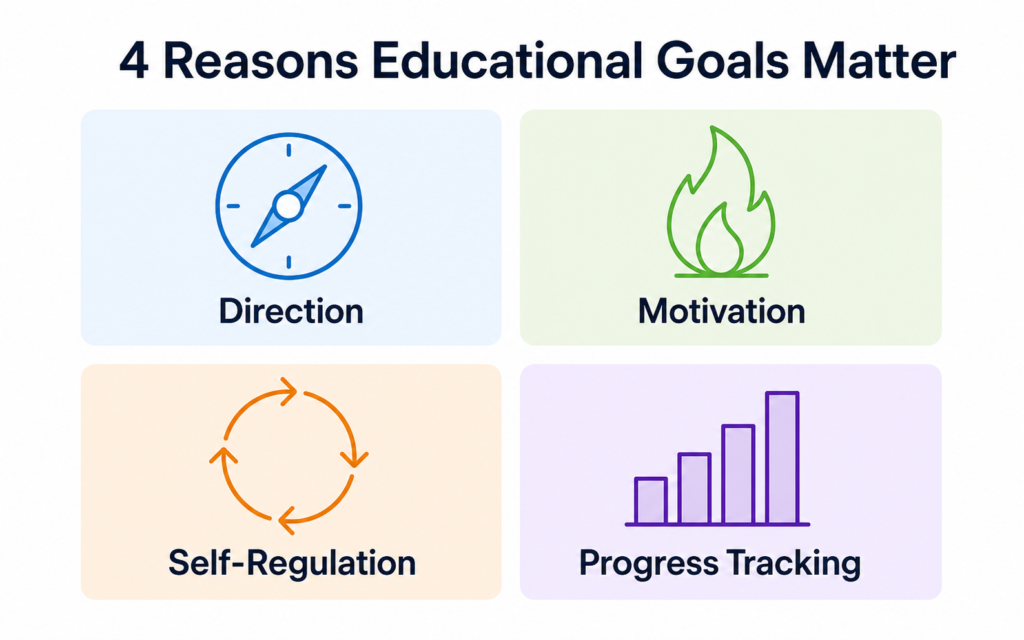
Here are four reasons why I believe educational goals matter so much:
1. They Give Students Direction
A student without goals is like a driver without a destination. They may keep moving, but they are not sure where they are headed. Goals provide a roadmap. They help students decide what to study, how much time to spend, and what success looks like. This clarity reduces wasted effort and builds academic confidence over time.
2. They Build Motivation and Persistence
Goals activate a student’s drive to keep going, especially when things get hard. When a student knows why they are studying for a test or working through a difficult assignment, they are more likely to push through frustration. Research published in the RSIS International Journal (2025) confirms that goal-setting, combined with self-efficacy, is a strong predictor of achievement motivation in students.
3. They Support Self-Regulated Learning
Self-regulated learners manage their own time, check their own progress, and adjust their approach when something is not working. Goal-setting is the engine behind this process. A 2025 study from TU Delft found that academic goal-setting is one of the most frequently used strategies to improve self-regulated learning and raise academic performance in higher education.
4. They Create a System for Measuring Progress
Goals make it possible to track growth. A student aiming to raise their reading level by two grades has something to measure. A student who just wants to “do better” has nothing to track. Measurable progress builds momentum, and each small win reinforces the belief that the bigger goal is reachable.
How Do Educational Goals Improve Academic Performance?
Educational goals improve academic performance by creating a feedback loop between effort and results. When students set clear targets, they are more likely to persist through challenges, ask for help before falling behind, and review their own work more carefully.
A large-scale study from the University of New South Wales (UNSW, 2021), one of the biggest of its kind, found that students who adopted growth-oriented educational goals showed significant gains in perseverance, academic aspirations, attendance, and homework behavior. These were not small changes. They showed up consistently across classrooms and grade levels.
The key mechanism here is self-efficacy, which is the belief that your effort will lead to results. Psychologist Albert Bandura showed that students who believe they can reach a goal put in more effort, recover faster from setbacks, and perform better on assessments. Educational goals strengthen self-efficacy by giving students proof of their own progress.
Stat to know: Students who set goals, write them down, and share their progress achieve 40% more than those who simply think about their goals. (Dr. Gail Matthews, Dominican University)
The connection between goals and academic performance is not a theory. It is backed by peer-reviewed research from 2021 through 2026, and I think every student deserves to know about it.
Short-Term vs. Long-Term Educational Goals: What Is the Difference?
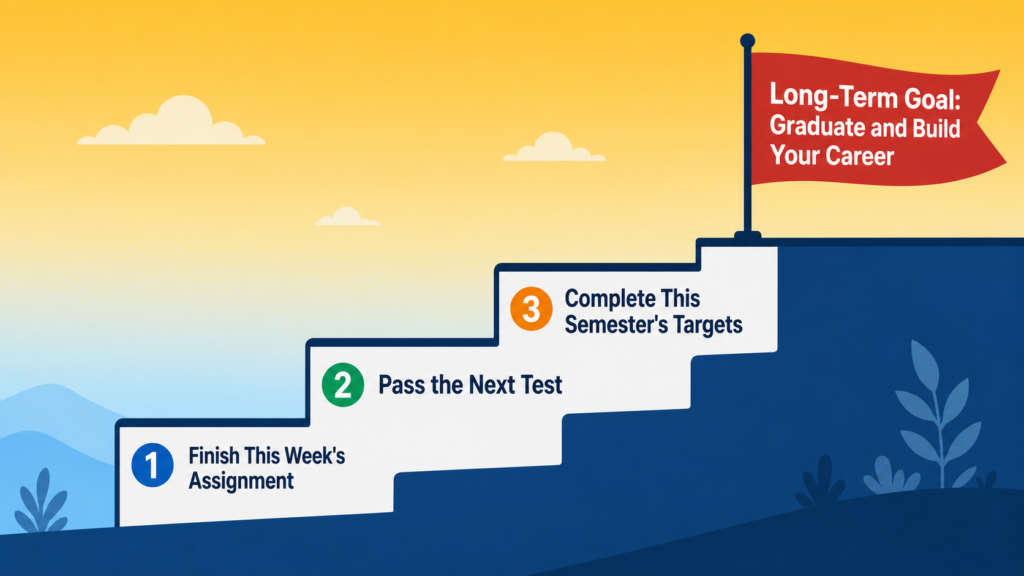
Short-term educational goals focus on outcomes within days, weeks, or a single semester. Long-term educational goals span months, years, or an entire academic career. Both types work together. Short-term goals build the habits and skills needed to reach long-term ones.
| Short-Term Goals | Long-Term Goals |
|---|---|
| Pass the next math test | Graduate with a STEM degree |
| Read one chapter per day this week | Develop strong reading comprehension by end of year |
| Submit all assignments on time this month | Build a consistent academic work ethic over time |
| Improve spelling scores by next quiz | Master written communication before high school |
The OECD’s Education at a Glance 2025 report highlights that education-to-labor market alignment has become a central long-term educational objective for schools and governments worldwide. Students who set long-term academic goals early are better prepared to connect their schooling to real career paths.
A practical way to structure both types is the SMART framework:
- Specific: “I will improve my science grade from a C to a B”
- Measurable: Track weekly quiz scores to see progress
- Achievable: Pick a target that is challenging but realistic
- Relevant: Make sure the goal connects to a bigger academic aim
- Time-bound: Set a deadline, like “by the end of this semester”
Short-term goals built with the SMART method act as stepping stones toward larger academic outcomes.
The Role of Educational Goals in Student Motivation
Goals and motivation are deeply connected. When students set meaningful educational goals, something shifts in how they approach learning. They stop seeing school as something that happens to them and start seeing it as something they are actively shaping.
This idea sits at the heart of Self-Determination Theory, developed by psychologists Edward Deci and Richard Ryan. Their research shows that learners stay motivated when three needs are met: autonomy (feeling in control of their choices), competence (feeling capable of reaching their targets), and relatedness (feeling connected to the people and purpose around them). Educational goals support all three needs at once.
Carol Dweck’s growth mindset research adds another layer. Students who set goals around growth, like learning from mistakes and getting better over time, show stronger resilience than students who only set goals around performance metrics like grades and rankings. Growth-oriented goal-setting changes how students react to failure. Instead of giving up, they adjust their approach and try again.
A 2025 meta-analysis published by Edutopia, covering multiple large-scale studies, found that social-emotional learning programs, many of which include structured goal-setting, improve overall academic achievement by 8.4 percentile points. Students who feel a sense of belonging and purpose in school consistently outperform those who do not.
Educational goals create that sense of purpose. They give learning a reason.
Are Educational Goals Important for Struggling Students?
Yes, and in my view, research shows they may matter most for students who are already behind.
The UNSW study from 2021 found that growth goal-setting was particularly beneficial for previously low-achieving students and those from lower socioeconomic backgrounds. These students showed the greatest gains in engagement, persistence, and academic aspirations when they adopted clear, growth-focused goals.
This is a point that most articles on this topic miss entirely. Goals are not just a tool for high achievers to get even further ahead. They are a powerful support structure for students who need direction the most.
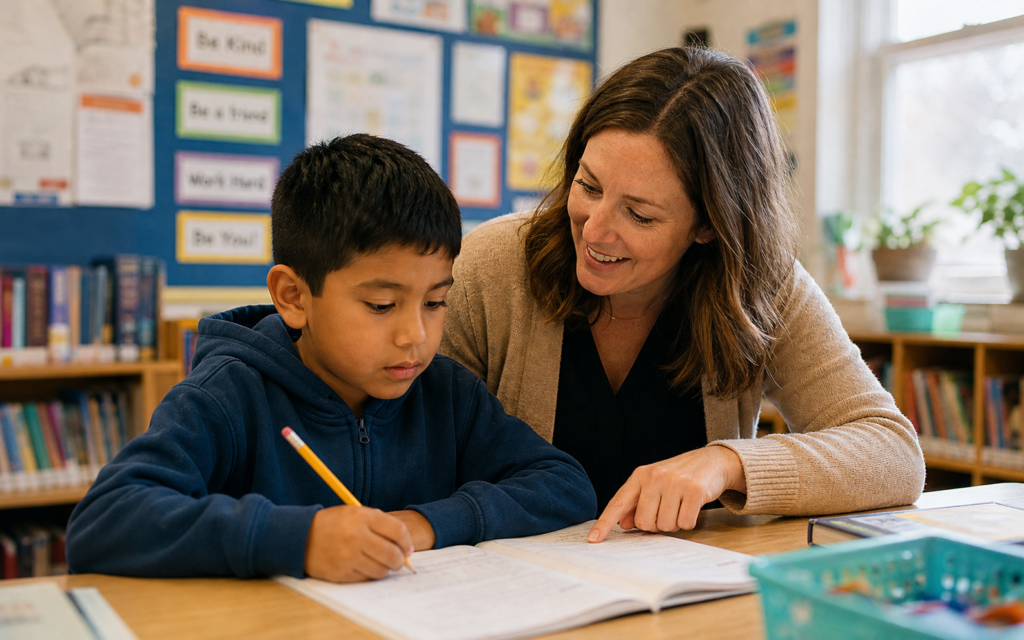
For teachers working with struggling learners, I recommend these approaches:
- Help students set small, achievable short-term goals first, because early wins build confidence
- Frame goals around growth rather than grades, since “understand this concept” beats “score 90%”
- Check in regularly on progress, because accountability strengthens goal commitment
Students with specific health-related learning needs can also benefit from structured goal-setting. For context on how objectives are applied in health education settings, see our guide on health education aims and objectives.
How Teachers and Schools Use Educational Goals
Educational goals are not just for students. Teachers and school systems depend on goal-setting to design effective lessons, track progress, and meet curriculum standards.
Benjamin Bloom’s Taxonomy is the most widely used framework for setting educational goals in classroom instruction. It organizes learning into six levels of cognitive skill:
- Knowledge: remembering facts
- Comprehension: understanding meaning
- Application: using knowledge in new situations
- Analysis: breaking down ideas
- Synthesis: combining ideas to create something new
- Evaluation: making judgments based on criteria
Teachers set goals at each level when designing lessons and assessments. A lesson that only targets knowledge stays at the surface. A lesson built toward analysis or evaluation pushes students toward deeper, more durable learning.
A 2026 study published in PMC on goal-setting mechanisms in educational management confirms that scientific goal-setting promotes positive teaching and learning behaviors through clear psychological pathways. When schools set institutional goals and teachers align their instructional plans to those targets, student outcomes improve across the board.
The 2025 standards-driven education trend reported by Routledge Academic confirms this shift: grade-level goals are now front and center in how schools organize all academic activity. I see this as a positive development for students at every level.
Frequently Asked Questions
What types of goals work best for building long-term academic habits?
Goals that focus on process rather than outcomes tend to build the strongest long-term habits. A goal like “I will study for 30 minutes every evening before dinner” builds a routine. A goal like “I will get an A” only measures a result. Process goals create the daily behaviors that lead to better grades over time, and they are easier to stay consistent with when motivation dips.
How do educational goals connect to a student’s career path?
When students set long-term educational goals early, they begin connecting classroom skills to real-world applications. A student who aims to develop strong writing skills before graduation is not just preparing for English class. They are building a transferable skill that employers and universities value. The OECD’s Education at a Glance 2025 report shows that education-to-career alignment is now a central focus of educational planning globally.
How often should students review and update their goals?
Goal review should happen at natural checkpoints. Short-term goals benefit from a weekly check-in. Long-term goals should be reviewed at the end of each semester. If a goal feels too easy, it needs to be raised. If it feels impossible, it needs to be broken into smaller steps. Goals are not fixed targets. They are living guides that grow with the student.
Can goal-setting help students who feel unmotivated at school?
Yes, and this is one of the most underused benefits of goal-setting. When students feel unmotivated, it often means they cannot see the connection between their effort and any meaningful outcome. A clear, achievable goal restores that connection. Starting with one small, specific goal, such as finishing a reading assignment before dinner tonight, is enough to begin rebuilding a sense of academic purpose.
How can parents get involved in supporting their child’s educational goals?
Parents can help by asking open questions about what their child is working toward, celebrating small wins along the way, and helping break big goals into manageable weekly steps. Research by Dr. Gail Matthews confirms that students who share their goals and report progress to someone else achieve significantly more than those who work in isolation. A brief weekly check-in at home can make a real difference.
What is the difference between an educational goal and a learning objective?
An educational goal is a broader target that guides a student’s direction over weeks, months, or years, such as “I want to become a confident public speaker.” A learning objective is a narrow, measurable step that supports that goal, such as “I will deliver a two-minute speech in class by Friday.” Goals set the direction. Objectives map the steps to get there.