Teacher Centered Methods: What They Are, Types, and When to Use Them
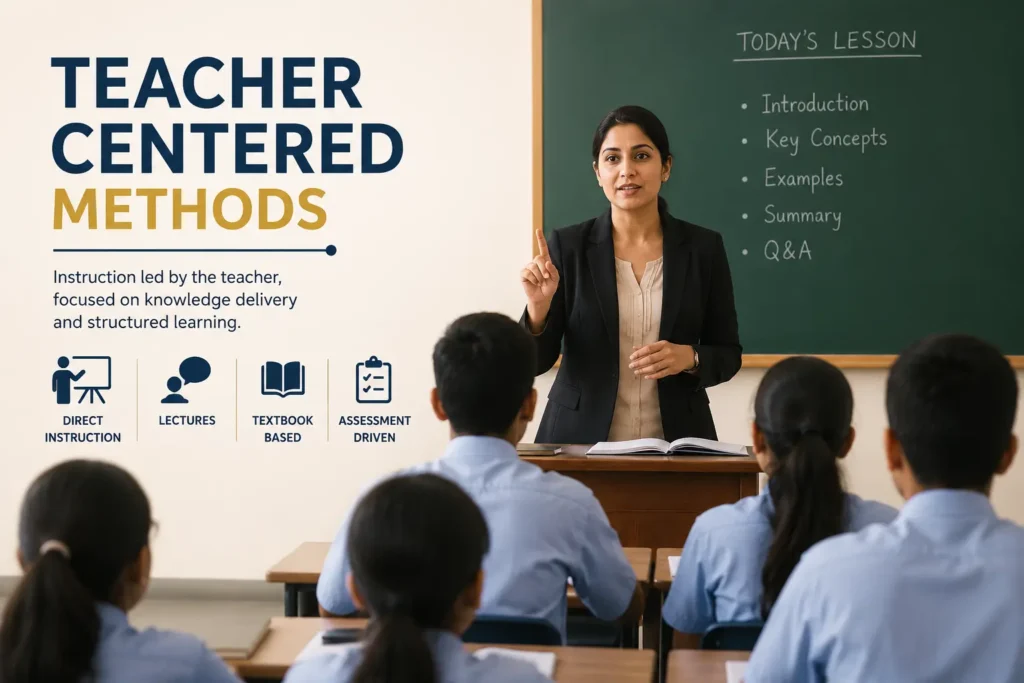
Teacher centered methods are teaching approaches where the teacher controls the lesson, delivers the content, and guides students through learning. The main types include the lecture method, direct instruction, demonstration, drill and practice, and expository teaching. These methods work best for introducing new topics, building foundational knowledge, and managing large classrooms. Most effective teachers blend teacher centered methods with student centered approaches for the best learning outcomes.
What Are Teacher Centered Methods?
Teacher centered methods are instructional strategies where the teacher acts as the main source of knowledge in the classroom. The teacher controls the pace, structure, and delivery of every lesson. Students primarily listen, observe, and practice what the teacher presents.
This approach is also known as traditional teaching, didactic teaching, or teacher directed instruction. It has been used in classrooms for centuries and remains one of the most widely practiced styles of instruction around the world.
In a teacher centered classroom, the teacher decides what gets taught, how it gets taught, and when students move on to the next topic. Students take a mostly passive learning role. They receive information rather than discover it on their own.
| Teacher Role | Student Role |
| Main knowledge source | Listener and receiver |
| Controls lesson pace | Follows teacher guidance |
| Delivers content directly | Practices what is taught |
| Evaluates understanding | Responds to teacher prompts |
This is different from student centered methods, where learners take a more active role in building their own understanding. Both approaches have value, and the best classrooms use both depending on the situation.
For a broader view of how these approaches fit together, explore our guide on teaching and learning methods.
What Are the Main Types of Teacher Centered Methods?
No single teacher centered method works for every lesson or subject. There are several distinct types of teacher centered methods, each suited to a different teaching goal. Understanding each one helps teachers choose the right approach for every classroom situation.
Lecture Method
The lecture method is one of the most recognized teacher centered methods. The teacher verbally presents information while students listen and take notes. It is widely used in secondary schools, colleges, and universities.
The lecture method is efficient for delivering large amounts of content in a short time. It works well for introducing a new unit, providing background knowledge, or explaining complex ideas in a clear and organized way.
The biggest challenge with lectures is keeping students engaged. Long lectures without interaction can lead to passive learning and lower retention. Shorter, well-structured lectures with clear checkpoints work much better than uninterrupted talking for 45 minutes.
Direct Instruction
Direct instruction is one of the most research-supported teacher centered methods in education. It uses structured, scripted lesson plans with explicit modeling, guided practice, and independent practice built into every lesson.
The teacher introduces the skill or concept clearly, models it step by step, walks students through guided practice together, and then lets students practice independently. This method is especially effective for building skill automaticity in subjects like mathematics, reading, grammar, and spelling.
Educational researchers including those at the Association for Supervision and Curriculum Development (ASCD) have found that direct instruction produces strong results for foundational knowledge building. Madeline Hunter’s lesson design model, which follows a seven-step instructional sequence, is one of the most well-known frameworks built around direct instruction principles.
Demonstration Method
In the demonstration method, the teacher physically shows students how a task, process, or concept works. Students observe carefully before attempting the activity themselves.
This method is common in science labs, physical education, vocational training, cooking classes, and art instruction. Watching a skilled teacher perform a task before trying it helps students build a mental model of what success looks like.
The demonstration method reduces errors during independent practice because students have a clear visual reference. It works best when the skill involves specific steps, safety considerations, or techniques that are difficult to explain in words alone.
Drill and Practice
Drill and practice is a structured repetition method designed to build speed, accuracy, and automaticity. The teacher assigns repeated exercises on the same skill until students can perform it quickly and correctly without hesitation.
This method is highly effective in mathematics (multiplication tables, equations), foreign languages (vocabulary, verb conjugation), spelling, and music (scales, chord progressions). The goal is not just understanding but fluent, automatic recall.
Drill and practice gets a bad reputation when it is used without meaning. However, when students understand the underlying concept first and then use drill to build fluency, it becomes a powerful tool for long-term retention.
Didactic Questioning
Didactic questioning is a teacher centered method where the teacher asks structured questions to guide students toward a correct, predetermined answer. The teacher controls the direction of the conversation and leads students through a logical path of thinking.
This is different from open-ended Socratic questioning, where the goal is exploration and debate. In didactic questioning, the teacher knows the answer and uses questions as a tool to check understanding and move the lesson forward.
This method is useful for reviewing material, checking comprehension during a lesson, and helping students make connections between concepts. It keeps students attentive and involved without giving up teacher control of the lesson direction.
Expository Teaching
Expository teaching is a method where the teacher explains a concept using examples, analogies, and structured explanations. The teacher takes abstract ideas and makes them concrete through carefully chosen illustrations and comparisons.
This method is one of the most common forms of classroom instruction. A teacher explaining how photosynthesis works using the analogy of a kitchen, or describing a historical event by comparing it to a modern situation, is using expository teaching.
Expository teaching works well when students need conceptual clarity before they can do anything practical with the information. It bridges the gap between raw content delivery and deep understanding.
What Are the Advantages of Teacher Centered Methods?
Teacher centered methods offer real, proven benefits when applied in the right situations. These are not just theoretical advantages. They reflect what works in actual classrooms every day.
- Efficient content delivery: Teachers can cover a large amount of curriculum content in a single lesson. This is especially important when working within tight curriculum schedules.
- Consistent knowledge transmission: Every student in the classroom receives the same information at the same time. This reduces gaps in foundational understanding.
- Teacher controls accuracy: When content must be precise (mathematical formulas, scientific facts, grammar rules), teacher directed instruction ensures that students learn the correct version from the start.
- Works well in large classrooms: Student centered approaches become harder to manage with 30 or 40 students. Teacher centered methods scale easily to any class size.
- Supports students who need structure: Some learners, especially younger students or those new to a subject, feel more confident and secure when the teacher provides clear, predictable guidance.
- Effective for foundational knowledge: Before students can think critically or creatively about a topic, they need a knowledge base. Teacher centered methods build that base efficiently.
Research published in the Journal of Positive Psychology and Wellbeing found statistically significant positive effects of teacher centered approaches on student academic performance, particularly in structured and technical subject areas.
What Are the Disadvantages of Teacher Centered Methods?
No teaching method is perfect. Teacher centered methods have real limitations, and being honest about them helps teachers use these approaches more wisely.
- Passive learning reduces retention: When students only listen without actively engaging, they are less likely to remember the content long-term. Information absorbed passively fades faster than information discovered or applied actively.
- Limited student voice and creativity: Students have little opportunity to contribute their own ideas, questions, or perspectives. This can limit creative thinking and intrinsic motivation over time.
- Reduced critical thinking development: Teacher centered methods focus on transmitting knowledge, not on developing the skills to evaluate, question, or apply that knowledge independently.
- Risk of disengagement: Extended lectures or repetitive drills without variety can lead to boredom and reduced attention, particularly for older students.
- Not ideal for collaborative skills: Modern workplaces require teamwork, communication, and problem solving. Purely teacher directed classrooms give students limited practice in these areas.
It is important to note that most of these disadvantages come from overuse, not from the methods themselves. A teacher who relies exclusively on lectures every single day will face these problems. A teacher who uses direct instruction for new content and then shifts to student centered activities for practice and application avoids most of them.
How Do Teacher Centered Methods Compare to Student Centered Methods?
Understanding the difference between teacher centered and student centered approaches helps educators make better decisions about when to use each one. These two approaches are not opposites or enemies. They are complementary tools.
| Dimension | Teacher Centered Methods | Student Centered Methods |
| Teacher role | Knowledge authority and instructor | Facilitator and guide |
| Student role | Passive receiver of knowledge | Active constructor of knowledge |
| Focus | Content delivery and coverage | Learner inquiry and exploration |
| Lesson control | Teacher controls pace and structure | Students have more choice and input |
| Best use case | New concepts, foundational skills, large classes | Application, critical thinking, collaboration |
| Common examples | Lecture, direct instruction, demonstration | Project based learning, inquiry learning, peer teaching |
| Assessment style | Teacher-evaluated tests and quizzes | Portfolios, presentations, self-assessment |
The most effective classrooms do not choose one approach and stick with it rigidly. Research in instructional design consistently shows that blended models work best. A teacher might use direct instruction to introduce a new grammar rule, then shift to student centered group writing activities to practice and apply it.
To see what student centered approaches look like in practice, visit our detailed guide on student-centered methods.
When Should Teachers Use Teacher Centered Methods?
Knowing when to use teacher centered methods is just as important as knowing what they are. Here are the situations where teacher directed instruction is the right choice.
1. When introducing a completely new topic
Students cannot explore or discuss something they know nothing about. Teacher centered methods give students the foundational knowledge they need before any student centered activity can be meaningful.
2. When the content requires precision and accuracy
In subjects like mathematics, science, grammar, and formal writing, errors in foundational understanding cause problems later. The teacher needs to ensure that every student learns the correct information from the start.
3. When managing a large class
Student centered methods like group projects or individualized inquiry work require more monitoring and support. In large classrooms, teacher centered delivery ensures that all students receive the instruction they need.
4. When time is limited
Curriculum deadlines are real. When a teacher needs to cover a specific topic before an assessment or move the class forward to the next unit, teacher centered methods deliver content efficiently.
5. When students need confidence before attempting a task
Some learners feel anxious or lost when asked to explore independently before receiving guidance. A clear demonstration or direct instruction session gives them the confidence to try it themselves.
6. When building automaticity in core skills
Reading fluency, multiplication facts, vocabulary recall, and language rules all require the kind of repetitive, structured practice that teacher centered drill and practice methods provide exceptionally well.
What Role Do Frameworks and Educators Play in Teacher Centered Teaching?
Several important frameworks and educators have shaped how teacher centered methods are understood and practiced today.
Bloom’s Taxonomy, developed by Benjamin Bloom and his colleagues, describes levels of learning from basic knowledge recall to higher-order evaluation and creation. Teacher centered methods are most directly associated with the lower levels of Bloom’s Taxonomy (remembering and understanding), which form the essential foundation for all higher-order learning.
Madeline Hunter’s Direct Instruction Model provides a seven-step framework for structured lesson planning that draws heavily on teacher centered principles. Her model includes anticipatory set, objective statement, instruction, modeling, checking for understanding, guided practice, and independent practice. It remains one of the most widely used instructional design frameworks in K-12 education.
John Dewey, while known for advocating experience-based and student centered learning, acknowledged that knowledge transmission has a necessary role in education. His work helped define the boundaries between teacher directed and learner directed instruction.
Organizations like UNESCO and the OECD publish ongoing research on instructional effectiveness that education policymakers and curriculum designers use to evaluate the role of teacher centered and student centered methods in global education systems.
Understanding these frameworks and the people behind them gives teachers a richer, more research-grounded perspective on why teacher centered methods work and when they work best.
What Are Recent Trends in Teacher Centered Methods for 2025 and 2026?
Teacher centered methods are not disappearing. They are evolving. Several important trends are shaping how these methods are used in modern classrooms.
Blended instructional models are now the dominant approach in most well-resourced schools. Teachers use direct instruction and lectures to deliver new content, then shift to student centered collaborative activities for application and deeper processing. This model takes the best of both worlds.
AI-assisted direct instruction is an emerging development. Teachers are beginning to use AI tools to create more precisely structured lesson scripts, identify gaps in student understanding after a lecture, and generate targeted drill and practice materials in real time. This does not replace the teacher but makes teacher centered delivery more responsive and data-driven.
Shorter, more focused lectures are replacing long unbroken lectures in higher education and secondary schools. Research on cognitive load theory, associated with educational psychologist John Sweller, supports breaking content delivery into shorter segments with built-in reflection or practice pauses. This keeps the teacher in control of knowledge transmission while reducing the passive learning problem.
Explicit teaching for equity is gaining attention from educators and curriculum developers. Direct instruction and explicit teacher led teaching has been shown to reduce learning gaps for students from disadvantaged backgrounds who may have less access to informal learning experiences outside school. Organizations like ASCD and UNESCO have highlighted this finding in recent curriculum guidance.
Final Thoughts
Teacher centered methods are not a relic of an outdated educational system. They are a set of powerful, evidence-backed instructional strategies that every effective teacher needs in their toolkit.
The lecture method, direct instruction, demonstration, drill and practice, didactic questioning, and expository teaching each serve a real purpose. When used at the right moment, in the right context, with the right students, they produce strong learning outcomes and confident learners.
The key is balance. Use teacher centered methods to build knowledge, establish accuracy, introduce complex ideas, and develop foundational skills. Then open the classroom up to student centered learning for application, creativity, collaboration, and deeper thinking.
No single method is always right. The best teachers are the ones who know their full range of options and choose wisely based on what their students need in that moment.
Ready to explore the full picture of classroom instruction? Browse our complete library of teaching and learning methods to find the right approach for every lesson you teach.