What Are Student Centered Methods? A Practical Guide for Teachers
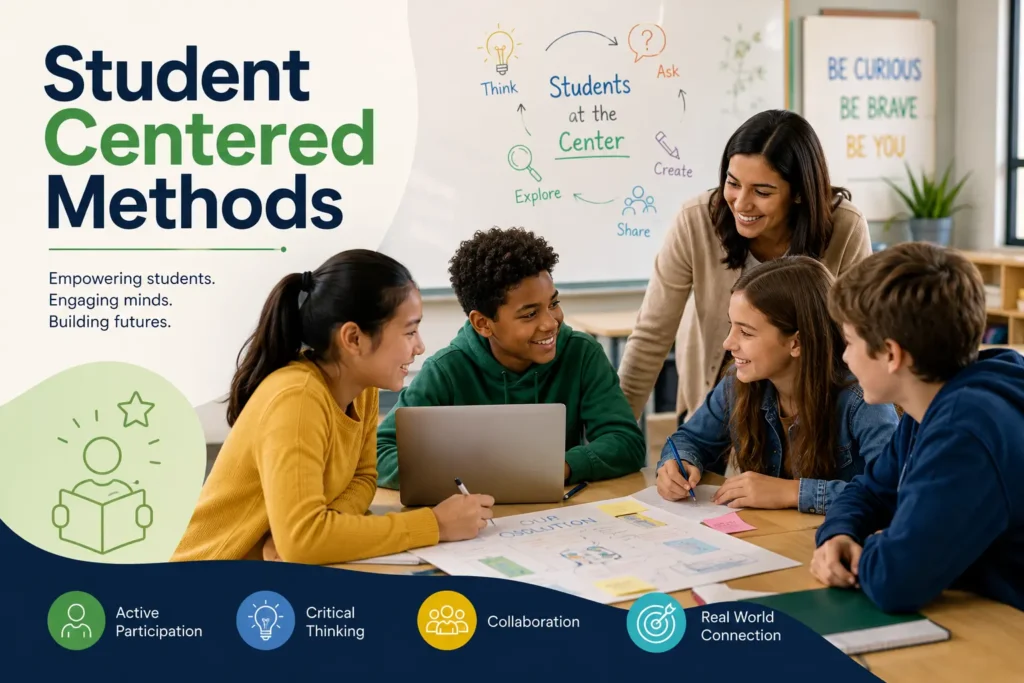
Most students forget up to 70% of what they hear in a lecture within just 24 hours. Traditional teaching places all the power in the teacher’s hands. Students sit, listen, and wait to be told what to learn next. Student centered methods flip that dynamic completely. They put the student in the driver’s seat and turn the classroom into an active, engaging space where real learning actually sticks.
This guide covers what student centered methods are, the main types you can use, the real benefits backed by research, the challenges teachers face, and simple steps to start using these approaches in your classroom today.
What Are Student Centered Methods?
Student centered methods are teaching approaches that place the learner at the heart of the educational process. Instead of the teacher controlling every step, students take an active role in deciding how and what they explore.
This approach is rooted in constructivist learning theory, a framework developed by thinkers like Jean Piaget and Lev Vygotsky. Constructivism holds that learners do not simply receive information. They build knowledge by connecting new ideas to what they already know. Vygotsky’s concept of the Zone of Proximal Development shows that students learn best when they are challenged just beyond their current ability with the right support in place.
According to ScienceDirect, student centered learning is defined as “an educational approach that empowers students by considering their diverse experiences and needs.” In simple terms, the teacher shifts from being the main source of all knowledge to becoming a guide who creates the right conditions for students to discover, question, and grow.
This stands in contrast to teacher centered methods, where the instructor leads every activity and students mostly listen and follow directions. In a student centered classroom, students have a voice in planning, activities, and even how they show what they have learned.
What Are the Core Characteristics of Student Centered Learning?
Student centered learning is not one single technique. It is a broader approach that shares five key characteristics across all its methods.
- Active engagement: Students participate in tasks, discussions, and projects rather than passively listening
- Learner autonomy: Students make choices about their learning path, topic focus, or how they demonstrate understanding
- Collaboration: Students regularly work with peers, share ideas, and build knowledge together
- Personalization: Instruction adapts to individual student needs, interests, and learning styles through differentiated instruction
- Reflective thinking: Students are encouraged to think about their own learning through self-assessment and reflective journaling
These characteristics make the learner centered approach flexible enough to work across grade levels and subjects. They also explain why student engagement and intrinsic motivation tend to be much higher in student centered classrooms compared to traditional settings.
What Are the Main Student Centered Methods?
The main student centered methods include project based learning, inquiry based learning, collaborative learning, the flipped classroom, problem based learning, Socratic seminars, experiential learning, differentiated instruction, the Jigsaw Method, and gamification. Each method gives students a different level of control over how they learn and how they show what they know.
Here is a closer look at each one.
Project Based Learning
Project based learning (PBL) is one of the most widely used student centered teaching methods. Students work on a real world challenge over an extended period, research it deeply, and create a product or presentation to share their findings.
For example, a science class might spend two weeks designing a water filtration system for a local problem. Students research, collaborate, and present their solutions. This builds critical thinking and active learning at the same time.
PBL works especially well in STEM and social studies because it connects classroom content to real life situations students actually care about.
Inquiry Based Learning
Inquiry based learning starts with a question rather than a lesson. The teacher poses a problem or a puzzling scenario, and students investigate it using their own curiosity as the engine.
This method strongly supports the constructivist learning theory because students are building answers themselves rather than being handed them. Inquiry based learning naturally develops self-directed learning habits and deepens understanding because students own the discovery process.
Teachers using this method design open ended tasks, allow exploration time, and guide students toward conclusions rather than stating those conclusions outright.
Collaborative Learning
Collaborative learning puts students in pairs or small groups to work through problems, discuss ideas, and build understanding together. Learning becomes a shared product between at least two people, as researchers at George Washington University describe it.
This method builds communication skills, peer accountability, and the ability to consider multiple perspectives. It is one of the easiest student centered strategies to start with because it requires minimal resource changes but delivers high engagement quickly.
Effective collaborative learning includes clear roles for each group member, structured discussion prompts, and a group product that each student contributed to.
Flipped Classroom Method
In a flipped classroom, students watch video lessons or read material at home before class. Then class time is used for active tasks like group problem solving, discussions, or hands on projects.
This method inverts the traditional structure. Instead of listening during class and struggling with homework alone, students engage with teacher support during the active learning phase. Teachers become facilitators during class time, which is exactly the kind of teacher role that student centered learning calls for.
The flipped classroom works particularly well for older students who can manage independent pre-learning at home.
Problem Based Learning
Problem based learning (different from project based learning) drops students into a specific scenario and asks them to solve it. These scenarios are usually messy, real world situations with no single correct answer.
Students must define the problem, identify what they already know, figure out what they need to learn, and work toward a solution. This method closely mirrors how professionals solve challenges in medicine, law, and engineering, which is why it is especially popular in higher education and career technical programs.
Socratic Seminar
A Socratic seminar is a structured discussion where the teacher asks open ended questions and students talk through their answers together. The goal is not to reach one right answer but to develop reasoning and critical thinking skills.
The method draws from John Dewey’s belief that dialogue is central to democratic education. Students must listen actively, build on each other’s ideas, and support their views with evidence. Socratic seminars are excellent for literature, history, and ethics based topics.
Experiential Learning
Experiential learning means learning by doing. Field trips, science experiments, simulations, internships, and community projects all fall under this category.
The key principle is that direct experience creates deeper and longer lasting understanding than text or lecture alone. When students visit a museum, run a mock trial, or manage a classroom garden, they engage emotionally and intellectually in ways that passive instruction cannot replicate.
Differentiated Instruction
Differentiated instruction means adjusting content, tasks, and pace to match each student’s individual readiness, interests, and learning profile.
Rather than giving every student the same worksheet, a teacher using differentiated instruction might offer three versions of an activity at different complexity levels, or let students choose between reading, watching, or listening to access the same content. This is one of the most powerful ways to support diverse learners in a single classroom.
Jigsaw Method
The Jigsaw Method is a cooperative learning structure where students first become experts in one small piece of a topic within an “expert group.” They then return to their original “home group” and teach their part to classmates.
Every student is both teacher and learner. This method builds accountability because each person’s contribution is essential to the whole group’s understanding. It also supports peer learning in a structured, low stress way that most students respond well to.
Gamification in Learning
Gamification applies game elements such as points, badges, progress bars, and friendly competition to academic tasks. It is not about playing video games instead of studying. It is about using the motivational mechanics of games to make learning more engaging.
When students earn badges for completing challenges or compete in a class trivia round to review material, they stay motivated longer and are more willing to take academic risks. Gamification pairs well with digital tools and works across all age groups.
What Are the Benefits of Student Centered Methods?
Research consistently shows that student centered methods deliver real, measurable benefits for learners. These are not just classroom theories. They are backed by peer reviewed studies and large scale education research.
A 2025 study published in Frontiers in Education found that student centered strategies positively impact both the academic and personal growth of graduate students. Researchers observed improvements in critical thinking, independence, and overall academic performance.
A separate study published in PMC by the National Center for Biotechnology Information showed that students expressed a strongly positive opinion about the student centered approach in professional programs, indicating high levels of learner satisfaction and engagement.
The Michigan Virtual research report on K-12 schools found meaningful gains in student achievement linked to student centered learning environments.
Key benefits include:
- Stronger critical thinking skills from problem solving and inquiry tasks
- Higher student engagement because learners have voice and choice
- Better long term retention compared to lecture based instruction
- Improved collaboration and communication skills through peer learning and group work
- Greater intrinsic motivation because students connect learning to their own interests
- More equitable outcomes through differentiated instruction that meets diverse needs
These benefits do not happen automatically. They depend on how well the teacher designs and supports the learning environment.
What Challenges Do Teachers Face With Student Centered Methods?
Student centered teaching is not without real difficulties. Honest research acknowledges several persistent barriers that teachers must plan for before diving in.
A 2024 study examining student centered learning at Soran University in the Kurdistan Region identified limited institutional resources, insufficient faculty training, and large class sizes as the top factors that slow adoption.
The global picture mirrors this finding. Research from Vitae Ready in 2026 confirms that under resourced schools and untrained educators continue to face the biggest obstacles to successful implementation.
Here are the main challenges and brief ways to address each one:
- Large class sizes: Managing student centered activities with 30 or more students is harder than with small groups. Solution: use structured cooperative learning formats like the Jigsaw Method that assign clear roles to every student.
- Insufficient teacher training: Many educators were trained in teacher centered methods and find the facilitator role unfamiliar. Solution: start with one method at a time and join professional learning communities focused on active learning.
- Student resistance: Students who spent years in passive classrooms sometimes resist taking ownership of their learning. Solution: introduce student voice gradually, starting with small choices before moving to full project based units.
- Limited resources: Some schools lack the technology, materials, or time for experiential learning projects. Solution: use low cost collaborative methods like Socratic seminars and peer teaching, which require no special equipment.
- Assessment challenges: Traditional grading systems do not always capture the skills student centered methods develop. Solution: use formative assessments, rubrics, and learning progressions written in student friendly language to track growth over time.
How Are Student Centered Methods Different From Teacher Centered Methods?
Understanding the contrast between student centered and teacher centered methods helps teachers know when and how to use each approach effectively.
| Dimension | Teacher Centered Methods | Student Centered Methods |
| Role of the teacher | Primary knowledge source and instructor | Facilitator and learning guide |
| Role of the student | Passive recipient of information | Active participant and co-creator |
| Classroom direction | Teacher drives all decisions | Students share in planning and choices |
| Type of tasks | Lectures, note taking, direct instruction | Projects, discussions, inquiries, simulations |
| Assessment style | Tests and quizzes focused on recall | Formative assessments, portfolios, presentations |
| Learning pace | Set by teacher for the whole class | Flexible, adapted to individual needs |
For a deeper look at the traditional side of this comparison, explore the full breakdown in our guide to teacher centered methods.
Neither approach works perfectly on its own. The most effective educators blend both, using direct instruction when building foundational knowledge and switching to student centered strategies when developing higher order thinking skills like analysis, evaluation, and creation as described in Bloom’s Taxonomy.
How Can Teachers Start Using Student Centered Methods in the Classroom?
Shifting to a student centered approach does not require redesigning every lesson overnight. Small, deliberate steps make the transition much smoother.
- Start with one method. Pick one student centered strategy such as collaborative learning or inquiry based discussion and use it consistently for two to three weeks before adding another.
- Run a student interest survey. Ask students what topics, formats, and activities energize them. This data directly informs how you design student centered tasks that feel relevant.
- Redesign one assignment at a time. Take a traditional worksheet or test and replace it with an open ended task where students can show understanding in multiple ways.
- Build in structured reflection. Add a short journaling or discussion prompt at the end of each lesson where students write or say what they learned, what confused them, and what they want to explore next. This builds the self-directed learning habit over time.
- Use diagnostic and formative assessments. Before starting a new topic, assess what students already know. This lets you design tasks that sit inside each student’s Zone of Proximal Development, the productive challenge zone identified by Vygotsky.
- Shift your classroom setup. Arrange desks in clusters or circles rather than rows. Physical space signals to students that they are expected to interact and collaborate, not just face forward and listen.
- Celebrate student voice publicly. When students lead a discussion, present a project, or teach a concept to peers, acknowledge that contribution visibly. This builds the classroom culture that makes student centered learning thrive over time.
Final Thoughts: Is It Time to Put Students at the Center?
Student centered methods are not a trend. They are a research backed shift in how we understand learning itself. When students actively engage with content, work through real problems, collaborate with peers, and reflect on their own progress, they develop skills that last far beyond any single test.
The evidence from Frontiers in Education, Michigan Virtual, and global classroom research points in the same direction: learner centered education builds stronger critical thinkers, more motivated learners, and more confident individuals.
You do not need to overhaul your entire curriculum to start. Pick one method from this guide, such as collaborative learning, an inquiry based discussion, or a Jigsaw activity, and try it this week. Notice what changes in your classroom energy and your students’ engagement. Then build from there.
For a full picture of where student centered methods fit within the broader landscape of approaches available to educators today, visit our complete guide to teaching and learning methods and explore the full range of strategies you can bring into your classroom.