Functions of Teaching: A Complete Guide for Students and Educators

Teaching performs several important, classified functions in the educational process. The three core functions are diagnostic (checking what students already know), prescriptive (planning what and how to teach), and evaluative (measuring what students have learned). Beyond these, teaching also motivates students, creates learning environments, develops creativity, and helps manage classroom activities. Together, these functions make learning structured, purposeful, and effective for every learner.
Teaching is much more than speaking in front of a classroom. Every time a teacher walks into a room, several important processes begin. These processes have specific names and purposes. They are called the functions of teaching.
Understanding the functions of teaching and learning helps students, teacher trainees, and education professionals see how the entire process of knowledge transmission works. Whether you are studying for a B.Ed. exam, preparing a lesson plan, or simply curious about pedagogy, this guide breaks down every function clearly and simply.
This article covers all major teaching functions, explains the difference between functions and roles, and connects these ideas to modern classrooms in 2025 and 2026.
What Are the Functions of Teaching?
Teaching is a systematic process that uses specific methods to transmit knowledge, change behaviors, and provide life experiences to learners. But the word “functions” refers to something more precise. The functions of teaching are the specific operational purposes that the act of teaching serves inside the educational process.
Think of it this way. A car has parts like the engine, brakes, and steering. Each part has a specific function. Teaching works the same way. The diagnostic function, the prescriptive function, the evaluative function, and others all play a defined role in how learning happens successfully.
Here is a quick overview of the main teaching functions you will learn in this article:
- Diagnostic function
- Prescriptive function
- Evaluative function
- Instructional or informing function
- Motivating function
- Facilitative function
- Creative development function
- Curriculum-making function
- Administrative and directing function
- Social and emotional function
Each of these functions is explained in detail in the sections below.
The Three Core Functions of Teaching
Most B.Ed. curricula and educational psychology texts organize teaching functions around three primary categories. These are the diagnostic, prescriptive, and evaluative functions.
What makes these three special is that they do not work in a straight line. They work in a cycle. A teacher diagnoses student needs, then prescribes appropriate instruction, then evaluates whether learning occurred. The results of evaluation feed back into the next round of diagnosis. This cycle repeats throughout the entire learning process.
Understanding this cycle is one of the most important ideas in pedagogy and teacher training.
The Diagnostic Function of Teaching
Before a teacher can teach effectively, they need to know where their students are starting from. This is exactly what the diagnostic function does.
The diagnostic function involves assessing students’ prior knowledge, learning readiness, entry behaviors, and existing abilities before instruction begins. It helps teachers identify learning gaps so they can tailor instruction to actual needs rather than assumed ones.
In practice, the diagnostic function includes activities such as:
- Giving pre-tests or entry quizzes to check prior knowledge
- Observing students during classroom interactions
- Asking informal questions to assess understanding
- Reviewing previous grades, reports, and teacher notes
- Identifying students with learning difficulties or special needs
John Dewey emphasized that good teaching must begin with the learner, not the subject. The diagnostic function puts this idea into action. Without knowing what students already understand, a teacher cannot plan effective lessons. Curriculum planning without diagnosis is guesswork.
The diagnostic function is considered foundational because everything else in the teaching cycle depends on it. A well-executed diagnosis makes all other functions more accurate and effective.
The Prescriptive Function of Teaching
Once a teacher has diagnosed student needs and identified learning gaps, the next step is to plan. This is where the prescriptive function takes over.
The prescriptive function involves designing instruction based on diagnostic findings. It includes selecting content, determining appropriate teaching methods, setting instructional objectives, and planning activities that match what students need.
The prescriptive function is where lesson planning and curriculum design come alive. Key prescriptive activities include:
- Writing clear learning objectives based on Bloom’s Taxonomy
- Choosing appropriate teaching strategies and methods
- Selecting and organizing relevant curriculum content
- Preparing materials, examples, and exercises for learners
- Adapting instruction for different learning styles and abilities
Jerome Bruner’s idea of scaffolding fits directly into the prescriptive function. A teacher using scaffolding plans instruction in steps, building on what students already know and gradually introducing more complex content. This kind of careful, layered planning is the heart of effective prescriptive teaching.
The prescriptive function ensures that teaching is responsive rather than routine. It transforms diagnostic data into a concrete action plan.
The Evaluative Function of Teaching
After teaching has taken place, a teacher needs to know whether students actually learned. This is the evaluative function.
The evaluative function measures learning outcomes through tests, assignments, observations, and feedback. It tells the teacher whether the prescribed instruction worked and whether students achieved the intended learning objectives.
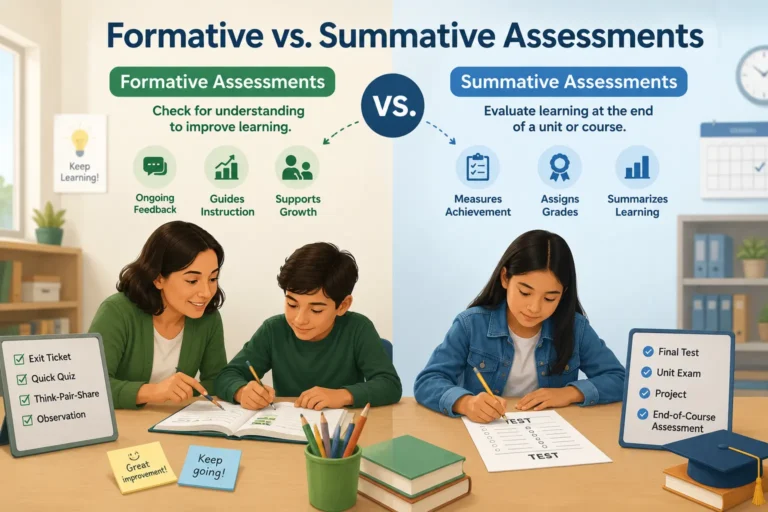
There are two main types of evaluation in teaching:
| Type | When It Happens | Purpose |
| Formative Evaluation | During the lesson or unit | Monitors ongoing progress; guides adjustments |
| Summative Evaluation | At the end of a unit or term | Measures final achievement; produces grades and reports |
Both types are essential. Formative assessment helps teachers adjust their methods in real time. Summative assessment provides a final record of student achievement.
Research from NCBI shows that teachers have large measurable effects on student self-efficacy and classroom happiness. This finding highlights how important consistent, thoughtful evaluation is. When students receive clear, supportive feedback, they develop stronger confidence in their own learning abilities.
The evaluative function also closes the teaching cycle. Results from evaluation feed directly back into the diagnostic function, beginning the process again with better information.
What Are the Other Important Functions of Teaching?
Beyond the three core functions, teaching performs several other vital functions that support the overall learning process. These functions address the full range of student needs, from cognitive development to emotional support and classroom organization.
Instructional and Motivating Functions
The Instructional Function is perhaps the most visible function of teaching. It involves explaining knowledge clearly, transmitting information, and communicating academic content in ways that students can understand. In the instructional function, a teacher presents subject matter according to each student’s ability and developmental level.
Effective instruction draws on strong communication skills, clear explanation strategies, and the ability to break complex ideas into simpler parts. This function is closely connected to knowledge transmission and teacher-student interaction.
The Motivating Function is equally important. The success of learning depends heavily on student motivation. A motivated student engages more, tries harder, and retains information better. The motivating function means a teacher actively works to:
- Spark curiosity and interest in subjects
- Celebrate small successes to build confidence
- Connect learning to real-life situations students care about
- Create a positive, encouraging classroom atmosphere
- Use varied activities to keep students engaged
Lev Vygotsky’s concept of the Zone of Proximal Development is deeply linked to motivation. When teachers present tasks that are just slightly beyond a student’s current level, with proper support, students feel challenged but not overwhelmed. This balance is powerful for sustaining motivation.
Facilitative, Social, and Administrative Functions
The Facilitative Function shifts the teacher’s role from direct instructor to learning guide. Rather than simply delivering information, the teacher using the facilitative function supports students in discovering knowledge for themselves.
This function is becoming more prominent in 2025 and 2026 as student-centered learning and self-directed learning gain importance across schools worldwide. The facilitative function includes:
- Providing scaffolding during independent tasks
- Encouraging critical thinking and problem-solving
- Designing collaborative learning activities
- Asking guiding questions rather than giving direct answers
- Supporting students in developing cognitive development skills
The Social and Emotional Function addresses the human side of learning. Teaching is not purely academic. Teachers also help students navigate social influences, clarify values and attitudes, and build emotional security inside the classroom. A student who feels safe, respected, and understood learns far more effectively than one who does not.
The Administrative and Directing Function keeps the classroom running smoothly. This function covers classroom management, organizing group activities, maintaining records, managing time, and meeting institutional reporting requirements. Without the administrative function, even the best-planned lessons can fall apart due to poor organization.
The Creative Development Function is an often-overlooked but vital part of teaching. One of the key functions of teaching is to identify each learner’s creative strengths and help nurture them. Every student has a unique potential. The teacher’s job is to recognize and develop that potential through encouraging expression, original thinking, and problem-solving.
The Curriculum-Making Function involves developing and adapting curriculum content to match the needs of learners and the demands of society. A teacher does not simply follow a textbook. They assess whether the content is relevant, adjust pacing, and create learning experiences that connect curriculum objectives to real student needs.
What Is the Difference Between Functions of Teaching and Roles of a Teacher?
This is one of the most common points of confusion in education studies, especially for B.Ed. students. The terms “functions of teaching” and “roles of a teacher” sound similar but mean different things.
The functions of teaching refer to the specific operational purposes that teaching serves. They are actions and processes embedded within the teaching act itself.
The roles of a teacher are the broader professional responsibilities a teacher holds as a person in the educational system. Roles describe what a teacher IS; functions describe what teaching DOES.
| Functions of Teaching | Roles of a Teacher |
| Diagnostic | Mentor |
| Prescriptive | Guide |
| Evaluative | Facilitator |
| Motivating | Role model |
| Administrative | Counselor |
| Facilitative | Administrator |
| Instructional | Knowledge provider |
Functions are embedded within roles. A teacher acting as a mentor performs motivating and social-emotional functions. A teacher acting as an evaluator performs the evaluative and diagnostic functions. Both concepts are connected but they are not the same thing.
Keeping this distinction clear will help you write stronger academic assignments and answer exam questions with greater precision.
How Do the Functions of Teaching Apply in the Modern Classroom?
The core functions of teaching have existed for generations. But in 2025 and 2026, technology and new educational approaches have transformed how these functions are carried out in practice.
The diagnostic function now benefits from digital assessment tools. Teachers can gather data on student performance in real time using adaptive learning platforms. Instead of waiting for a written pre-test, a teacher can receive instant reports on each student’s strengths and gaps.
The prescriptive function has also evolved. AI-assisted planning tools help teachers analyze learner data and suggest differentiated instruction pathways. This makes prescriptive planning faster and more personalized.
The evaluative function is being transformed by adaptive testing, where assessment items adjust in difficulty based on student responses. This gives a much more accurate picture of true learning outcomes than traditional fixed tests.
Google for Education reported in 2025 that classrooms are shifting from passive content consumption toward active, collaborative creation. This shift places the facilitative function at the center of modern teaching. Teachers today are expected to be designers of learning experiences, not just deliverers of content.
The motivating function is also more complex now. In a world full of digital distractions, keeping students engaged requires creativity, relevance, and genuine human connection. The best modern teachers blend traditional motivational strategies with digital engagement tools to maintain student interest.
For a broader look at how teaching has changed over time, explore how the changing perspectives of teaching have shaped modern education practices.
Why Are the Functions of Teaching Important in Education?
The functions of teaching exist because learning does not happen by accident. Left without structure, students receive information randomly, develop uneven skills, and often miss foundational concepts entirely. The functions of teaching create a reliable system that ensures learning is intentional and measurable.
UNESCO has long recognized that the purpose of education is the physical, intellectual, emotional, and ethical integration of the individual into a complete human being. The functions of teaching are the operational tools through which this purpose is actually achieved in the classroom.
When the diagnostic function works well, no student falls behind unnoticed. When the prescriptive function works well, every lesson is matched to genuine learner needs. When the evaluative function works well, progress is tracked, reported, and used to improve future instruction. When the motivating and facilitative functions work well, students develop the intrinsic drive and independent thinking skills they need for lifelong learning.
Without these functions operating together, teaching becomes disconnected from student progress. With them, teaching becomes a powerful, responsive, and deeply human process.
The functions also work together as a system, not as separate checkboxes. Curriculum planning is informed by diagnosis. Instructional objectives are shaped by prescription. Formative assessment feeds back into the next round of planning. Every function supports every other function in a continuous cycle of improvement.
Functions of Teaching and Principles of Teaching: How They Connect
The functions of teaching do not exist in isolation. They are strongly connected to the principles and characteristics that define good teaching practice.
The principles of teaching provide the guiding values and rules that shape how a teacher performs each function. For example, the principle of readiness guides how the diagnostic function is applied. The principle of motivation informs how the motivating function is activated. Without sound principles, functions can be carried out mechanically rather than meaningfully.
Similarly, the characteristics of good teaching describe the qualities that make each function effective in practice. A teacher with strong communication skills performs the instructional function better. A teacher with empathy performs the social-emotional function better.
And of course, the factors of teaching shape the context in which all these functions are carried out. External factors like class size, available resources, and institutional support directly influence how well a teacher can execute diagnostic, prescriptive, and evaluative functions.
Understanding functions, principles, characteristics, and factors together gives the most complete picture of what effective teaching really means.
Teaching as a Science and an Art
One more idea connects beautifully to the functions of teaching. The question of whether teaching is a science or an art becomes clearer when you look at the functions themselves.
The diagnostic, prescriptive, and evaluative functions reflect the scientific side of teaching. They involve systematic assessment, data-driven planning, and measurable outcome tracking. These functions follow logical, structured processes.
But the motivating, facilitative, creative, and social-emotional functions reflect the artistic side of teaching. They require intuition, empathy, creativity, and the ability to connect with individual human beings in unique ways.
Effective teachers perform all of these functions well. They bring both scientific rigor and human artistry to the classroom. That combination is what makes great teaching so powerful.
Final Thoughts
The functions of teaching are the foundation of every effective classroom experience. They are not abstract theory. They are practical, daily processes that shape how students learn, grow, and develop.
From the first step of diagnosing what students know, to the careful work of prescribing the right instruction, to the ongoing process of evaluating progress, teaching is a structured and deeply intentional act. Add to this the motivating, facilitative, creative, and social functions, and you begin to see just how much a great teacher actually does.
For B.Ed. students, understanding these functions deeply will strengthen your academic work and your teaching practice. For classroom teachers, revisiting these functions regularly is one of the best ways to reflect on and improve your craft.
Great teaching changes lives. And it starts with understanding the functions that make it work.