Effective Lesson Plans: Key Components and Strategies
Every teacher has experienced a lesson that did not go as planned. Students lost focus halfway through. The timing ran over. The activity was fun, but students left without actually learning anything new. Most lesson failures trace back to the same root cause: the plan did not start with a clear outcome in mind.
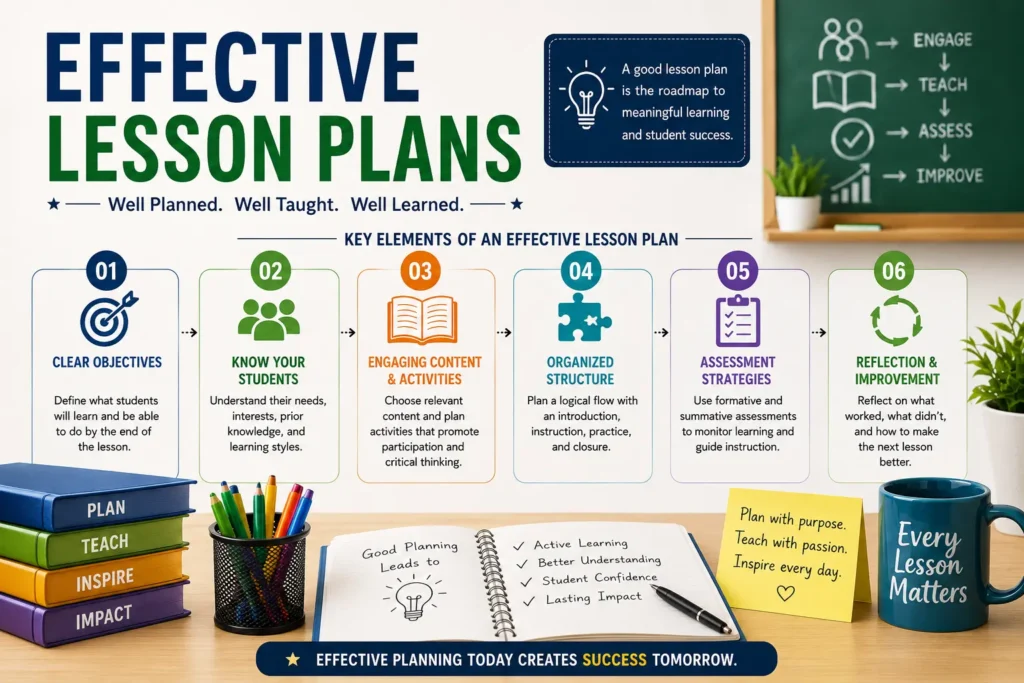
Effective lesson plans do not happen by accident. They follow a specific structure that connects what students should learn, how they will learn it, and how the teacher will know they learned it. This guide breaks down the six key components of effective lesson plans, the frameworks experienced teachers use, and the common planning mistakes to avoid in 2025 and 2026.
What Makes a Lesson Plan Effective?
An effective lesson plan is one that aligns clear learning objectives, purposeful activities, and meaningful assessments so students reach a defined outcome by the end of class. It is structured enough to guide instruction but flexible enough to respond to student needs. Effective plans are built on the principle that the objective drives every other decision in the lesson.pmc.ncbi.
The difference between a good lesson plan and an effective one comes down to alignment. A good plan is organized and covers the required content. An effective plan goes further. It connects the objective, the activity, and the assessment into a coherent learning experience that moves students toward a measurable goal.
Here is a quick way to see the contrast:
| Average Lesson Plan | Effective Lesson Plan |
| Has activities and a general topic | Has a specific, measurable learning objective |
| Assessment happens only at the end | Formative checks happen throughout the lesson |
| One path for all students | Flexible options for diverse learners |
| No reflection after the lesson | Teacher reflects and revises for next time |
| Another teacher could not follow it | Clear enough for any teacher to deliver |
According to the University of Michigan’s Center for Research on Learning and Teaching, a successful lesson plan addresses three key components: objectives for student learning, teaching and learning activities, and strategies to check for understanding. When all three align, students learn more and teachers feel more confident.
The 6 Key Components of Effective Lesson Plans
Understanding what goes inside a lesson plan is the foundation of effective teaching. The following six components appear consistently in research-backed lesson plans across every grade level and subject area.
1. Clear and Measurable Learning Objectives
The learning objective is the most important part of any lesson plan. It tells both the teacher and the students exactly what they should be able to do by the end of class. Strong learning objectives use action verbs from Bloom’s Taxonomy such as describe, analyze, compare, evaluate, or create.
Research from the University of Michigan recommends keeping objectives focused. A list of ten learning objectives is not realistic for one class period. Narrow it down to two or three key concepts so students can reach real understanding rather than surface-level exposure.
Example of a weak objective: Students will learn about fractions.
Example of a strong objective: Students will be able to add two fractions with unlike denominators and explain their steps in writing.
2. An Engaging Hook or Introduction
The first few minutes of a lesson set the tone for everything that follows. An effective lesson plan includes a deliberate hook that activates prior knowledge and sparks student curiosity. This could be a short video clip, a thought-provoking question, a quick real-world problem, or a brief review of the previous lesson.
Prior knowledge activation is especially important. When students connect new information to something they already know, they understand and retain it more easily. The hook is not extra time you can skip when running late. It is the entry point into the lesson’s core content.
3. Aligned Instructional Activities
Instructional activities must connect directly to the learning objective. This sounds obvious, but activity-first planning is one of the most common mistakes teachers make. When the activity is chosen before the objective, the lesson ends up being entertaining without being educational.
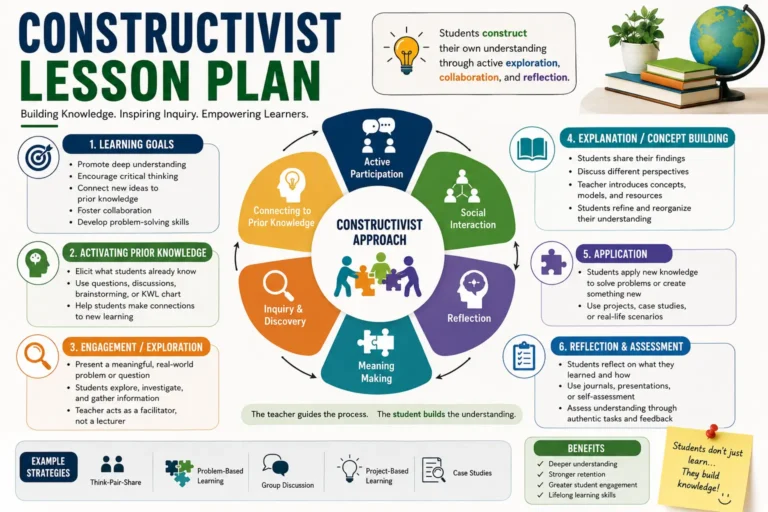
Activities should reflect what students need to do with the content, not just be exposed to it. Discussion, collaborative problem-solving, guided practice, and hands-on tasks all create deeper learning than passive listening. A constructivist approach to activity design places students at the center of the learning process, encouraging them to build understanding through experience and reflection.
For a deeper look at how constructivist principles can shape your instructional activities, see the constructivist approach to lesson planning guide on CleverPortal.
4. Formative Assessment Checkpoints
Formative assessments happen during the lesson and give teachers real-time data about whether students are understanding the material. Discovery Education confirms that effective lesson plans include a mix of formative and summative assessments, not just a quiz at the end.
Simple formative strategies include exit tickets, think-pair-share discussions, thumbs up or thumbs down responses, mini whiteboards, or a quick show of hands. These checkpoints allow teachers to slow down and re-teach when needed or move forward when students are ready.
5. Differentiation for Diverse Learners
Effective lesson plans work for all students in the classroom, not just those at grade level. Differentiated instruction means designing flexible pathways so every learner can reach the same objective, regardless of their readiness level or learning background.
Universal Design for Learning (UDL) is the modern standard for differentiation. UDL asks teachers to offer multiple means of representation (how information is taught), multiple means of expression (how students show learning), and multiple means of engagement (how students connect to the material). Differentiation does not mean writing a separate plan for every student. It means building choice and flexibility into one plan.
6. Lesson Closure and Reflection
Every effective lesson plan ends with a structured closure activity. This is not just packing up early. Closure gives students a chance to consolidate their learning, connect it to the objective, and identify what they still have questions about.
Strong closure strategies include asking students to write one thing they learned and one question they still have, completing a brief exit ticket, or sharing a takeaway with a partner. Closure signals to both students and the teacher whether the lesson achieved its goal.
Why Backward Design Makes Lesson Plans More Effective
Backward design is a planning approach where teachers start by defining the learning objective, then create the assessment, and finally design the instruction. It was developed by education researchers Grant Wiggins and Jay McTighe and is considered the most reliable sequence for building aligned, purposeful lessons.
Edutopia confirms that the secret to writing great lesson plans is ensuring the objective, assessment, and instruction are closely aligned. Backward design makes that alignment automatic because every decision flows from the objective.
Here is how the three-step sequence works:
- Define the learning outcome. What should students know or be able to do by the end of the lesson? Write this as a specific, measurable objective.
- Create the assessment first. How will you know students reached the outcome? Design the formative check or summative task before you plan any activities.
- Plan the instruction. Only after the objective and assessment are clear, choose the teaching strategies, activities, and materials that will help students get there.
Most lesson plans that fail do so because teachers reverse this sequence. They pick an activity they like, plan around it, and then try to write an objective that fits. The result is a lesson that is busy but not purposeful.
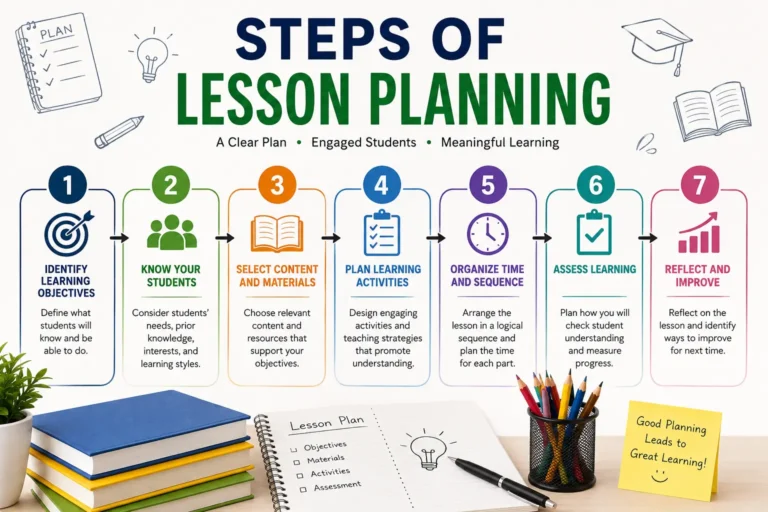
For a step-by-step walkthrough of the full planning process, the complete lesson planning guide on CleverPortal walks through each stage in detail.
How to Write Learning Objectives That Drive Results
A learning objective is only useful if it is specific enough to drive planning and measure success. Vague objectives like “students will understand photosynthesis” do not tell teachers what to look for or what activities to design.
Writing SMART Objectives
The SMART framework provides a reliable structure for writing strong learning objectives:
- Specific: Describe exactly what students will do or know
- Measurable: Use an action verb that can be observed or evaluated
- Attainable: Set a goal that is realistic within one class period
- Relevant: Connect to the lesson topic and broader curriculum standards
- Timely: Define the expected outcome for this specific lesson
Discovery Education recommends using this framework as the starting point for every lesson plan because it forces teachers to think concretely about what success looks like.
Using Bloom’s Taxonomy to Choose Action Verbs
Bloom’s Taxonomy organizes thinking skills from lower to higher order. Matching your objective to the right level of Bloom’s ensures the activity and assessment align properly.
| Bloom’s Level | Example Action Verbs | Example Objective |
| Remember | list, identify, recall | Students will list three causes of World War I |
| Understand | explain, describe, summarize | Students will explain how photosynthesis works |
| Apply | use, solve, demonstrate | Students will solve two-step equations |
| Analyze | compare, differentiate, examine | Students will compare two character motivations |
| Evaluate | judge, argue, justify | Students will justify their position with evidence |
| Create | design, construct, develop | Students will write an original persuasive paragraph |
Choosing a Bloom’s verb before writing the rest of the objective helps teachers build activities and assessments that match the expected level of thinking.
Strategies for Keeping Students Engaged During a Lesson
Engagement is not the same as entertainment. An effective lesson plan builds engagement into the structure itself rather than relying on in-the-moment teacher energy. Here are five planning strategies that consistently improve student participation:
- Connect to real-world relevance. Show students why the content matters outside of the classroom. A math lesson about percentages connects directly to discounts, taxes, and budgets. Real-world context raises curiosity and motivation.
- Build in student choice. Giving students options in how they demonstrate understanding increases ownership of their learning. A student who can write, draw, or present their answer is more likely to engage than one forced into a single format. Research from ExploreLearning confirms that student choice increases engagement and academic ownership.
- Use varied activity types. Alternate between direct instruction, partner work, independent practice, and group discussion. No single activity format holds attention for an entire class period.
- Activate prior knowledge early. Start with what students already know before introducing new content. This reduces cognitive load and creates a bridge into unfamiliar material.
- Plan for movement or discussion breaks. A short pair-share or a brief stretch moment every 15 to 20 minutes helps students refocus and process what they have just learned.
How to Build Assessment Into Your Lesson Plan
Formative assessment is the built-in feedback system of an effective lesson plan. It tells the teacher what is working in real time rather than waiting until the end to find out. Discovery Education recommends including both formative and summative assessment in every lesson plan, not relying only on end-of-lesson tests.
| Formative Assessment | Summative Assessment |
| Happens during the lesson | Happens at the end of a unit or lesson |
| Guides in-the-moment teaching decisions | Measures overall learning achievement |
| Examples: exit tickets, quick polls, observation | Examples: tests, projects, final essays |
| Low-stakes and frequent | Higher-stakes and less frequent |
The most common planning mistake related to assessment is leaving it out of the lesson plan entirely and assuming the teacher will know intuitively whether students understood the material. That assumption rarely holds. Building at least one formative checkpoint into the plan ensures the teacher collects real evidence of learning.
Here are four practical formative assessment strategies any teacher can add to a lesson plan:
- Exit tickets: A 2-3 sentence written response to a prompt at the end of class
- Think-pair-share: Students think independently, discuss with a partner, then share with the group
- Cold calling with wait time: Give students 30 seconds to think before calling on anyone to respond
- Mini whiteboards or sticky notes: Quick visible responses the teacher can scan at a glance
Common Mistakes That Make Lesson Plans Less Effective
Even experienced teachers fall into predictable planning patterns that reduce lesson effectiveness. Recognizing these mistakes is the first step to avoiding them.
- Planning activities before objectives. Choosing a fun activity first and writing the objective around it leads to misaligned lessons. Always start with the objective.
- Setting too many objectives. A lesson plan with five or six objectives rarely achieves any of them deeply. The University of Michigan recommends limiting plans to two or three key concepts per lesson.
- Skipping the hook. Starting a lesson without activating prior knowledge loses students in the first five minutes. The hook is not optional.
- Ignoring time and pacing. A plan without realistic time estimates per activity almost always runs long or short. Include time markers for each section of the lesson.
- Leaving out reflection. Most lesson plan formats skip teacher reflection entirely. Without it, the same planning mistakes repeat across the school year.
How to Adapt Effective Lesson Plans for Different Learners
A lesson plan is only truly effective if it works for the students in the actual classroom, not an imaginary average student. Differentiated instruction means designing flexible pathways so all learners can reach the same learning objective regardless of their readiness level, learning style, or language background.pmc.ncbi.
Universal Design for Learning (UDL) is a practical framework for differentiation that asks teachers to build flexibility in from the start rather than retrofitting accommodations after the plan is written. UDL organizes differentiation into three categories:
- Multiple means of representation: Offer content in more than one format. Pair written instructions with visual diagrams. Provide vocabulary support alongside complex text.
- Multiple means of expression: Let students show their learning in different ways. Some students write best. Others do better with a presentation or a diagram.
- Multiple means of engagement: Connect the content to student interests and provide choices that increase motivation.
Three practical differentiation strategies to build into any lesson plan:
- Tiered activities: Design the same task at three levels of complexity so all students work on the same concept with different levels of support or challenge.
- Flexible grouping: Change groups based on the task, not just by ability. Sometimes group by interest. Sometimes pair a stronger and developing student together.
- Student choice boards: Offer a grid of activity options so students select how they engage with and demonstrate learning.
For more on constructivist lesson planning methods that naturally support differentiation, see the constructivist lesson plan framework on CleverPortal.
The Role of Reflection in Making Lesson Plans Better Over Time
Post-lesson reflection is what separates developing teachers from master teachers. Most lesson plan formats treat reflection as an afterthought or skip it entirely. Research consistently shows that teachers who reflect intentionally on their practice improve student outcomes more rapidly than those who do not.
Reflection does not need to be time-consuming. A few targeted questions asked right after a lesson can reveal patterns that transform future planning. Here are five specific reflection prompts to add to any lesson plan:
- Did students reach the learning objective? How do I know?
- Which part of the lesson worked best and why?
- Where did students struggle or get confused?
- What would I change if I taught this lesson again?
- Did my timing match the actual pace of the class?
Treating the lesson plan as a living document that gets revised after each use is the single most effective long-term planning habit a teacher can develop. A plan that has been taught, reflected on, and revised three times will outperform a freshly written plan almost every time.
Final Thoughts
Effective lesson plans share one core principle. Every decision in the plan, from the hook to the final closure activity, connects back to the learning objective. When objectives, activities, and assessments align, students learn more and teachers feel more prepared and confident in the classroom.
Research from the RSIS International Journal confirms that effective lesson plan implementation positively impacts student understanding, academic performance, active participation, and reduces learning difficulties. That outcome is achievable for any teacher who is willing to plan with intention rather than habit.
Start with the objective. Design the assessment next. Then build the activities around them. Add a hook that activates prior knowledge, build in at least one formative checkpoint, plan for differentiation, and leave time for reflection after the lesson ends. That is the framework used by the most effective teachers across every grade level and subject area.
Ready to take your planning further? Explore the complete lesson planning guide for a step-by-step walkthrough of the entire process, or discover how the constructivist approach to lesson planning can transform the way you design learning experiences for your students.