Philosophy of Educational Aims: What It Means, Who Shaped It, and Why It Matters
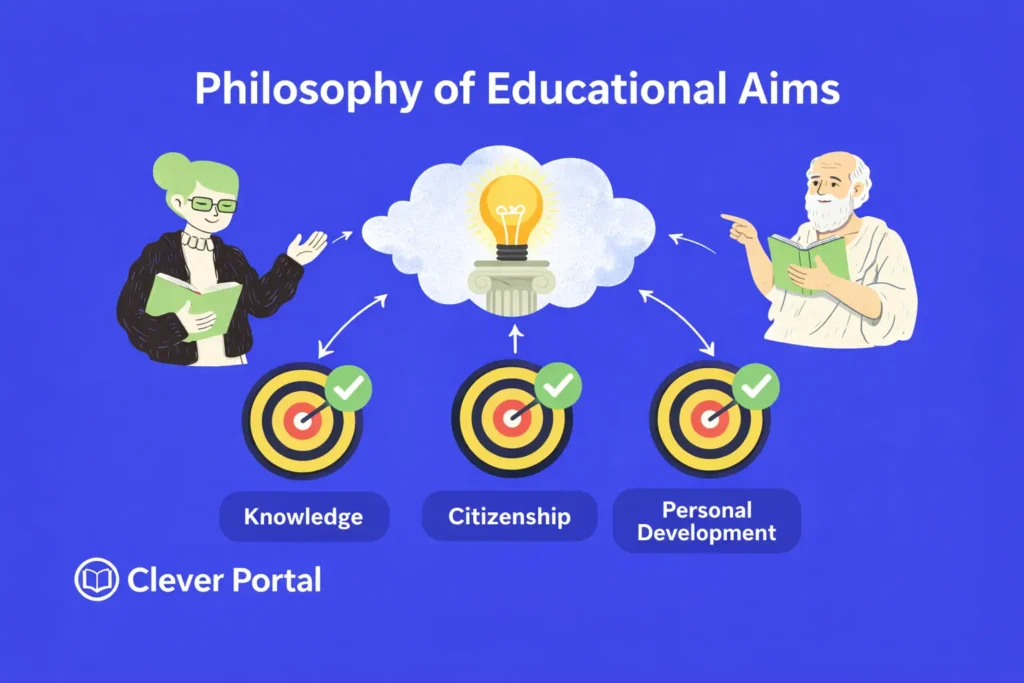
The philosophy of educational aims asks why people should be educated and what goals education should pursue. Major thinkers including Plato, Aristotle, and John Dewey gave different answers. Their ideas fall into three broad categories: goods-based aims (knowledge and understanding), skills-based aims (critical thinking and rational autonomy), and character-based aims (moral development and virtue). Understanding these frameworks helps educators, curriculum designers, and policymakers make principled decisions about what education should achieve.
Education is everywhere. Every society builds schools, trains teachers, writes curricula, and sends children to learn. Yet ask ten educators what education is for and you will get ten different answers.
That disagreement is not a failure. It is the starting point of the philosophy of educational aims, a field that takes seriously the question every classroom and every policy implicitly answers: What should education actually achieve?
This guide explains what the phrase means, which philosophical frameworks define the debate, which great thinkers shaped our understanding, and how these ideas play out in real schools and curricula today.
What Does “Philosophy of Educational Aims” Actually Mean?
The philosophy of educational aims is a branch of philosophy of education. It asks two connected questions: Why should people be educated? and What goals should education pursue?
These questions go beyond teaching methods or assessment techniques. They sit at the deepest level of educational theory, what philosophers call the normative level. A normative question is not about what is done but about what should be done.
Here is a simple way to understand the three layers:
- Aims are the broadest philosophical statements about education’s ultimate purpose
- Goals are medium-term outcomes that align with those aims
- Objectives are specific, measurable targets for individual lessons or units
Aims sit at the top of this hierarchy. They are the philosophical foundation that everything else is built on. When a school says it wants to “develop the whole child” or “produce lifelong learners,” it is making a statement about its educational aims, whether it knows it or not.
The philosophy of educational aims makes that statement explicit, examines it critically, and asks whether it holds up.
Why Do Educational Aims Matter?
Educational aims shape everything that comes after them. Curriculum content, teaching methods, what gets assessed, and how schools are funded all flow from decisions, often unstated, about what education is for.
Wrexham Glyndwr University puts it clearly: educational policies “aim to assist with the development of curricula and teaching techniques that help learners gain the knowledge and skills they need to succeed.” But succeed at what? That is the philosophical question.
Without clearly defined aims, education drifts. Schools may train students for employment while ignoring moral development. Or they may focus on cultural transmission while neglecting critical thinking. Many ongoing political disputes about education, over standardized testing, arts funding, or STEM vs. humanities, are really disagreements about educational purpose, not just about teaching methods.
Philosophy gives educators and policymakers a language for having those disagreements clearly, rather than arguing past each other.
What Are the Three Core Frameworks for Educational Aims?
Philosophers who study educational aims generally group them into three main categories. Each framework answers the question “What is education for?” differently.
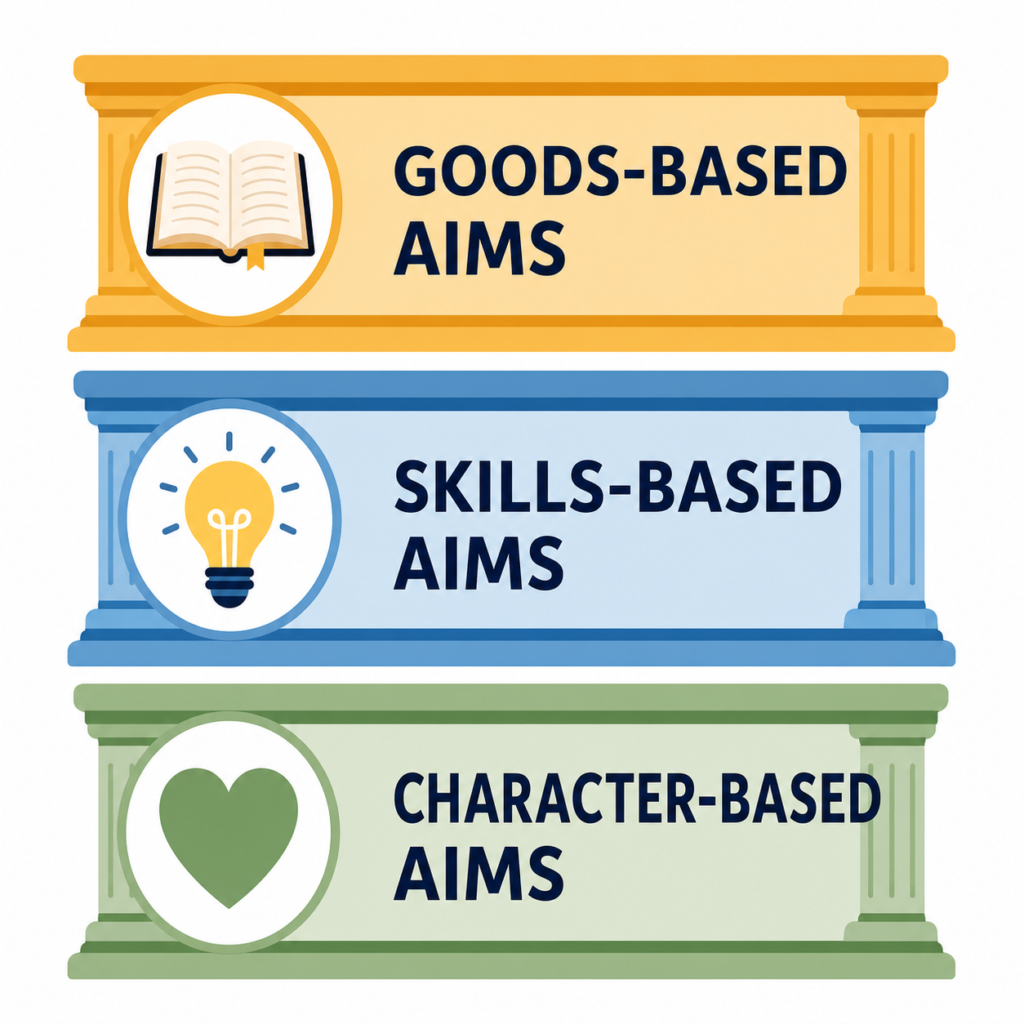
Goods-Based Aims: Knowledge and Understanding
Goods-based accounts hold that the main aim of education is to produce epistemic goods, truth, knowledge, and understanding. On this view, a well-educated person knows things accurately, understands how and why things work, and can evaluate evidence.
This framework emphasizes knowledge transmission and the development of rational understanding. It aligns with traditions that value academic rigor, disciplinary depth, and the preservation of intellectual culture. Subjects like history, science, and mathematics are central because they deliver genuine knowledge about the world.
Skills-Based Aims: Rationality and Critical Thinking
Skills-based accounts argue that specific knowledge matters less than the capacity to think well. The aim is to develop rational autonomy, the ability to evaluate claims, think independently, and reach well-reasoned conclusions.
This framework supports inquiry-based learning, Socratic discussion, and approaches that teach students how to think rather than what to think. Democratic education, in the tradition of John Dewey, leans heavily on this framework.
Character-Based Aims: Virtue and Moral Development
Character-based accounts hold that the deepest aim of education is moral development, the cultivation of virtue, good character, and human flourishing (what Aristotle called eudaimonia). On this view, a school that produces clever, skilled graduates who lack honesty, compassion, or civic responsibility has failed at its most important task.
This framework underlies character education programs, social-emotional learning, and religious or values-based schooling traditions.
Most real educational systems blend all three, though the balance shifts depending on the cultural, political, and philosophical context.
Instrumental vs. Intrinsic Aims: A Key Philosophical Divide
One of the most important distinctions in the philosophy of educational aims separates instrumental aims from intrinsic aims.
Instrumental aims treat education as a means to something else. The goal of education, on this view, is to produce economically productive citizens, reduce unemployment, strengthen national competitiveness, or maintain social order. Education serves external purposes. Its value depends on what it leads to.
Intrinsic aims treat education as valuable in itself. Developing wisdom, cultivating virtue, achieving intellectual flourishing, these are worth pursuing regardless of their economic payoff. Education, on this view, is not a tool for producing outcomes. It is itself a form of human development worth having for its own sake.
A practical example makes this clearer. A government that pours funding into vocational STEM training is prioritizing instrumental aims. A school that protects time for philosophy, literature, and ethical discussion, even when these subjects have no obvious job market value, is protecting intrinsic aims.
The Stanford Encyclopedia of Philosophy identifies both instrumental and non-instrumental grounds for educational aims, noting that some aims can be justified by their outcomes and others are justified as ends in themselves. Most philosophical traditions argue that education needs both, the question is how to balance them.
How Did Major Philosophers Approach Educational Aims?
The debate over educational aims is not new. It stretches back more than two thousand years. Here is how five major thinkers positioned themselves:
| Philosopher | Core Aim of Education | Approach | Key Work |
|---|---|---|---|
| Plato | Attain knowledge of the Good; create a just society | Dialectic / Socratic method | The Republic |
| Aristotle | Harmonious development; preparation for civic life | Virtue practice, empirical observation | Nicomachean Ethics |
| John Dewey | Continuous growth; democratic participation | Experiential learning | Democracy and Education |
| Immanuel Kant | Develop rational autonomy; fulfill moral duty | Discipline and structured instruction | On Education |
| Paulo Freire | Liberation from oppression; critical consciousness | Dialogic education | Pedagogy of the Oppressed |
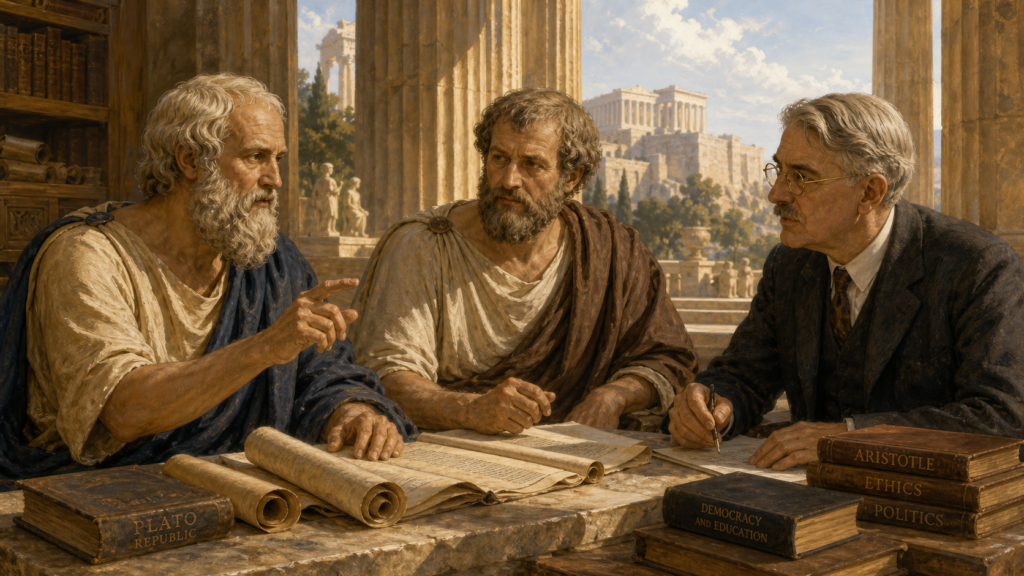
Plato’s Aims: Justice, Wisdom, and the Ideal State
Plato believed education’s highest purpose was to help individuals attain knowledge of “the Good”, the ultimate philosophical truth that underlies all genuine knowledge. In The Republic, he argued that education should cultivate reason and virtue so that the best-educated citizens could lead justly.
For Plato, education was deeply tied to social order. A just society required wise leaders, and wise leaders required rigorous philosophical education. His model was elitist by modern standards, he believed only the philosophically gifted should govern, but his core idea, that education should produce people capable of rational, ethical judgment, remains central to the field.
Aristotle’s Aims: Practical Wisdom and Civic Virtue
Aristotle took a more grounded approach than his teacher Plato. Where Plato focused on abstract knowledge of ideal forms, Aristotle emphasized practical wisdom (phronesis), the ability to make good decisions in real-world situations.
In the Nicomachean Ethics, Aristotle argued that education should develop the virtues citizens need to live well and participate in civic life. He saw education as the cultivation of excellent character through practice and habit, not just instruction. A student does not become courageous by learning about courage, they become courageous by practicing courageous acts.
John Dewey’s Aims: Growth, Democracy, and Experience
John Dewey rejected fixed ultimate aims entirely. In Democracy and Education, he argued that education should not be aimed at some predetermined endpoint, not virtue, not knowledge of the Good, not even civic readiness. The aim of education, for Dewey, is growth itself.
Dewey believed education should be a continuous reconstruction of experience, where learners engage with real problems, reflect on results, and grow in their capacity to engage further. His famous phrase captures it: education is not preparation for life, it is life itself.
Dewey also connected educational aims directly to democratic values. Schools should cultivate the habits of inquiry, cooperation, and open-minded participation that democracy depends on. A well-functioning democracy requires citizens who can think critically and work collaboratively, and that is what education should aim to produce.
How Do These Philosophical Aims Influence Modern Education?
These classical theories did not stay in philosophy classrooms. They shaped how modern schools define their purpose, whether or not the schools name their philosophical sources.
The influence maps onto real curriculum decisions:
- Goods-based aims support knowledge-heavy curricula, core subject requirements, and standardized testing built around subject mastery
- Skills-based aims support inquiry-based learning, project-based education, critical thinking courses, and Socratic seminars
- Character-based aims support social-emotional learning programs, ethics courses, mentorship models, and school culture initiatives
A 2025 article in the Journal of Philosophy of Education at Oxford explored human flourishing as an aim of higher education, noting growing support for eudaimonia, genuine human wellbeing and development, as a legitimate educational goal alongside or even above economic productivity. The University of Humanistic Studies explicitly builds its educational philosophy around this idea.
At the same time, new instrumental aims are entering the debate. Research published in Tandfonline highlights data science and AI literacy as emerging educational goals, reflecting how rapidly the skills economy is changing. Whether these are genuine educational aims or just vocational training priorities is itself a philosophical question the field is actively working through.
What Is the Difference Between Aims, Goals, and Objectives in Education?
This question trips up students and educators alike, so it is worth being direct about the distinctions.
Aims are the broadest, most philosophical statements. They describe the ultimate purpose of education. Example: “Education should develop virtuous, thinking citizens.”
Goals are medium-term targets that flow from aims. Example: “Students should develop the ability to evaluate sources critically by the end of secondary school.”
Objectives are specific, measurable outcomes for a lesson, unit, or course. Example: “By the end of this lesson, students will be able to identify three types of logical fallacy.”
The hierarchy runs: aims at the top, goals in the middle, objectives at the bottom.
This distinction matters because conflating them leads to a real problem in educational practice. A school may write excellent lesson objectives while its actual philosophy of education remains undefined or contradictory. Philosophy of educational aims works at the top of the hierarchy, it ensures that the specific choices made in classrooms actually point toward something worth pointing toward.
Where to Go Next
The philosophy of educational aims is a rich field that connects to nearly every decision made in schools and educational systems. Once you understand the foundational frameworks, you will start to see them operating everywhere: in curriculum debates, assessment policies, school mission statements, and education legislation.
If this article opened up new questions for you, explore related guides on educational theories and theorists, the aims and objectives of education, and the specific philosophies of John Dewey and Plato. Each goes deeper into the ideas introduced here and gives you more tools for thinking clearly about what education is really for.
Frequently Asked Questions About Philosophy of Educational Aims
What do philosophers mean by “educational aims”?
Philosophical educational aims are the broadest statements about what education should ultimately achieve. They differ from lesson objectives because they are not measurable targets. They are value judgments about the purpose of education itself, whether that purpose is producing knowledgeable people, virtuous citizens, or autonomous thinkers.
Did Plato and Aristotle agree on what education should aim for?
They agreed that education should develop human excellence, but they disagreed on what that meant. Plato focused on abstract philosophical knowledge and the ability to grasp ideal truths. Aristotle focused on practical wisdom and civic virtue developed through habit and real-world experience. Their disagreement reflects the broader tension between goods-based and character-based educational aims.
Is Dewey’s idea of “education as growth” still relevant today?
Very much so. Dewey’s emphasis on experiential learning, critical thinking, and democratic participation is reflected in modern inquiry-based learning models, project-based education, and the push for civic education in schools. His rejection of fixed endpoints also resonates with lifelong learning frameworks that see education as a continuous process, not a phase of life that ends at graduation.
How does the philosophy of educational aims connect to curriculum design?
Curriculum design is the practical expression of educational aims. Every choice about what to include or exclude from a curriculum reflects an assumption about what education is for. A philosophy that prioritizes knowledge transmission produces one kind of curriculum. A philosophy that prioritizes critical autonomy produces another. Philosophy of educational aims makes those assumptions visible so they can be examined and debated.
What role does human flourishing play in modern educational philosophy?
Human flourishing, or eudaimonia, is gaining significant attention as an alternative to economic productivity as the central aim of education. Recent work in the Journal of Philosophy of Education argues that schools and universities should orient themselves around helping students live well and develop as full human beings, not just acquire credentials or workforce skills.
How do different cultures approach educational aims differently?
Educational aims are not universal. Western liberal traditions tend to emphasize rational autonomy, critical thinking, and individual development. Other traditions may place greater weight on community values, religious formation, cultural transmission, or civic duty. Comparative philosophy of education studies these differences and asks which aims, if any, are genuinely universal.