Formative vs. Summative Assessments: Key Differences, Examples, and Uses
Teachers use assessments to learn what students know, what they need, and what to teach next. The two most common types are formative and summative assessments.
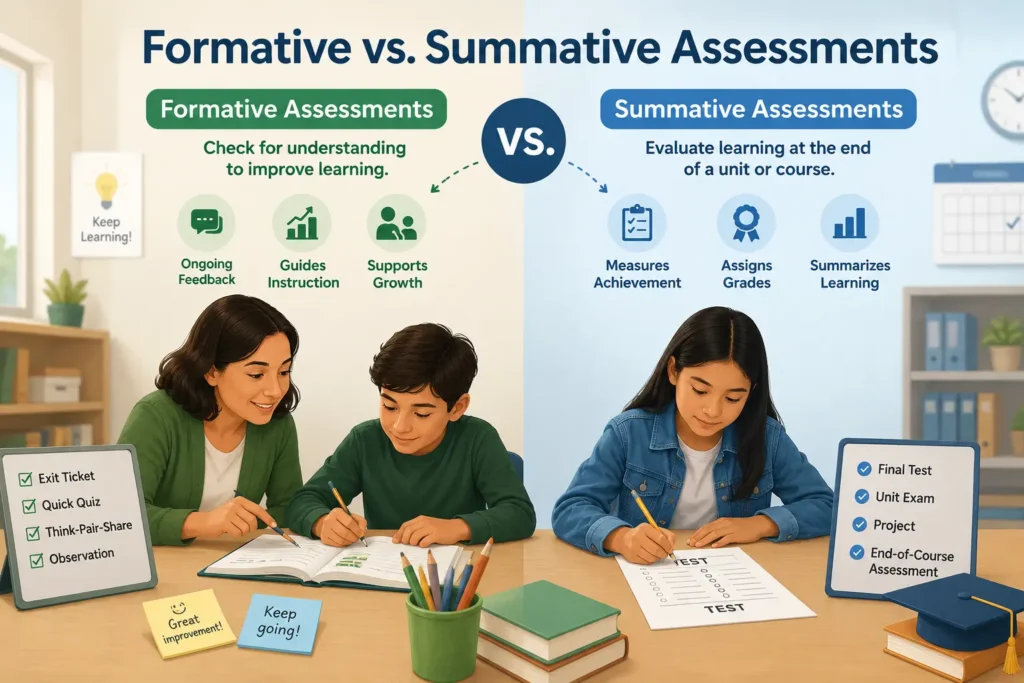
Formative vs. summative assessments can sound confusing at first. The main difference is simple. Formative assessments happen during learning. Summative assessments happen after learning. Formative checks help teachers improve instruction. Summative tasks measure what students learned.
Both types matter in K-12 classrooms. A strong teacher does not choose only one. Instead, they use each type at the right time.
Formative assessment is used while students are learning. It gives teachers ongoing feedback about student progress, strengths, questions, and misconceptions. Summative assessment is used after a lesson, unit, course, or school year. It shows how much students learned compared with a learning goal, standard, or benchmark.
Think of formative assessment as a checkup during a trip. It helps you see if you are going in the right direction. Think of summative assessment as the final result after the trip is over.
What Is the Difference Between Formative and Summative Assessments?
The difference between formative and summative assessment comes down to purpose, timing, and how teachers use the results.
A formative assessment helps improve learning while there is still time to make changes. A teacher may use a quick question, an exit ticket, a class discussion, or a short quiz to see what students understand. Then the teacher can reteach a skill, give extra practice, or move ahead.
A summative assessment measures learning after instruction is complete. It may happen at the end of a chapter, unit, semester, or course. Teachers often use summative results for grades, reports, and decisions about whether students met the learning objectives.
Formative assessment is often called assessment for learning. It supports learning as it happens. Summative assessment is often called assessment of learning. It looks at what students have learned at the end.
Neither type is better than the other. They do different jobs.
Formative vs. Summative Assessments Chart
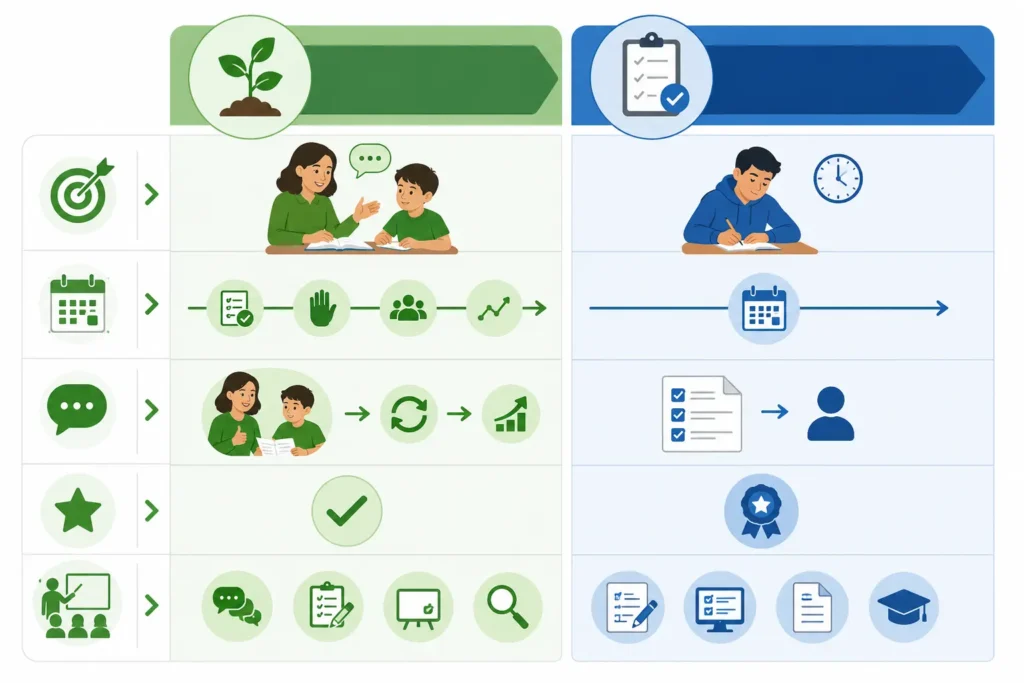
This formative and summative assessment chart shows the main differences at a glance.
| Feature | Formative Assessment | Summative Assessment |
| Main purpose | Improve learning while it is happening | Measure learning after instruction |
| Timing | During a lesson, unit, or course | At the end of a unit, course, or term |
| Main question | What do students understand right now? | What have students learned? |
| Stakes | Usually low-stakes | Often high-stakes |
| Feedback | Quick and ongoing | Often final or later |
| Teacher action | Adjust teaching, reteach, group students | Grade, report, evaluate outcomes |
| Student action | Reflect, practice, improve, revise | Show mastery of learning objectives |
| Common examples | Exit tickets, polls, drafts, discussions | Final exams, unit tests, projects, portfolios |
| Focus | Learning process | Final product or outcome |
| Grading | May be graded, but feedback is the main goal | Often graded and used for reporting |
Carnegie Mellon University explains that formative assessment monitors student learning and gives ongoing feedback that teachers and students can use to improve. Summative assessment evaluates student learning at the end of an instructional unit against a standard or benchmark.
What Are Formative Assessments?
Formative assessments are short checks that happen during learning. They help teachers see what students understand before a lesson, unit, or course is over.
The goal is not only to collect scores. The goal is to find useful information. A teacher can use that information to improve classroom instruction. Students can use it to understand what they need to practice.
For example, a teacher may ask students to solve one math problem before leaving class. If many students make the same mistake, the teacher knows that skill needs more attention the next day.
This creates a feedback loop:
- The teacher teaches a skill.
- Students show what they understand.
- The teacher checks student progress.
- The teacher gives feedback.
- Students practice again.
- The teacher adjusts the next lesson.
Formative assessments are usually low-stakes checks. This means they often have little or no effect on final grades. Students should feel safe making mistakes because mistakes help teachers see where support is needed.
Why Do Formative Assessments Matter?
Formative assessments help teachers find learning gaps early. They can show misunderstandings before students take an end-of-unit test.
For example, a class may appear to understand a science lesson during a discussion. But a short written response may show that many students still confuse two key ideas. The teacher can then pause, explain the concept in a new way, and give students more practice.
Yale’s Poorvu Center notes that formative assessment can identify strengths, challenges, and misconceptions. It can also help teachers decide how to close learning gaps.
Formative assessment can support:
- Student progress
- Ongoing feedback
- Better classroom instruction
- Faster reteaching
- Student reflection
- Clear learning objectives
- More useful practice
- Better communication between teachers and students
- Early support for students who are struggling
- Stronger preparation for summative assessments
The most important part is what happens after the assessment. A formative check only helps if teachers and students use the results.
What Are Examples of Formative Assessments?
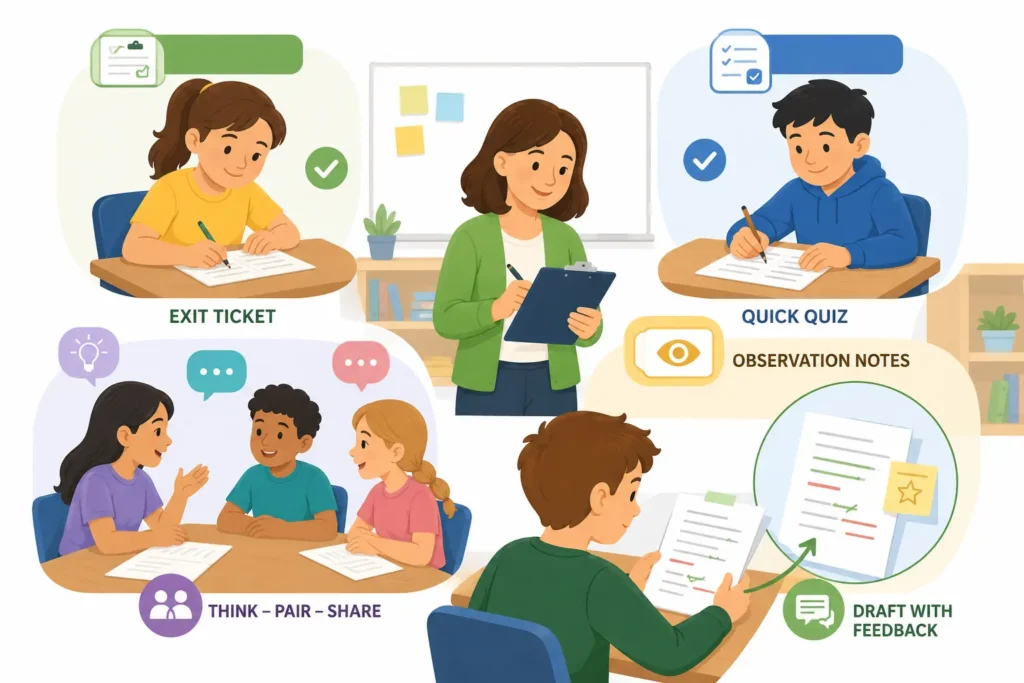
There are many formative assessment examples that teachers can use in any grade level or subject.
The best choice depends on the learning goal. A reading teacher may use a short written response. A math teacher may use a quick problem. A science teacher may ask students to explain a diagram. An art teacher may use peer feedback on a draft.
Here are common formative assessment examples.
Exit Tickets
An exit ticket is a short task students complete at the end of a lesson. It may ask students to answer one question, solve one problem, explain one idea, or share one question they still have.
Example: “Write one fact you learned about the water cycle and one question you still have.”
Exit tickets help teachers plan the next lesson. They are formative when the teacher reads the responses and uses them to adjust instruction.
Quick Quizzes
A short quiz can be formative when it checks understanding during a unit. It does not need to be a major grade.
For example, a five-question quiz after two lessons can show whether students are ready to move on. If many students miss the same question, the teacher can reteach that skill.
Classroom Discussions
Class discussion is a useful formative assessment when teachers listen closely to student answers.
Ask open questions such as:
- Why do you think that?
- What evidence supports your answer?
- Can you explain your thinking?
- Do you agree or disagree? Why?
- What would happen if we changed this part?
Student answers can show what they understand and where misconceptions may be hiding.
Think-Pair-Share
In think-pair-share, students first think about a question on their own. Next, they discuss their answer with a partner. Finally, some students share ideas with the class.
This method gives more students a chance to speak. It also gives teachers a fast way to check understanding.
Polls and Quick Digital Questions
Digital polls can provide quick feedback during a lesson. Teachers can use a poll after explaining a new concept. The results can show whether students are ready for the next step.
A digital learning platform may also provide practice data. That data can support formative assessment when the teacher reviews it and responds with help, grouping, practice, or reteaching.
The tool does not replace teacher judgment. The teacher still decides what the data means.
Observation Notes
Teachers often learn a lot by watching students work. During group work, independent practice, reading time, lab work, or a class discussion, teachers can write short observation notes.
Notes may include:
- Who can explain the skill
- Who needs more support
- Which students use a helpful strategy
- Which students avoid a task
- What errors appear often
- Which groups need a quick conference
Observation is formative when it helps guide the next teaching step.
Draft Feedback
Students can submit a rough draft before turning in a final paper, project, or presentation. The teacher can give feedback on the draft.
For example, feedback may say:
- Add evidence to support this point.
- Explain your second idea more clearly.
- Check your topic sentence.
- Use the rubric before you submit the final version.
This gives students time to revise. It also helps them learn from feedback before the final product is graded.
Self-Assessment
Students can reflect on their own learning. A simple self-assessment may ask students to rate their confidence, list what they understand, or name one skill they still need to practice.
Example prompts include:
- I can explain this skill to someone else.
- I understand some parts but need more practice.
- I need help with this step.
- One thing I learned today is…
- One question I still have is…
Self-assessment supports metacognition. Metacognition means thinking about your own thinking and learning.
Peer Assessment
Peer assessment lets students give feedback to one another. It works best when students have clear criteria or rubrics.
For example, students may use a simple checklist to review a partner’s paragraph:
- Does it have a clear main idea?
- Does it include evidence?
- Does it have correct punctuation?
- Is the ending clear?
Peer assessment should be kind, specific, and focused on improvement.
Bell Ringers
A bell ringer is a short task students complete at the start of class. It can help a teacher see what students remember from a previous lesson.
Example: “Solve this problem from yesterday’s lesson.”
If many students struggle, the teacher may need a short review before starting new content.
Homework Review
Homework can also be formative when teachers use it to check learning and provide support. The goal should not only be points. It should help the teacher understand which skills need more practice.
A homework task becomes more useful when students receive feedback and have a chance to correct errors.
What Are Summative Assessments?
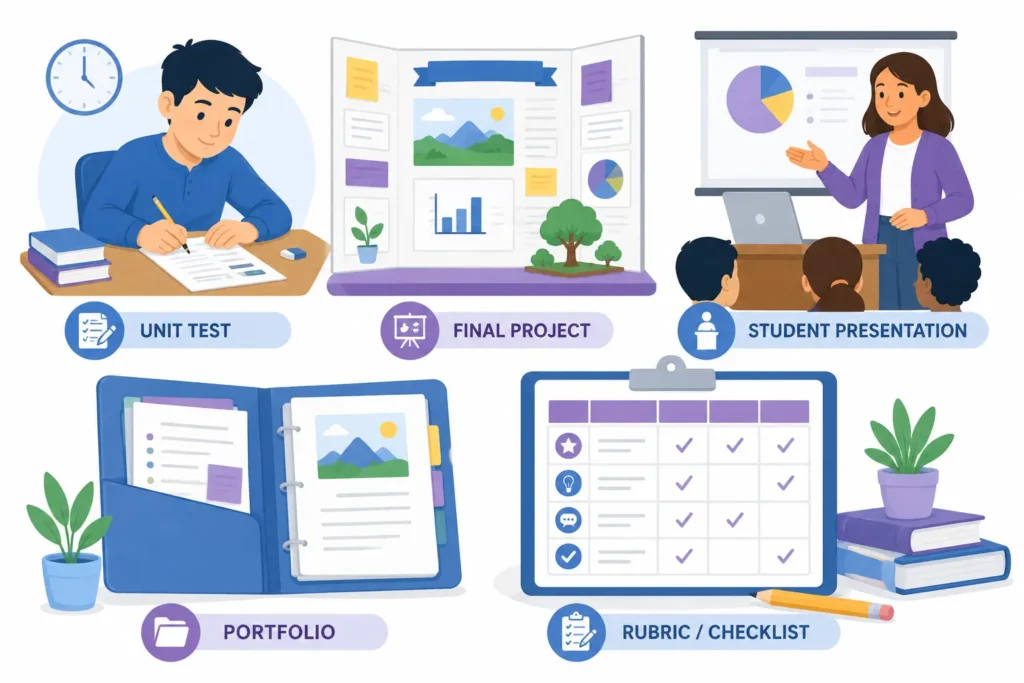
Summative assessments happen after learning is complete. They measure student learning at the end of an instructional period.
That period may be:
- A lesson
- A chapter
- A unit
- A quarter
- A semester
- A school year
- A course
Summative assessments often carry more weight than formative assessments. They may affect grades, reports, promotion decisions, or program evaluation.
The goal is to see whether students met the learning objectives. A teacher may compare student work to a rubric, a benchmark, a standard, or a set of success criteria.
Northern Illinois University explains that formative assessment focuses more on the process of learning, while summative assessment is more product-oriented and looks at the final product.
A summative assessment should align with what students were taught. It should give students a fair chance to show their knowledge and skills.
Why Do Summative Assessments Matter?
Summative assessment helps teachers, students, families, and schools understand final learning outcomes.
For example, an end-of-unit test can show whether students mastered key vocabulary, concepts, and skills. A final project can show whether students can apply learning in a meaningful way.
Summative results can help with:
- Course grades
- Student reports
- School progress data
- Curriculum review
- Program planning
- Learning standards
- Benchmark decisions
- Identifying strengths and needs across a class or grade
Summative assessment is useful, but it usually comes too late to fix every learning gap in the same unit. That is why formative assessments are important before the final task.
What Are Examples of Summative Assessments?
There are many summative assessment examples. A final test is only one option.
Teachers can choose the type of summative task that best matches the learning objectives.
End-of-Unit Tests
An end-of-unit test checks what students learned after a full unit. It may include multiple-choice questions, short answers, essays, math problems, or other question types.
Example: A fifth-grade science test after a unit on ecosystems.
Final Exams
Final exams often happen at the end of a semester or course. They may cover many topics.
A final exam can be useful when students need to show broad knowledge. However, teachers should make sure the questions match the content students studied.
Research Papers
A research paper can be a summative assessment when students use the skills learned during a unit or course.
For example, students may research a historical event, use sources, organize ideas, and write a final paper.
A rubric can help students understand how their work will be scored.
Final Projects
A final project asks students to apply learning in a larger task.
Examples include:
- Building a model
- Creating a science fair project
- Making a history timeline
- Writing a story
- Designing a poster
- Producing a video
- Creating a presentation
- Solving a real-world math problem
Final projects can help students show learning in different ways.
Presentations and Performances
Students may show what they learned through an oral presentation, debate, speech, music performance, dramatic performance, or demonstration.
For example, students may present a persuasive speech after learning how to support an opinion with evidence.
Portfolios
A portfolio is a collection of student work. It may include writing samples, art pieces, lab reports, problem-solving tasks, reflections, and revised work.
Portfolios can show growth over time. They are useful when a single test does not fully show student learning.
Standardized Tests
Standardized tests use the same rules and scoring process for all students who take them. Schools may use them to measure progress toward state standards or benchmarks.
These tests are often high-stakes assessment tools. They can provide broad data, but they should not be the only measure of student learning.
Performance Tasks
A performance task asks students to use their knowledge in a real or realistic situation.
For example, students may plan a budget, design a bridge model, conduct an experiment, or write a solution to a community problem.
Performance tasks can measure deeper learning because students must apply skills, not only remember facts.
When Should Teachers Use Formative vs. Summative Assessments?
Teachers should use formative assessments during learning and summative assessments after learning.
This sounds simple, but planning matters. The right assessment at the right time can save time and improve student learning.
Use Formative Assessment During a Lesson
Use formative assessments when you need to know whether students understand a skill right now.
For example, use a quick check after teaching a new math strategy. Ask students to solve one problem on a whiteboard. Look for common errors.
If most students understand, move forward. If many students struggle, reteach using a new example.
Use formative assessment when you want to:
- Check understanding
- Find misconceptions
- Group students for support
- Plan reteaching
- Give students feedback
- Help students reflect
- Decide whether to move forward
- Adjust classroom instruction
Use Formative Assessment During a Unit
A unit often includes several lessons. Teachers can use short formative checks throughout the unit.
For example, during a writing unit, students may:
- Choose a topic.
- Create an outline.
- Write a first draft.
- Get peer feedback.
- Revise the draft.
- Submit a final piece.
The outline, draft, peer feedback, and revision are formative parts of the process. They help students improve before the final writing piece.
Use Summative Assessment at the End of a Unit
Use summative assessment when students have had enough time to learn, practice, receive feedback, and improve.
For example, after a unit on fractions, students may complete an end-of-unit test or a performance task. This task shows whether they can use fraction skills independently.
Use summative assessment when you need to:
- Measure final learning
- Assign grades
- Report progress
- Check mastery of standards
- Review the success of a unit
- Plan future curriculum changes
- Compare results with a benchmark
Use Both Across the School Year
A strong classroom uses both formative and summative assessments across the year.
Formative data helps with daily and weekly teaching. Summative data helps teachers see larger learning outcomes at the end of a unit, term, or year.
Some schools also use interim assessment or progress monitoring assessments. These happen between daily formative checks and end-of-year summative assessments. They can help schools track growth over time.
Do not let assessment become constant testing. Every assessment should have a clear purpose.
How Do Formative and Summative Assessments Work Together?
Formative and summative assessments work best as part of a balanced assessment system.
Formative assessment gives teachers information during learning. Summative assessment gives teachers information after learning. Both types of data can help teachers make better decisions.poorvucenter.
Here is a simple example from a reading unit.
Step 1: Start With Learning Objectives
The teacher explains the learning objective.
Example: “Students will be able to identify the main idea and support it with key details.”
Students need to know what they are learning and what success looks like.
Step 2: Use Formative Checks During Lessons
During the week, the teacher uses:
- Discussion questions
- Short reading responses
- Exit tickets
- Small-group conferences
- Quick quizzes
- Observation notes
The teacher sees that some students can find details but cannot explain the main idea. The teacher plans a small-group lesson for those students.
Step 3: Give Feedback and Reteach
The teacher gives specific feedback tied to the learning objective.
Instead of saying, “Try harder,” the teacher may say, “You found a detail. Now explain how it supports the main idea.”
Students get another chance to practice.
Step 4: Use an Interim Check if Needed
An interim assessment can provide a bigger progress check during the year. It is not as small as an exit ticket and not as final as an end-of-year test.
It may help teachers see patterns across a grade level or school.
Step 5: Use a Summative Task
At the end of the unit, students complete a reading task. They read a passage, identify the main idea, choose supporting details, and explain their thinking.
The teacher uses a rubric to score the task. The result shows whether students met the learning objective.
This is how assessment for learning and assessment of learning connect. Formative assessments prepare students for the summative task. Summative results can also help teachers plan future instruction.
Can a Quiz Be Formative or Summative?
Yes. A quiz can be formative or summative depending on how and when it is used.
A quiz is formative when it happens during learning and helps guide the next teaching step.
Example: A teacher gives a short quiz halfway through a unit. The results show that students need more work with two skills. The teacher reteaches those skills before the final assessment.
A quiz is summative when it happens at the end of a unit and is used to measure final learning.
Example: A teacher gives a unit quiz after all lessons are complete. The score becomes part of the student’s final grade.
The format alone does not decide the assessment type. The purpose does.
Common Mistakes Teachers Make With Formative and Summative Assessments
Assessment is most useful when it has a clear purpose. These common mistakes can make assessment less helpful.
Mistake 1: Giving a Check Without Using the Results
A teacher may collect exit tickets but never review them. This wastes time and misses a chance to improve instruction.
Better approach: Review the responses quickly. Use them to plan a warm-up, small group, reteaching lesson, or extra practice.
Mistake 2: Making Every Assessment High-Stakes
Students can feel stressed if every quiz, task, or discussion affects their grade.
Better approach: Keep many formative assessments low-stakes. Let students practice, make mistakes, and improve.
Mistake 3: Confusing Feedback With a Score
A number score does not always tell students what to do next.
Better approach: Give feedback that is clear and useful. Tell students what they did well, what needs work, and what step to try next.
Mistake 4: Waiting Until the Final Test to Find Problems
If a teacher only uses summative assessments, learning gaps may appear too late.
Better approach: Use formative checks throughout the instructional unit. This gives students time to learn, revise, and improve.
Mistake 5: Using the Same Assessment for Every Goal
A multiple-choice test may work for some goals. But it may not fully measure speaking, writing, teamwork, creativity, or problem-solving.
Better approach: Match the assessment to the learning objective. Use a performance task, portfolio, presentation, rubric, or written response when needed.
Mistake 6: Giving Unclear Success Criteria
Students may not know what good work looks like.
Better approach: Share rubrics, examples, checklists, and clear instructions before the task begins. Yale recommends using clear criteria and opportunities for students to apply feedback before final work is submitted.
Mistake 7: Over-Testing Students
Too many tests can reduce teaching time and cause stress.
Better approach: Use short, useful checks. Ask only what you need to know. Choose assessments that lead to a clear action.
Quick Classroom Workflow for a Unit
Here is a simple way to use formative and summative assessment in one instructional unit.
1. Set Clear Learning Objectives
Start by deciding what students should know or be able to do.
Example: “Students will solve two-step word problems using addition and subtraction.”
Make sure students understand the goal.
2. Give a Short Diagnostic Check
A diagnostic assessment happens before or at the start of learning. It helps teachers see what students already know.
For example, give two simple word problems before starting the unit. This helps the teacher plan instruction.
Diagnostic assessment is different from formative and summative assessment. It is used before learning to find starting points.
3. Teach and Use Formative Checks
During each lesson, use a quick formative assessment.
You might use:
- Whiteboard responses
- A math problem
- An exit ticket
- A partner explanation
- A short digital poll
- Teacher observation
- A practice activity
Use the results to group students, reteach, or provide extra support.
4. Give Feedback and Allow Practice
Students need time to use feedback.
For example, after a writing draft, students can revise one paragraph. After a math quiz, students can correct missed problems and explain the right answer.
This step helps students build skill before the final task.
5. Use a Summative Assessment
At the end of the unit, give students a fair way to show what they learned.
This may be:
- An end-of-unit test
- A final project
- A portfolio
- A presentation
- A performance task
- A written response
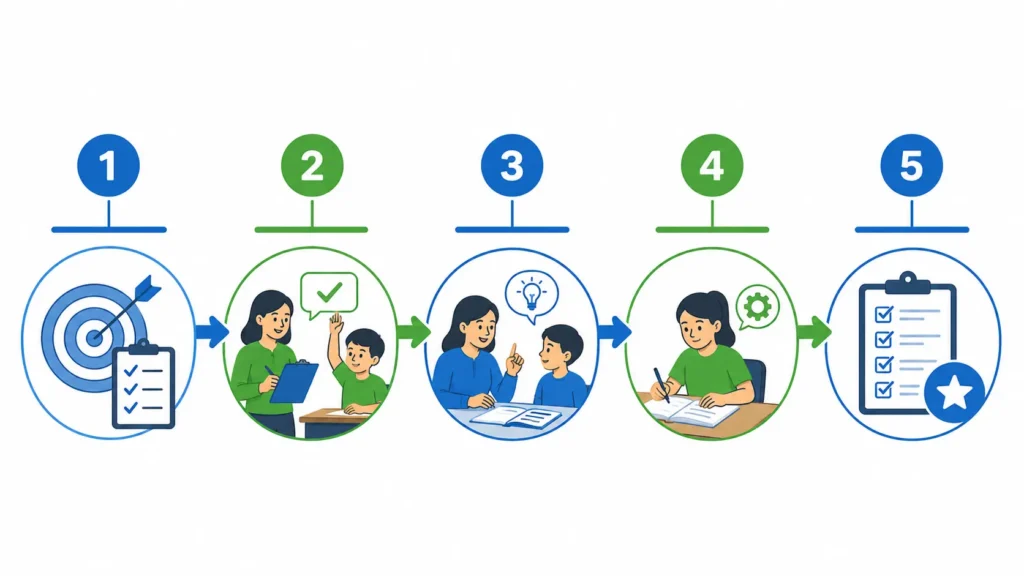
Use a rubric or clear scoring guide. Then review the results to plan future instruction.
How Can Digital Learning Tools Support Formative Assessment?
Digital learning tools can make it easier to collect quick feedback. They may show practice results, quiz answers, progress data, or common errors.
For example, a teacher may use digital practice tools for math, reading, vocabulary, or skill review. Tools like SplashLearn, i-Ready, and Boddle may support practice and progress checks when used as part of a larger lesson plan.
However, data alone is not formative assessment. The teacher must use the results.
A tool becomes more helpful when a teacher asks:
- Which skill caused the most errors?
- Which students need a small group lesson?
- Who is ready for a harder task?
- What should I reteach tomorrow?
- What feedback will help students improve?
Technology can save time, but it should support good teaching. It should not replace teacher feedback, observation, or classroom relationships.
Final Thoughts
Formative vs. summative assessments is not a choice between two competing ideas. Each one has an important role in education.
Formative assessment helps teachers understand student learning while there is still time to help. It gives students useful feedback, supports practice, and helps teachers adjust classroom instruction.
Summative assessment shows what students learned at the end of an instructional unit. It helps teachers measure outcomes, report progress, and review whether learning objectives were met.
The best classrooms use both. Start with clear learning goals. Check understanding often. Give feedback. Provide time to practice. Then use a fair summative assessment to measure what students learned.
For more classroom-friendly education guides and digital learning tool resources, explore Clever Portal US.
FAQs About Formative vs. Summative Assessments
Can formative assessments be graded?
Yes, formative assessments can be graded. However, their main purpose is feedback, not final judgment. A small grade may motivate some students, but the teacher should still use the results to guide instruction and help students improve.
Are exit tickets formative or summative?
Exit tickets are usually formative assessments. Teachers use them at the end of a lesson to check student understanding. They become most useful when the teacher reviews the answers and changes the next lesson based on what students need.
What are common summative assessments?
Common summative assessments include end-of-unit tests, final exams, research papers, final projects, portfolios, presentations, standardized tests, and performance tasks. These assessments usually happen after students have finished learning a topic or unit.
Which is better, formative or summative assessment?
Neither is better by itself. Teachers need both. Formative assessment helps students improve while learning is still happening. Summative assessment shows whether students reached the learning objectives at the end.
What is assessment for learning vs assessment of learning?
Assessment for learning means using assessment to help students improve during instruction. This usually refers to formative assessment. Assessment of learning means measuring what students learned after instruction. This usually refers to summative assessment.
What is a balanced assessment system?
A balanced assessment system uses different types of assessments for different needs. It may include diagnostic assessment before learning, formative assessment during learning, interim assessment for progress checks, and summative assessment after learning.