Active Learning Strategies: The Complete Simple Guide for Teachers
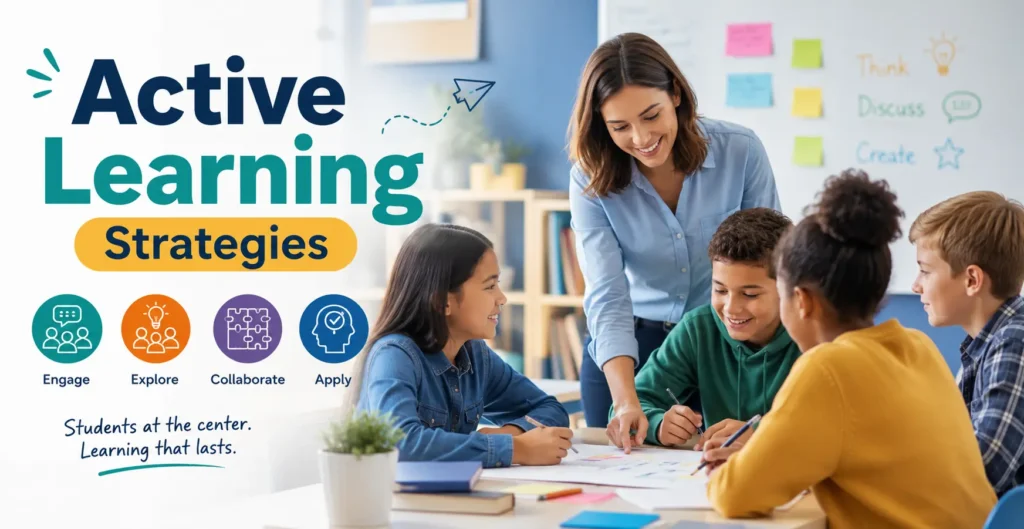
Active learning strategies are teaching methods that ask students to do something with the material they are learning. Instead of just listening to a lecture, students discuss, write, solve problems, or teach each other. Research shows these methods raise test scores by about half a letter grade and cut failure rates by 55 percent. Popular examples include Think-Pair-Share, the Jigsaw Method, and the Muddiest Point. For the best results, start small, match activities to your learning goals, and explain the benefits to your students so they understand why you are asking them to participate.
What Are Active Learning Strategies?
For many years the standard way to teach was simple. The teacher stood at the front of the room and talked. The students sat in rows and listened. They took notes. They tried to memorize the information for the test. This is called passive learning. The student receives information but does not use it during class.
Active learning strategies change this dynamic. These methods require students to engage with the material during class. They must think about what they are hearing. They must talk about it. They must write about it. They must apply it to a problem. The goal is to move students from being passive listeners to active participants in their own education.
This guide breaks down the data behind active learning. It provides a categorized list of the most effective strategies organized by how much class time they take. It also offers a step-by-step framework for putting them into practice. Finally, it addresses the number one challenge teachers face: student resistance. Whether you teach twenty students or two hundred, you will find practical ideas you can use in your next lesson.
Active vs. Passive Learning: What is the Difference?
Understanding the difference between these two approaches is the first step. The core distinction comes down to who is doing the cognitive work.
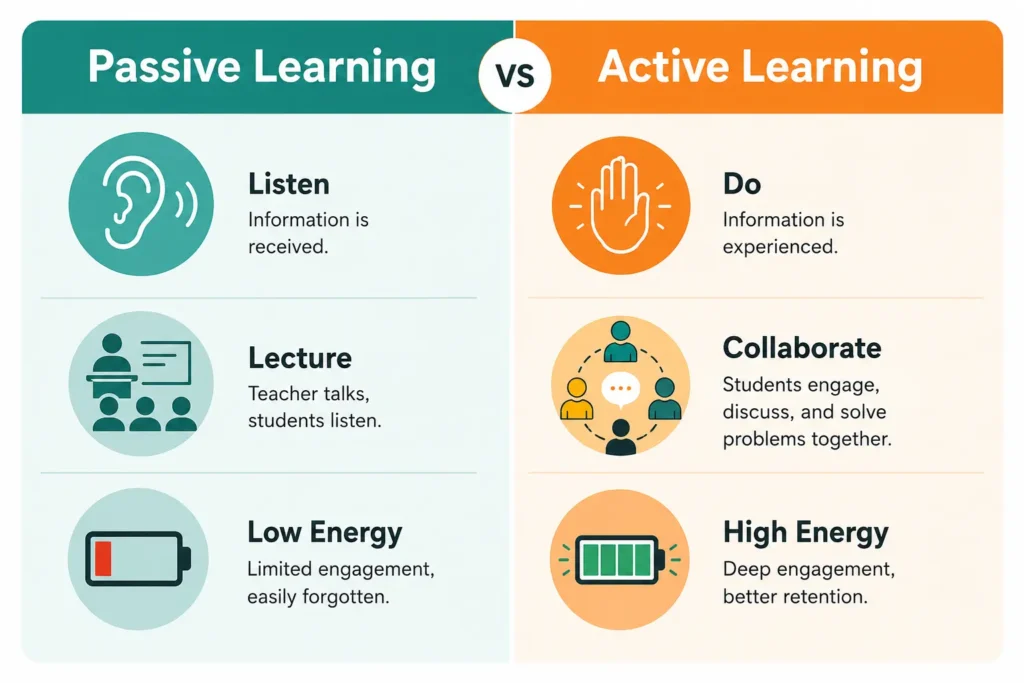
In a passive classroom the teacher does the work. The teacher organizes the material. The teacher explains the concepts. The teacher answers the questions. The student’s job is to absorb the information.
In an active classroom the student does the work. The student organizes the ideas. The student explains the concepts to a peer. The student answers the questions. The student solves the problems. The teacher acts as a guide or a coach.
Here is a quick comparison to help you visualize the difference:
| Feature | Passive Learning | Active Learning |
| Student Role | Receiver of information | Participant in the process |
| Teacher Role | Presenter or lecturer | Facilitator or coach |
| Main Activities | Listening, reading, highlighting | Discussing, writing, solving, creating |
| Cognitive Load | Low during class | High during class |
| Typical Retention | Low (around 10 percent after lecture) | High (up to 75 percent when practicing by doing) |
Passive learning includes listening to a lecture, watching a video without pausing, or reading a textbook chapter without taking notes. Active learning includes debating a topic, working through a case study, building a concept map, or teaching a concept to a classmate.
Both methods have a place in education. A short lecture can efficiently deliver new vocabulary or complex historical context. However, research shows that learning sticks when students immediately do something with that new information. The most effective instructional design often blends short bursts of direct instruction with frequent active learning pauses.
The Research-Backed Benefits of Active Learning
Teachers often ask if active learning is worth the extra planning time. The answer from educational research is a clear yes. The evidence comes from large studies that analyzed hundreds of classrooms.
The most famous study is a meta-analysis published in the Proceedings of the National Academy of Sciences (PNAS) by Scott Freeman and his colleagues in 2014. They looked at 225 studies comparing traditional lecturing to active learning in science, engineering, and math. The findings were striking.
- Higher test scores: Students in active learning classes scored about six percent higher on exams. This is roughly half a letter grade improvement.
- Lower failure rates: Students in traditional lecture classes were 1.5 times more likely to fail. The failure rate in lecture classes averaged almost 34 percent. In active learning classes it dropped to about 22 percent.
- Benefits for everyone: The gains were consistent across all class sizes and all types of institutions.
More recent data from Engageli in 2024 confirms these trends. Their research showed a 54 percent increase in test scores for students in active learning environments compared to traditional lectures. They also found that active learning environments report better attendance and fewer disciplinary issues.
Retention rates tell a powerful story. The Learning Pyramid model, often cited by the National Training Laboratories, suggests students retain only about 10 percent of what they hear in a lecture. They retain about 75 percent of what they learn when they practice by doing. They retain up to 90 percent when they teach the material to someone else.
A fascinating study from Harvard University led by Louis Deslauriers revealed a psychological trap. Students in active learning classes actually learned more. They scored higher on tests. But they felt like they learned less. They reported lower satisfaction because the mental effort was higher. The smooth lecture felt easier. The struggle of active learning felt harder. Understanding this “perception gap” is key to getting student buy-in.
Active learning also promotes equity. Research from the University of Minnesota and a 2024 study in MDPI Education Sciences show that active learning narrows achievement gaps for underrepresented students in STEM fields. When the classroom structure requires everyone to participate, the students who might stay silent in a large lecture are brought into the conversation.
9 Proven Active Learning Strategies Organized by Time Required
One of the biggest barriers for teachers is time. You have a set curriculum to cover. You cannot spend three class periods on one activity. The solution is to match the strategy to the time you have available. Below is a menu of nine proven active learning techniques grouped by the class time they require.
Quick Strategies (Under 5 Minutes) – Lecture Breakers
Use these strategies to break up a long lecture. They reset student attention. They check for understanding. They require almost zero preparation.
1. Think-Pair-Share
This is the gold standard for a reason. It works in any subject. It works in any class size.
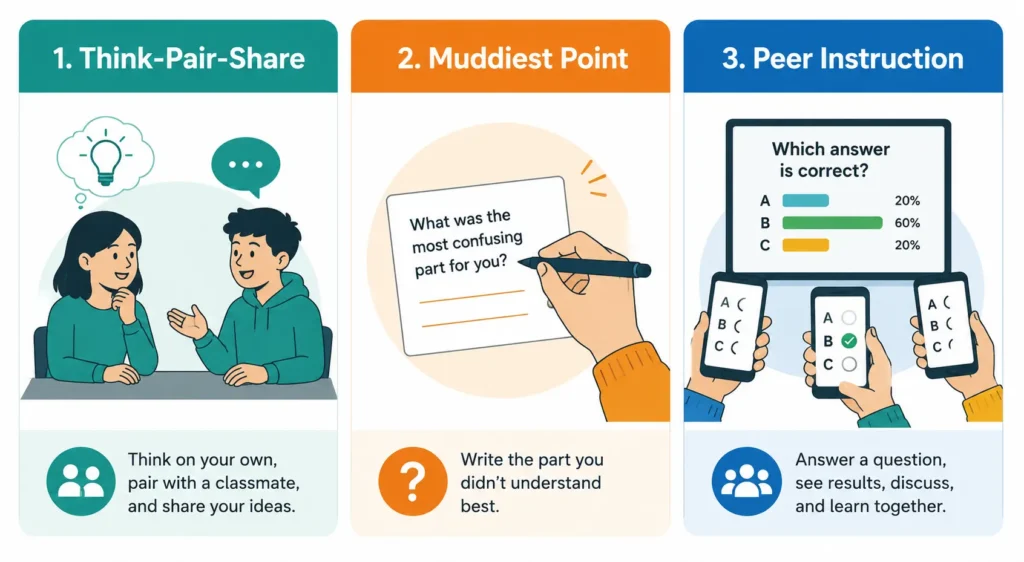
- Think: Pose a specific question. Give students sixty to ninety seconds to think silently and write down their answer.
- Pair: Ask students to turn to a neighbor. They share their answers. They discuss differences. They refine their thinking. This takes two to three minutes.
- Share: Call on a few pairs to summarize their discussion for the whole class.
Why it works: It forces every student to formulate an answer. The pair stage creates a safe space to test ideas before speaking publicly.
2. Muddiest Point or One Minute Paper
At the end of a lesson or right before a break, ask students to write a quick response on a scrap of paper or a digital form.
- Prompt: “What was the most confusing part of today’s lesson?” (Muddiest Point)
- Prompt: “What is the one thing you learned today?” (One Minute Paper)
Collect these as students leave. You get instant formative assessment data. You can start the next class by addressing the top confusion points.
3. Peer Instruction with Polling
This method was popularized by Eric Mazur at Harvard. It uses multiple choice questions.
- Present a conceptual question. Students vote individually using clickers or a phone app like Poll Everywhere or Mentimeter.
- If the class is split (30 to 70 percent correct), do not give the answer. Say “Turn to your neighbor and convince them of your answer.”
- Students discuss for two minutes.
- Vote again. The correct answer percentage almost always jumps.
- Explain the reasoning.
Medium Strategies (10 to 20 Minutes) – Concept Deepeners
Use these when you have a complex concept that students typically struggle to grasp. They replace the “I will just explain it again” approach.
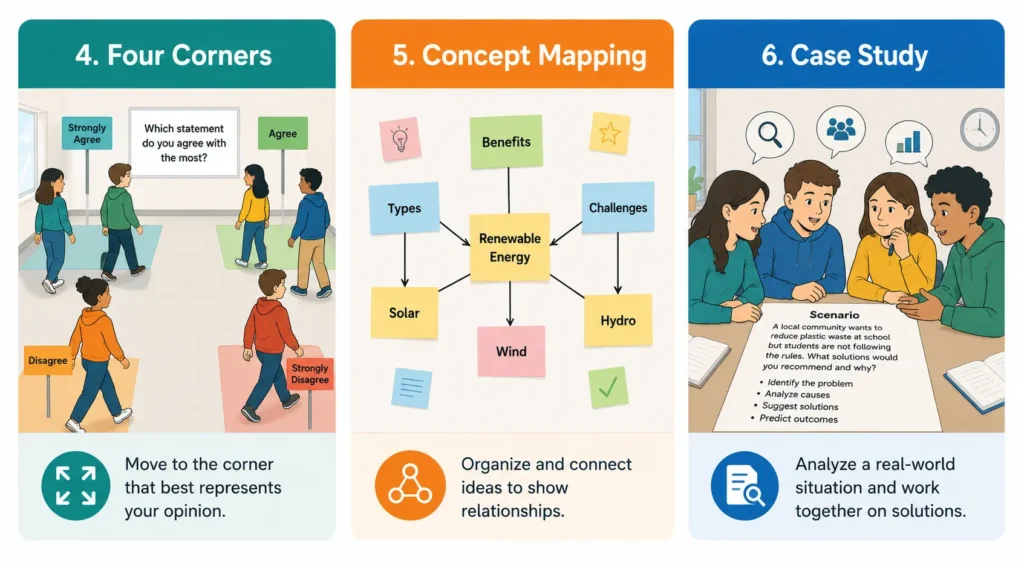
4. Four Corners
This gets students moving. It works well for questions with multiple valid perspectives or distinct answer choices.
- Label the four corners of your room: Strongly Agree, Agree, Disagree, Strongly Disagree (or Option A, B, C, D).
- Read a statement or problem.
- Students walk to the corner that matches their view.
- In their corner groups, they discuss why they chose that spot. They prepare a defense.
- Each corner presents their reasoning. Students can switch corners if persuaded.
5. Concept Mapping
Students often memorize definitions but miss the connections between ideas. Concept mapping makes those connections visible.
- Give students a list of 10 to 15 key terms from the unit.
- Ask them to arrange the terms on a large paper or digital whiteboard (like Miro or Jamboard).
- They draw lines connecting related terms. They write linking words on the lines (for example, “causes,” “leads to,” “is a type of”).
- Students compare maps with a partner or gallery walk to see different structures.
6. Case Study Analysis
Bring the real world into the classroom.
- Provide a short, realistic scenario (a patient case, a business dilemma, a historical turning point).
- Ask small groups to analyze the case using the concepts you just taught.
- Give them specific questions: “What is the problem? What data supports your diagnosis? What would you do first?”
- Debrief by having groups share their decisions.
Advanced Strategies (Full Class Period) – Deep Engagement
These strategies turn the classroom over to the students. They require more setup but yield the highest retention and critical thinking gains.
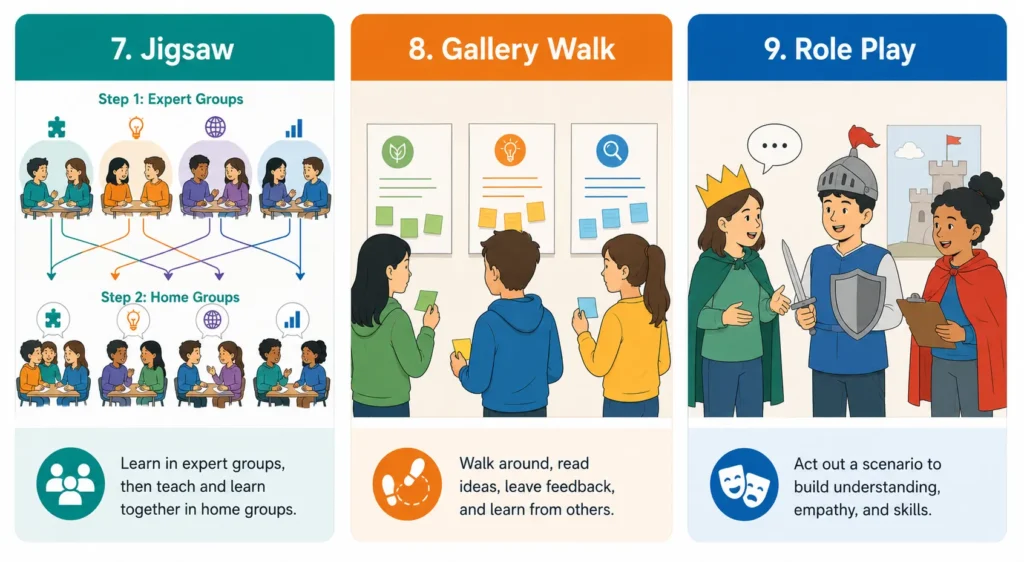
7. The Jigsaw Method
This is the ultimate cooperative learning structure. It builds positive interdependence. Every student is essential.
- Divide a topic into 4 to 5 subtopics (for example, for World War I: Causes, Trench Warfare, Home Front, Technology, Treaty).
- Form “Home Groups” of 4 to 5 students. Each member gets a different subtopic.
- Students leave Home Groups and join “Expert Groups” with everyone who has the same subtopic. They read, discuss, and master the material together. They plan how to teach it.
- Students return to Home Groups. Each expert teaches their piece to the group.
- Assess the whole group on all subtopics.
8. Gallery Walk or Poster Session
Turn student work into the curriculum.
- Groups create a poster, a diagram, or a written solution on large paper or a shared digital slide.
- Post the work on the walls or screens.
- Students rotate silently. They leave sticky note feedback or questions on each piece: “I like…” “I wonder…” “Have you considered…?”
- Groups return to their own work to read feedback and revise.
9. Role Play and Simulation
Students step into a perspective. This builds empathy and forces application of knowledge.
- History: Simulate a constitutional convention.
- Science: Role play a town hall meeting on a local environmental issue.
- Business: Negotiate a contract.
- Language: Act out a marketplace scenario.
Debrief is critical. Connect the emotions and decisions in the simulation back to the academic concepts.
How Do You Implement Active Learning Strategies Successfully?
To implement active learning strategies successfully, educators should start with one simple strategy aligned to a specific learning objective, provide clear instructions and time limits, facilitate actively during the activity, and always close with a class-wide debrief to correct misconceptions and solidify learning.
Knowing the strategies is not enough. You need a reliable process to make them work in your specific classroom. Follow this four step cycle every time.
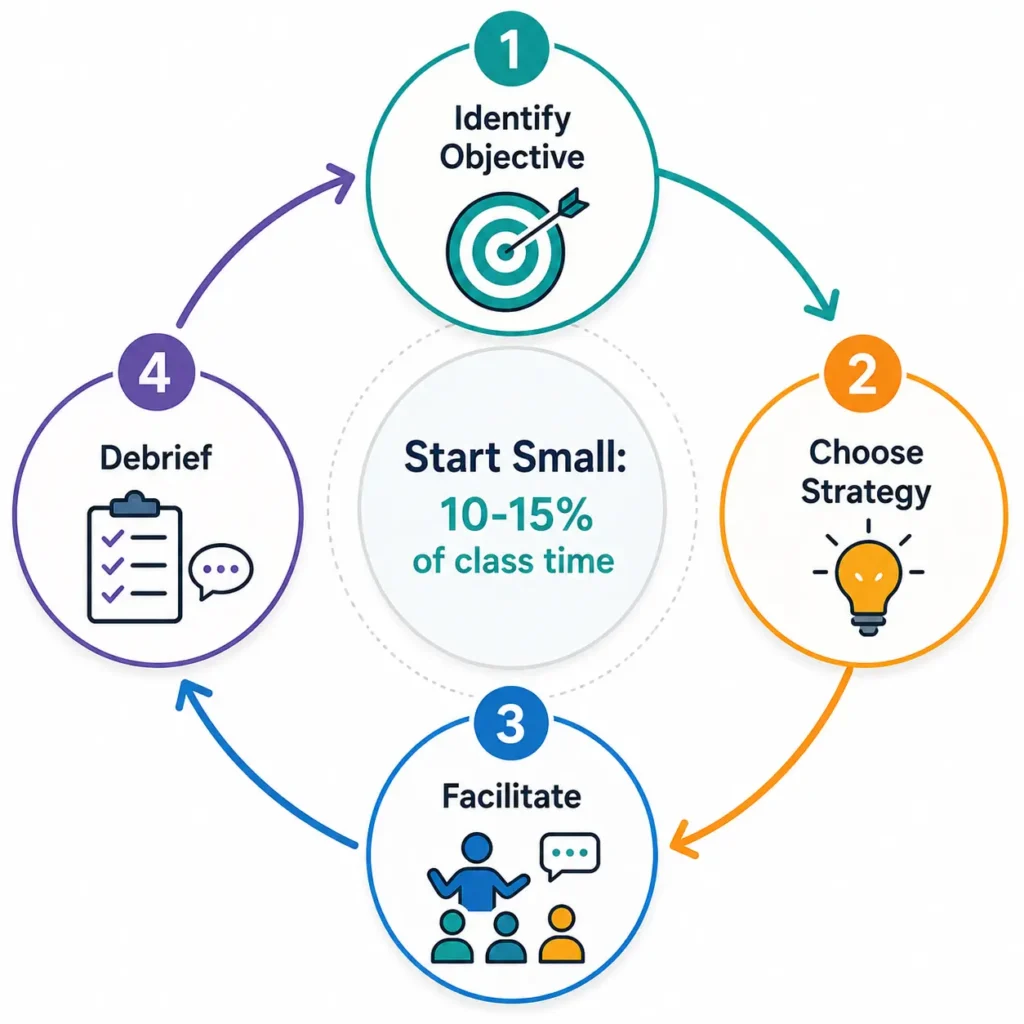
Step 1: Identify the Learning Objective
Do not choose an activity because it looks fun. Choose it because it targets a specific skill or concept.
- Weak: “We have extra time, let’s do a Think-Pair-Share.”
- Strong: “Students struggle to distinguish between correlation and causation. I will use a Four Corners activity with specific scenarios to force them to evaluate evidence.”
Step 2: Choose the Right Strategy
Match the strategy to the cognitive level of your objective using Bloom’s Taxonomy.
- Remember/Understand: Muddiest Point, One Minute Paper, Polling.
- Apply/Analyze: Think-Pair-Share, Case Study, Concept Mapping.
- Evaluate/Create: Jigsaw, Gallery Walk, Role Play, Debate.
Consider your logistics. If you have fixed stadium seating, Jigsaw is hard. Think-Pair-Share is easy. If you have 300 students, Gallery Walk is chaos. Digital polling works great.
Step 3: Facilitate the Logistics
The biggest failure point is unclear instructions. Students cannot engage if they are confused about the task.
- Write the prompt on the board or slide. Do not just say it.
- Specify the product. “Write one sentence.” “Draw a diagram.” “List three reasons.”
- Set a visible timer. Project a countdown clock. It creates urgency and fairness.
- Circulate. Do not sit at your desk. Listen to conversations. Nudge stalled groups. Answer questions with questions (“What does the text say about that?”).
Step 4: Debrief with Purpose
Never skip the debrief. If you run out of time, cut the activity short, but keep the debrief.
- Synthesize. Ask groups to report key takeaways.
- Correct. Address misconceptions you heard while circulating.
- Connect. Explicitly link the activity back to the learning objective and the next assessment. “This is exactly the kind of analysis Question 3 on the exam will require.”
Start Small Tip: Research by Freeman suggests that converting just 10 to 15 percent of lecture time to active learning yields measurable gains. You do not need to flip your whole course tomorrow. Replace one ten minute lecture segment with a Think-Pair-Share next week. Build from there.
How to Overcome Student Resistance to Active Learning
You introduce a Think-Pair-Share. You hear groans. “Can’t you just tell us the answer?” “Why do we have to do the work?” This is normal. It is not a sign you are failing. It is a sign the strategy is working.
The Harvard study by Deslauriers explains why. Active learning feels harder. The brain has to work. That effort feels like frustration. Students interpret “this feels hard” as “I am not learning.” In a smooth lecture, the teacher does the cognitive heavy lifting. The student feels smart because they understand the teacher’s explanation. But that understanding is often an illusion.
Here is how to turn resistance into buy-in.
Be Transparent About the Science
On day one, share the data. “I use these methods because a massive study of 225 classes found students in traditional lectures were 55 percent more likely to fail. I want you to pass. That is why we do this.” Show them the Freeman graph. Treat them like partners in the process.
Teach the Concept of Desirable Difficulty
Explain that the struggle is the learning. Use the analogy of the gym. Watching a personal trainer lift weights does not build your muscles. You have to lift the weights yourself. The confusion during a Jigsaw activity is the muscle burning. It means growth is happening.
Grade the Process, Not Just the Correctness
If students fear a wrong answer hurts their grade, they will disengage. Make active learning participation low stakes.
- Give credit for the Muddiest Point card just for turning it in.
- Use a simple rubric for group work: “Contributed idea? Yes/No. Listened to peers? Yes/No.”
- Let the debrief be the safe space to be wrong. “Great wrong answer. Let’s unpack why that is a common trap.”
Establish Psychological Safety
Set ground rules for discussion on day one.
- Critique ideas, not people.
- One voice at a time.
- “I don’t know” is a valid starting point.
When students trust that the classroom is safe, they take the intellectual risks active learning requires.
Use Student Feedback Loops
Mid-semester, ask: “What active learning activity helped you the most? Which one felt like a waste of time?” Adjust based on their input. They will respect the methods more if they see you listening.
Final Thoughts
Active learning strategies are not a trend. They are a response to decades of cognitive science telling us how the human brain actually learns. The brain learns by doing. It learns by connecting new information to old knowledge. It learns by explaining, by struggling, and by teaching.
You do not have to choose between covering content and using active learning. You choose between presenting content and ensuring learning. The strategies in this guide, Think-Pair-Share, Jigsaw, Muddiest Point, Concept Mapping, and the rest, are tools. Pick one. Try it this week. See how the energy in the room changes. See how the questions get deeper.
If you want to understand how these strategies fit into the bigger picture of instructional design, read our guide on the core principles of teaching. It connects these daily tactics to the long term goals of effective education.
Frequently Asked Questions
What are the best active learning strategies for higher education?
In large lecture halls, quick strategies work best because they require no furniture moving. Think-Pair-Share, digital polling for Peer Instruction, and the Muddiest Point scale easily to 200 or 300 students. They break the anonymity of the big room.
How much class time should be active learning?
There is no magic number. Research shows benefits from converting just 10 to 15 percent of lecture time. A common model is the “10 and 2” rule. Teach for ten minutes. Pause for two minutes of activity. Repeat.
Does active learning take away from content coverage?
It takes more class minutes to run an activity than to lecture the same material. However, students retain significantly more. You spend less time re-teaching later. The net result is often better coverage of the important concepts.
What is the easiest active learning strategy for beginners?
Think-Pair-Share. It requires zero materials. It takes three to five minutes. It works on the first try. It builds the habit of student talk without high risk.
How do you grade active learning participation?
Keep it simple. Use a participation log or a simple check system. Did they submit the One Minute Paper? Check. Did they contribute in the pair discussion? Check. Avoid grading the correctness of the ideas generated during the learning phase. Save correctness for summative exams.
Can active learning work in online or hybrid classes?
Yes. Digital tools make some strategies easier.
- Think-Pair-Share: Use Breakout Rooms in Zoom or Teams.
- Muddiest Point: Use a Google Form or the chat.
- Jigsaw: Assign Expert Groups to separate Breakout Rooms, then reshuffle into Home Groups.
- Gallery Walk: Use a shared Google Slides deck where each group gets one slide. Students leave comments on slides.