Dramatization Method Advantages: Why It Works So Well in the Classroom
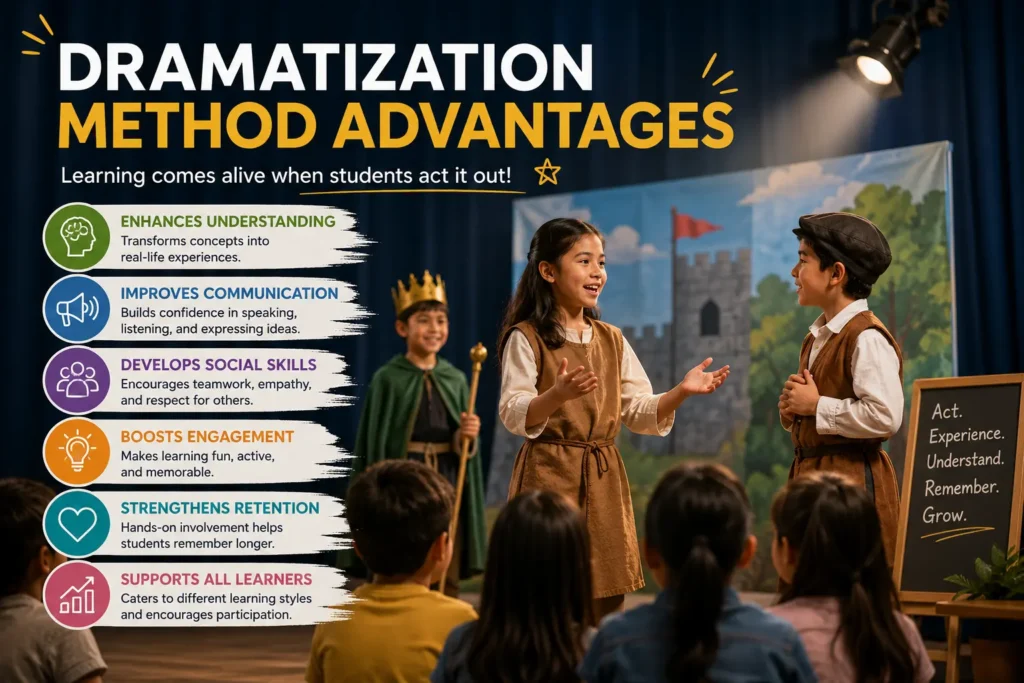
The dramatization method gives students a powerful way to learn by doing. Instead of sitting and listening, students act out lessons, take on roles, and bring ideas to life. This builds stronger memory, better communication skills, and deeper understanding. Research shows it supports visual, auditory, and kinesthetic learners all at once. The advantages of the dramatization method make it one of the most effective student-centered teaching approaches available today.
Most students forget a lecture within 24 hours. But they rarely forget a scene they performed. That gap is exactly why so many teachers are turning to the dramatization method in their classrooms. When students act out a lesson instead of just reading about it, the content sticks. This article breaks down the key advantages of the dramatization method of teaching, explains why each benefit works, and shows how teachers can use them right away.
What Is the Dramatization Method?
The dramatization method is a teaching approach where students act out events, ideas, or situations to better understand them. It uses role-playing, storytelling, and performance to make learning active. The goal is not to put on a theater show. The goal is to make lessons more effective by helping students learn through experience.
It is a form of experiential learning that puts students at the center of their own education. Instead of passive listening, students speak, move, react, and respond. This makes the dramatization teaching method different from most traditional classroom approaches.
For a deeper look at how this method is structured, visit our full guide on the dramatization method.
Why Does the Dramatization Method Work in the Classroom?
The dramatization method works because it activates multiple senses and mental processes at the same time. When a student acts out a scene, they use their voice, body, memory, and emotions together. This kind of multi-sensory learning creates much stronger connections in the brain than reading alone.
Research from Hacettepe University confirms that using drama as an educational method supports students developmental outcomes in meaningful ways. Students do not just hear information. They live it. That is what makes the role of dramatization in learning so powerful across all age groups and subject areas.
Advantage 1: Boosts Student Engagement and Classroom Participation
One of the biggest advantages of the dramatization method is how quickly it grabs student attention. When a lesson involves movement, voice, and performance, students stop being passive observers. They become active contributors.
A study found 100% student engagement in drama-based learning activities. That number is hard to match with any other approach. Students who struggle to focus during traditional lectures often thrive when they have a role to play. They feel a sense of ownership over the lesson.
This boost in classroom participation is especially helpful for students who are shy, bored, or disengaged. The dramatization method gives them a reason to show up and take part. Teachers can start small, with short improvisation scenes before introducing a new topic, and build from there.
Active learning research also supports this. The three core components of active learning are engagement, reflection, and application. Dramatization delivers all three in a single activity.
Advantage 2: Strengthens Memory and Retention
Dramatization significantly improves memory and retention because it creates what researchers call episodic memory. This is the type of memory formed through personal experience. When a student enacts a scene, they store the lesson through movement, emotion, and narrative all at the same time. This produces much stronger and more lasting memory than passive note-taking.
Think of it this way. A student who reads about a historical event may forget the details by next week. A student who acted out that same event, taking on a role and speaking the words, is far less likely to forget it. Dramatized events are rarely forgotten.
This makes dramatization in education especially valuable for subjects where long-term retention matters, such as history, literature, and social studies. The method turns abstract content into a personal lived experience. That experience becomes part of the student’s own memory.
Acting also engages Bloom’s higher-order thinking levels, including analysis, application, and synthesis. Students do not just recall facts. They interpret them, embody them, and express them. That level of cognitive engagement is what drives strong retention and memory in learning.
Advantage 3: Develops Communication and Language Skills
The dramatization method is one of the best tools for building communication and language skills. Students are placed in realistic situations where they must speak clearly, choose the right words, and express themselves with confidence.
A study from Universidad Nacional Autonoma de Nicaragua found that dramatization improves language fluency, self-confidence, and self-esteem in learners. These are not small gains. They represent a real shift in how students relate to language inside and outside the classroom.
This is especially true for language learners and ESL or EFL students. When students act out a conversation or scene, they use vocabulary and grammar in a natural context. They are not filling in blanks on a worksheet. They are using language to do something real. That authentic use of language is what builds true fluency.
Beyond language classes, this advantage carries over to all subjects. Whether presenting a science experiment as a talk show or debating a historical decision as a character, students practice communication every single time they dramatize.
Advantage 4: Builds Social and Collaborative Skills
Dramatization builds social and collaborative skills by asking students to work together toward a shared goal. They must assign roles, listen to each other, make decisions as a group, and perform together. This process mirrors the kinds of teamwork students will need throughout their lives.
Schools that use the dramatization method reported a 48% increase in collaborative skills among students. That is a significant jump. It shows that when students work through a dramatic task together, they are not just learning the subject. They are learning how to work with other people.
Cooperative learning happens naturally in dramatization activities. Students negotiate, support each other, and solve problems in real time. They also have to listen carefully and respond to what their scene partners say and do. That kind of active listening is a core social-emotional learning skill.
Beyond group skills, dramatization also encourages students to respect different ideas and contributions. Every student brings something different to a scene. That diversity makes the group stronger, and students learn to value it over time.
Advantage 5: Supports Emotional Intelligence and Empathy
One of the most overlooked benefits of drama in the classroom is how it grows emotional intelligence. When students take on a character, they step into someone else’s perspective. They feel what that person might feel. They think about why that person makes certain choices.
This builds empathy in a direct and personal way. Students do not just read about how a historical figure felt during a crisis. They try to understand it from the inside. That kind of perspective-taking is a core part of social-emotional learning.
Research also shows that dramatization provides a safe emotional outlet for children. It reduces stress and aggressive behavior. Students who struggle with emotional regulation often find that acting gives them a healthy way to express what they feel without real-world consequences.
Howard Gardner’s theory of Multiple Intelligences supports this benefit too. Interpersonal intelligence, which is the ability to understand and relate to others, is one of the learning areas that dramatization directly activates. Students with strong interpersonal intelligence often shine during dramatic activities, and students who lack confidence in that area grow through the practice.
Advantage 6: Benefits All Types of Learners
Most teaching methods work well for one type of learner. Dramatization works for all three at the same time. Visual learners, auditory learners, and kinesthetic learners all gain something meaningful from dramatization activities.
Visual learners benefit from watching scenes unfold and seeing emotions and actions play out in front of them. Auditory learners benefit from speaking, listening to dialogue, and hearing tone and expression. Kinesthetic learners benefit most of all, because they get to move, gesture, and physically experience what they are learning.
Researchers Koc and Dikici (2002) identified six types of learning that dramatization supports: movement learning, active learning, social learning, emotional learning, collaborative learning, and discovery learning. Covering all six in one method is a strong sign of how well dramatization fits diverse student needs.
This inclusivity also supports student-centered teaching. The teacher does not have to create six different activities for six different learning styles. One well-designed dramatization task can reach the entire classroom at once.
Advantage 7: Stimulates Creativity and Critical Thinking
Dramatization pushes students to think on their feet. When they improvise, they have to respond to what is happening right now, not what they planned. That real-time problem-solving builds creative thinking in a way that scripted lessons rarely achieve.
According to TeacherAcademy.eu, drama education strengthens creativity, problem-solving, and teamwork in students. These are not just soft skills. They are the same higher-order thinking skills that Bloom’s Taxonomy identifies at the top of the learning pyramid, including analysis, evaluation, and creation.
When a student acts out a moral dilemma or a historical negotiation, they are not just recalling information. They are using that information to make decisions, justify choices, and respond to consequences. That process builds critical thinking in a hands-on way that is very hard to replicate through worksheets or traditional lectures.
Advantage 8: Bridges Abstract Concepts to Real-World Application
Many concepts in school feel far away from real life. History happened long ago. Science processes are invisible. Moral questions feel abstract. Dramatization closes that gap in a way few other methods can.
When students act out a scene from a historical period, they connect emotionally to the people and events involved. When they perform the steps of a scientific process, they experience cause and effect directly. This bridges the lesson from something abstract to something real and personal.
This is one of the most powerful benefits of drama in the classroom for subjects like history, literature, and ethics. The content stops being something in a textbook. It becomes something the student has lived, even if only for a few minutes. That shift in connection leads to deeper understanding and stronger long-term learning outcomes across subject areas.
What Are the Limitations to Be Aware Of?
The dramatization method is highly effective, but it does come with some challenges worth knowing. Preparation takes time. Teachers need to plan the scene, assign roles, and guide students through the activity carefully.
Some students may feel uncomfortable performing in front of others. Not every student is ready to take the stage right away. Teachers can address this by starting with small group scenes rather than full-class performances.
Also, not every topic is a natural fit for dramatization. Purely technical or highly abstract subjects may be harder to translate into dramatic activities. The method works best when there is a human element to the content, such as events, decisions, relationships, or processes.
Knowing these limitations helps teachers plan better and get the most out of the method when they do use it.
Final Thoughts
The answer is clearly yes. The advantages of the dramatization method of teaching go far beyond simple engagement. This approach builds lasting memory, grows language and communication skills, strengthens social and emotional learning, supports every learning style, and develops creativity and critical thinking all at once.
Whether you teach primary school, secondary school, or work with language learners, the benefits of dramatization in education are well-supported by research and real classroom experience. Researchers from Hacettepe University, ETF Open Space, and multiple academic institutions confirm that this student-centered method produces meaningful and measurable results.
The best way to start is small. Pick one lesson where students could act out an event, a process, or a situation. Watch what happens to engagement, participation, and understanding. The results will speak for themselves.
Ready to explore more teaching and learning methods like this one? Browse our full collection of evidence-based strategies built for today’s classrooms.