
How Many Continents Are There in the World?
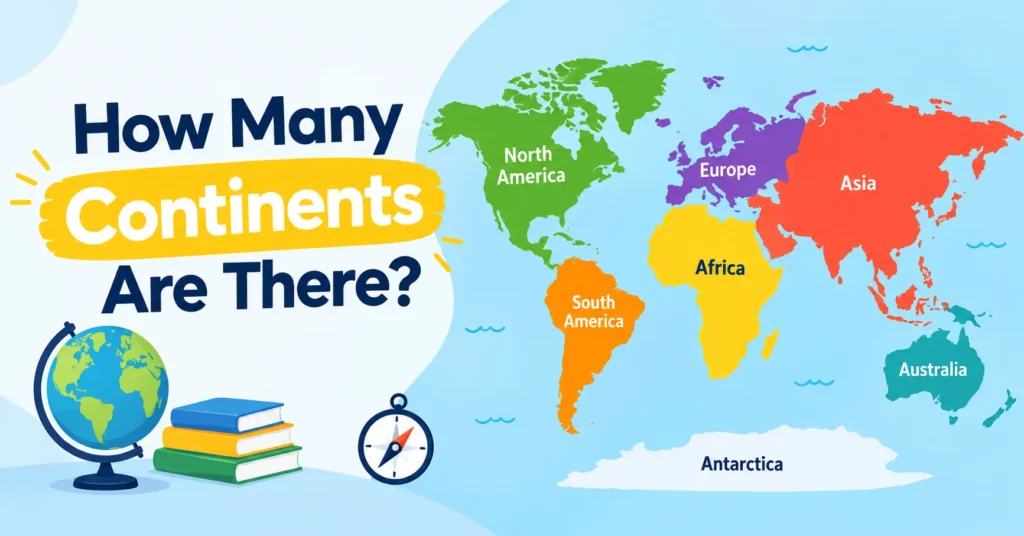
Most schools teach that there are 7 continents: Asia, Africa, Europe, North America, South America, Antarctica, and Australia (also called Oceania). That is the answer used in the United States, the United Kingdom, and China. But not every country agrees. Some places teach 5 or 6 continents instead, and a few scientists argue there could be 8. For most everyday purposes, the answer is 7.
You probably learned a number in school and figured that settled it. Then maybe a friend from another country told you they learned a different number, and now you are not sure who was right. Both of you were right, in a way. The question “how many continents are there” has more than one correct answer, and the reason comes down to how different parts of the world choose to group land. This guide gives you the quick answer first, then walks through why the number changes, what the real data says about each continent, and a few facts that surprise most people, like the story behind Zealandia.
How Many Continents Are There?
Most of the world teaches that there are 7 continents: Asia, Africa, Europe, North America, South America, Antarctica, and Australia (Oceania). This 7-continent model is the standard answer in the United States, China, and most English-speaking countries. It is also the version you will see on most world maps sold in North America.
Here they are, listed simply:
- Asia
- Africa
- Europe
- North America
- South America
- Antarctica
- Australia (Oceania)
That said, this is not the only accepted answer. Depending on where you grew up, you may have learned 5 or 6 continents instead. We will get into why below.
What Is a Continent, Exactly?
A continent is a very large, connected area of land. That sounds simple, but there is no single scientific group that decides where one continent ends and another begins. The lines we use today come mostly from history and culture, not strict geology.
Some experts look at tectonic plates, the giant slabs of rock that make up the Earth’s crust and slowly move over time. Others look at a landmass and its continental shelf, the underwater edge of land that surrounds it. Still others just go by what people have been taught for generations.
This is exactly why the continent count is not fixed. There is no world authority that can say one number is the only correct one. Different regions settled on different groupings a long time ago, and those groupings stuck.
The 7 Continents of the World, by Population and Size
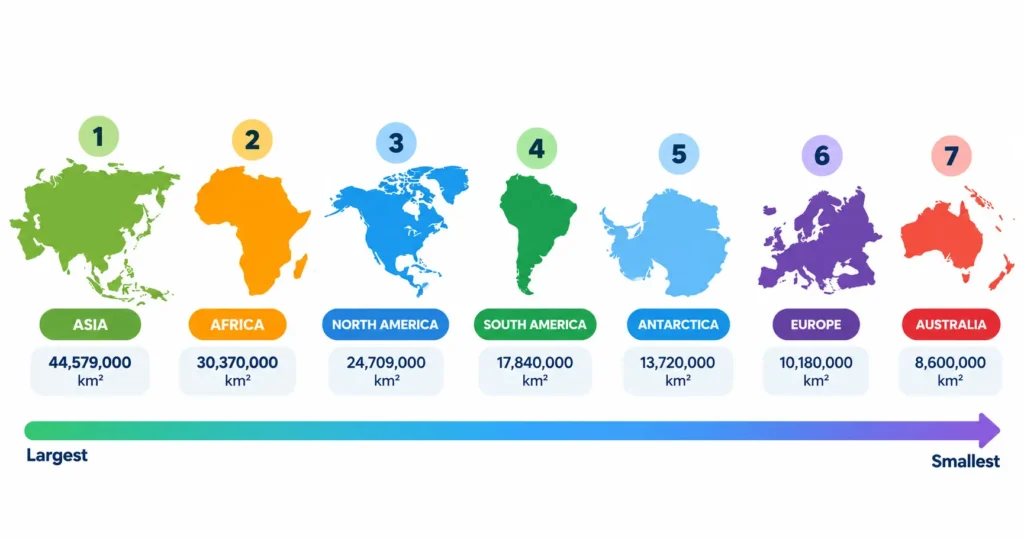
If you want the full picture of the 7 continents, numbers help more than words. Here is how each one compares by population, land area, and share of the world’s people, based on 2026 figures from Worldometer.
| Continent | Population (2026) | Land Area (km²) | Density (people per km²) | Share of World Population |
| Asia | 4,863,327,395 | 31,033,131 | 157 | 58.6% |
| Africa | 1,584,985,258 | 29,648,481 | 53 | 19.1% |
| Europe | 741,646,655 | 22,134,710 | 34 | 8.9% |
| North America | 621,279,953 | 21,330,000 | 29 | 7.5% |
| South America | 440,484,431 | 17,461,112 | 25 | 5.3% |
| Australia/Oceania | 47,118,994 | 8,486,460 | 6 | 0.6% |
| Antarctica | 0 | 13,720,000 | 0 | 0% |
A few things stand out here. Asia is by far the largest continent, both in land area and in the number of people who live there. It holds more than half of everyone on Earth. Australia/Oceania is the smallest continent by land area among the inhabited ones, and Antarctica has no permanent population at all, only scientists who stay for research.
Why Do Some Places Teach 5 or 6 Continents Instead of 7?
This is where most of the confusion starts, so let’s break it down clearly.
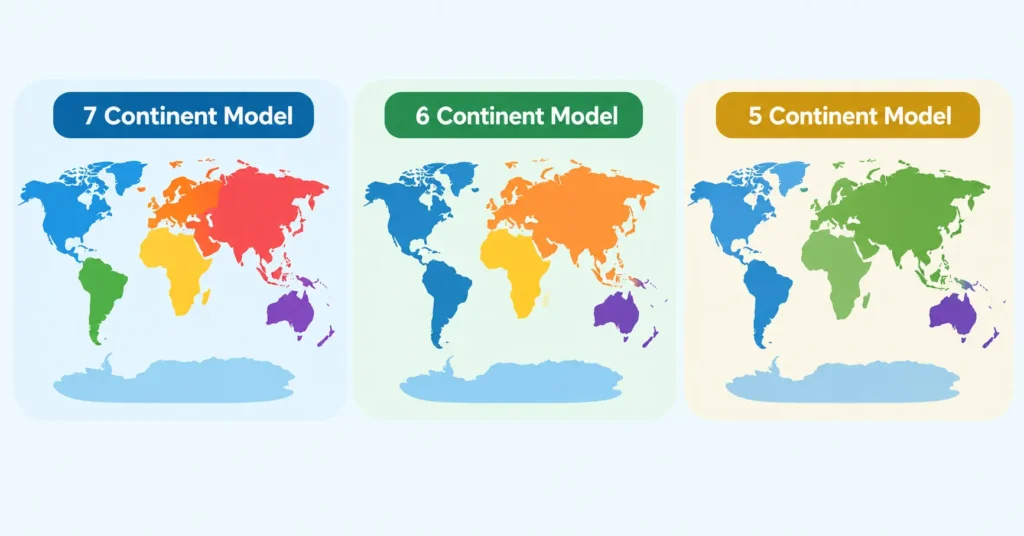
The 6-Continent Models
There are actually two different ways to get to 6 continents, and they group different places together.
The first way combines Europe and Asia into one continent called Eurasia. This makes sense on a map, since Europe and Asia are joined by one uninterrupted landmass. The dividing line people usually point to is the Ural Mountains in Russia, but that line is more of a tradition than a hard geological border. This model is common in Russia, Japan, and parts of Eastern Europe.
The second way combines North America and South America into a single continent called America. The two landmasses are connected by the narrow Isthmus of Panama, so treating them as one continent is not a stretch geographically. This version is taught in parts of Latin America.
The 5-Continent Model
If you combine both mergers at once, joining Europe with Asia and joining North America with South America, you land on 5 continents: Africa, Eurasia, America, Antarctica, and Australia.
There is also a slightly different 5-continent idea that many people recognize without realizing it: the Olympic rings. The five rings represent the five inhabited continents at the time the symbol was created: Africa, Asia, America, Europe, and Oceania. In this version, Antarctica is left out entirely since no country calls it home.
Here is a simple side-by-side view of the models:
| Model | Continents Included | Where It Is Common |
| 7 continents | Asia, Africa, Europe, North America, South America, Antarctica, Australia/Oceania | United States, United Kingdom, China |
| 6 continents (Eurasia version) | Eurasia, Africa, North America, South America, Antarctica, Australia | Russia, Japan, parts of Eastern Europe |
| 6 continents (combined America) | Africa, Europe, Asia, America, Antarctica, Australia | Parts of Latin America |
| 5 continents | Africa, Eurasia, America, Antarctica, Australia | Occasional academic use |
| 5 continents (Olympic rings) | Africa, Asia, America, Europe, Oceania | Symbolic, not academic |
Some geographers push the number even lower. Since Africa and Asia are joined near the Isthmus of Suez, and since the two Americas are joined near Panama, a few argue that most of Earth’s land is really just one giant connected mass plus Antarctica. It is a fair point, even if most schools do not teach it that way.
Is There an 8th Continent?
Yes, at least according to some scientists. In 2017, a group of geologists proposed that a mostly underwater landmass in the Southern Hemisphere, named Zealandia, should count as Earth’s 8th continent. New Zealand sits on the small part of Zealandia that pokes above the water.
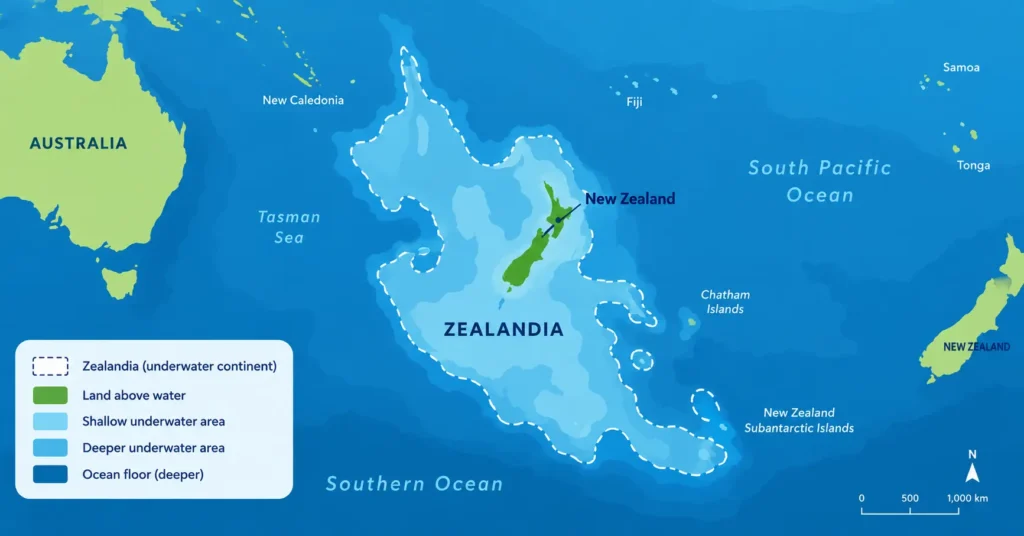
The case for Zealandia rests on the same rules geologists use to define any continent: it has its own continental crust, it is a large connected area, and it is clearly separated from Australia by deep ocean floor rather than a shallow continental shelf. Most of Zealandia is simply too far under the sea for people to notice it as land.
Zealandia has not been added to school textbooks or official government lists yet, but it keeps coming up in geography discussions and science reporting, so it is worth knowing about even if the 7-continent model remains the common answer for now.
How Many Countries Are on Each Continent?
Continents are not just about land, they are also home to a very different number of countries each. Here is a list of continents and countries based on recent country-count data.
| Continent | Number of Countries |
| Africa | 54 |
| Europe | 51 |
| Asia | 49 |
| North America | 23 |
| Oceania | 14 |
| South America | 12 |
| Antarctica | 0 |
Africa has more countries than any other continent, even though it is smaller than Asia in both land area and population. Antarctica has no countries at all, since no nation is allowed to claim ownership of it under an international treaty that keeps it open for scientific research only.
You may notice these numbers do not perfectly match a strict count of United Nations member states. That is because a handful of countries, like Russia, Turkey, and Kazakhstan, sit across two continents at once. For counting purposes, each of these countries is usually placed on whichever continent holds most of its land or population.
Continents vs. Regions: Common Points of Confusion
A few places on the map trip people up almost every time this topic comes up.
Take Russia. Its territory stretches across both Europe and Asia, split roughly along the Ural Mountains. About three out of every four Russians live on the European side, even though most of the country’s land area sits in Asia. For simple country lists, Russia is usually grouped under Europe.
Then there is Hawaii. Many people assume it belongs to North America since it is part of the United States. Politically, that is correct. Geographically, Hawaii is a set of volcanic islands out in the Pacific Ocean and is not part of any continent’s landmass.
Countries like Turkey, Egypt, and Kazakhstan face a similar situation. Small parts of their territory sit on one continent while the majority sits on another. These are usually called transcontinental countries, and mapmakers just pick one continent for simplicity, even though the real geography is a bit messier.
Will the Number of Continents Ever Change?
Over a human lifetime, no. Over millions of years, almost certainly yes.
Continents sit on tectonic plates, and those plates drift at a slow but steady pace, roughly one inch, or about 2.5 centimeters, every year. That does not sound like much, but given enough time, it adds up to entire landmasses moving, splitting, and joining together.
This has already happened once on a massive scale. Around 300 million years ago, nearly all of Earth’s land was joined into one supercontinent called Pangaea. Over time, Pangaea broke apart into the separate continents we recognize today.
Some geologists argue this process never really stopped. Since North America connects to Asia through the narrow Bering Strait area, and Africa connects to Asia near the Isthmus of Suez, they say most of today’s “separate” continents are already touching in some form, with Antarctica being the true outlier standing on its own. It is a reminder that continents are less like fixed puzzle pieces and more like a very slow-moving picture that is still being redrawn.
A Quick Recap
The honest answer to how many continents are there is that it depends on where you were taught, but 7 is the most widely used answer around the world today: Asia, Africa, Europe, North America, South America, Antarctica, and Australia/Oceania. Five and six-continent models exist too, and a growing number of scientists talk about Zealandia as a possible 8th. None of these answers are wrong. They are just different ways of drawing lines on the same planet.
If you found this useful for a school project or a lesson plan, you might also like our guides on types of education and learning styles, which cover other foundational topics students and teachers search for often.
Frequently Asked Questions
What are the 7 continents of the world?
The 7 continents are Asia, Africa, Europe, North America, South America, Antarctica, and Australia (also called Oceania). This is the model most commonly taught in the United States, the United Kingdom, and China.
Is it 5, 6, or 7 continents?
All three counts are used somewhere in the world. Seven is most common in English-speaking countries. Six comes from merging either Europe and Asia, or North and South America. Five comes from merging both pairs at once.
Why do Europe and Asia count as separate continents if they share the same landmass?
The split is based on history and culture more than strict geography. The Ural Mountains are commonly used as the dividing line, even though the two areas are physically connected.
Is Zealandia really the 8th continent?
Some geologists proposed it in 2017 based on the same rules used to define any continent, including its own continental crust. It has not been officially adopted everywhere, so most sources still stick with 7 for now.
What is the smallest continent in the world?
Australia/Oceania is the smallest continent by land area, even smaller than Europe.
What continent is Russia part of?
Russia sits across both Europe and Asia, divided along the Ural Mountains. Most country lists place it under Europe, since most of its population lives on that side.
How many countries are on each continent?
Africa has the most countries at 54, followed by Europe with 51 and Asia with 49. Antarctica has none, since no country is allowed to claim territory there.