Dramatization Method in Teaching: Definition, Steps and Types
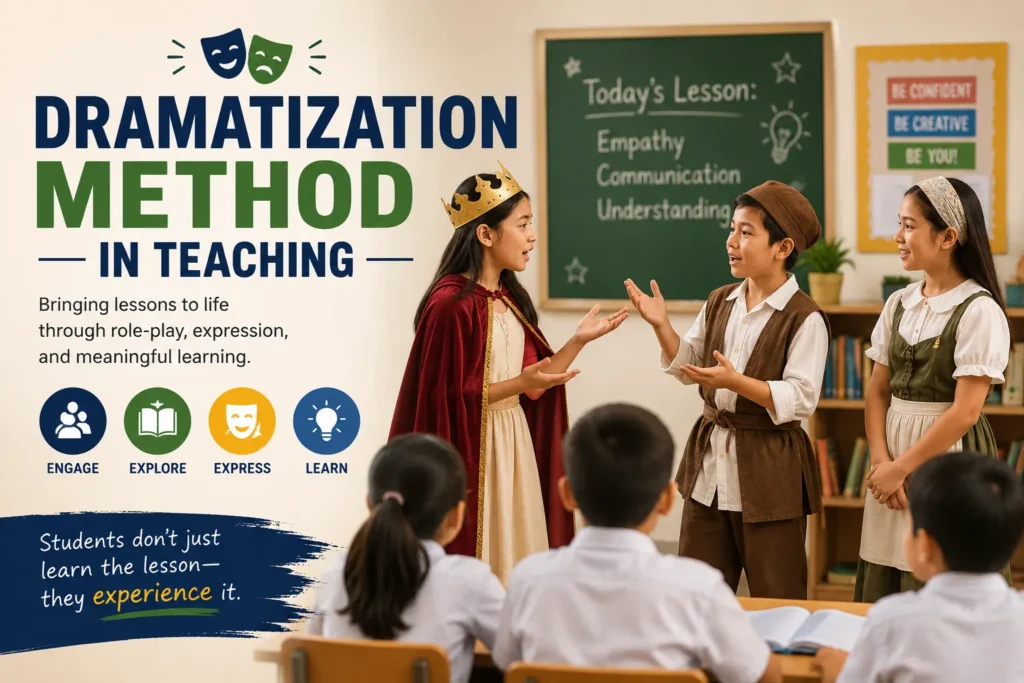
The dramatization method is a structured teaching strategy in which students enact situations, characters, or events to learn through direct experience. Rooted in the principle of learning by doing, it follows three core stages: preparation and warm-up, enactment, and evaluation. It is used across history, language arts, and social studies to increase student engagement, build communication skills, and improve learning retention across all age groups.
Most students forget what they hear within 24 hours. But when they act it out, feel it, and experience it in the classroom, the learning stays with them. That is exactly what the dramatization method in teaching is designed to do. This guide explains what the dramatization method is, how it works step by step, what types exist, which subjects benefit most, and how it compares to role play. Whether you are a student teacher, a classroom educator, or a curriculum designer, this article gives you everything you need to understand and use this method with confidence.
What Is the Dramatization Method?
The dramatization method is a teaching approach in which learners enact feelings, situations, or events before a group. Derived from the Greek word “drama,” which means “to do” or “to act,” it turns passive learning into active, embodied experience. The goal is not theatrical performance. The goal is deeper understanding through participation.
According to the KÜRE Encyclopedia, dramatization in education is defined as “the enactment of a feeling, thought, situation, problem, or event before a group.” Students participate not by sitting and listening but by physically expressing a concept through movement, voice, facial expression, and speech. This activates multiple senses at once, which strengthens both the efficiency and the permanence of learning.
The ETF (European Training Foundation) describes dramatization as “an attempt of one or more people to act as if they were someone else at a specific time, in a specific situation and in a specific place.” This makes dramatization in education a deeply experiential learning tool. It belongs to the broader family of constructivist teaching methods, where learning is built through experience rather than delivered through lectures.
Researchers Koc and Dikici (2002) found that dramatization provides learners with all learning styles simultaneously, including movement-based learning, social learning, emotional learning, collaborative learning, and learning by discovery. That is what makes the drama method of teaching so valuable in diverse classrooms.
Is Dramatization the Same as Theater Education?
No. Dramatization and theater education are two different things. Theater education focuses on artistic performance, stage craft, and dramatic expression as an art form. The dramatization method uses dramatic structure as a tool for learning content that has nothing to do with drama itself. A science teacher using dramatization to teach photosynthesis is using it as a learning strategy, not staging a performance. This distinction matters because many teachers hesitate to use dramatization thinking they need acting skills. They do not.
What Are the Types of Dramatization in Teaching?
Dramatization takes several forms in the classroom, each suited to different learning objectives and student readiness levels. Text-based enactment works well for structured subjects, while improvisation in education builds creativity and spontaneous communication skills.
Here are the five main types:
| Type | Description | Best Use Case |
| Scripted Enactment | Students follow a pre-written script | Literature, history, language arts |
| Improvisation | Unscripted, theme-guided creative acting | Creative drama, EFL speaking practice |
| Puppet Drama | Students use puppets to enact characters | Early childhood, primary education |
| Mime or Shadow Play | Physical expression without words | Vocabulary development, kinesthetic learners |
| Role Play in Education | Students assume specific personas in a scenario | Social studies, ELT, conflict resolution |
Each type supports active learning in a different way. Scripted enactment helps students internalize a text by living it. Improvisation builds spontaneous language use, which is especially powerful in language acquisition classrooms. Puppet drama is ideal for young learners who may feel too shy to perform directly. Mime encourages students to communicate without relying on words, which strengthens body language awareness. Role play in education asks students to step into a viewpoint different from their own, which builds both critical thinking and empathy.
The choice of type should match the lesson objective. For enactment-based learning in a history class, scripted drama gives students a clear framework. For developing spoken English in an EFL class, improvisation and role play produce the strongest results.
What Are the Steps of the Dramatization Method?
The dramatization method steps follow a clear, structured process that moves from preparation through performance to reflection. Each stage has a specific purpose, and skipping any stage weakens the learning outcome.
Step 1: Select the Topic
The teacher chooses a topic or theme that connects directly to the curriculum. The topic should be meaningful, relatable, and appropriate for the age group. For dramatization method examples in a history class, a teacher might choose a key moment from a historical event. In a language class, a topic like “ordering food at a restaurant” gives students a real-world context to act within.
Step 2: Select Students and Assign Roles
The teacher selects students and assigns roles based on personality, interest, and ability. Every student should receive a role, including background characters and narrators, so that all learners stay actively involved. McCaslin (1981) emphasized that fair role assignment is a foundation of successful creative drama. Students who feel left out disengage quickly.
Step 3: Preparation and Warm-Up Activities
This is where the learning environment is set up for success. Warm-up activities help students relax physically and mentally, build group trust, and shift into a creative mindset. Music, rhythm, breathing exercises, and simple movement games are all effective warm-up tools. The ETF recommends that teachers plan and adapt the space, furniture, and equipment before this stage begins, and support the activity with short video examples where helpful.
The warm-up is not optional. Without it, students feel awkward and self-conscious. A good warm-up breaks that barrier and builds the psychological safety that enactment-based learning requires.
Step 4: Script Preparation or Improvisation Planning
At this stage, students either work from a provided script or prepare their own with teacher guidance. In improvisation, the teacher defines the theme and situation but does not write the dialogue. Students create it themselves. The SCERT West Bengal Best Practices document recommends giving student groups short worksheets to write a maximum five-minute script before performance. This builds ownership of the content and deepens engagement.
Step 5: Rehearsal and Practice
Students rehearse their roles before performing. This is where cooperative learning happens most naturally. Students give each other feedback, adjust their delivery, and refine how they express emotions through movement and speech. The teacher monitors the activity and provides support without taking over.
Step 6: Performance or Enactment
Students perform before the class. This is the core stage of the dramatization method in teaching. The audience is not passive. They observe carefully because they know they will participate in the evaluation stage immediately after. Teachers should consider recording the performance so that students can review it during the discussion phase.
Step 7: Evaluation and Discussion
The evaluation stage is where the real consolidation of learning happens. The teacher leads a structured discussion using open-ended questions. What did students notice? What did they feel? What did they learn from watching or playing their role? According to the KÜRE Encyclopedia, critiques in this stage must always be directed at the enacted role, never at the individual student. This protects trust and keeps the learning environment safe.
The ETF recommends designing and distributing rubrics for evaluation before the activity begins, so students know what good performance looks like. After the debrief, teachers can assign group work or home tasks that connect the dramatization to real-world situations outside the classroom.
What Subjects and Age Groups Benefit Most from Dramatization?
Dramatization in education works across subjects and age groups, but some contexts produce especially strong results. The key is matching the type of dramatization to the subject goal.
Language Arts and English Language Teaching (ELT):
The IJLLNET research journal confirms that dramatization is an excellent activity for developing oral skills in a safe classroom environment. In EFL and ESL classrooms, role play and improvisation build speaking fluency, vocabulary, and pronunciation in ways that grammar drills cannot replicate. Students learn language acquisition through real communicative use, not memorization.
History and Social Studies:
Dramatization method examples in history classrooms often involve students re-enacting key events or decisions. SlideShare pedagogy resources describe how students acting out roles from the past make historical experiences feel real and develop emotional attachment to historical figures. This builds critical thinking alongside factual recall.
Preschool and Primary Education:
Research from Hacettepe University shows that drama in education is most widely applied at the preschool level. Young learners benefit greatly from puppet drama and mime, which build foundational language skills, social awareness, and emotional expression without requiring reading or writing ability.
Vocational and Adult Education:
The ETF (European Training Foundation) actively promotes the dramatization method in vocational training programs across Europe. Adult learners use improvisation and role play to simulate workplace scenarios, practice professional communication skills, and develop problem-solving strategies in realistic contexts.
How Does the Dramatization Method Support Student Development?
The dramatization method builds far more than subject knowledge. Research from UNAN confirms that this method develops fluency, richer vocabulary, increased learning motivation, and public speaking confidence simultaneously. It also helps students overcome shyness and strengthen group relations.
The SCERT West Bengal research identifies several developmental benefits that make this method stand out from traditional instruction:
- Active engagement: Students are involved physically and mentally, not just passively receiving information
- Confidence building: Students overcome stage fear and build self-confidence through supported performance
- Creativity: Students design scenarios, write dialogue, and make creative choices during improvisation
- Emotional intelligence in learning: Students explore different roles and emotions, building empathy and emotional awareness
- Cooperative learning: Students work together, depend on each other, and give peer feedback throughout the process
- Cultural awareness: Dramatization brings cultural contexts and historical perspectives to life through experience
Research also indicates that the dramatization method helps students learn academically, socially, and developmentally when used consistently. The combination of enactment-based learning with a structured evaluation stage creates a full cycle: experience, reflection, and meaning-making.
For a full breakdown of the pros and cons of this approach, read the dedicated guide on advantages and disadvantages of the dramatization method.
How Is Dramatization Different from Role Play?
Both dramatization and role play involve students taking on characters, but they are not the same method. Understanding the difference helps teachers choose the right tool for each learning goal.
| Aspect | Dramatization Method | Role Play in Education |
| Scope | Broad, narrative or theme-based | Focused on a specific situation |
| Structure | Formal stages: warm-up, enactment, evaluation | Shorter, less structured |
| Group Size | Larger groups, whole class involvement | Usually dyadic or small groups |
| Duration | Longer activity, often spans a full lesson | Brief, often 5 to 10 minutes |
| Evaluation Stage | Formal, teacher-led discussion required | Informal or absent |
| Script | Often prepared in advance | Usually improvised |
| Primary Focus | Learning through the full experience cycle | Practicing a specific skill or scenario |
Dramatization requires more planning and classroom time but produces a deeper, more complete learning experience. Role play is faster and more flexible, making it ideal for quick skill practice. In an EFL classroom, a teacher might use role play to practice ordering coffee, but use the dramatization method to enact a full scene at a market, with a warm-up, assigned characters, and a group debrief afterward.
What Challenges Do Teachers Face with the Dramatization Method, and How Can They Overcome Them?
The dramatization method in teaching is highly effective, but it does come with practical challenges that teachers should prepare for. Knowing the challenges in advance makes it much easier to manage them.
Challenge: Shy or anxious students refuse to participate.
Solution: Start with low-pressure activities like mime or puppet drama. Build psychological safety gradually through warm-up games before asking students to perform. Assign backstage or narrator roles to hesitant students so they stay involved without pressure.
Challenge: Off-task behavior during rehearsal.
Solution: Give students a specific task and a short time limit for each rehearsal stage. Circulate during practice, monitor group progress, and use the worksheet-based script method to keep focus.
Challenge: Time constraints in a standard lesson period.
Solution: Use shorter improvisation activities rather than scripted performances. The ETF recommends starting with simple, general, and familiar situations before expanding to complex scenarios. Even a 10-minute mini-dramatization with a 5-minute discussion counts as a full learning cycle.
Challenge: Unequal role assignment leading to disengagement.
Solution: Ensure every student has a role, no matter how small. Use background characters, narrators, and stage managers to include everyone. Jendyk (1981) and McCaslin (1981) both emphasize that inclusive role assignment is essential for effective creative drama.
Challenge: Limited classroom space.
Solution: Clear desks and chairs to the sides. Use the front of the room or hallway space. Even a small cleared area is enough for a structured dramatization activity. Teacher-as-facilitator is more important than the physical space.
Final Thoughts: Is the Dramatization Method Right for Your Classroom?
The dramatization method is one of the most powerful teaching tools available to educators today. It combines active learning, cooperative learning, experiential learning, and emotional intelligence development into a single, structured activity. It is not just a drama class strategy. It is a cross-curricular method supported by decades of educational research from institutions including ETF, UNAN, and Hacettepe University.
When students step into a role, they stop being passive receivers of information. They become active participants in the learning process. That shift in ownership produces stronger retention, deeper understanding, and greater classroom participation than most traditional methods can match.
If you are ready to explore more strategies like this one, visit the complete guide to teaching and learning methods to discover other approaches that bring learning to life in your classroom.