Characteristics of Good Teaching: A Complete Guide for Students and Educators
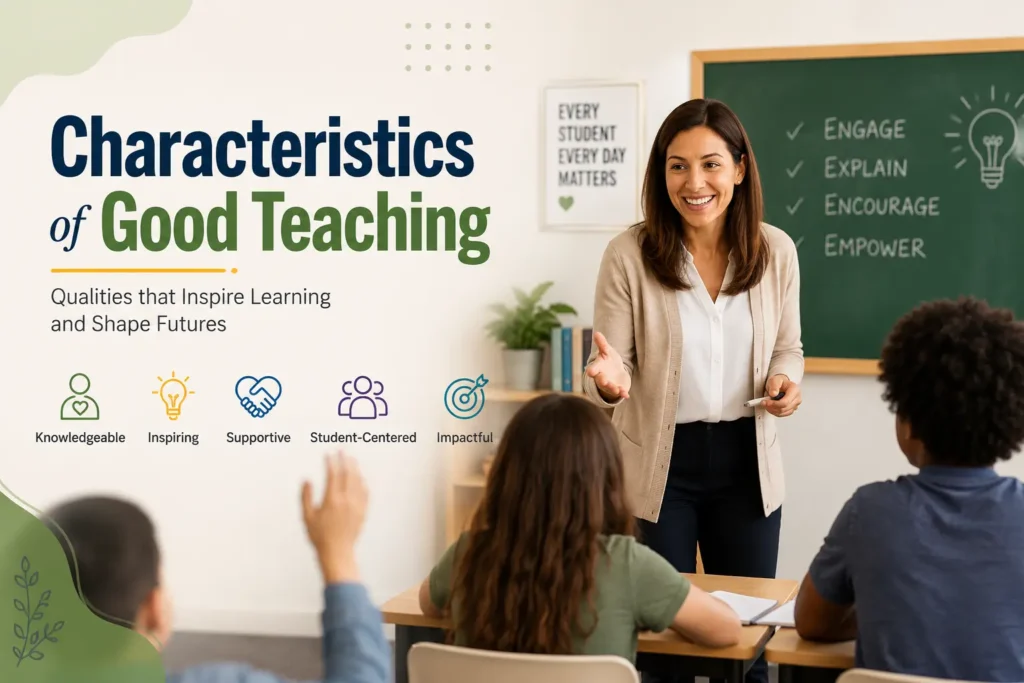
The characteristics of good teaching go far beyond subject knowledge. Effective teaching combines personal qualities, strong instructional strategies, meaningful student relationships, and reflective professional habits. Teachers who demonstrate these characteristics consistently produce better learning outcomes, higher student engagement, and lasting academic growth. This guide breaks down each characteristic in a clear, organized way so students, trainee teachers, and educators have a ready reference grounded in current research.
What Is Good Teaching?
Good teaching is not simply the act of standing in front of a classroom and talking. It is a purposeful, structured process that leads to real student learning outcomes. According to researchers at Harvard Graduate School of Education, a good teacher does three core things: builds caring relationships with students, challenges them to think and reason deeply, and delivers subject matter accurately and clearly.
The key point many people miss is this: the characteristics of good teaching describe a process, not just a personality. Teaching is what a teacher does, step by step, day by day. Good teaching requires both who you are and how you teach to work together.
When these characteristics are present in the classroom, students engage more, learn more, and develop a positive attitude toward education that lasts long after the lesson ends.
Why Do the Characteristics of Good Teaching Matter?
The quality of teaching is the single most important in-school factor that affects how well students learn. Research published by the OECD in April 2025 identified five core teaching goals and twenty evidence-based classroom practices that contribute to high-quality instruction. These findings confirm that effective teaching is not accidental. It is built on specific, learnable characteristics.
A landmark 2025 study from the University of Sydney analyzed 50 indicators of teaching quality. The researchers found that great teachers share a consistent set of personal and professional traits that show up across all grade levels, subjects, and school types. This means the characteristics of good teaching are universal. They apply whether you are a primary school educator, a university lecturer, or a trainee teacher just starting your career.
Understanding these characteristics helps students recognize quality instruction when they experience it. It also helps trainee teachers, B.Ed students, and education professionals develop a clear roadmap for what to build and improve. To understand how these characteristics connect to structured instructional planning, it also helps to study the principles of teaching.
Personal Characteristics of Good Teaching
Personal characteristics are the human qualities a teacher brings into the classroom. They form the foundation that every instructional strategy is built upon.
Patience and Empathy
Patience is one of the most frequently mentioned qualities in education research. A global survey by Pearson found that trusting, compassionate relationships sit at the top of what stakeholders expect from effective teachers. Empathy allows teachers to see the classroom from each student’s perspective. When a student struggles with a concept, a patient and empathetic teacher responds with support rather than frustration.
In practice, this means giving students time to process, asking guiding questions instead of rushing to give answers, and acknowledging that different learners move at different speeds.
Enthusiasm and Passion for the Subject
A study published in PMC found that good teachers are enthusiastic, friendly, and committed to the growth of their students. Enthusiasm is contagious. When a teacher is genuinely excited about what they are teaching, students are more likely to pay attention, participate, and remember the lesson.
Enthusiasm does not mean performing or being loud. It means bringing energy, curiosity, and genuine interest to the subject every single day. This is closely tied to the broader idea of understanding the maxims of teaching, which guide how teachers should approach their craft.
Ethical Conduct and Integrity
Good teaching requires fairness, honesty, and consistency. Teachers who show ethical conduct treat all students equally, give honest feedback, and model the behavior they expect from their students. The University of Sydney’s 2025 study listed ethical behavior as one of the ten core traits of quality teachers.
Students notice when a teacher plays favorites or says one thing and does another. Integrity builds trust, and trust is the soil in which learning grows.
Resilience and Adaptability
No lesson goes perfectly every time. Good teachers bounce back from setbacks, adjust their plans when needed, and keep moving forward. Resilience means staying positive and focused even when classroom management gets difficult or students are unresponsive.
Adaptability goes hand in hand with resilience. It means a teacher can shift from one instructional strategy to another if the first approach is not working. This flexibility is a defining feature of effective teaching across all education levels.
Pedagogical Characteristics of Good Teaching
Pedagogical characteristics are the instructional skills that directly shape how and what students learn. These are the most researched and most impactful characteristics of effective teaching.
Deep Subject Matter Knowledge
A teacher cannot teach what they do not understand. Deep subject matter knowledge allows a teacher to explain concepts clearly, answer student questions accurately, and connect ideas across different topics. Harvard researchers list accurate subject delivery as one of three non-negotiable markers of good teaching.
Importantly, subject knowledge also includes knowing how to teach the subject, not just knowing the subject itself. This is what educational researchers call pedagogical content knowledge, a concept central to how effective educators approach their work.
Clarity of Communication and Explanation
Clear communication is one of the most consistently valued qualities across education research. A study in the International Journal of Practical Design of Learning and Leadership (2025) identified clarity as a core instructional characteristic alongside content knowledge and purposeful assessment.
Good teachers break complex ideas into smaller steps. They use examples, comparisons, and visuals to make abstract concepts concrete. They check for understanding regularly and adjust their language to match the age, background, and experience of their students.
Use of Active Learning Strategies
Good teaching does not rely on lecture alone. Active learning strategies, such as group discussions, problem-solving tasks, peer teaching, and hands-on activities, push students to engage with material rather than just receive it. The Learning Policy Institute’s research review of 35 rigorous studies confirmed that active learning is a core feature of effective instruction and professional development alike.
Benjamin Bloom’s Taxonomy provides a useful framework here. Good teachers design activities that move students up through levels of thinking, from basic recall to analysis, evaluation, and creation.
Differentiated and Inclusive Instruction
Every classroom has students with different backgrounds, learning speeds, and abilities. Good teaching accounts for this diversity. Differentiated instruction means adjusting the content, process, or product of a lesson so that each learner can access and engage with the material.
Lev Vygotsky’s concept of the Zone of Proximal Development (ZPD) is directly relevant here. Good teachers work in the space just beyond what a student can do independently, offering just enough support to move them forward. This approach, sometimes called scaffolding, is a hallmark of quality instruction recognized across cultures and education systems.
The OECD’s 2025 report on unlocking high-quality teaching specifically highlights culturally responsive and inclusive teaching as a modern standard, not an optional extra. Good teachers recognize student backgrounds and adapt their instruction accordingly.
Purposeful Use of Assessment
Assessment in good teaching is not just about giving grades. It is about using information to guide instruction. Good teachers use formative assessment on a regular basis, checking for understanding through questions, observations, exit tickets, and informal feedback during lessons.
A theoretical framework published in 2025 by the International Journal of Practical Design and Learning identified purposeful assessment as one of the three essential pillars of effective teaching, alongside content knowledge and diverse instructional strategies. When assessment is purposeful, students know where they stand, and teachers know what to teach next.
Relational Characteristics of Good Teaching
How Do Teacher-Student Relationships Define Good Teaching?
Relational characteristics refer to the interpersonal skills and behaviors that build trust, respect, and connection between teachers and students. Research from Harvard and Pearson consistently identifies the teacher-student relationship as one of the most powerful drivers of learning outcomes.
John Hattie’s extensive research into visible learning ranked teacher-student relationships among the highest-effect instructional factors. A student who trusts their teacher is more willing to ask questions, take risks, and persist through challenges. A student who does not trust their teacher will disengage, even if the content is interesting.
Building Strong Teacher-Student Relationships
Building strong relationships requires consistency, care, and genuine interest in each student as an individual. Good teachers learn student names quickly. They notice when a student seems frustrated or withdrawn. They celebrate effort, not just achievement.
This characteristic does not require a teacher to be a student’s best friend. It requires a teacher to be a reliable, respectful, and caring adult presence in the classroom. Harvard’s 2025 research confirms that this is one of the three things every good teacher does, without exception.
To understand how these relationships play out across the instructional process, it is useful to explore the phases of the teaching process.
Effective Communication and Active Listening
Communication in good teaching flows in both directions. Good teachers speak clearly, but they also listen actively. They pay attention to what students say, ask follow-up questions, and make students feel that their contributions are valued.
Active listening also means reading non-verbal cues. A confused expression, a reluctant body posture, or an unusually quiet student can all signal that something is not working. Good teachers notice these signals and respond.
Collaboration with Students, Parents, and Colleagues
Good teaching does not happen in isolation. Effective educators collaborate with their colleagues to share strategies and resources. They communicate with parents to support learning at home. They involve students in the learning process by setting shared goals and asking for feedback.
The SNHU list of core teacher qualities highlights collaboration as one of the ten defining characteristics of good teachers. In modern education systems, teaching is increasingly understood as a team effort, not a solo performance.
Professional Characteristics of Good Teaching
Reflective Practice
Good teachers think critically about their own work. After a lesson, they ask themselves: What worked? What did not? What would I do differently next time? This habit of self-evaluation is called reflective practice, a concept John Dewey introduced more than a century ago and one that remains central to teacher education today.
The University of Sydney’s 2025 study listed reflection as one of the ten core traits shared by high-quality teachers. Reflective teachers do not wait for someone else to tell them how to improve. They seek feedback proactively and use it constructively.
Commitment to Professional Development
The best teachers never stop learning. Ongoing professional development keeps educators current with new research, updated curriculum frameworks, and emerging classroom strategies. The Learning Policy Institute’s analysis of effective teacher development found that the most impactful programs involve active learning, collaboration, and modeling of effective practice, not just passive attendance at workshops.
Good teaching in 2025 and 2026 increasingly includes familiarity with research-informed tools, including AI-assisted personalized feedback systems that help teachers track student progress more accurately and efficiently.
Research-Informed Teaching
Good teachers do not rely only on tradition or habit. They pay attention to what education research shows about how students learn. They refer to established frameworks like Bloom’s Taxonomy, the ZPD, and the Gradual Release of Responsibility model to guide their instructional decisions.
Being research-informed does not mean reading academic journals every day. It means being open to evidence, staying curious, and being willing to change practices when better approaches are available.
What Do Characteristics of Good Teaching Look Like in the Classroom?
Good teaching shows up in specific, observable ways during everyday classroom interactions. The Kentucky Department of Education’s Characteristics of Highly Effective Teaching and Learning (CHETL) framework identifies several practical markers of quality instruction that students and observers can recognize directly.
Here is what good teaching looks like in real classroom settings:
- The classroom feels safe and respectful. Students ask questions without fear of being laughed at. Different opinions are welcomed and discussed calmly.
- Expectations are high but supported. The teacher sets challenging goals and then provides the scaffolding students need to meet them.
- Students are actively involved. Lessons include opportunities for students to think, discuss, practice, and create, not just sit and listen.
- Feedback is regular and specific. Students receive constructive feedback that tells them exactly what to improve and how.
- The lesson has a clear structure. Students know what they are learning, why it matters, and how success will be measured.
- Diversity is acknowledged. The teacher adjusts their approach to meet the needs of different learners in the room.
- The teacher models what they teach. Good teachers demonstrate the thinking, the behavior, and the values they want students to develop.
Each of these observable practices connects directly to the deeper characteristics explored in this article. Seeing them in action helps connect theory to real classroom life. To understand how these practices connect to external influences on learning, it helps to also explore the factors that influence teaching effectiveness.
Characteristics of Good Teaching vs. Qualities of a Good Teacher
Many people use these two ideas interchangeably, but they are actually different concepts. Understanding the distinction helps trainee teachers and B.Ed students answer exam questions more precisely and think about teaching more clearly.
| Characteristics of Good Teaching | Qualities of a Good Teacher |
| Describe the process and practice of teaching | Describe the person who teaches |
| Focus on instructional behaviors and outcomes | Focus on personality traits and dispositions |
| Observable in lesson design and delivery | Observable in how a teacher interacts with others |
| Examples: use of active learning, clarity, formative assessment | Examples: patience, enthusiasm, empathy |
| Can be measured through student outcomes | Can be observed through teacher behavior and attitude |
Both matter. But the characteristics of good teaching are broader than any single teacher’s personality. They describe what effective instruction looks like regardless of who is delivering it. A quiet, introverted teacher can demonstrate every characteristic of good teaching just as effectively as an outgoing, charismatic one.
Final Thoughts
The characteristics of good teaching are not a mystery. They are well-researched, clearly defined, and fully learnable. From personal qualities like patience and enthusiasm to pedagogical skills like differentiated instruction and purposeful assessment, every characteristic on this list can be developed through study, practice, and reflection.
For B.Ed students and trainee teachers, understanding these characteristics is essential. For experienced educators, revisiting them is a powerful way to identify areas for growth. And for students at every level, knowing what good teaching looks like helps you recognize, appreciate, and seek it out.
Good teaching changes lives. Every characteristic in this guide is a step toward making that happen, one lesson at a time.
If you want to build a deeper understanding of how effective teaching works at every stage, explore our complete guides on the maxims of teaching, the principles of teaching, and the factors of teaching.