Explanation Method in Teaching: What It Is, How It Works, and When to Use It
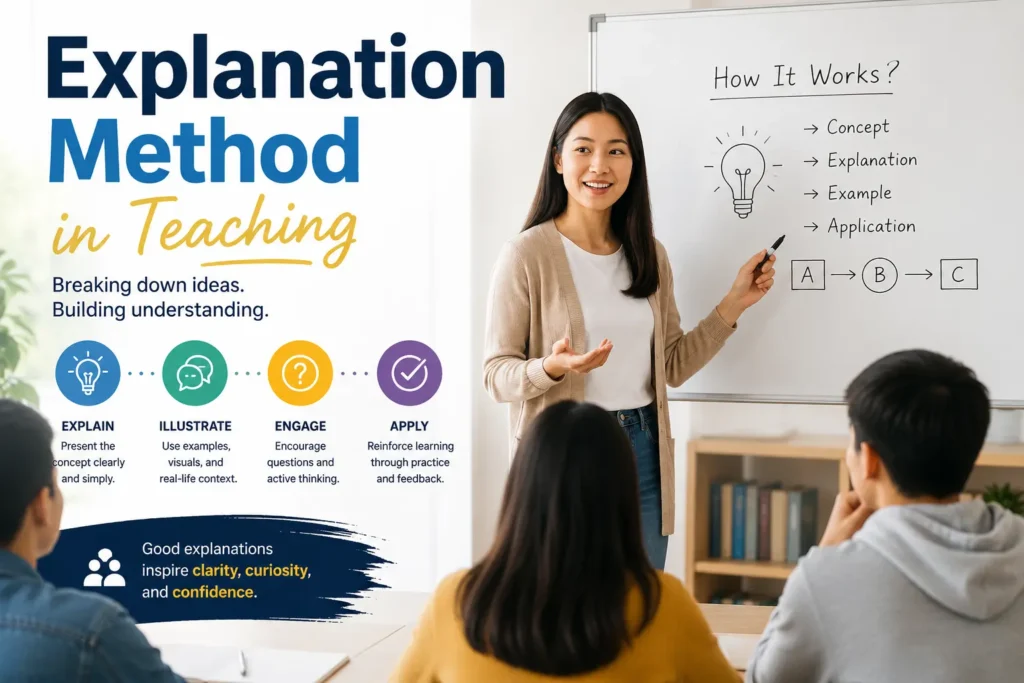
The explanation method in teaching is a structured technique where the teacher verbally clarifies a concept using examples, sequencing, and logic. Rooted in Ausubel’s expository teaching theory, it helps students understand new or complex topics before they work independently. It works best when delivered in clear steps, supported by analogies, and followed by a quick comprehension check.
Why do some explanations leave students more confused than before, while others make a difficult idea suddenly click?
The answer often comes down to method. Not every teacher explains the same way, and not every explanation follows a clear structure. The explanation method in teaching is a specific, intentional instructional strategy. It is not the same as simply talking at students or reading from a textbook.
This guide covers exactly what the explanation method is, how it works step by step, what types exist, its advantages and limitations, and when it is the right choice for your classroom.
What Is the Explanation Method in Teaching?
The explanation method is a teacher-centered instructional technique where the educator verbally presents, clarifies, and elaborates on a concept, process, or principle to help students build clear understanding.
In simple terms, the teacher does the explaining. The goal is to take something unfamiliar or complex and make it meaningful for students.
A formal definition from the AB Academics Journal describes a teaching method as “a set of performances that the teacher uses to achieve expected behavior among learners.” The explanation method fits squarely within this definition because it is purposeful, planned, and directed at a specific learning outcome.
This method belongs to a broader family of teacher-centered instruction techniques, which also includes the lecture method and the description method. Among these, explanation is the most focused. It targets one concept at a time and builds understanding through logic, examples, and structured verbal delivery.
The theoretical foundation for this method comes from psychologist and educator David Ausubel, who developed the theory of Meaningful Reception Learning. Ausubel believed that students learn best when new information is carefully organized by an expert and connected to what they already know. This idea is at the heart of how the explanation method works.
How Does the Explanation Method Work in the Classroom?
The explanation method works through a clear sequence. It is not just talking. It is organized, intentional communication that moves the learner from confusion to clarity.
Planning an Effective Explanation
Before stepping in front of students, a teacher using this method should:
- Identify the specific concept to be explained. Narrow it down to one clear idea.
- Assess prior knowledge. What do students already know that connects to this concept? This is where Ausubel’s advance organizer becomes critical.
- Select examples and analogies. Good explanations rely on concrete examples and comparisons that match the student’s world.
- Sequence the content logically. Move from simple to complex, or from known to unknown.
- Plan a comprehension check. Decide how you will confirm students understood the explanation before moving on.
According to Ausubel’s Expository Teaching Model, the advance organizer serves three purposes: it directs attention to what is important, it highlights relationships among ideas, and it reminds students of relevant knowledge already in memory. Used correctly, it acts as a scaffold that holds new information in place.
Delivering the Explanation in Class
Once planned, the delivery follows a structured path:
- Open with an advance organizer. Give students a clear mental framework before the new content arrives. This might be a brief overview, a connecting question, or a familiar comparison.
- Deliver the core explanation. Present the concept in clear, sequenced language. Use plain words. Avoid jargon unless you explain it immediately.
- Use examples and non-examples. Show students what the concept looks like and what it does not look like. Both are equally useful for building clarity.
- Invite guided response. Ask a targeted question to test understanding. Encourage students to rephrase the concept in their own words.
- Summarize and connect. Return to the advance organizer and link it to what was just learned. This reinforces the structure and closes the loop.
High Speed Training describes effective instructional strategy as using “techniques, principles, and strategies that educators use to enable and expedite the learning process in the most engaging and memorable way.” The steps above reflect exactly that.
Types of Explanation Used in Teaching
Not all explanations are the same. Depending on the subject and learning goal, teachers use different explanation types. Understanding these helps teachers choose the right approach for each lesson.
| Type | What It Does | Classroom Example |
| Interpretive | Explains what something means | “What does democracy mean in everyday life?” |
| Descriptive | Explains what something looks like or consists of | “The heart has four chambers. Here is what each one does.” |
| Reason-giving | Explains why something happens | “Why does metal expand when heated?” |
| Procedural | Explains how to do something step by step | “Here is how you solve a quadratic equation.” |
| Normative | Explains what should be done or what is correct | “This is the correct way to cite a source in an essay.” |
Most lessons involve more than one type. A science teacher might start with a reason-giving explanation, then move into a procedural one when demonstrating an experiment. Knowing the type you need helps you plan the language, examples, and structure more precisely.
For a related look at how descriptive language is used in instruction, see our guide on the description method in teaching.
What Are the Key Characteristics of the Explanation Method?
The explanation method has a distinct set of features that separate it from casual classroom talk or general instruction. Here is what defines it:
- Verbal and structured. The explanation is delivered through organized speech or writing, not through discovery or experiment.
- Teacher-led. The teacher holds the role of expert and knowledge organizer during this method.
- Purposeful. Each explanation targets one specific concept or process.
- Sequential. Content moves in a logical order, usually from simple to complex or from cause to effect.
- Example-driven. Concrete examples and analogies are not optional. They are central to the method’s effectiveness.
- Interactive at the check stage. Even though the teacher leads, comprehension checks create a moment of student response.
- Adaptive. A skilled teacher adjusts language level and pacing based on the audience, aligning with the concept of comprehensible input in pedagogy.
These characteristics are what separate an effective explanation from a stream of words that students quickly forget.
What Are the Advantages of the Explanation Method in Teaching?
Used at the right moment and in the right way, the explanation method offers clear benefits for both teachers and students.
It saves time when introducing new content. When students have no prior knowledge of a topic, asking them to discover it independently can take far longer than a well-structured teacher explanation. Expository teaching allows efficient delivery of foundational knowledge.
It gives all students the same starting point. In a classroom with mixed ability levels, a clear explanation ensures every student receives the same core information before moving forward.
It supports complex subjects. Subjects like mathematics, science, history, and law rely on precise conceptual understanding. The explanation method delivers that precision in a way that open-ended approaches sometimes cannot.
It builds cognitive clarity before practice. According to Ausubel’s meaningful learning theory, students retain new knowledge better when it is organized and connected to existing knowledge before they practice it independently. The explanation method creates exactly that structure.
It scales to any group size. Whether teaching five students or fifty, the explanation method works without requiring group reorganization or special materials.
It develops teacher communication skills. Crafting a clear, structured explanation forces teachers to deeply understand the content themselves. This makes the method as valuable for educators as it is for learners.
What Are the Disadvantages of the Explanation Method?
No teaching method works perfectly in every situation. The explanation method has real limitations that teachers should understand.
It can create passive learners. If students only listen and do not respond, process, or apply the content, understanding stays shallow. Research in pedagogy suggests that student talking time (STT) should make up a significant portion of any lesson. An explanation-heavy lesson that leaves no room for student response can work against deep learning.
It depends heavily on teacher skill. A well-structured explanation builds understanding. A poorly organized one does the opposite. Students who hear a confusing explanation may leave with more questions than they arrived with, and with a false sense that the concept is simply too hard.
It does not suit all learning goals. Skills that require physical practice, creative exploration, or collaborative problem-solving cannot be learned through explanation alone. The method delivers conceptual knowledge, not lived experience.
It may not reach all learning styles. Some students learn best by doing, observing, or discussing. A purely verbal explanation, without visual support or interactive follow-up, may not connect with every learner in the room.
The solution is not to avoid the method. It is to use it intentionally, keep it focused and brief, and follow it with student activity that requires genuine engagement with the new idea.
Explanation Method vs. Lecture, Description, and Demonstration Methods
Teachers often confuse the explanation method with similar approaches. The differences matter because choosing the wrong method for a learning goal can reduce effectiveness.
| Method | Core Focus | Direction | Best Use Case | Key Difference from Explanation |
| Explanation Method | Making one concept clear through logic and examples | Teacher to student | Introducing a new or complex concept | Focused, targeted, typically brief |
| Lecture Method | Delivering broad content on a topic | Teacher to student | Covering a full topic in depth | Longer, less interactive, covers more ground |
| Description Method | Describing the features or appearance of something | Teacher to student | Explaining what something looks like or consists of | Focuses on features, not causes or reasoning |
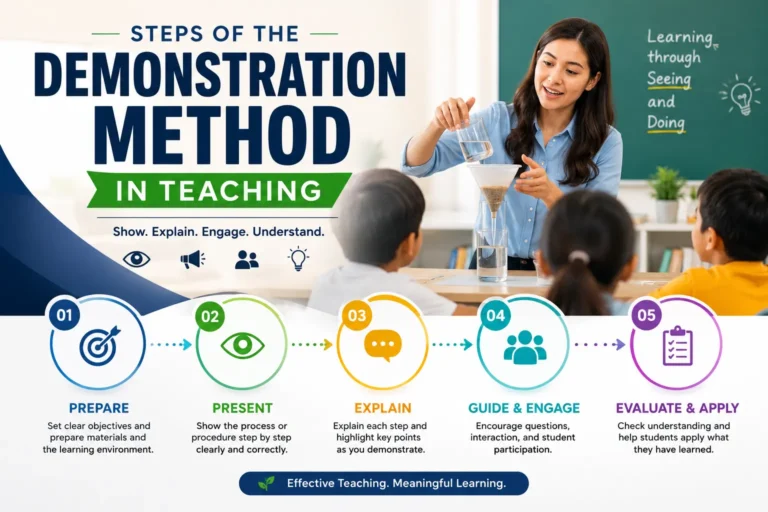
| Demonstration Method | Showing how something is done | Teacher (and observation) | Procedural or skill-based learning | Visual and physical; shows rather than tells |
The lecture method and the explanation method are closely related but serve different purposes. A lecture covers a topic broadly. An explanation drills into one specific concept until it is clear. You can find a full breakdown in our guide to the lecture method in teaching.
The demonstration method often works as a natural partner to explanation. A teacher might first explain why a chemical reaction happens, then demonstrate it in the lab. Together, they create a stronger learning experience than either method alone.
When Should a Teacher Use the Explanation Method?
The explanation method is not the right choice for every lesson. Knowing when to use it makes the difference between effective teaching and an overloaded classroom.
Best Subjects and Contexts
Use the explanation method when:
- Introducing a completely new concept that students have no prior experience with
- Correcting a widespread misconception before students practice and reinforce the wrong idea
- Preparing students for an independent task that requires conceptual understanding first
- Teaching concept-heavy subjects like mathematics, science, grammar, law, philosophy, or economics
- Time is limited and students need a clear, organized explanation quickly
- Students are struggling with a concept they have already been introduced to and need re-clarification
When to Combine the Explanation Method With Other Methods
Avoid using the explanation method as the only strategy in a lesson when:
- The learning goal is a physical or performance skill (use demonstration or practice instead)
- Students need to build critical thinking (use inquiry-based or discussion methods alongside explanation)
- The lesson is long and complex (break it into shorter explanation segments, each followed by an activity)
- Student engagement is low (explanation alone will not solve a motivation problem)
The explanation method works best at the start of a lesson as an advance organizer, or in the middle when a student activity reveals a gap in understanding. Pairing it with methods like discussion, demonstration, or collaborative learning creates a fuller, more balanced lesson.
To understand how the explanation method fits within a broader instructional framework, explore our complete guide to teaching and learning methods.
What Recent Research Says About Explanatory Teaching
Education research in 2025 and 2026 has continued to support the value of structured explanation, while also refining how it should be delivered.
Cognitive Load Theory, developed by John Sweller, highlights that learners can only process a limited amount of new information at once. This supports the explanation method’s emphasis on focused, sequential delivery. Overloading a single explanation with too many ideas at once causes confusion, not clarity.
Lev Vygotsky’s Zone of Proximal Development (ZPD) supports the scaffolding role of explanation. When a teacher explains a concept just above the student’s current level and provides structured support, the student can reach understanding they would not achieve alone.
The TEFL Institute notes that effective teaching requires “comprehensible input,” pitched just above the learner’s current level. This applies beyond language learning. Every explanation should be calibrated to the audience, not delivered at one fixed level for all.
Modern pedagogy also highlights the growing role of blended learning environments, where teachers combine verbal explanation with annotated digital slides, visual aids, and AI-assisted examples. These tools do not replace the explanation method. They extend it, making explanatory teaching even more flexible and effective in today’s classrooms.
Final Thoughts
The explanation method in teaching is one of the most powerful tools in any educator’s toolkit. When used with purpose and structure, it cuts through confusion and builds the kind of understanding that prepares students for real practice.
The key is to use it with intention. Plan your advance organizer. Choose your examples carefully. Keep the explanation focused on one concept at a time. Check for understanding before moving on.
Used well, the explanation method creates those moments in learning where something finally clicks for a student.
If you want to keep building your teaching practice, explore the full range of teaching and learning methods on Clever Portal. Each method has its place, and understanding all of them gives you the flexibility to reach every learner, in every lesson.