Etymology of Education: What Latin Roots Tell Us About the True Meaning of Learning
Have you ever stopped to wonder where the word “education” actually comes from? Most people use it every day without thinking about its history. But when you trace the origin of the word education back to its roots, you find something surprising.
The word did not start out meaning “going to school.” In fact, when it first appeared in English, it had almost nothing to do with classrooms or textbooks at all. The history of this single word carries a deep debate inside it, one that has shaped how teachers teach and how students learn for over 500 years.
This article explains the full etymology of education, walks through each Latin root word, shows how the meaning changed over time, and connects that history to the way we think about teaching today.
What Does “Education” Mean in Latin?
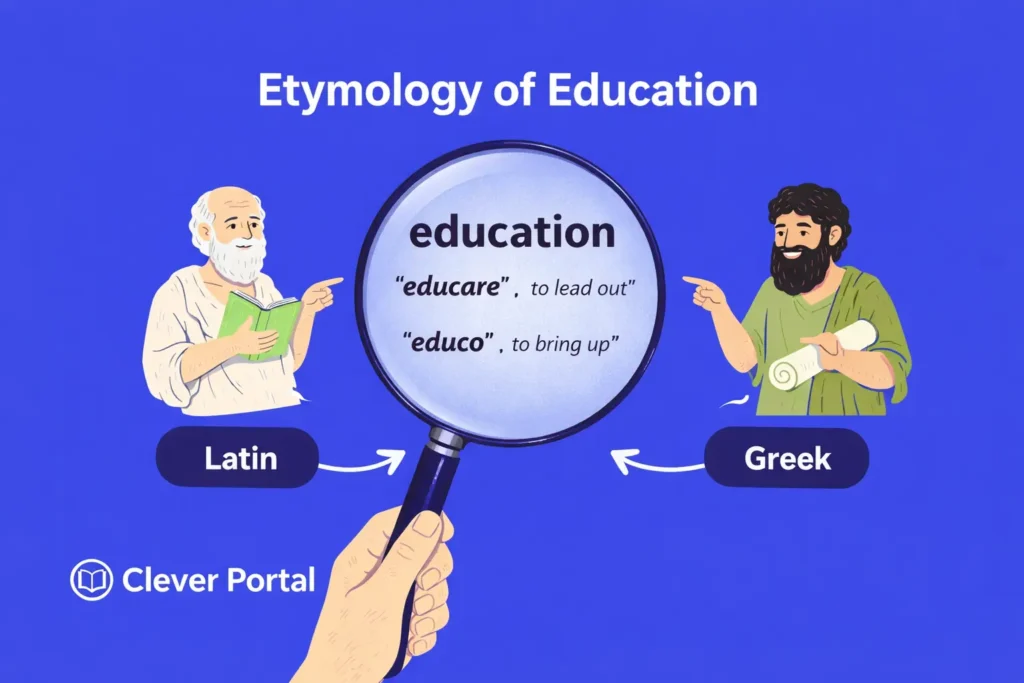
The Latin root of “education” is the noun educationem, which means “a rearing” or “a bringing up.” This word comes from the Latin verb educare. When you break it down, you can see two parts: the prefix e-, which means “out of” or “from,” and the verb ducare, which means “to lead.” Put them together and you get a meaning that is close to “to lead out” or “to bring forth.”
English borrowed the word directly from Latin educationem as well as from the French word education, which had been in use since the 14th century. So by the time English speakers started using the word “education” in the 1530s, it had already passed through French hands on its way from Latin.
The key Latin phrase to remember is educare, the root verb. It means to nourish, to raise, to train, and to bring up. Think of it the way a farmer tends to a growing plant, giving it water and sunlight so it can grow.
When Did the Word “Education” First Appear in English?
The word “education” first appeared in written English in the 1530s. At that time, it did not mean going to school or studying academic subjects. Its original meaning was “child-rearing” and also “the training of animals.”
Yes, you read that right. The very same word we use for universities and learning was first used to describe how you raise a child or train a horse.
Here is a simple timeline of how the meaning changed:
- 14th century (France): The French word education entered use, meaning child-rearing and upbringing
- 1400s (England): The verb to educate entered English as educaten, meaning to bring up children or to train
- 1530s (England): The noun “education” became common in English, originally meaning child-rearing and training of animals
- 1530s to 1600s: The word shifted to mean teaching manners and proper social codes, not academic subjects
- 1610s onward: The meaning changed again to mean “systematic schooling and training for work,” which is much closer to how we use it today
This journey from animal training to academic instruction shows just how much the word grew and changed over time. The Romans originally thought about education as training someone to fit a role in society. The French applied it to child-rearing. The English focused first on manners and social behavior, then later on job skills and formal schooling.
The Two Latin Roots at the Heart of the Debate
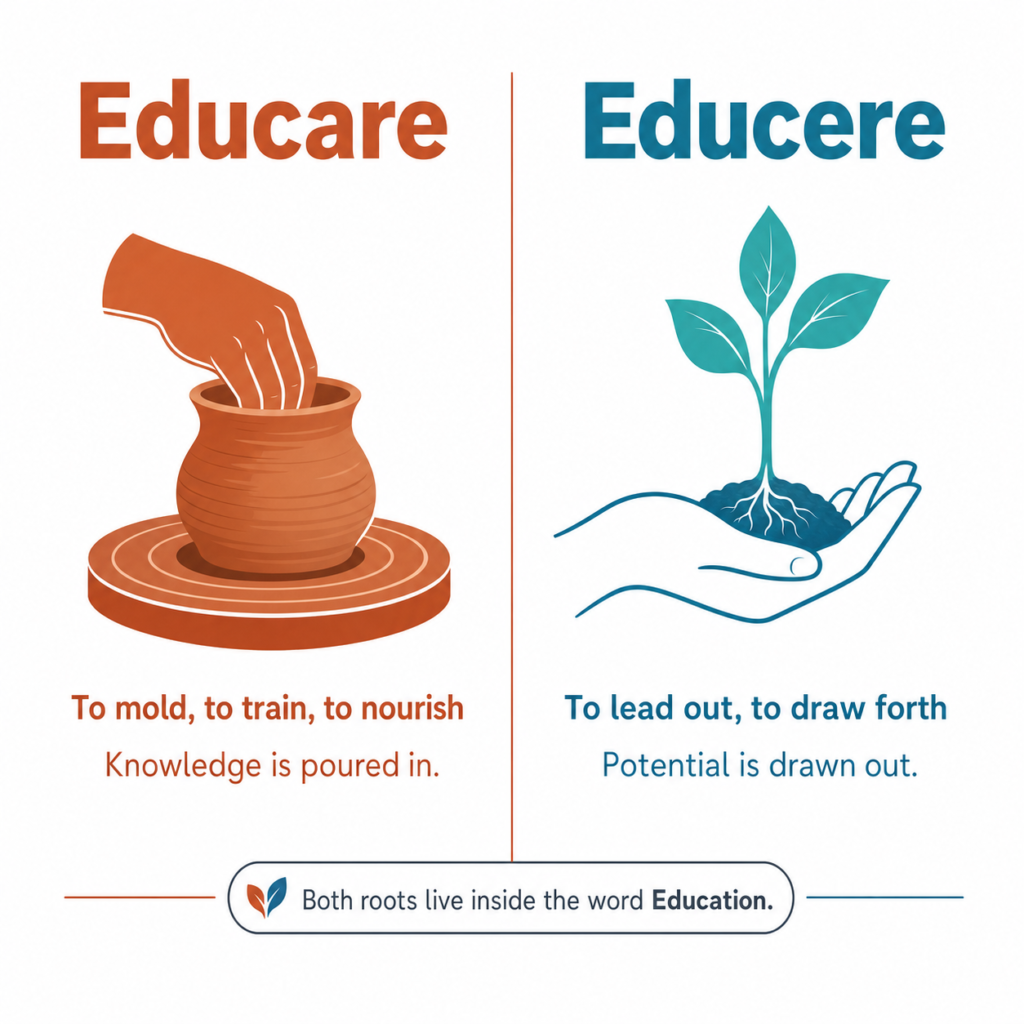
This is where the etymology of education gets truly interesting. Researcher M.A. Craft noted in 1984 that there are actually two different Latin roots behind the English word “education,” and the two roots mean very different things.
What Does Educare Mean?
Educare means to train, to mold, to nourish, and to bring up. In this view, the educator acts upon the learner. The teacher holds the knowledge and pours it into the student. Think of a potter shaping clay. The student is the raw material, and the teacher shapes it into something useful.
This idea gave birth to the traditional model of schooling that many of us recognize. The teacher stands at the front of the room. Students sit quietly and receive information. The goal is to produce a person who knows the right things and behaves in the right ways.
What Does Educere Mean?
Educere comes from the same prefix e- (out of) and ducere (to lead), but it carries a different sense. Educere means to lead out, to draw forth, to bring forward what is already there. In this view, the knowledge and potential already exist inside the learner. The teacher’s job is to draw that potential out, not to fill an empty space.
This is the idea that Socrates lived by. He did not lecture his students. Instead, he asked them questions and guided them to discover answers themselves. His famous teaching method, which we now call the Socratic method, is a perfect example of the educere tradition in action.
Craft (1984) pointed out that both roots are valid and both are represented in the English word “education.” This means the debate between these two styles of teaching was literally built into the word itself from the very beginning.
The Full Latin Family: Educare, Educere, Educo, and Educatum
Scholars of the Latin language have identified four key words that all contributed to the formation of “education.” Each one adds a slightly different layer of meaning:
- Educare means to bring up, to nourish, or to raise. It focuses on the care and nurturing of the learner over time.
- Educere means to lead out or to draw out. It focuses on helping the learner discover what is already inside them.
- Educo means to lead out of. It is a direct action verb describing the movement of bringing someone from one place or state to a better one.
- Educatum refers to the act of teaching or training itself. It is made up of the letter E (meaning outward movement) and Duco (meaning to lead or to develop). Together, they describe the deliberate act of guiding someone forward.
Together, these four classical roots paint a much richer picture of education than any single word can offer. Education, at its core, involves both nurturing from the outside and drawing out from within.
How the Etymology of Education Shaped Teaching Philosophy
The two Latin roots, educare and educere, did not just give us a word. They gave us two completely different visions of what learning should look like. And those two visions have been competing with each other ever since.
The educare tradition sees the learner as someone who needs to be filled, shaped, and trained. This view supported the classical grammar schools of Europe, where students memorized texts, drilled Latin, and learned a fixed body of knowledge. This model is also behind modern standardized testing, where students demonstrate that they have absorbed the required content.
The educere tradition sees the learner as someone who already carries potential inside them. The teacher’s role is to create the right conditions for that potential to grow and emerge. Plato, writing through the voice of Socrates, described education as “the bringing out of the ideas of universal validity which are latent in the mind of every man.” Plato himself defined education as developing in the body and soul of the pupil all the beauty and perfection they are capable of.
This philosophical tradition gave rise to progressive education in the late 19th and early 20th centuries, a movement that championed student-centered learning, inquiry-based methods, and critical thinking over rote memorization. Thinkers like John Dewey pushed for education that developed the whole person, not just their ability to pass tests.
The connection between classical roots and modern pedagogy is direct. When you hear a teacher say “I want to draw out my students’ curiosity,” they are speaking from the educere tradition, even if they have never studied Latin. When a policy debate erupts over standardized tests versus project-based learning, it is the same argument that the word “education” has been carrying inside it since the 1530s.
Common Myths About the Origin of the Word Education
A lot of people get the origin of the word education slightly wrong. Here are three of the most common misconceptions, along with the correct facts.
Myth 1: Education is a Greek word.
This comes up often because Greek philosophers like Plato and Aristotle are so strongly associated with the history of learning. But the English word “education” is Latin in origin, not Greek. While Greek philosophy deeply influenced what education became, the word itself traveled from Latin through French and into English.
Myth 2: There is only one Latin root.
Many basic sources list only educare as the single Latin root of the word. But as the research from ERIC and scholarly sources makes clear, at least two valid Latin roots contributed to the word: educare and educere. These two roots mean different things and point toward different educational philosophies.
Myth 3: Etymology does not affect real-world teaching.
Some readers might think that word origins are just an interesting footnote. But the dual etymology of “education” actually explains why educators have been disagreeing for centuries about the teacher’s role. Is the teacher a molder or a guide? A transmitter or a facilitator? The answer you choose reflects which Latin root you are drawing from, whether you know it or not.
The Word That Has Been Debating With Itself for 500 Years
The etymology of education is not just a lesson in Latin. It is a window into the oldest argument in teaching: What is a teacher really supposed to do?
The word “education” has been shaped by at least four Latin roots, refined through French, transformed in English, and pulled between two competing philosophies since the 1530s. Whether a teacher sees their role as filling students with knowledge or drawing out what is already inside them, they are taking a side in a debate that the word “education” began the moment it entered the language.
The Romans trained students for roles in their society. The French nurtured their children. The English taught manners and then job skills. Today, classrooms all over the world still argue about whether the best teaching looks more like educare or educere, and whether the right answer might actually be a blend of both.
Understanding where this word comes from is more than a vocabulary exercise. It is a guide to understanding what education has always been trying to be.
Curious to explore more of these foundational ideas? Read our full guide to the philosophy of education, or explore the complete history of formal schooling across civilizations.
Frequently Asked Questions About the Etymology of Education
What is the etymological meaning of education?
The etymological meaning of education comes from the Latin educationem, meaning “a rearing” or “a bringing up.” It draws from the Latin verb educare (to nourish, train, bring up) and educere (to lead out, draw forth). Together, these roots suggest that education is both a process of nurturing and a process of drawing out natural potential.
What is the origin of the word education?
The word “education” entered English in the 1530s from the French education (in use since the 14th century) and directly from the Latin educationem. Its earliest English meaning was child-rearing and the training of animals, not formal schooling. The meaning shifted toward systematic schooling and training for work by the 1610s.
What does the Latin word educere mean?
Educere is a Latin verb made up of the prefix e- (out of) and ducere (to lead). It means to lead out or to draw forth. In educational philosophy, it represents the belief that a teacher’s job is to bring out the knowledge and potential that already exists within the student, rather than simply placing it there from the outside.
What is the difference between educare and educere in education?
Educare means to mold, train, or nourish the learner from the outside in. Educere means to lead out or draw forth the learner’s inner potential from the inside out. These two roots reflect two opposite teaching philosophies. Educare aligns with traditional, teacher-led instruction. Educere aligns with progressive, student-centered learning.
Is the word education Latin or Greek?
The English word “education” is Latin in origin. It comes from the Latin educationem and the verb educare, via the French education. While ancient Greek thinkers like Plato and Socrates shaped the philosophy of education, the actual English word is a Latin-derived term, not a Greek one.
What did education originally mean when it first appeared in English?
When “education” first appeared in English in the 1530s, it meant child-rearing and the training of animals. It originally related to teaching manners and social codes, not academic subjects. The meaning we recognize today, which is systematic schooling and instruction, developed gradually over the following century.
Why does the etymology of education matter today?
The etymology of education matters because the two Latin roots encode two competing visions of what teaching should do. The debate between filling students with knowledge versus drawing out their potential is the same debate that plays out in modern arguments about standardized testing, inquiry-based learning, and educational reform. The word itself has carried this argument for over 500 years.