Demonstration in Teaching Science: A Complete Guide for Teachers
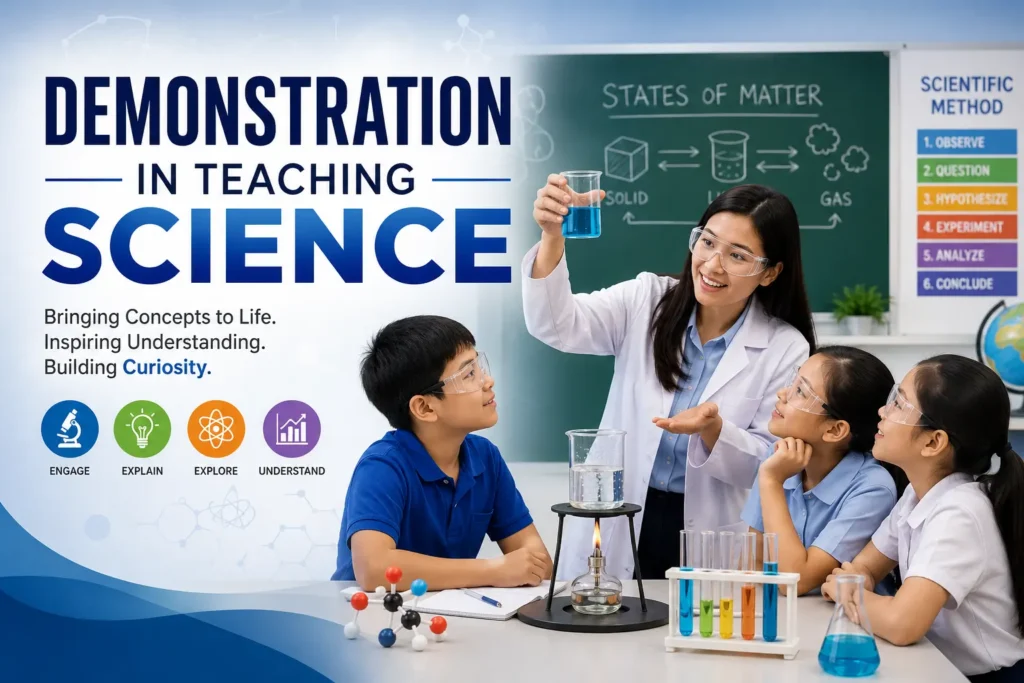
Demonstration in teaching science is a method where the teacher performs or shows a scientific process while students watch, think, and draw conclusions. It connects classroom theory to real-world observation. Research from 2024 shows students taught through demonstration in chemistry scored a mean of 78 compared to 72 for lecture-only groups. Effective science demonstrations follow five clear phases: preparation, introduction, presentation, interaction, and blackboard summary.
Have you ever watched a student’s face light up the moment a chemical reaction fizzes and bubbles right in front of them? That moment of surprise, curiosity, and sudden understanding is exactly what demonstration in teaching science is designed to create.
When students only read about science, many concepts stay abstract and hard to remember. But when a teacher shows them how something works, things click. A 2026 study published in SciMath confirmed that demonstration-based teaching significantly improves student achievement and scientific attitudes, even in primary school science classes.
This guide covers everything science teachers need to know. You will learn what this method is, the different types, the step-by-step process for running one well, subject-specific examples for chemistry, physics, and biology, and what the latest research says about its effectiveness in the classroom.
Whether you are a classroom teacher, a B.Ed. student, or a teacher educator, this resource will help you use science demonstrations with confidence.
What Is Demonstration in Teaching Science?
Demonstration in teaching science is a method where the teacher performs a scientific activity, experiment, or process in front of the class. Students observe what happens, listen to the explanation, and then discuss and analyze the results together.
It is not just about showing something cool. It is a structured instructional strategy that builds both cognitive thinking and observation skills. The goal is always to link a visible, concrete action to a scientific concept students might otherwise find hard to picture.
This approach is rooted in the constructivist learning theory, which argues that students understand more deeply when they can connect new information to something they have seen or experienced. Jean Piaget and later David Kolb both emphasized that experiential learning leads to stronger knowledge retention than passive listening.
Three key characteristics define a good science demonstration:
- The teacher performs the activity while students carefully observe
- Verbal explanation runs alongside the physical action throughout
- A structured discussion at the end helps students make sense of what they saw
For a deeper look at how this method works across all subjects, visit our demonstration method of teaching page.
How Is Demonstration Different from Experimentation?
Many teachers use “demonstration” and “experiment” as if they mean the same thing. They do not.
Understanding the difference helps you choose the right method for each lesson goal.
| Demonstration | Experiment | |
| Who performs it? | The teacher (sometimes with a student helper) | The students themselves |
| Primary purpose | Guided observation and concept explanation | Hands-on investigation and skill development |
| Student role | Observe, listen, question, discuss | Plan, execute, record, analyze |
| Level of control | Teacher-controlled | Student-directed |
| Best used when | Introducing a new concept or showing complex/risky processes | Reinforcing learning or developing practical skills |
Both methods are valuable in science education. Demonstration is especially useful for introducing new concepts, handling expensive or hazardous equipment, and ensuring all students see the same result at the same time. Experimentation is better suited for developing independent investigative skills and applying what has already been learned.
Types of Demonstration in Teaching Science
Not all science demonstrations look the same. There are four main types, and each serves a different instructional purpose.
Live Laboratory Demonstration
This is the most common type. The teacher performs a physical experiment in real time while students watch. It is particularly effective in chemistry and biology, where observable reactions or processes bring concepts to life.
Simulation Demonstration
When a real phenomenon is too large, too small, too fast, or too dangerous to recreate in a classroom, teachers use models, digital simulations, or animations. Showing planetary orbits, atomic structure, or cellular division with a simulation gives students a visual reference they could not otherwise see.
Data Analysis Demonstration
In this type, the teacher demonstrates how to read and interpret scientific data, graphs, charts, or experimental results. This is a critical skill in inquiry-based science education, and showing students how an expert approaches a data set is far more effective than telling them what to look for.
Operational or Equipment Demonstration
Before students use laboratory apparatus, the teacher shows them how to handle it correctly. This covers items like the microscope, Bunsen burner, voltmeter, measuring cylinder, or any specialist equipment. It prevents misuse, reduces risk, and builds psychomotor skills before students touch anything themselves.
Together, these four types cover the full range of science teaching needs from concept introduction to safety instruction.
The 5 Steps of Demonstration in Science Teaching
A well-run science demonstration does not just happen. It follows a clear structure that guides both the teacher and the students from beginning to end.
For the complete step-by-step breakdown, explore our detailed guide on the steps of demonstration method.
Here are the five essential phases:
Step 1: Planning and Preparation
This is the most important step, and it is the one most often skipped. The teacher must write a full lesson plan that includes the learning objectives, the equipment needed, the questions to ask students, and a rehearsal of the experiment itself.
Rehearse the demonstration under the same classroom conditions you will face on the day. If the demo does not work reliably in practice, it will not work reliably in front of thirty students.
Step 2: Introduction of the Lesson
Begin the lesson in a way that creates curiosity and motivates students to pay attention. One effective technique is to present a scientific problem or question and tell students the demonstration will help them find the answer. This activates prior knowledge and gives students a reason to observe carefully.
Step 3: Presentation
Now the teacher presents the lesson with examples, teaching aids, charts, models, or slides. This stage builds the theoretical foundation that the demonstration will then make visible. Use real-world examples wherever possible to connect the science to something students already know.
Step 4: Performance of the Experiment
This is the heart of the demonstration. The teacher performs the experiment step by step, explaining each action and asking questions at key moments. Questions like “What do you think will happen next?” and “Why did the liquid change color?” keep students mentally active rather than passively watching.
After the performance, use the Predict-Observe-Explain (POE) framework. Ask students to predict what will happen, observe what does happen, and then explain the result. This structured approach dramatically improves the quality of student thinking during a demonstration.
Step 5: Blackboard Summary
Once the experiment is complete, write the key points on the board together with the students. Include the purpose of the demonstration, the main steps, and the final result or conclusion. This step locks the learning in place and gives students notes they can refer to later.
Advantages of Demonstration in Science Teaching
Science teachers who use demonstrations regularly report stronger student engagement and better learning outcomes. Here is why this method works so well:
- Makes abstract concepts concrete. Ideas like electrical resistance, osmosis, or acid-base reactions are difficult to imagine. Seeing them happen changes that immediately.
- Improves academic achievement. A 2024 chemistry research study found that students taught via demonstration scored a mean of 78, compared to a mean of 72 for students taught using the conventional lecture method.
- Develops observation and critical thinking skills. Students learn to watch carefully, notice patterns, and question what they see, which are core skills in scientific inquiry.
- Caters to multiple learning styles. Demonstration combines visual, auditory, and in some cases kinesthetic learning, making it accessible to a wider range of students.
- Stimulates curiosity. A surprising result or an unexpected reaction sparks questions students genuinely want answered. Curiosity is one of the strongest drivers of learning in science education.
- Bridges theory and practice. Students see exactly how a concept they studied in a textbook plays out in the real world, which strengthens understanding and long-term retention.
- Supports safe science teaching. Hazardous or expensive experiments can be shown by the teacher while keeping students safe from direct risk.
Limitations of the Demonstration Method in Science
No teaching method is perfect. Being honest about the limitations of demonstration in teaching science helps teachers use it more wisely.
- It is largely teacher-centered. Students observe rather than do, which means they may not develop the same practical skills as they would through hands-on experimentation.
- Not all students can see clearly. In a large class, students at the back or sides may not have a clear line of sight, which reduces the effectiveness of the demo.
- Equipment costs can be a barrier. Some demonstrations require apparatus that schools may not always have, particularly in under-resourced settings.
- One-size-fits-all pacing. The teacher controls the speed, which may be too fast for some students and too slow for others.
- A failed demonstration is disruptive. If the experiment does not work as planned, it can confuse students and undermine confidence.
What to Do When a Science Demonstration Fails
Even with perfect preparation, science does not always cooperate. If a demonstration fails in class, stay calm and treat it as a teachable moment.
Discuss with students why it might have gone wrong. Was there a variable that changed? Was there a measurement error? This is real scientific thinking. If time and materials allow, try again. If not, show a pre-recorded video of the phenomenon and continue the lesson from there. A failed demonstration, handled well, can actually teach students more about the scientific process than a perfect one.
How to Make Science Demonstrations More Effective
These practical tips come directly from teacher-educator research and classroom experience:
- Always rehearse first. Practice the exact demo in the actual classroom with the actual equipment. A demo that “sort-of works” is not good enough.
- Check visibility before you begin. Walk to different parts of the room and confirm every student has a clear view. For small-scale reactions, connect a camera to the projector screen.
- Set a clear learning objective. Ask yourself, “What exactly do I want students to take away from this?” Share that objective with the class before you begin.
- Use the POE framework. Ask students to Predict, Observe, and Explain at each key moment during the demonstration.
- Ask questions throughout. Do not lecture over the experiment. Pause frequently to ask students what they notice, what they think is happening, and why.
- Use showmanship where appropriate. Science is exciting. Show genuine enthusiasm. If the result is dramatic, let the students enjoy it. A teacher who is clearly enjoying the demonstration creates an audience that is fully engaged.
- Involve a student volunteer. When it is safe to do so, invite a student to assist with parts of the demonstration. It increases attention and makes the experience more personal.
- Always end with a discussion. The conversation after the demonstration is just as important as the demonstration itself. If you run out of time for this step, the learning is incomplete.
Examples of Demonstration in Science Teaching by Subject
One of the biggest gaps in most resources on this topic is the lack of subject-specific examples. Here are practical, classroom-ready demonstrations broken down by science discipline.
Chemistry Demonstrations
- Acid-base neutralization: Add a few drops of sodium hydroxide to hydrochloric acid with universal indicator present. Students watch the color shift from red to green as the reaction reaches a neutral pH. This demonstrates neutralization and pH concepts visually.
- Electrolysis of water: Pass electric current through water with a small amount of dissolved salt. Students observe hydrogen and oxygen gas collecting at separate electrodes, making the composition of water tangible.
- Titration technique: Demonstrate the precise process of adding a measured volume of acid to an alkali using a burette. This teaches both technique and the concept of equivalence points in chemical reactions.
Physics Demonstrations
- Pendulum motion: Suspend different masses on strings of varying lengths and release them. Students observe how only the length of the string affects the period, not the mass, making the concept of simple harmonic motion visible.
- Ohm’s Law circuit board: Build a simple circuit with a variable resistor, ammeter, and voltmeter in front of the class. Change the resistance and show how current and voltage respond, bringing the relationship V = IR to life.
- Newton’s Third Law trolley push: Place two trolleys facing each other on a smooth track and push one against the other. Both move in opposite directions with equal force, making action-reaction pairs immediately observable.
Biology Demonstrations
- Osmosis in plant cells: Place potato slices in water and in a concentrated salt solution. Leave them for thirty minutes and have students compare the firmness of each slice. The difference makes osmosis a concrete, measurable reality.
- Breathing mechanism model: Use a bell jar model with balloons and a rubber diaphragm to demonstrate how the lungs expand and contract during breathing. Students see the mechanics of respiration rather than just reading about it.
- Microscope slide preparation: Demonstrate how to prepare and stain a cheek cell or onion cell slide before students attempt it themselves. This operational demonstration prevents common technique errors and improves the quality of student results.
What Recent Research Says About Demonstration in Science Education
The evidence for demonstration as an effective science pedagogy is growing stronger. Here is what recent studies from 2024 to 2026 confirm:
A 2024 study published on SSRN investigated the effectiveness of demonstration in teaching senior secondary school chemistry. The findings showed a statistically significant difference in academic achievement. Students taught through demonstration scored a mean of 78 while those taught through the conventional lecture method scored a mean of 72. There was no significant difference in performance between male and female students, which suggests demonstration works equally well across genders.
A 2026 study in SciMath found that integrating demonstration-based teaching enhanced both academic achievement and scientific attitudes in third-grade students learning about sustainability topics. The researchers recommended wider adoption of demonstration approaches in early science education to improve long-term outcomes.
An Indonesian study published in the OJS UNM journal examined Class IX students learning science through the demonstration method over two classroom cycles. Results showed improved learning outcomes in each successive cycle, confirming that repeated, structured use of demonstration builds both understanding and confidence over time.
Research published by SEAHIPUB on the effects of demonstration in Building Construction education found that students taught using demonstration consistently achieved higher results than those taught conventionally, with learning achievement ratings described as “high” compared to average scores in the control group.
Across subjects and grade levels, the pattern is consistent. Demonstration in teaching science works. It improves scores, improves engagement, and improves students’ relationship with science as a subject.
Final Thoughts
Demonstration in teaching science is one of the oldest and most effective tools in a science teacher’s kit. When it is planned carefully, rehearsed thoroughly, and followed by a strong discussion, it transforms abstract concepts into memorable experiences.
The key takeaway is this: a great demonstration is not just a performance. It is a structured, purposeful learning event with a clear objective, active student involvement, and a conclusion that makes the science stick.
Whether you are teaching chemistry titration, physics circuits, or biology osmosis, the five phases of a well-structured demonstration give you a reliable framework to follow every time.
Ready to strengthen your teaching approach even further? Explore our full library of teaching and learning methods to find more strategies that work for science classrooms at every level. Each method has its place, and understanding all of them helps you make smarter decisions about how and when to use each one.