Improvisation in Teaching: What It Is, Why It Matters, and How Teachers Can Use It
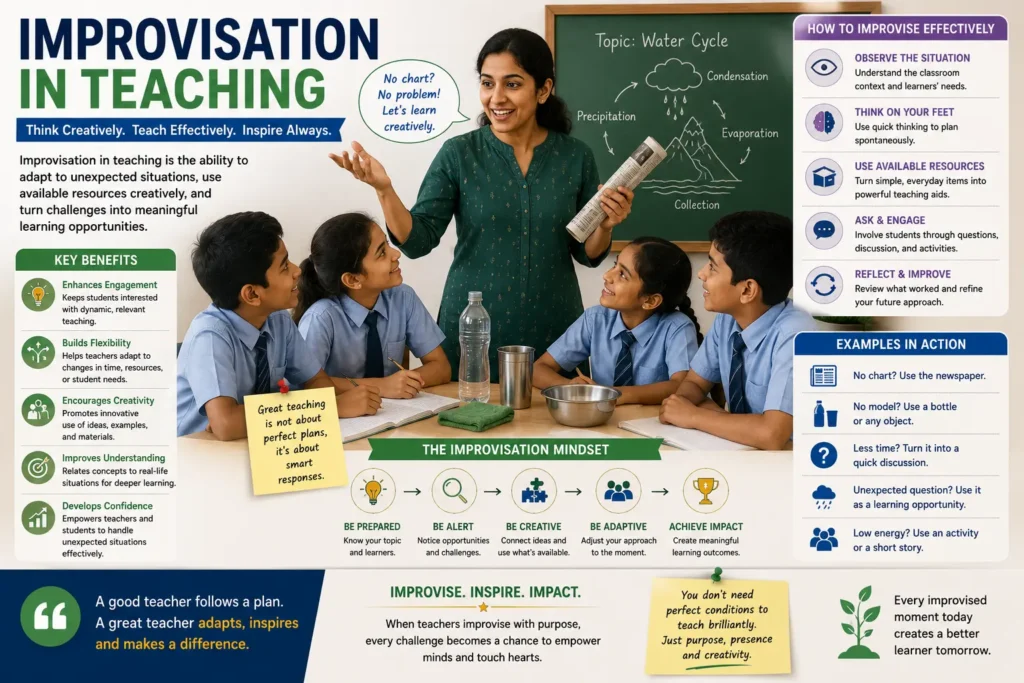
Improvisation in teaching is the ability of educators to adapt their lessons, responses, and resources creatively in real-time classroom situations. It is a professional skill built on deep subject knowledge and pedagogical flexibility. It includes adapting lesson delivery on the spot, responding to unexpected student questions, and creating teaching materials from locally available resources. Teachers who practice improvisation tend to be more effective, adaptable, and student-centered in their approach.
No lesson plan survives first contact with a real classroom. A student asks a question you did not prepare for. The projector fails five minutes before class. Half the group finishes the activity early and looks at you waiting for what comes next. These moments happen every single day. The teachers who handle them well are not just lucky. They have a skill. That skill is called improvisation in teaching.
This guide covers what improvisation in teaching means, the main types teachers use, the real benefits for both teachers and students, how to apply it in the classroom, the challenges that get in the way, and how educators can actively develop this skill over time.
What Is Improvisation in Teaching?
Improvisation in teaching is a professional skill that allows teachers to develop new solutions and respond quickly, flexibly, and precisely to unexpected classroom situations. The word “improvisation” comes from the Latin term improvisus, which means “unexpected.” In the classroom, it describes any moment when a teacher creatively adapts their instruction, explanations, or materials without relying on a prepared script.
It is important to understand one thing right away: improvisation in teaching is not the same as being unprepared. A teacher who improvises well is actually drawing on deep subject knowledge and strong pedagogical creativity. They know their content so thoroughly that they can reshape it in real-time to match what students need in that moment.
Pedagogical improvisation spans two connected dimensions:
- Lesson delivery improvisation: Adapting how you teach in real-time, such as changing an example, adjusting a discussion, or shifting the pace of a lesson
- Instructional material improvisation: Creating or adapting teaching aids and learning tools from locally available resources when standard materials are not available
Both types are essential. Together, they make up the full picture of what adaptive teaching looks like in practice.
What Are the Main Types of Improvisation in Teaching?
Research identifies three core types of pedagogical improvisation that teachers use during classroom instruction. A fourth type, instructional material improvisation, is recognized separately and is especially important in resource-limited settings.
Sequential improvisation happens when a teacher changes the order, pacing, or structure of a lesson in real-time. For example, a teacher might skip an activity that is not landing well and move directly to a hands-on task to re-engage the class.
Dialogic improvisation happens during conversation and discussion. When a student asks an off-script question or takes the discussion in a new direction, the teacher responds spontaneously, building on what the student said to keep the learning moving forward.
Exemplary improvisation happens when a teacher generates a brand new example on the spot to clarify a concept. Instead of relying on the example written in the lesson plan, the teacher reads the room and creates a more relevant, more relatable illustration in the moment.
Instructional material improvisation is the process of creating or substituting teaching tools using whatever materials are locally available. For example, a teacher might use a plastic bottle to demonstrate volume when lab equipment is unavailable, or use cardboard to build a model that would normally require a store-bought kit.
Each type of improvisation requires a different set of instincts. Understanding all four helps teachers recognize which one the situation is calling for.
Why Is Improvisation Important in Teaching?
Real classrooms are unpredictable. Students arrive with different moods, different levels of readiness, and questions that no lesson plan could anticipate. A teacher who can improvise keeps learning moving forward even when the original plan falls apart.
Improvisation is also especially important in resource-constrained educational environments. Many schools, particularly in developing regions, face shortages of standard teaching materials. Teachers who can create learning tools from what they have on hand ensure that students still receive quality instruction regardless of the resource gap.
Beyond survival, improvisation connects directly to student-centered learning. When a teacher responds flexibly to where students are in the moment, rather than marching through a fixed script, the instruction becomes more relevant and more engaging. This is the foundation of adaptive teaching strategies, differentiated instruction, and inquiry-based learning, all of which depend on teacher flexibility.
Improvisation also models an important mindset for students. When they see a teacher think creatively under pressure, problem-solve in real-time, and stay calm when things do not go as planned, they internalize those same habits of mind.
How Does Improvisation Benefit Teachers?
Yes. One of the most consistent findings in education research is that teachers who practice improvisation develop greater professional confidence over time. When a teacher learns that they can handle unexpected situations well, the fear of classroom unpredictability decreases significantly.
Here are the core benefits of improvisation for teachers:
- Reduced anxiety: Teachers feel less stressed when they trust their own ability to adapt on the fly
- Stronger student rapport: Responsive teachers build better relationships because students feel heard and understood
- Greater professional creativity: Improvisation exercises the same creative problem-solving muscle used in curriculum design and lesson planning
- Increased teaching effectiveness: Adaptive teachers are consistently rated higher in instructional quality evaluations
- Long-term career sustainability: Teachers who can improvise avoid the rigidity and burnout that comes from clinging to scripts in dynamic environments
Experience matters more than academic qualifications when it comes to improvisation competence. The longer a teacher works in the classroom, the more improvisational situations they encounter and the more naturally adaptive they become.
What Do Students Gain from an Improvisational Classroom?
Research shows that students in classrooms where teachers use improvisation show measurable improvements across several areas.
A study published by SPM Online found a significant difference in the academic achievement of mathematics students taught with improvised instructional materials compared to those taught using traditional methods alone. A similar study in chemistry found that students taught using improvised materials outperformed students taught using conventional methods.
Beyond academic scores, students also benefit in the following ways:
- Better listening: Improv-based classroom environments train students to pay closer attention because they know the lesson may shift in unexpected ways
- More comfort with risk-taking: Students become more willing to offer ideas and answers when they see their teacher model flexibility and accept the unexpected
- Stronger collaborative skills: Classrooms that embrace spontaneous teaching often use more cooperative learning activities where students solve problems together
- More creative writing output: A study by Mary DeMichele showed that students wrote more words and more sentences after participating in improvisation-based workshops
- Improved behavior and focus: Research by Sunflower Creative Arts found that improvements in student behavior and lower stress levels are common outcomes in classrooms that incorporate improvisation
Students remember lessons taught with improvised materials more easily than those taught without them, partly because the physical and creative engagement makes concepts stick.
How Do Teachers Use Improvisation in Lesson Delivery?
Improvisation in lesson delivery does not mean teaching without a plan. It means being willing to leave the plan behind when the situation calls for it. Here is what that looks like in practice:
Scenario 1: The unexpected question
A student asks something your lesson plan does not address. Instead of saying “we will get to that later,” you pause, connect the question to the current topic, and build a brief unscripted explanation that uses the student’s curiosity as the entry point. This is dialogic improvisation at work.
Scenario 2: The pacing problem
Half the class finishes an activity while the other half is still working. Instead of waiting, you quickly generate an extension task that deepens the topic for students who are ready. This is sequential improvisation.
Scenario 3: The blank stare
You give an explanation and see confusion on multiple faces. Your prepared example is not working. You stop, think about something from the students’ own lives, and invent a new example on the spot that connects the concept to their reality. This is exemplary improvisation.
Scenario 4: Technology fails
Your presentation will not load. Rather than losing the lesson, you shift to a discussion-based format, writing key points on the board and drawing students into an active conversation instead of passive listening.
To use improvisation well in lesson delivery, teachers should:
- Know their subject content deeply enough to explain it multiple ways
- Watch for student signals like confused looks, distraction, or silence
- Stay focused on the learning objective even when the delivery changes
- Accept that the best moment in a lesson is sometimes the unplanned one
- Reflect after class on which improvisational moves worked and why
What Is Improvisation of Instructional Materials?
Improvisation of instructional materials means creating or adapting teaching tools using whatever materials are available in the local environment when standard resources are not accessible or are too expensive.
This type of improvisation is particularly important in schools that face resource limitations. Rather than canceling a lesson or skipping a practical activity, a teacher who improvises materials keeps the learning experience intact.
The process for improvising instructional materials follows five clear steps:
- Identify the need: Determine exactly what learning objective the material needs to support and what standard resource is missing
- Analyze available resources: Look at what is accessible in the classroom or local environment, such as cardboard, bottles, natural objects, or printed handouts
- Design the material: Plan how the available resource will serve the instructional function of the missing one
- Construct the material: Build or prepare the improvised tool, keeping the following factors in mind: safety, relevance to the lesson, durability, and cost
- Test and evaluate: Use the material in class and assess whether it achieves the intended learning outcome
A few practical examples of improvised instructional materials include:
- Using leaves and sticks as counting tools in math class
- Using a cardboard box to model a three-dimensional structure in science
- Using charcoal fragments as a substitute for pencils in art class
- Using a plastic bottle to demonstrate concepts of volume or pressure
- Using locally printed charts and diagrams in place of expensive commercial posters
When done well, improvised instructional materials can actually outperform commercial alternatives because they are more relevant to the student’s immediate environment.
What Challenges Do Teachers Face with Improvisation?
Despite how valuable improvisation is, many teachers find it genuinely difficult. Research identifies four core challenges that get in the way:
- Inadequate training: Most teacher training programs focus on scripted lesson plans and theoretical frameworks. Very few build the creative adaptability skills that improvisation requires. When teachers enter classrooms, they are often underprepared for the spontaneous nature of real teaching.
- Rigid curricula: In schools where every lesson must follow a strict structure and timeline, teachers have little room to deviate even when the situation clearly calls for it. Curriculum rigidity removes the space that improvisation needs to exist.
- Limited resources: Teachers who lack basic classroom materials sometimes feel paralyzed rather than resourceful. Without training in material improvisation, resource scarcity becomes a barrier instead of a creative prompt.
- Fear of failure: Many teachers worry that improvising will make them look unprepared or incompetent. This psychological barrier is especially strong in school cultures that reward scripted, predictable teaching and penalize visible uncertainty.
Addressing these challenges requires action at both the individual level and the institutional level. A single teacher working in isolation cannot overcome a rigid system on their own. Schools and teacher education programs must play an active role.
How Can Teachers Develop Improvisation Skills?
The good news is that improvisation in teaching is a learnable skill. Research shows that experience matters more than academic qualification when it comes to improvisational competence. The more real classroom situations a teacher navigates, the more naturally adaptive they become.
Here are five practical ways teachers can develop their improvisation skills:
1. Reflect on unplanned classroom moments
After class, write down one moment that did not go as planned. Ask yourself: What happened? How did I respond? What would I do differently? This reflective practice builds pattern recognition over time.
2. Join a professional learning community (PLC)
Communities of practice are one of the most effective ways to develop teacher improvisation skills. In a PLC, teachers share resources, strategies, and experiences with peers. This collective knowledge pool makes each teacher more resourceful and adaptive on their own.
3. Participate in professional development programs focused on creative adaptability
Teacher training programs that include modules on creativity, critical thinking, and flexible instruction directly build the mindset needed for improvisation. Look for workshops, courses, or coaching programs that go beyond scripted lesson planning.
4. Study subject content deeply outside of lesson preparation
The more a teacher knows about their subject, the easier it becomes to generate new examples, adjust explanations, and answer unexpected questions. Deep content knowledge is the fuel that powers good improvisation.
5. Cultivate a classroom culture that welcomes the unexpected
When students understand that questions are welcome and that the lesson can evolve, they become partners in the improvisational process. This shared openness makes classroom improvisation feel natural rather than risky.
Institutional support also matters enormously. Schools that reward innovation, tolerate creative risk-taking, and support peer collaboration give teachers the psychological safety they need to improvise with confidence.
Ready to Explore More Teaching Strategies?
Improvisation in teaching is one of the most valuable and most overlooked skills in a teacher’s professional toolkit. It transforms unexpected classroom moments from obstacles into opportunities. It helps students learn more deeply, engage more fully, and think more flexibly. And for teachers, it builds the kind of confidence and creativity that makes the work genuinely rewarding.
Improvisation does not replace good lesson planning. It works alongside it. The best teachers plan well and improvise brilliantly when the plan meets reality.
If you found this guide useful, explore our full library of teaching and learning methods to discover more strategies that can strengthen your classroom practice, build student engagement, and make every lesson more effective.