Drill Method in Teaching: What It Is, Types, Steps, and When to Use It
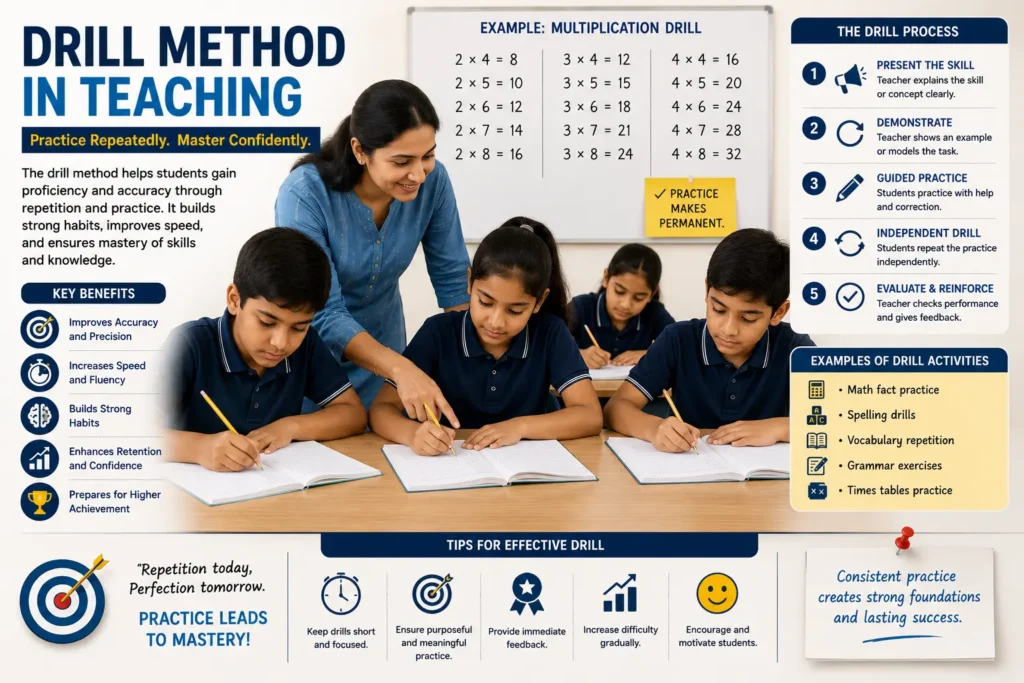
The drill method in teaching is a structured classroom technique that uses repetitive practice to help students build automaticity in a specific skill or language pattern. Teachers provide a clear model, and students repeat it until the response becomes accurate and natural. It works best for pronunciation, grammar structures, math facts, and procedural tasks. Drill method is most effective when used in short sessions and combined with communicative follow-up activities.
When students struggle to remember a grammar rule, a math formula, or the correct pronunciation of a word, one of the most reliable tools a teacher can reach for is the drill method. This classroom technique has been used by educators for decades because it works when applied correctly. But many teachers either overuse it or misunderstand how to run it properly.
This guide explains what the drill method in teaching really is, covers all the major types of drills used in classrooms, walks through how to implement it step by step, and helps you decide when it is the right tool and when it is not.
What Is the Drill Method in Teaching?
The drill method in teaching is a structured instructional technique that uses repetitive, guided practice to help learners develop automaticity in a specific skill or language form. The teacher provides a clear model, and students repeat that model verbally, physically, or in writing until the correct response becomes a natural habit.
This classroom technique is rooted in behaviorist learning theory, particularly the stimulus-response model developed by B.F. Skinner. When a student hears a model and repeats it correctly, the response is reinforced. Over time, that response becomes automatic, meaning the learner no longer has to think consciously about it.
The Open University defines a drill as “a classroom technique to aid memorisation by way of spaced repetition” that promotes “the acquisition of knowledge or skills through repetitive practice.” Scheffler (1965), quoted by Ryle, defines drilling as “the imposition of repetitions through which habits are built up.” This is different from rote learning, where students memorize without structure or guidance. In drill method teaching, every repetition is purposeful, modeled, and corrected in real time.
The drill and practice method is also a central feature of the audio-lingual method, which dominated English language teaching in the mid-twentieth century. Today, it remains a core tool in TEFL and B.Ed. curriculum standards worldwide.
What Are the Main Types of Drill Method in Teaching?
There are six main types of drill technique in teaching. Each type serves a different learning goal, from basic pronunciation practice to complex grammar transformation and peer-to-peer oral practice.
Repetition Drill
A repetition drill is the most basic and widely used type. The teacher says a word, phrase, or sentence, and students repeat it exactly as modeled. This type builds pronunciation accuracy and listening skills. For example, the teacher says “She walks to school every day,” and the entire class repeats it together. Repetition drills are the starting point for most skill acquisition in language classrooms.
Substitution Drill
In a substitution drill, students repeat a sentence but swap one or two elements with a new word provided by the teacher. For example, the teacher says “She walks to school” and then prompts with “runs.” Students respond: “She runs to school.” This type of oral practice builds pattern recognition and helps learners internalize grammatical structures without memorizing rules consciously.
Transformation Drill
A transformation drill asks students to change the grammatical structure of a sentence. The teacher might say “She walks to school” and ask students to make it negative: “She does not walk to school.” This type requires a slightly higher level of language processing and is useful for teaching tense changes, voice transformations, and question formation.
Chain Drill
A chain drill involves students taking turns in a sequence, each one responding to the previous student and then prompting the next. For example, Student A asks Student B a question, Student B answers and turns to Student C. This creates a chain of classroom interaction and makes habit formation feel more communicative and engaging.
Backward Build-Up Drill
The backward build-up drill, also called an expansion drill, breaks a long or difficult sentence into smaller pieces. Students start with the last chunk and build backward toward the full sentence. For instance: “school” > “to school” > “walk to school” > “I walk to school every morning.” This method reduces cognitive load and is especially helpful for sentences that are difficult to produce all at once.
Rhythm Drill
A music or rhythm drill uses a rhythmic pattern, chant, or song to make repetition more memorable. Teachers use this type to teach pronunciation patterns, stress, and intonation. Children and young learners especially respond well to rhythm-based oral practice because it turns repetitive learning into an enjoyable activity.
How Do You Implement the Drill Method Step by Step?
Knowing the types of drills is only half the picture. The way a teacher runs a drill matters just as much as which type they choose. Here is a clear, step-by-step process for implementing the drill method in the classroom effectively.
Step 1: Select a short, specific target item. Choose one word, phrase, grammar structure, or skill to focus on. Keep it narrow. Trying to drill too much at once leads to confusion, not skill acquisition.
Step 2: Present a clear model. Say or demonstrate the target item clearly. Speak at natural speed, then slower if needed. Students need an accurate model to copy from the start.
Step 3: Check for comprehension before repetition begins. This is the most important step that most teachers skip. Students should understand what they are practicing before they repeat it. Drilling without comprehension produces mechanical repetition, not learning.
Step 4: Conduct choral repetition first. Ask the whole class to repeat together. This lowers the anxiety of individual students and gives everyone a chance to hear the target item multiple times before being asked to produce it alone.
Step 5: Move to group, pair, and individual repetition. After choral practice, reduce group size progressively. This helps identify individual errors and gives the teacher better formative assessment data.
Step 6: Provide immediate corrective feedback. When a student makes an error, correct it right away using a clear recast or prompt. Do not wait until the end of the drill. Immediate feedback is what separates drill method from simple repetition.
Step 7: Keep each session under five minutes. The Open University recommends keeping drill exercises short to allow the teacher to assess progress multiple times during the lesson. Long drills cause boredom and reduce the quality of student responses.
Step 8: Rotate drill types across lessons. Using the same drill type every lesson leads to disengagement. Alternating between repetition drills, substitution drills, and chain drills keeps students alert and challenges them at slightly different cognitive levels.
Common Mistake to Avoid: Never run a drill when students do not yet understand what they are practicing. Understanding must come before repetition. Without it, even the best-designed drill produces meaningless output.
What Are the Advantages of the Drill Method in Teaching?
The drill method in teaching offers several clear advantages when used appropriately. These benefits make it a reliable tool in any teacher’s instructional toolkit.
- Builds automaticity quickly. Structured repetition moves a skill from conscious effort to automatic response faster than most other instructional methods. This is especially true for pronunciation practice and grammar form acquisition.
- Provides immediate formative assessment. Because students are responding in real time, teachers can hear errors immediately and correct them on the spot. This real-time feedback loop is one of the strongest features of the drill technique.
- Works well for diverse learners. Students who need repetition-based reinforcement, including learners with certain learning differences, benefit from the predictable structure of drill activities.
- Requires minimal resources. Drills can be run with no materials at all. A teacher’s voice, a target item, and students are all that is needed. This makes the method highly accessible in under-resourced classrooms.
- Research supports its effectiveness. A study published in the Journal of Language and Learning Studies found that the drill method produced a t-count of 366.82 compared to a t-table value of 2.015, confirming that drill method significantly outperforms traditional lecture method for improving listening skills. The average student score after the drill method intervention reached approximately 80.2, compared to lower pre-test scores.
What Are the Disadvantages of the Drill Method?
Like any classroom technique, the drill method has real limitations. Understanding these helps teachers use it wisely rather than reflexively.
- Ineffective for abstract or conceptual knowledge. The drill method builds habits, not understanding. It cannot teach critical thinking, problem-solving, or concepts that require reasoning. Using drill for these goals wastes classroom time.
- Risk of mechanical repetition. If comprehension is not established first, students simply parrot responses without learning anything meaningful. The RSI International journal highlights this as a fundamental distinction between drilling and teaching.
- Can cause disengagement if overused. Drill sessions that are too long or used too frequently become boring. Students go through the motions without genuine engagement, which undermines the habit formation goal entirely.
- May suppress creativity and language risk-taking. Over-reliance on drill activities can condition students to wait for a model before producing language, making them hesitant to experiment or make creative attempts on their own.
- Not suitable for all learner styles. Some learners need variety, visual input, or meaning-centered tasks to retain information. A drill-heavy approach can frustrate these students and reduce overall classroom motivation.
The key takeaway is that drill method is one tool in a broader instructional repertoire. It works best as a short, focused activity within a lesson, not as the primary instructional approach for an entire unit.
In Which Subjects and Situations Is the Drill Method Most Effective?
The drill and practice method is not limited to language classrooms. It is effective in any subject area where the learning goal is skill mastery through repetition rather than conceptual understanding.
Is Drill Method Effective in Language Teaching?
Yes, strongly. The drill technique is most deeply associated with language learning, particularly in TEFL and ESL classrooms. It is used to build pronunciation accuracy, reinforce grammar structures, and develop listening skills. A study in the Journal of Language and Learning Studies confirmed measurable improvement in listening skills after drill method interventions in junior high school students. The audio-lingual method places drill-based oral practice at the center of its language acquisition framework.
Does Drill Method Work in Mathematics?
Absolutely. Multiplication tables, number bonds, and formula recall are perfect targets for drill method in math classrooms. When students automatically know that 7 times 8 equals 56, they can dedicate their working memory to solving the actual problem rather than computing basic facts. Spaced repetition tools like Anki and Quizlet apply this same drill-based logic digitally to help students build math automaticity.
Can Drill Method Be Used in Physical Education?
Yes. In PE, drill activities are used to teach movement patterns, sport techniques, and physical sequences. A basketball dribbling drill, a dance step sequence, or a swimming stroke technique all benefit from structured repetition with immediate corrective feedback from the coach or teacher.
Is Drill Method Used in Religious Education?
Research published in the Al-Ishlah Journal confirms that the drill method had a positive impact on student skill development in religious education, specifically in teaching practical materials like ablution and prayer procedures. When learning involves procedural steps that must be performed accurately, drill method supports both memory and physical habit formation.
When to Use Drill Method:
- The learning goal is skill automaticity, not conceptual understanding
- Students need to internalize a short, specific pattern
- The session can be kept under five minutes
- Immediate feedback can be provided
When to Avoid Drill Method:
- The topic requires reasoning, creativity, or open-ended exploration
- Students have not yet developed basic understanding of the target item
- The same drill type has been used every lesson recently
How Is the Drill Method Different from Rote Learning and the Lecture Method?
Teachers sometimes confuse drill method with rote learning or use it interchangeably with lecture method. These are three distinct approaches with different purposes.
| Feature | Drill Method | Lecture Method | Rote Learning |
| Student role | Active, responsive | Passive, listening | Passive, self-directed memorizing |
| Teacher role | Models, corrects, guides | Explains, presents | Minimal involvement |
| Learning goal | Skill automaticity | Knowledge transmission | Memory storage |
| Feedback | Immediate and corrective | Delayed or absent | None or self-assessed |
| Best for | Skills and patterns | Concepts and content | Facts and definitions |
| Risk | Boredom if overused | Student passivity | No comprehension |
The RSI International journal makes an important distinction: teaching builds understanding, while drilling builds habits. Neither is superior to the other. They serve different purposes and are most powerful when used together in a thoughtfully planned lesson.
The project method of teaching sits at the opposite end of the spectrum. Where drill method works through guided repetition, project-based learning develops critical thinking, creativity, and collaboration through extended student-directed tasks. Both methods have a role in a balanced classroom.
Final Thoughts
The drill method in teaching is a proven, practical classroom technique that builds skill automaticity through structured repetition. When used correctly, it produces measurable results in language acquisition, mathematics, physical education, and procedural learning.
The key is knowing how to use it well. Keep sessions short. Always establish comprehension before starting any drill. Vary the types of drills you use across lessons. Give immediate corrective feedback. And treat drill method as one focused part of a lesson, not the entire lesson itself.
When combined with communicative tasks, inquiry-based activities, or project-based learning, drill method becomes even more effective. Students build the accuracy they need through structured repetition, then develop fluency and deeper understanding through meaningful use.
If you want to explore how drill method fits alongside other evidence-based strategies, the complete teaching and learning methods guide covers the full range of classroom approaches you can use to support every type of learner.