Is Teaching a Science or Art? (The Answer May Surprise You)
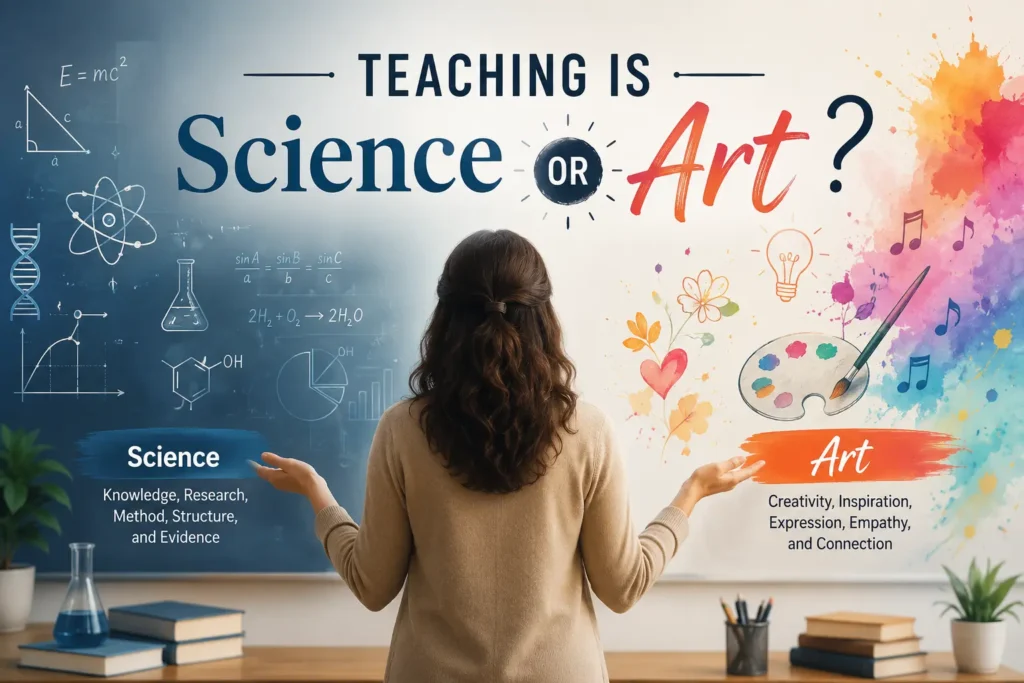
Teaching is widely understood as both a science and an art. As a science, it uses evidence-based strategies, cognitive research, and instructional design. As an art, it calls on creativity, empathy, and real-time judgment. Most education scholars today agree that great teaching needs both working together. Neither the science alone nor the art alone tells the full story of what effective teachers actually do in a classroom.
The question of whether teaching is a science or art has been debated for well over a century. Walk into any teacher training program today, and you will hear both sides of this argument. Some say teaching is a science because it follows research and data. Others say it is an art because it requires creativity and human connection.
Here is the truth: this is a false choice.
Teaching is not one or the other. It is a unique mix of both. Understanding why this matters can help teachers grow faster, plan better, and connect more deeply with their students. This article breaks down both sides clearly, introduces the key theorists behind each view, and explains what the debate means for real classrooms in 2025 and 2026.
What Does It Mean to Call Teaching a Science?
Calling teaching a science means its methods come from research and evidence. Teachers who treat their work as a science rely on what studies show about how people learn. They use strategies that have been tested, measured, and proven to work.
Nathaniel Gage, one of the most important voices in educational philosophy, wrote a landmark text in 1978 called The Scientific Basis of the Art of Teaching. His central argument was that teaching has a scientific foundation. It can be studied, improved, and standardized through research.
Examples of Teaching as a Science in the Classroom
Here are some concrete ways the science side of teaching shows up every day:
- Spaced repetition: Reviewing material across multiple sessions rather than all at once. Research shows this method strengthens long-term memory.
- Retrieval practice: Asking students to recall information from memory through quizzes. Studies confirm it boosts retention significantly more than re-reading notes.
- Scaffolding: Breaking complex tasks into smaller, supported steps so students can build skills gradually without becoming overwhelmed.
- Cognitive load theory: Designing lessons that do not overload working memory at one time. Teachers who plan with this in mind see better student performance.
- Data-driven assessment: Collecting and analyzing student work to identify gaps and adjust instruction accordingly.
These strategies come directly from cognitive science and educational psychology. They can be replicated across classrooms, schools, and grade levels. That consistency is what gives teaching its scientific character.
According to a published essay by Dennis Weisman at Kansas State University, “the science dimension is concerned with comprehensive knowledge of the subject matter” and how it connects to the learning process. Knowing what to teach and how learning happens is the scientific backbone of good instruction.
The principles of teaching build directly on this scientific foundation, providing structured guidance for how teachers can apply research in their daily practice.
What Makes Teaching an Art?
If science explains the what and the how of learning, art explains the who and the when. Teaching as an art is about the qualities that no formula can fully capture.
Elliot Eisner, a leading education theorist from Stanford University, argued that teaching involves artistry. He believed that great teachers make complex, nuanced decisions in real time that go far beyond any lesson plan or research framework. They read the room. They sense when a student is confused before that student raises a hand. They shift tone, pace, or approach without any script telling them to.
Examples of Teaching as an Art in the Classroom
The artistic side of teaching includes skills that are developed through experience, reflection, and human sensitivity:
- Storytelling: Using narrative to make abstract ideas feel real and memorable.
- Improvisation: Changing direction mid-lesson when students are not following, without losing focus.
- Emotional connection: Building trust with students so they feel safe to take risks and make mistakes.
- Cultural responsiveness: Understanding each student’s background and adapting communication style to honor it.
- Classroom presence: Commanding attention and creating an environment where students want to engage.
These qualities cannot be measured on a rubric or replicated through a checklist. They grow with time, self-awareness, and reflective practice.
Timothy Shanahan, one of the most respected voices in literacy education, put it this way: “Teaching is an act of practical reasoning, persuasiveness, problem solving, and communication. It need be shaped by science but much of it is [art].”
The characteristics of good teaching reflect exactly this blend. The most admired teachers combine strong knowledge of their subject with a warm, responsive presence that no textbook alone can teach.
Is Teaching Both an Art and a Science?
Yes. Most education scholars today agree that teaching is both an art and a science, and this is not a diplomatic compromise. It is the most accurate description of what skilled teachers actually do.
Nathaniel Gage’s own title made this clear. He did not call his book “The Science of Teaching.” He called it The Scientific Basis of the Art of Teaching, because he understood that science supports the art. Research gives teachers their tools, but art is how teachers use those tools with real students in real moments.
The University of Kansas C3BE research group identified five core teacher competencies that capture this blend beautifully: Design Thinking, the Science of Learning, Teaching for Justice, Learning to Improve, and Collaborating for Change. Together, these competencies show that effective teaching requires both systematic knowledge and creative, adaptive application.
The table below makes the distinction clear:
| Dimension | Teaching as Science | Teaching as Art |
| Foundation | Research and data | Intuition and creativity |
| Key examples | Retrieval practice, scaffolding | Storytelling, improvisation |
| Key theorist | Nathaniel Gage | Elliot Eisner |
| Core strength | Consistency and replicability | Flexibility and human connection |
| Risk if overused | Rigid, scripted instruction | Inconsistency without structure |
The strongest teachers understand that these two columns work together, not against each other. Science without art produces robotic instruction. Art without science produces engaging but ineffective teaching. The combination produces both.
Education Week published a major opinion piece in April 2026 stating: “Teaching is science when we rely on evidence-based frameworks and research, like the science of reading, scaffolding structures, and comprehension strategies.” The same article argued that the art comes in every time a teacher responds to the unexpected, connects personally, or inspires a struggling student to keep going.
Understanding this balance is central to understanding how perspectives on teaching have evolved from purely philosophical debate to a working professional framework that real educators use today.
How Has the Art vs. Science Debate Changed Over Time?
This debate is not new. It stretches back to the work of John Dewey in the late 1800s and early 1900s, who argued that education must be grounded in experience and scientific thinking, but always in service of human growth and creativity.
Here is a brief look at how the debate has developed:
- Late 1800s (John Dewey): Teaching should be both experiential and intellectually rigorous. Learning is active, not passive.
- 1978 (Nathaniel Gage): Argues for the scientific basis of teaching. Evidence-based methods gain credibility in teacher training programs.
- 1980s–1990s (Elliot Eisner): Pushes back with the artistry argument. Warns against over-standardizing teaching in ways that strip out creativity and teacher judgment.
- 2000s–2010s: Evidence-based teaching grows stronger. Bloom’s Taxonomy and Universal Design for Learning (UDL) become widely used frameworks in schools.
- 2024–2026 (Today): Two new forces are reigniting the debate.
The first is the Science of Reading movement. This growing effort to base reading instruction on cognitive research has sparked intense discussion about how much of literacy teaching should be standardized versus left to teacher judgment.
The second is artificial intelligence in education. As AI tools begin to handle more of the “science” side of teaching, such as data analysis, adaptive assessments, and content delivery, many educators are asking: what part of teaching can AI never replace? The answer, most agree, is the art.
As one popular education video from 2025 put it: “Everyone is arguing about whether teaching is an art or a science. Here is the problem: they are both right, and the debate is getting in the way.”
What Are the Practical Implications for Teachers?
Understanding the art and science of teaching is not just an academic exercise. It has real meaning for how teachers develop their practice and think about their professional identity.
Here are five practical takeaways:
- Start with the science. Use evidence-based teaching strategies as your starting point. Cognitive load theory, spaced repetition, and retrieval practice are well-researched tools that improve student outcomes. Do not rely on intuition alone.
- Trust your artistry. Research gives you a foundation, but it does not script every moment. Adapt, respond, and connect. Allow yourself to improvise when the lesson plan is not working.
- Practice reflective thinking. After each lesson, ask yourself what worked and why. Reflective practice is the bridge between science and art. It helps you learn from your experience, not just repeat it.
- Study student-centered learning. Great teaching is not about delivering content. It is about helping each student make meaning. This requires both understanding how learning works (science) and knowing each student as a person (art).
- Keep learning. Teaching effectiveness grows over time. The more you learn about pedagogy and the more experience you gain, the better you become at applying both dimensions together.
The key factors of effective teaching reinforce this point. Factors like subject mastery, classroom environment, and teacher-student relationships all reflect the dual nature of teaching as both a scientific and artistic profession.
Final Thought: Stop Choosing a Side
The question “is teaching a science or art?” is worth asking, but the wrong answer is picking just one.
Teachers who lean too far into science can become inflexible. They follow research faithfully but struggle to connect with students as human beings. Teachers who lean too far into art can be inspiring but inconsistent. They bring energy to the classroom but lack the structure that helps all students succeed.
The most effective teachers hold both in balance. They walk into class with lesson plans grounded in educational psychology. They also bring warmth, creativity, and the ability to read the room in real time. Science tells them what to do. Art tells them how to do it for this student, in this moment, on this day.
As you continue building your teaching philosophy, keep exploring the theory and practice that inform great instruction. Understanding the nature of good teaching is one of the most valuable investments you can make in your classroom career.