Arts and Craft Education: What It Is, Why It Matters, and How It Shapes Better Learners
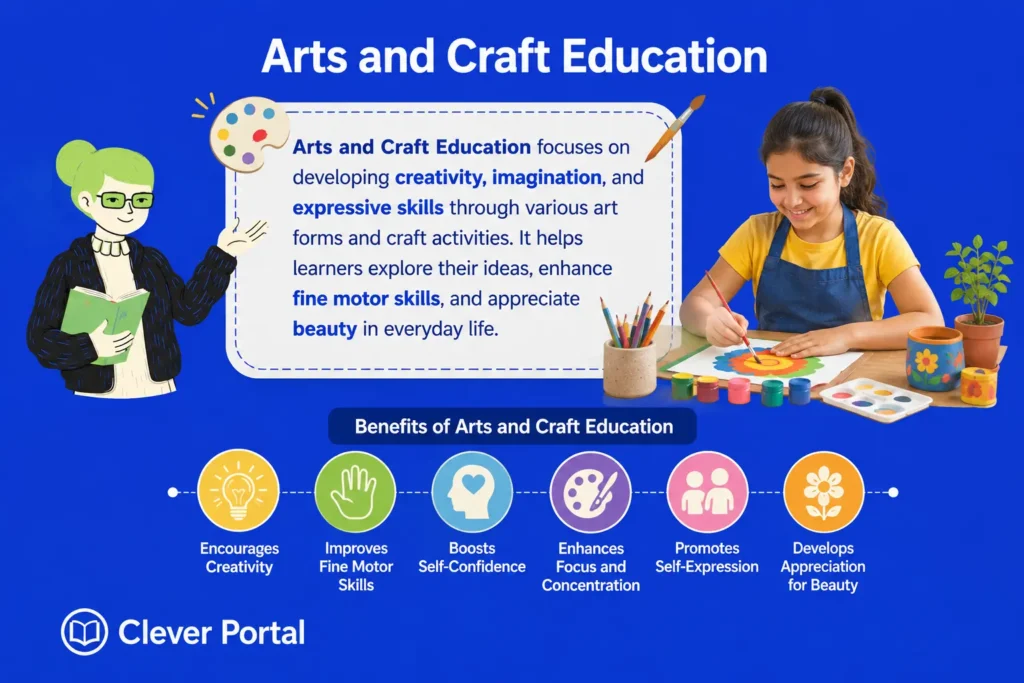
Arts and craft education integrates visual arts and handcraft activities into learning to support children’s cognitive, physical, social, and emotional development. Research consistently shows it improves critical thinking, fine motor skills, self-confidence, and academic performance across subjects. Recognized in national education frameworks like NEP 2020 and supported by bodies like the NEA and UNESCO, arts and craft education is now considered a core pillar of holistic, well-rounded schooling.
Introduction
Students with high arts participation drop out of school at just 4 percent. Their peers with low arts involvement drop out at 22 percent. That single data point from the Americans for the Arts tells a story that school budgets often ignore. Arts and craft education is one of the most powerful learning tools available to students of every age, yet it is often the first subject cut when schools face financial pressure. This guide explains what arts and craft education is, why it matters across every age group, and how research proves its impact goes far beyond the classroom.
What Is Arts and Craft Education?
Arts and craft education is the structured integration of visual arts and handcraft activities into school or home learning. It gives students a chance to create, explore, and express themselves using their hands and imagination. The term covers two related but distinct areas.
Arts education focuses on self-expression and aesthetic development. It includes drawing, painting, sculpture, and printmaking. Craft education focuses on skill-based making with physical materials. It includes weaving, pottery, paper crafts, origami, collage, and textile arts like embroidery and knitting.
In most school programs, these two areas work together. A student might paint a scene (art) and then stitch a pattern inspired by it (craft). Both approaches build different strengths, and both matter in a well-rounded creative education.
Arts and craft education is also the “A” in STEAM, which stands for Science, Technology, Engineering, Arts, and Mathematics. This connection signals that creative education is not separate from academic learning. It is central to it.
Why Does Arts and Craft Education Matter?
Arts and craft education matters because it develops skills that no other subject covers in the same way. It builds fine motor control, visual thinking, creative problem-solving, and emotional expression all at once.
Research from the Dana Arts and Cognition Consortium, which gathered findings from seven major universities, found that arts training creates measurable improvements in how children’s brains process information. Students showed stronger attention spans, better cognition, and improved learning ability across multiple subjects.
On a global scale, the K-12 arts and crafts materials market was valued at 4.0 billion dollars in 2024 and is projected to reach 4.4 billion dollars by 2030. This growth reflects rising demand from schools and homeschool families who recognize the value of creative education. National education frameworks support this view as well. India’s NEP 2020 makes art-integrated learning a core teaching method. The UK’s Ofsted has published a full art and design research review. The US National Endowment for the Arts (NEA) sets quality standards for arts curriculum inclusion. These institutions do not treat arts and craft education as optional. They treat it as essential.
What Are the Cognitive Benefits of Arts and Craft Education?
A 2025 systematic review published in PMC found that arts education significantly enhanced critical thinking, creative cognition, and analytical reasoning in students. Executive function and attention regulation, which are key skills for academic success, were also strengthened, with a statistically significant effect (beta 0.32, p less than 0.01).
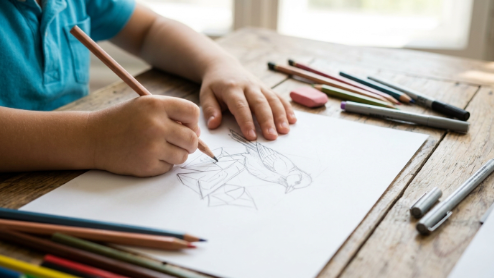
Here is a breakdown of the key cognitive development benefits:
- Critical thinking: Students plan, evaluate, and adjust their work throughout the creative process, building decision-making skills used in every subject.
- Problem-solving: Figuring out how to construct a sculpture or fix a weaving mistake requires creative thinking under real constraints.
- Memory retention: A 2018 study found that drawing information dramatically improved memory recall compared to writing or visualization alone.
- Spatial cognition: Visual arts build the ability to think in shapes and dimensions, a skill directly linked to stronger math and science performance.
- Focus and attention: Completing a detailed craft project trains children to concentrate for longer periods.
How Does Art Build Problem-Solving Skills?
Arts and craft activities require students to face challenges and find solutions on their own. When a painting does not look the way a child imagined, they must think about what went wrong and how to fix it. This process mirrors scientific and mathematical thinking. It builds a mindset that is not afraid to try again.
Visual Arts and Mathematical Thinking
Research from Johns Hopkins University and the NEA shows that students who study visual arts perform better in geometry and spatial reasoning tasks. The ability to visualize shapes, measure proportions, and plan compositions in art directly trains the same part of the brain used in math problem-solving.
How Does Arts and Craft Education Support Emotional and Social Development?
Arts and craft activities give children a healthy channel for emotional expression, which reduces stress and builds self-confidence. A 2024 study published in Frontiers in Public Health found that creating arts and crafts significantly predicted higher life satisfaction, greater happiness, and a stronger sense of purpose in participants, even after accounting for age, income, and other factors. A study from Anglia Ruskin University published in 2024 confirmed these findings, showing that regular engagement with crafting and visual arts boosts mental wellbeing in measurable ways.
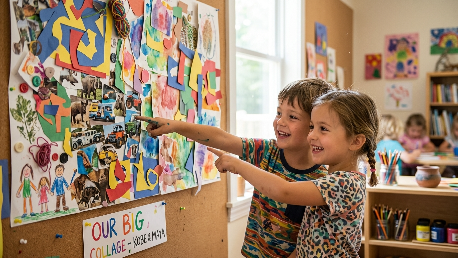
The social benefits are equally strong:
- Group art projects build communication and teamwork skills.
- Sharing art supplies teaches patience, taking turns, and cooperation.
- Discussing artwork in class develops vocabulary and confident self-expression.
- Creating cultural crafts builds awareness of and respect for different traditions and backgrounds.
Arts and craft education shares important values with other learning approaches focused on community and connection. It overlaps naturally with the goals of peace education, which focuses on building empathy, respect, and social harmony.
What Physical Skills Do Children Develop Through Arts and Crafts?
Arts and craft activities are among the most effective tools for developing fine motor skills in young children. Fine motor skills involve the small muscles in the hands and fingers that control precise movements.
These activities build specific physical skills:
- Hand-eye coordination: Painting a shape, cutting along a line, or threading a bead all require the eyes and hands to work together.
- Bilateral coordination: Using scissors or rolling clay requires both hands to work at the same time, strengthening coordination.
- In-hand manipulation: Turning a pencil, shaping clay, or folding paper trains the fingers to move objects precisely.
- Pincer grip strength: Holding a paintbrush or pencil correctly prepares young children for writing.
These are not just art class skills. They are foundational physical abilities that children need for writing, sports, daily self-care tasks, and later vocational work.
How Is Arts and Craft Education Integrated Into the School Curriculum?
Arts and craft education is increasingly embedded across subjects rather than taught only in standalone art classes. Schools and education systems around the world are finding that art-integrated learning makes all subjects more engaging and effective.
According to SCERT Delhi research cited in a 2026 journal study, schools that practice art-integrated pedagogy show higher student engagement, better comprehension, improved attendance, and reduced dropout rates. These are not minor improvements. They represent a meaningful shift in how students experience school.
Art-Integrated Learning vs. Standalone Art Class
A standalone art class teaches students specific techniques like shading, color mixing, or weaving. Art-integrated learning goes a step further. It uses arts and craft activities as tools for teaching other subjects.
Students might create maps out of clay to learn geography. They might build paper models to understand geometry. They might weave patterns to explore symmetry in math. This approach, promoted by India’s NEP 2020 and frameworks used in the UK and USA, makes learning more hands-on and memorable.
Arts and Craft in Homeschool Education
Homeschooling families are among the fastest-growing users of arts and craft educational materials. The global arts and crafts workshop market is projected to grow from 5.8 billion dollars in 2025 to 15.2 billion dollars by 2033, driven partly by families seeking structured creative learning at home. For homeschool settings, craft-based learning provides the same cognitive and social benefits as classroom programs when structured thoughtfully.
Arts and craft education in homeschooling connects meaningfully with social science education, especially when students explore cultural crafts, traditional folk art, and community-based making traditions.
What Types of Activities Are Included in Arts and Craft Education?
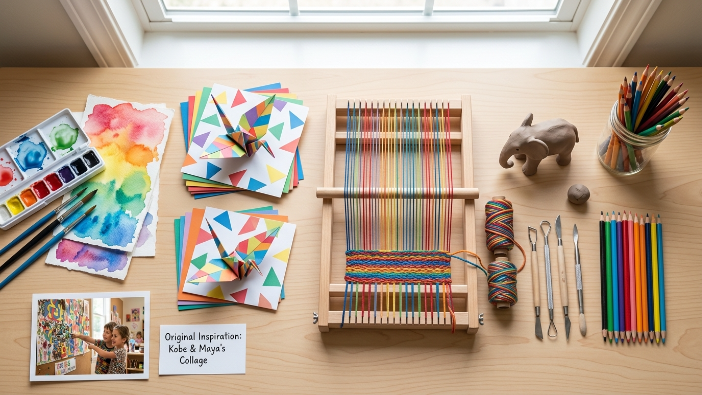
Arts and craft education covers a wide range of hands-on activities. Here is a breakdown by category:
Visual Arts Activities:
- Drawing (pencil, charcoal, ink)
- Painting (watercolor, acrylic, finger painting)
- Printmaking (stamp printing, block printing)
- Sculpture (clay modeling, papier-mache, wire sculpture)
- Collage (arranging paper, fabrics, and found objects)
Craft Activities:
- Textile arts (weaving, embroidery, knitting, felting)
- Paper crafts (origami, card making, papier-mache)
- Pottery and ceramics
- Jewelry making
- Heritage crafts (Navajo weaving, Appalachian quilting, folk art traditions)
Digital Arts (emerging in 2025 and 2026 STEAM contexts):
- Digital illustration and animation
- Graphic design using educational software
- Stop-motion video projects
Activities vary by age group. Early childhood programs use finger painting, tearing paper, and simple clay work to build motor skills. Primary school students progress to more structured painting, weaving, and paper crafts. Secondary students explore design thinking, mixed media, and cultural art traditions.
Does Arts and Craft Education Improve Academic Performance?
Yes, and the data is consistent across multiple independent studies.
Research by James Catterall tracking over 25,000 secondary students found that students with high arts engagement significantly outperformed their peers across academic measures. The Americans for the Arts reports the following:
- Low-income students with high arts participation graduate at a 4 percent dropout rate, compared to 22 percent for those with low arts participation.
- Arts students are three times more likely to win attendance awards.
- They are more likely to participate in science fairs and hold class office.
A 2024 study published in the QJSS Journal confirmed a positive correlation between participation in arts and crafts activities and overall academic achievement in a survey of 500 students. A University of Maryland study supported by the NEA found that each additional year of arts study was associated with a 20 percent reduction in the likelihood of out-of-school suspension. Better academic performance and better behavior are two direct outcomes of sustained arts and craft education.
What Career Paths Does Arts and Craft Education Support?
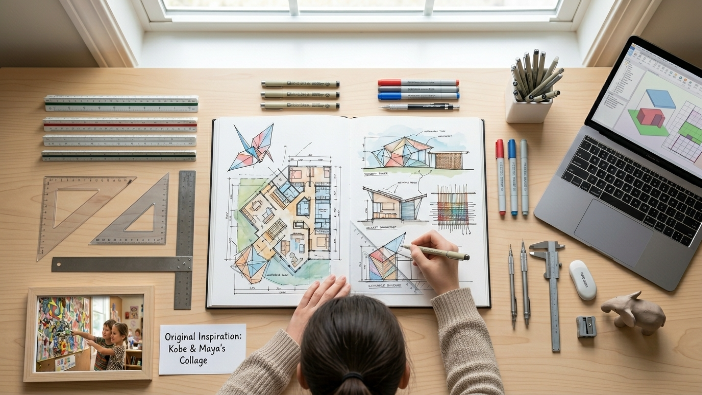
Arts and craft education builds skills that open doors across many different career paths.
Design and Creative Industries:
- Graphic designer, fashion designer, interior designer
- Industrial designer and architect
Education and Research:
- Art teacher or arts curriculum designer
- Museum curator or cultural heritage specialist
Craft Entrepreneurship:
- Independent maker or artisan business owner
- Craft workshop instructor and product designer
Technology and Digital Arts:
- Digital illustrator, animator, or game designer
- UX and UI designer
A 2025 research article from RSIS International noted that students who receive structured arts and craft education show stronger entrepreneurial thinking and a greater willingness to pursue independent creative work as adults. Many of these career paths align directly with hands-on, skill-based training, making arts and craft education a natural complement to technical and vocational education, which also prioritizes applied skills and real-world practice.
The Bigger Picture: Arts and Craft in Holistic Development
Holistic development means educating the whole child, not just their ability to recall facts and figures. Arts and craft education addresses every dimension of development at the same time.
- Cognitive: Thinking, reasoning, planning, and problem-solving
- Physical: Fine motor skills, hand-eye coordination, and bilateral control
- Emotional: Self-expression, stress relief, confidence, and resilience
- Social: Teamwork, communication, cultural awareness, and empathy
- Creative: Imagination, originality, and aesthetic sensibility
This is why institutions like UNESCO and the Arts Council England advocate for arts education at every level of schooling. It is also why art education researchers at institutions like Teachers College Columbia University have spent decades documenting its wide-ranging benefits. The connection between creative learning and other important subjects is strong. Arts and craft education reinforces the goals of religious education through cultural art forms and symbolic expression, further strengthening its place in a well-rounded curriculum.
Final Thoughts
Arts and craft education is not a luxury. It is not a reward for finishing real work. It is real work.
The evidence from the Dana Arts and Cognition Consortium, the NEA, the QJSS Journal, and Frontiers in Public Health is clear. Students who engage with arts and craft education think better, feel more confident, stay in school longer, and develop skills that serve them in every career and every area of life.
Whether it happens in a classroom with 30 students or at a kitchen table at home, creative education through visual arts and craft activities shapes more capable, more emotionally intelligent, and more engaged learners. Every child deserves access to that kind of education.
If you want to explore how arts and craft education connects to a broader curriculum, visit the complete guide on the types of education and discover the full range of approaches that shape how children learn and grow.