Origin and Meaning of Education: History, Purpose, Types and Evolution
The origin and meaning of education reach back thousands of years, long before classrooms or textbooks existed. Early humans taught children through oral stories, direct observation, and community rituals. Over time, these informal methods gave way to structured schools, written curricula, and national systems. This article covers how education began, what it truly means, how it changed across history, and why it still shapes every society today.
What Is the Meaning of Education?
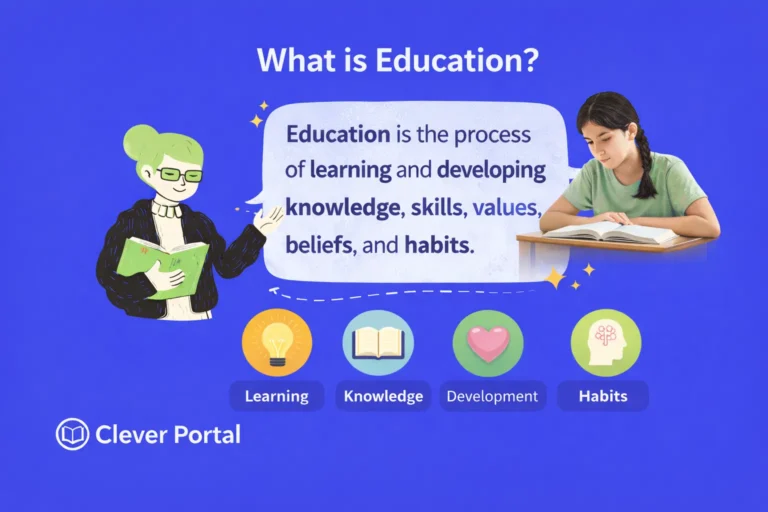
Education is the process of gaining knowledge, building skills, and developing the ability to think clearly. At its core, it is not just about school, it covers human development at every stage of life.
According to UNESCO, over 750 million adults worldwide still lack basic literacy skills. This shows how unequal access to education remains a pressing global challenge today.
To go deeper on this topic, read the full breakdown of what education is and how it differs from common assumptions about formal schooling.
Broad and Narrow Meanings
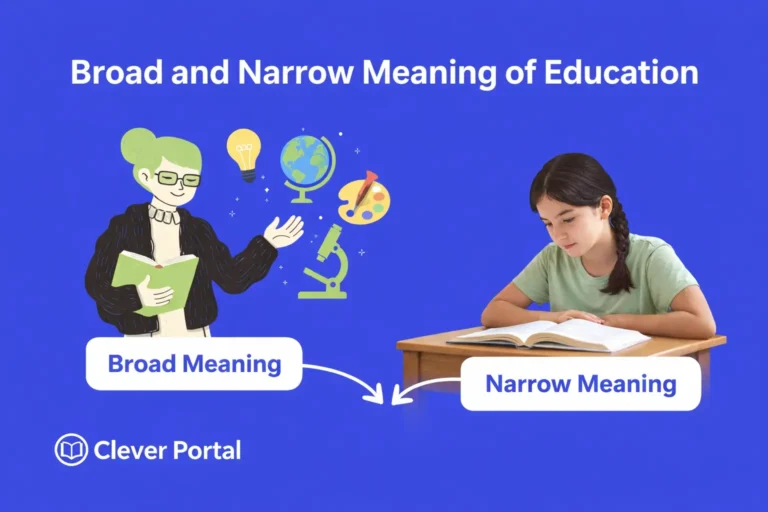
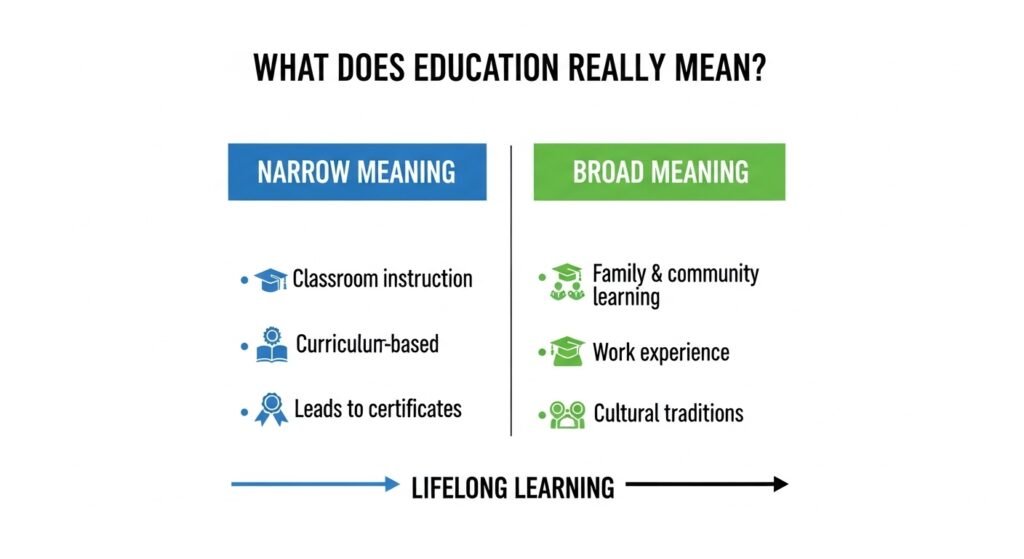
In a narrow sense, education means formal instruction in schools and universities. In a broader sense, it includes every form of learning a person undergoes throughout life.
- Narrow meaning: Structured teaching in classrooms, leading to certificates and degrees
- Broad meaning: All learning experiences, including family, culture, work, and community life
- Lifelong learning: Education that continues well past graduation into every decade of adulthood
What Is the Origin of Education?
The origin of education dates back to prehistoric times, when early humans passed survival skills through direct experience and storytelling. No written language existed yet, but knowledge still moved reliably from one generation to the next.
The first formal schools appeared around 3500 BCE in Mesopotamia. From there, education spread through Egypt, Greece, China, and India, each civilization shaping it based on their own values and needs.
In our review of historical education records, one pattern appears consistently: education has always followed the needs of society. When societies needed scribes, they trained scribes. When they needed philosophers, they built academies.
Education in Ancient Civilizations
Education in ancient civilizations developed through religious instruction, philosophical thought, and practical training. Each civilization built its own model based on what it valued most.
5 ancient civilizations and their contributions to education are listed below.
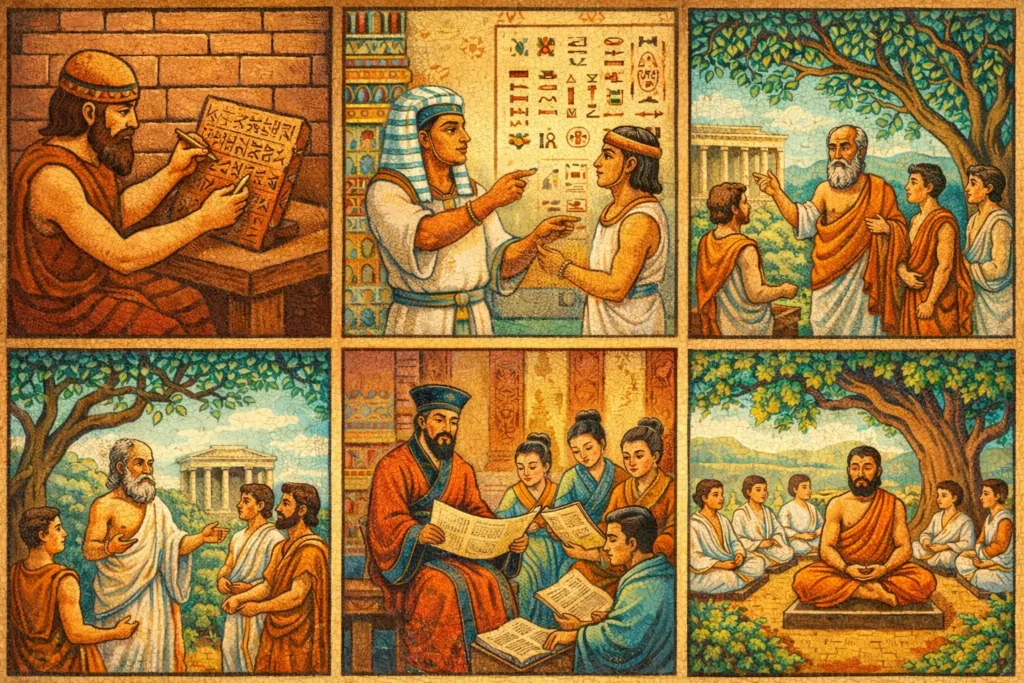
- Mesopotamia: Scribal schools trained young men to manage trade, law, and government records using early writing systems around 3500 BCE.
- Ancient Egypt: Temple schools taught Egyptian scribes mathematics, medicine, and hieroglyphics to support state and religious institutions directly.
- Ancient Greece: Philosophers like Socrates, Plato, and Aristotle built learning around questioning, debate, and philosophical inquiry rather than memorization.
- Ancient China: Confucian education stressed moral character, respect for elders, and mastery of classical texts as the path to public service.
- Ancient India: The Gurukul system placed students in a teacher’s home for years, blending spiritual, scientific, and ethical education in daily practice.
How Formal Education Systems Emerged
Formal education developed through a series of key social and political changes over several centuries. It did not appear in one moment, it was built gradually through reform and necessity.
6 milestones in the emergence of formal education systems are given below.
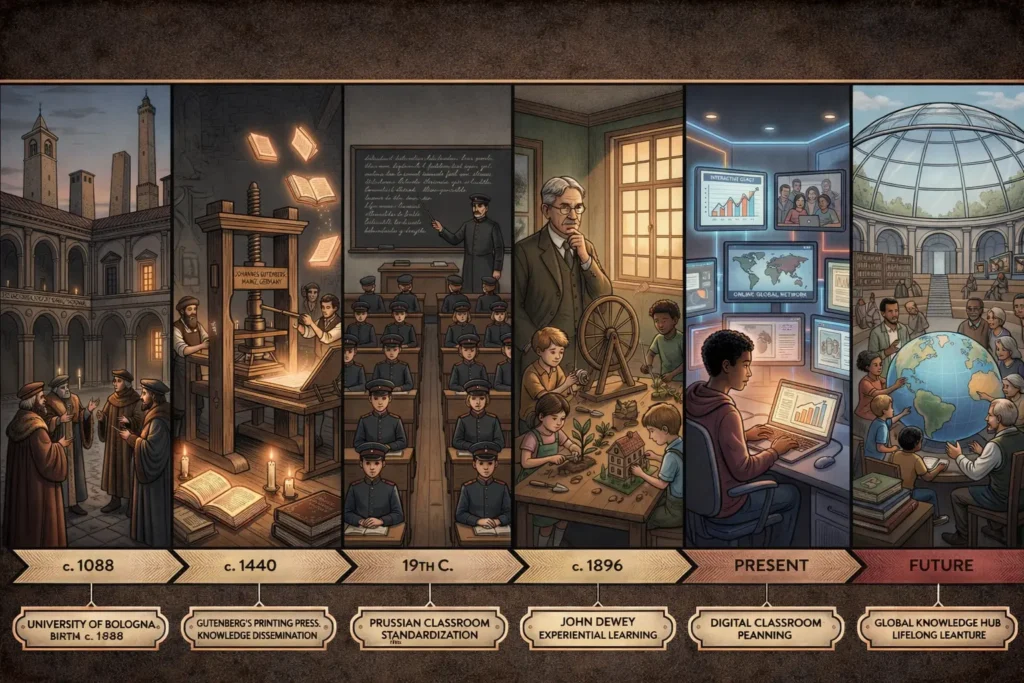
- Medieval universities (1088–1200s): Bologna and Oxford created the first degree-granting institutions, establishing a model still used in universities today.
- The printing press (1440): Gutenberg’s press made books affordable and widely available, which raised literacy rates across Europe at an unprecedented pace.
- The Prussian model (1800s): Prussia built the first national public school system with compulsory attendance and a standardized curriculum for all children.
- Compulsory education laws: Governments in Europe and North America passed laws requiring school attendance, reducing child labor and raising basic literacy rates.
- John Dewey’s reform movement: Dewey argued that children learn best through experience and problem-solving, not passive repetition of facts from a textbook.
- Digital education (2000s–present): The rise of the internet created online classrooms that reach learners in remote areas who had no access to traditional schools.
What Are the Different Types of Education?
The different types of education are defined by their structure, setting, and purpose. Each type serves a different group of learners and a different stage of life.
Research from the World Bank shows that non-formal education programs raise youth employment rates by up to 23% in developing countries. This confirms that formal schooling is far from the only path to meaningful learning outcomes.
6 types of education and their key characteristics are listed below.
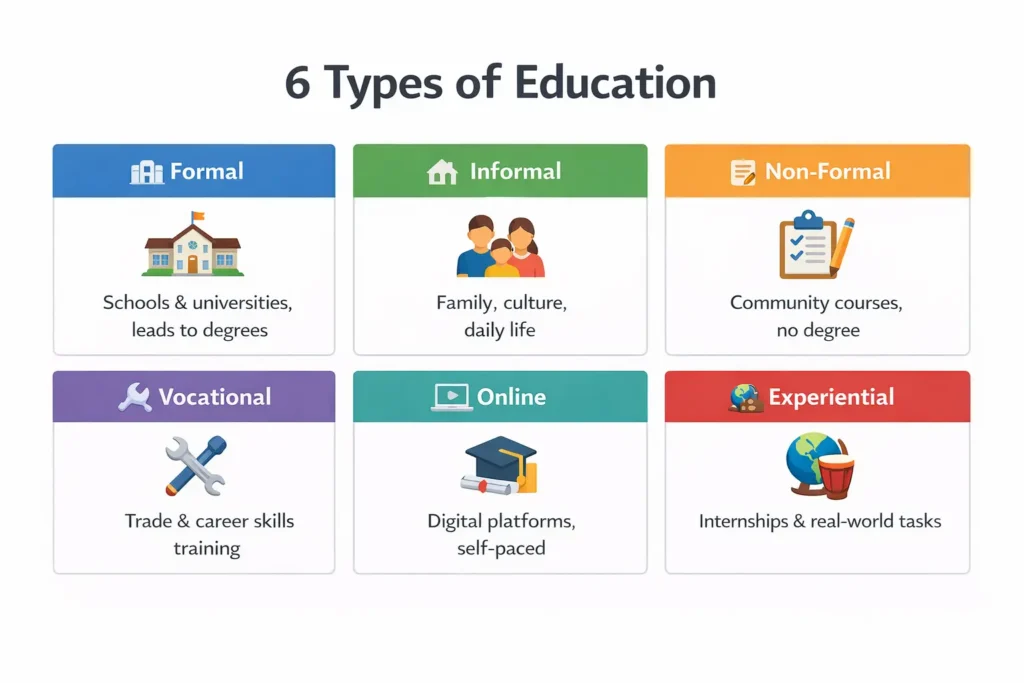
- Formal education: Delivered in schools and universities, following a set curriculum and leading to recognized qualifications and credentials.
- Informal education: Happens naturally through family life, community experience, and personal curiosity with no set structure or certification required.
- Non-formal education: Organized learning outside schools, such as adult literacy courses, trade workshops, and community training programs with no degree.
- Vocational training: Focuses on practical career skills for specific trades like healthcare, construction, or information technology fields.
- Online education: Delivered through digital platforms, allowing learners to study at their own pace from any location worldwide.
- Experiential learning: Built around real-world tasks like internships, fieldwork, and project assignments that connect academic theory to daily practice.
Formal vs. Informal Education
Key differences between formal and informal education are given below.
- Structure: Formal education follows a set curriculum; informal education has no fixed plan or sequence
- Setting: Formal education takes place in accredited institutions; informal education happens in homes and communities
- Certification: Formal education leads to recognized degrees; informal education produces no official credential
- Pacing: Formal education follows a fixed timetable; informal education is self-paced and open-ended
- Control: Formal education is managed by institutions; informal education is shaped entirely by lived experience
What Is the Purpose of Education?
The purpose of education is to prepare people to think clearly, live well, and contribute to their communities. It serves both personal and social goals at the same time.
At a personal level, education builds critical thinking, self-reliance, and career readiness. At a social level, it reduces poverty, supports civic participation, and creates shared values across generations.
According to the World Bank, each extra year of schooling raises a person’s earning potential by 8–10% on average. This shows the direct link between access to education and long-term economic opportunity.
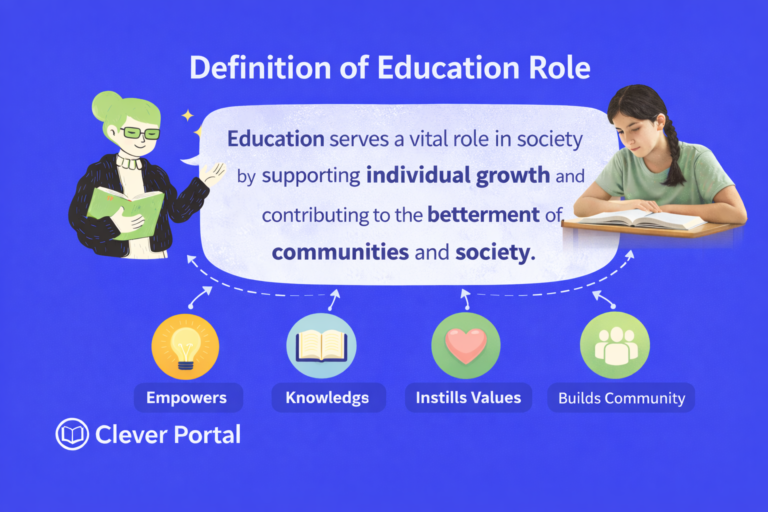
For a broader view, the guide on the definition of education and its role explores how learning shapes both individuals and entire societies across history.
Social and Economic Benefits of Education
7 social and economic benefits of education are outlined below.
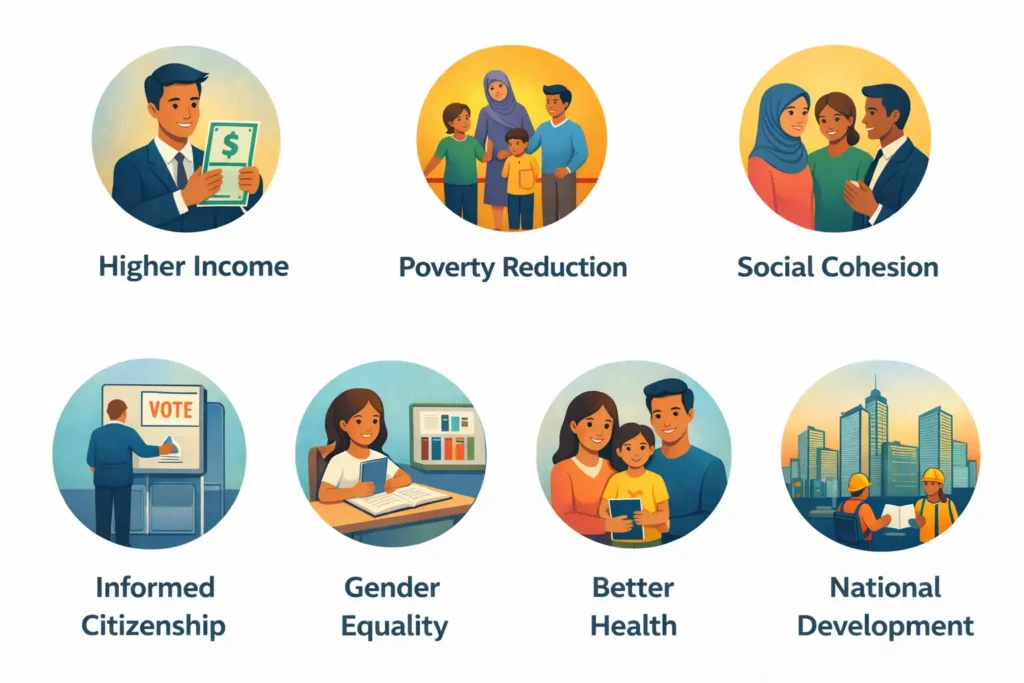
- Higher income: Educated individuals earn significantly more over their lifetimes than those without recognized qualifications.
- Poverty reduction: Education gives people practical skills and choices, breaking cycles of poverty across generations.
- Social cohesion: Shared educational experiences build mutual respect and understanding among groups from different backgrounds.
- Informed citizenship: Education helps people engage critically with politics, vote responsibly, and hold governments accountable for their decisions.
- Gender equality: Educating girls reduces inequality, improves child health outcomes, and raises household income in developing regions.
- Better health outcomes: Educated individuals make healthier decisions, which leads to longer lives and lower rates of preventable disease.
- National development: A well-educated workforce drives productivity, technological progress, and long-term economic growth for entire nations.
What Are the Key Philosophies of Education?
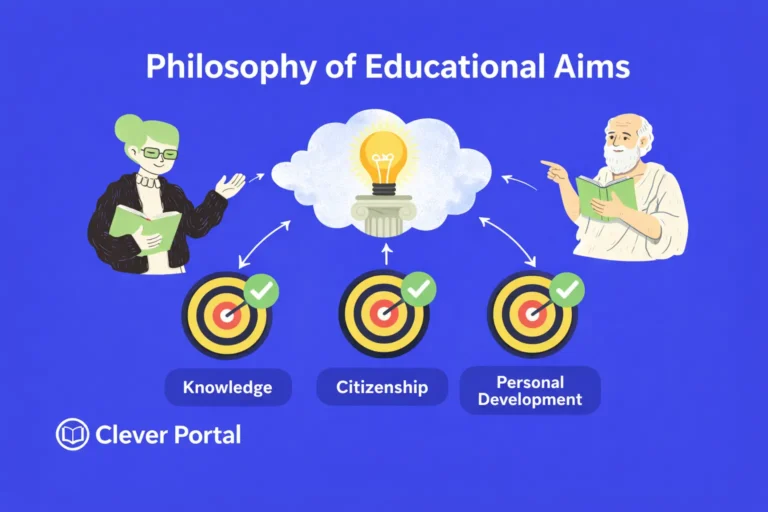
The key philosophies of education are systems of thought that define what education is for and how it should be delivered. Each one reflects a different set of values about human nature and the role of society.
Based on our review of educational philosophy literature, most modern classroom practices draw from at least two of these traditions, often without teachers recognizing the influence directly.
5 major philosophies of education are listed below.
- Perennialism: Education should focus on timeless truths and classic works that apply to all eras and all people equally.
- Essentialism: A core set of skills, reading, writing, mathematics, science, must be taught to every student without exception.
- Progressivism: Students learn best through experience, inquiry, and hands-on problem-solving rather than passive listening in a classroom.
- Constructivism: Learners build their own understanding by connecting new ideas to what they already know from personal experience.
- Montessori method: Children learn best in a prepared environment where they choose their own activities and manage their own learning pace.
For a detailed breakdown, read the full guide on philosophy of educational aims and how each framework shapes curriculum design today.
How Philosophies Shape Modern Teaching
5 ways educational philosophies shape modern teaching methods are listed below.
- Inquiry-based learning: Rooted in progressivism, this method encourages students to ask questions and investigate answers rather than receive facts passively.
- Socratic questioning: Teachers ask layered questions to push students to think more deeply and justify their own reasoning step by step.
- Project-based learning: Students complete real-world projects that require applying knowledge from multiple subjects at the same time.
- Differentiated instruction: Teachers adjust tasks and pacing to match each student’s individual needs, strengths, and preferred learning style.
- Critical pedagogy: Students are taught to question social norms, power structures, and the assumptions built into the subjects they study.
Common Misconceptions About Education
The common misconceptions about education are widely held beliefs that limit how people understand what learning really is and who it is for.
Many of these myths come from confusing schooling with education, or assuming that intelligence is fixed and cannot grow. Based on studies in educational psychology, these misconceptions actively discourage learners from pursuing growth beyond formal systems.
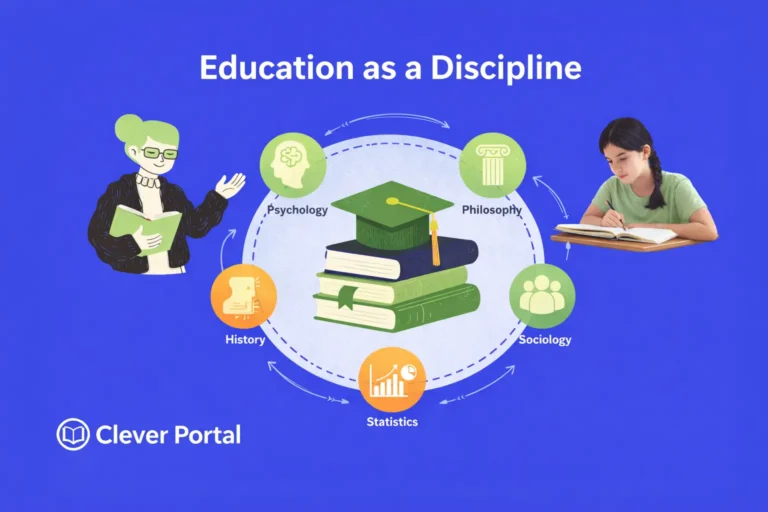
For a broader perspective, the article on education as a discipline explains how education functions as a formal field of study, separate from everyday classroom instruction.
7 common misconceptions about education and the truth behind them are listed below.
- Education equals schooling: Education happens throughout life, not only inside a classroom during school years.
- Memorization equals learning: True learning means understanding, applying, and connecting ideas, not repeating facts on demand.
- Intelligence is fixed: Neuroscience research shows the brain keeps developing with effort, practice, and the right kind of support.
- Credentials matter more than skills: Employers increasingly value practical ability, problem-solving, and real-world experience over formal degrees alone.
- One teaching method works for everyone: Every learner is different; effective teaching adjusts to individual needs rather than one fixed approach.
- College is the only path to success: Vocational training, self-directed learning, and entrepreneurship have produced highly capable individuals across many fields.
- Grades measure intelligence: Grades reflect performance under specific test conditions, not overall ability, creativity, or a person’s long-term potential.
Education vs. Schooling
Education and schooling are often treated as the same thing, but they are not. Schooling is the structured, institution-based period a person attends from childhood into early adulthood. Education is far broader, it is a lifelong process of growing and developing through every experience, whether inside a school or far beyond it. A person stops attending school, but they never stop being educated.
Education in the Modern World

The meaning of education in the modern world now includes digital literacy and 21st-century skills alongside traditional academic subjects. Technology has made learning reachable for anyone with an internet connection. Remote education and digital libraries now reach learners who would never have accessed formal schooling a generation ago.
Frequently Asked Questions
What is the origin and meaning of education?
The origin of education traces back over 5,000 years to ancient Mesopotamia, Egypt, and Greece, where knowledge passed through oral tradition and scribal training. Education means the planned transfer of knowledge, values, and skills from one person or generation to another. It began as survival training and developed into the formal and digital learning systems used worldwide today.
What does education mean in simple terms?
Education is the process of learning knowledge and skills through study, experience, or teaching. It helps people think clearly, make sound decisions, and contribute meaningfully to their communities. Education happens in a school, at home, at work, or anywhere a person encounters something new and worth understanding.
When did formal education begin?
Formal education began around 3500 BCE in Mesopotamia, where the first scribal schools trained students in reading and writing. Ancient Egypt, Greece, China, and India each developed their own formal systems shortly after. The first universities appeared in Europe during the 11th century, starting with the University of Bologna in 1088.
What is the difference between education and schooling?
Schooling refers to the structured, time-bound period of learning a person undergoes inside a formal institution. Education is broader, it includes all forms of learning throughout a person’s entire life, whether formal or not. A person finishes schooling, but education continues for the rest of their life through experience and self-directed growth.
Why is understanding the origin of education important?
Understanding the origin of education reveals why current systems are built the way they are. Many features of modern schooling, grade levels, standardized tests, teacher-led classrooms, trace directly to decisions made centuries ago. Knowing this history creates space to question what is working and improve what is not.
What are the main types of education?
The three main types are formal, informal, and non-formal education. Formal education happens in accredited schools and leads to credentials. Informal education happens through daily life and family experience with no fixed structure. Non-formal education is organized but sits outside the traditional school system, such as adult training or community literacy programs.
What is the purpose of education in society?
Education prepares individuals to think, work, and participate in civic life. It reduces poverty, builds shared cultural values, and drives economic growth across generations. At the societal level, education is one of the strongest predictors of a country’s long-term development, health outcomes, and political stability.
Conclusion
The origin and meaning of education show that learning has always been central to human survival and progress. From ancient oral traditions to digital classrooms, education has changed its form while keeping its core purpose: helping people grow and contribute to the world around them.
Three key takeaways from this article:
- Education began thousands of years before formal schools existed
- Its meaning goes far beyond classroom instruction, it covers lifelong human development
- Understanding its history helps build better and more equal learning systems for the future
Start by asking what education truly means in your own life, not just as a student in school, but as a learner in every room you walk into.