Origin and Meaning of Education: A Complete Guide
The word “education” comes from the Latin roots educare (to bring up or nourish) and educere (to lead out or draw forth). Formal education first appeared in ancient Egypt and Mesopotamia around 3000 BCE. Over centuries, philosophers like Socrates, Plato, Aristotle, and John Dewey expanded its meaning beyond simple instruction to include character development, critical thinking, and the full growth of human potential.
The word “education” holds a secret inside it. That secret is a 2,500-year-old disagreement about what learning really means. Does education mean shaping a person from the outside? Or does it mean drawing out what is already inside them? The answer depends on which Latin root you choose. This article explores the full origin and meaning of education, from its earliest Latin roots to ancient classrooms in Egypt and Greece, to the big ideas of philosophers who changed how the world thinks about learning.
What Is the Latin Origin of the Word “Education”?
The word “education” entered the English language in the 1530s. It originally meant “child-rearing” and was also used to describe the training of animals. By the 1610s, its meaning shifted to “systematic schooling and training for work.”
The word came into English from the French education, which appeared in the 14th century. But the French word itself came from the Latin educationem, which described the act of rearing or training a person.
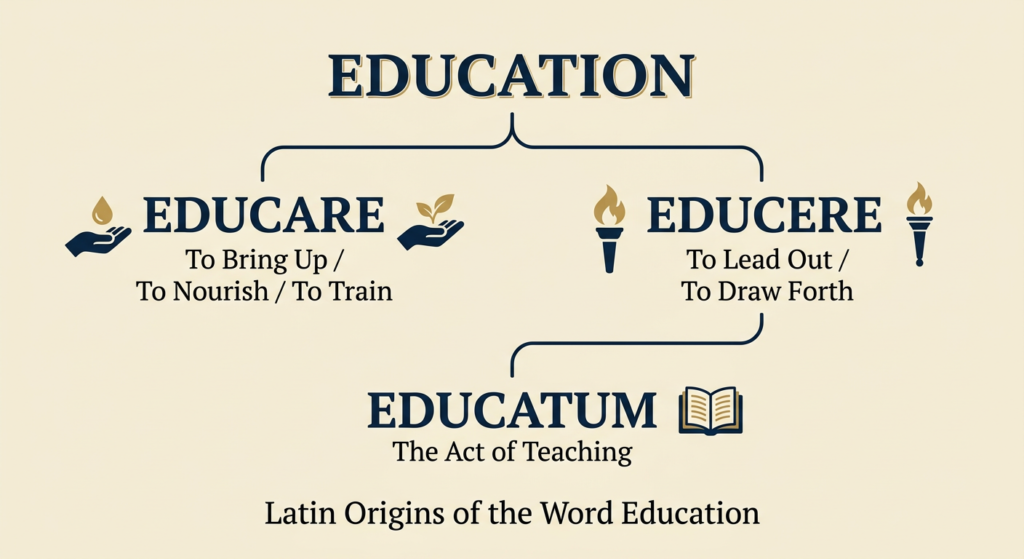
The word “education” traces back to two Latin roots: educare and educere, each representing a different philosophy of teaching and learning.
The three Latin roots of education are:
- Educare* means “to bring up,” “to nourish,” or “to train.” It suggests that a teacher molds a student, shaping knowledge and values from the outside.
- Educere* means “to lead out” or “to bring forth.” It comes from the prefix ex (meaning “out”) and ducere (meaning “to lead”). This root suggests drawing out the hidden potential already inside a learner.
- Educatum* refers to “the act of teaching or training.” It emphasizes education as a deliberate process with a clear purpose.
Together, these three roots paint a rich picture. Education is not just about filling a student with facts. It is about nurturing growth, drawing out inner ability, and guiding a person through a purposeful process of learning.
What Is the Difference Between Educare and Educere?
These two Latin roots are not just different words. They represent two entirely different ideas about what education should do.
Educare places the teacher at the center. The educator brings knowledge to the student, trains habits, and builds discipline. This approach values structure, repetition, and a clear curriculum. Most traditional schools follow this model, where teachers instruct and students absorb.
Educere places the student at the center. The teacher’s job is not to pour knowledge in but to draw understanding out. This view holds that every student already has potential waiting to be discovered. Progressive educators like John Dewey built their entire philosophy on this idea.
This simple difference in Latin roots helps explain a debate that has shaped education for hundreds of years. Should schools focus on teaching content, or on developing thinkers? The best education systems try to do both.
Where Did Education Originate in History?
Formal education did not begin with schools as we know them today. It began with the invention of writing, which created a need for trained people who could read, record, and communicate. As civilizations grew more complex, passing knowledge by word of mouth was no longer enough.
Education in Ancient Egypt and Mesopotamia
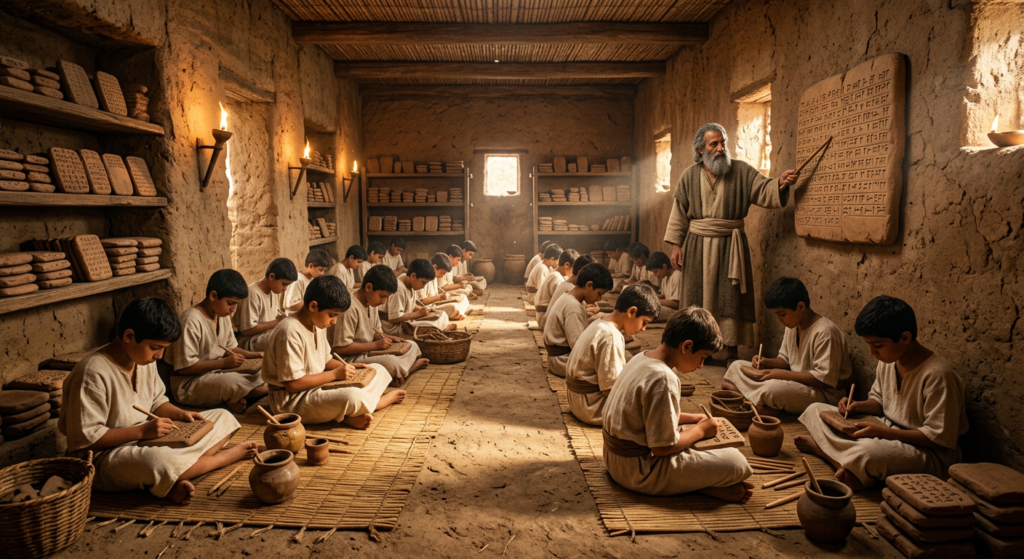
The earliest known formal school was developed in ancient Egypt’s Middle Kingdom under the direction of Kheti, treasurer to Mentuhotep II, who ruled from 2061 to 2010 BC.
This ancient Egyptian student writing board, marked with a teacher’s corrections in red ink, is one of the earliest physical records of formal classroom instruction in human history.
In Mesopotamia, the Sumerian civilization established scribe schools around 3000 BCE. Students in these schools learned writing, arithmetic, and literature. Education was practical and focused on training scribes and priests. It extended from basic reading and writing to higher learning in law, medicine, and astrology. Youth from upper-class families were prepared to become scribes, who worked as copyists, librarians, and teachers.
Egyptian educators also developed two types of formal schools for privileged youth. One type was supervised by government officials, and the other was run by priests. The temple library was the center of intellectual activity in both Egypt and Mesopotamia. Methods of teaching included memorization, oral repetition, and copying texts by hand.
Education in Ancient China and India
The first formal education system in ancient China was created during the Xia dynasty, which lasted from around 2076 to 1600 BC. These schools taught aristocrats rituals, literature, archery, and civic responsibilities.
In ancient India, education was primarily passed through the Vedic and Buddhist learning systems. Knowledge was transmitted through sacred texts, oral recitation, and close relationships between teachers and students.
Education in Ancient Greece and Rome
Ancient Greece changed the idea of education in a powerful way. The Greeks, especially in Athens, introduced a broader curriculum that included philosophy, rhetoric, mathematics, music, and physical education.
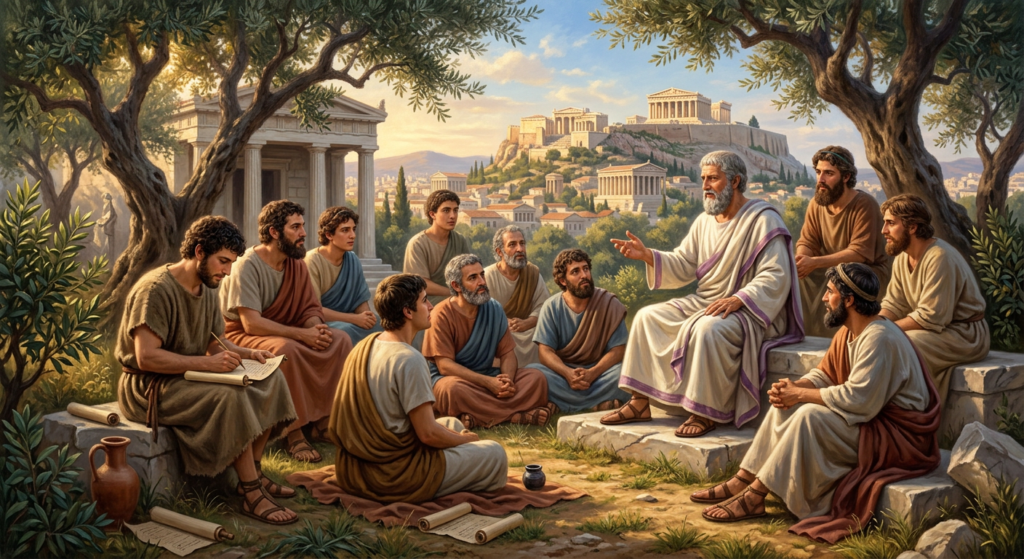
Plato’s Academy, founded in Athens around 387 BC, is widely considered the first institution of higher learning in the Western world, shaping the philosophy of education for centuries.
Plato founded the Academy in Athens around 387 BC. It is widely considered the first institution of higher learning in the Western world. Aristotle studied there for twenty years before founding his own school, the Lyceum. Plato was the first person to describe a complete and systematic philosophy of education.
In ancient Rome, the first schools appeared around the mid-4th century BC. Roman education was influenced by the Greeks but placed greater emphasis on law, agriculture, and practical subjects. Literacy rates were extremely low in early Rome. In the 3rd century BC, only about 1 to 2 percent of the Roman population could read or write.
How Did Philosophers Define the Meaning of Education?
Great thinkers across history have offered their own definitions of education. Each definition reflects the values and needs of its time, but together they show how the meaning of education has always reached beyond simple instruction.
Here are five key definitions from influential philosophers:
Socrates believed that education means “bringing out the ideas of universal validity latent in the mind of every man.” For Socrates, real learning was a process of discovery, not delivery. He used questions to guide students toward understanding, a method known as the Socratic method.
Plato defined education as developing “all the beauty and all the perfection” a person is capable of in both body and soul. He believed education should prepare individuals to understand truth, goodness, and beauty. His Academy became a model for higher learning for centuries.
Aristotle described education as “the creation of a sound mind in a sound body.” He believed education develops a person’s faculties, especially the mind, so that they may enjoy the contemplation of supreme truth, goodness, and beauty. Aristotle also believed that education should prepare people for life in a just society.
Jean-Jacques Rousseau argued that “education is the child’s development from within.” He believed that children are naturally good and that education should protect and nurture that natural goodness, not overwrite it with rigid rules.
John Dewey, one of the most influential educators of the modern era, defined education as the development of all capacities in the individual to control their environment and fulfil their responsibilities. Dewey believed that children learn best by doing, through hands-on experiences connected to real life. He emphasized educating the whole child, including intellectual, social, emotional, and ethical growth.
How Has the Meaning of Education Changed Over Time?
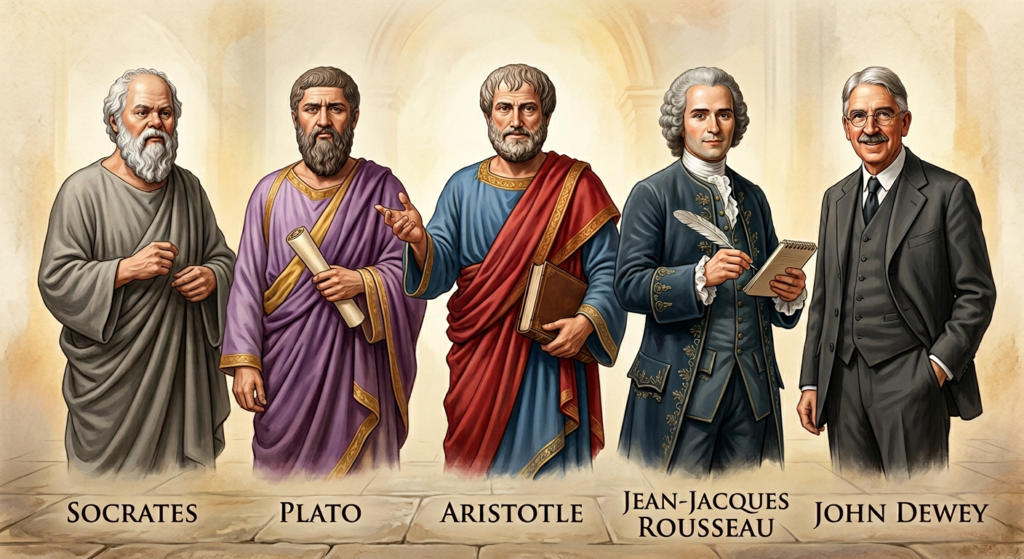
By the mid-20th century, the progressive education movement inspired by John Dewey had transformed classroom learning from rote memorization to student-centered, experience-based instruction.
Education did not stay the same across history. It changed as societies changed, and its meaning expanded with every major shift in human civilization.
In the earliest civilizations, education was reserved for the elite. Only priests, scribes, and the children of rulers received formal instruction. Most people learned practical skills from their parents, not from teachers.
The invention of the printing press in the 15th century was a turning point. Books became more widely available, and knowledge was no longer locked inside temples or wealthy households. By the 15th century, roughly one-third of the population in England could read and write.
The Renaissance period brought a new focus on humanism, the arts, and critical thinking. Education began to be seen as a path to individual growth, not just civic or religious duty.
The Industrial Revolution changed education again. As factories replaced farms, there was a growing need for a skilled workforce. Public schooling systems were established across Europe and North America, shifting education from a privilege to a public good. Subjects like science, mathematics, and technology became central.
In the 20th and 21st centuries, education expanded further to include lifelong learning, informal education, non-formal education, and digital learning. UNESCO and other international organizations began debating education’s “essential mission” in the modern world, recognizing that its meaning is one of the most important and least discussed aspects of global development.
Today, the transmission of knowledge, character development, and social responsibility are all considered essential components of what education entails.
What Does Education Really Mean Today?
Looking at all three Latin roots, the long history of formal education, and the ideas of great philosophers, a clear modern meaning begins to take shape. Education today is both a process and an outcome. It is the purposeful act of developing knowledge, skills, values, and character in a person so they can understand and shape the world around them.
The tension between educare and educere is still very much alive. Standardized testing, fixed curricula, and structured lessons reflect the educare model. Project-based learning, student choice, and experiential education reflect the educere model. The best schools and teachers find a balance between both.
What began as scribe training in ancient Mesopotamia and aristocratic instruction in Athens has become a universal human right. The word “education” has grown with humanity, and its meaning continues to evolve as the needs of society change.
Frequently Asked Questions
What is the origin of the word “education”?
The word “education” originates from the Latin roots educare (to bring up or nourish) and educere (to lead out or draw forth). It entered the English language in the 1530s, originally meaning child-rearing. By the 1610s, it came to mean systematic schooling and training for work.
What does educare mean in Latin?
Educare means “to bring up,” “to nourish,” or “to train.” It reflects an instructor-led model of education where the teacher shapes the learner through guidance, structure, and discipline. This root emphasizes forming character and habits from the outside.
What is the difference between educare and educere?
Educare means to mold or train a learner from the outside, while educere means to draw out or lead forth what is already latent within the learner. Together, they represent the two main philosophies of education: teaching as direct instruction versus teaching as facilitation of discovery.
When did formal education first begin?
Formal education first emerged in ancient Mesopotamia and Egypt around 3000 BCE, driven by the need to train scribes in newly developed writing systems. The earliest known formal school was established in Egypt’s Middle Kingdom between 2061 and 2010 BC under Kheti, treasurer to Mentuhotep II.
What did Plato say about the meaning of education?
Plato defined education as developing “all the beauty and all the perfection” a person is capable of in both body and soul. He founded the Academy in Athens around 387 BC, considered the first institution of higher learning in the Western world, and was the first thinker to describe a complete philosophy of education.
How has the meaning of education changed over time?
Education began as elite scribal training in ancient civilizations. The printing press in the 15th century democratized knowledge. The Industrial Revolution made public schooling widespread. In the 20th and 21st centuries, education expanded to include lifelong learning, digital learning, and both formal and informal education for all people.
What is the true meaning of education?
The true meaning of education combines both Latin roots. It is a purposeful process of nurturing growth (educare) and drawing out inner potential (educere). It involves the transmission of knowledge, the development of character, and the preparation of individuals to understand, contribute to, and shape their world.
Understanding where education comes from helps us appreciate what it can become. The word itself has always carried more meaning than most people realize, and that meaning grows deeper the more you explore it. If you want to go further, read our complete guide to the aims of education and discover how these foundational ideas shape what we teach and why.