Broad and Narrow Meaning of Education: A Complete Guide
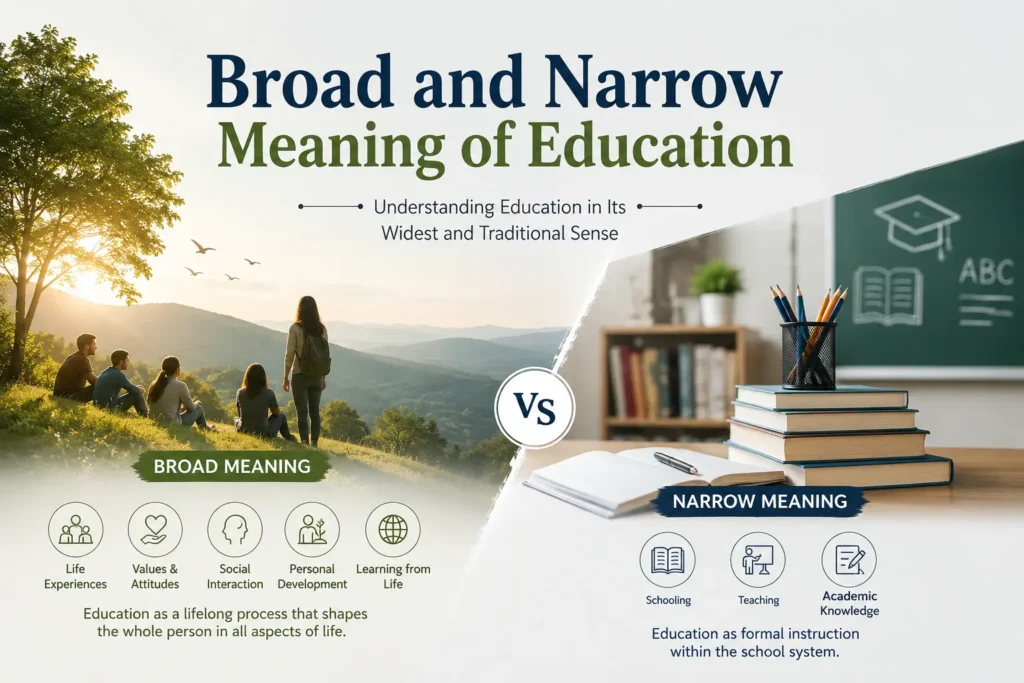
Education has two key meanings. In the narrow sense, education means formal schooling inside schools and universities, where teachers follow a set curriculum and students earn grades and degrees. In the broad sense, education is a lifelong process that includes every experience shaping a person from birth to death. Both meanings are equally important and work together to build a complete, well-rounded human being.
Introduction
Think about the last time you learned something truly valuable. Was it from a textbook, or was it from a conversation, a mistake, or watching someone you respect?
That question sits at the heart of a key debate in the philosophy of education. When we talk about the broad and narrow meaning of education, we are really asking: what counts as education? Does it only happen in school, or does it happen everywhere, all the time?
This guide breaks down both meanings clearly. You will find classical definitions from well-known education theorists, a full comparison, real-world examples, and a look at why this distinction matters more than ever in 2026.
What Is Education?
The word “education” comes from two Latin roots. The first is educere, which means “to lead out.” The second is educare, which means “to bring up” or “to nourish.” Both roots point to the same idea: education is about drawing out the best in a person and helping them grow.
UNESCO defines education as any act or experience that has a formative effect on the mind, character, or physical ability of an individual. In simple terms, education shapes who we are. It covers both structured classroom learning and the countless lessons life teaches us outside school walls.
Educators and philosophers have long debated how wide or narrow this definition should be. That debate gave us the two core perspectives we will explore next.
What Is the Narrow Meaning of Education?
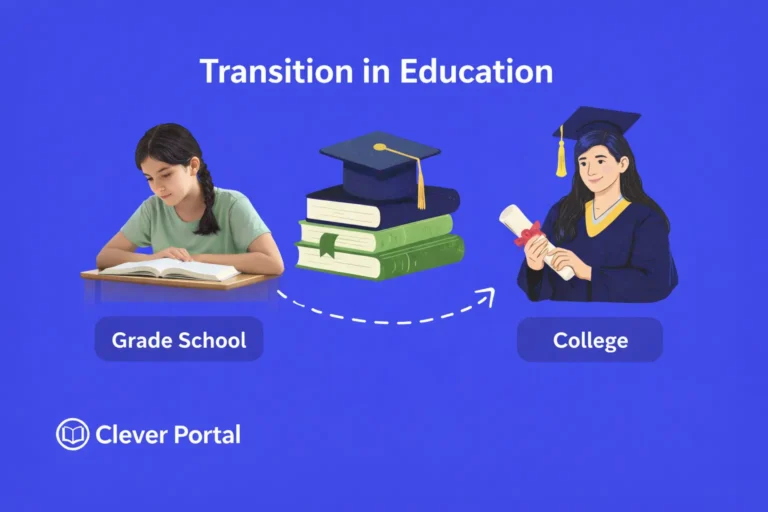
In the narrow sense, education means formal, planned instruction that takes place inside a school, college, or university. It begins when a child enters school and ends when they complete a set course of study with a certificate or degree.
T. Raymont gave one of the most widely cited definitions of education in the narrow sense. He wrote: “In the narrower and more definite sense, education does not include self-culture and the general influences of one’s surroundings, but only those special influences which are consciously and designedly brought to bear upon the young.”
S.S. Mackenzie defined it this way: “In the narrow sense, education may be taken to mean any consciously directed effort to develop and cultivate our powers.”
Both definitions highlight three key ideas. The process is deliberate. It is controlled by someone in authority, usually a teacher or institution. And it targets specific, measurable outcomes.
Key Features of Education in the Narrow Sense
- It takes place in a structured setting like a school or college
- A trained, certified teacher leads the instruction
- A fixed curriculum sets what students must learn
- Learning is time-bound, from school admission to graduation
- Outcomes are measured through exams, grades, diplomas, or degrees
- Knowledge is pre-selected and delivered in a planned sequence
- The student plays a mostly passive, receiving role
- Progress is tracked and formally recognized by an institution
This form of education provides the foundation of core knowledge, professional credentials, and structured cognitive development that societies depend on.
What Is the Broader Meaning of Education?
The broader meaning of education is far more expansive. It treats education as a continuous, lifelong process that goes well beyond the four walls of a classroom. Every experience, interaction, and environment that shapes a person’s growth counts as education in this wider sense.
Prof. Dumville captured this perfectly when he wrote: “Education in its wider sense includes all the influences which act upon an individual during his passage from the cradle to the grave.”
J.S. Mackenzie expanded on this view by stating: “In the wider sense, it is a process that goes on throughout life, and is promoted by every experience in life.”
Lodge added perhaps the most memorable definition: “All experiences are said to be educative. Whatever broadens your horizon, deepens your insight, refines your reactions, and stimulates thought and feeling educates us.”
These definitions show that the broader meaning of education is not anti-school. Rather, it places formal schooling inside a much larger picture of human learning and all-round personality development.
The Three Types of Education Within the Broader Meaning
Formal Education is the planned, structured learning that takes place in schools, colleges, and universities. It follows a set curriculum and leads to recognized qualifications. In the broader view, it is just one part of a much larger whole.
Non-formal Education includes organized learning that happens outside official school systems. Community programs, adult literacy classes, online courses, vocational training centers, and after-school clubs all fall here. It is intentional but flexible, and it does not always lead to formal credentials.
Informal Education is the unplanned, spontaneous learning that happens through everyday life. A child learning to share by playing with friends, a teenager picking up cooking skills from a parent, or an adult developing patience through years of experience are all clear examples of informal education.
Key Features of Education in the Broader Sense
- It is a lifelong process with no fixed start or end point
- It happens everywhere: at home, in the community, at work, and online
- Learning is often self-directed and driven by curiosity or need
- Anyone can be the teacher: a parent, a peer, a mentor, or even a situation
- There is no single curriculum; the content of learning is whatever life presents
- Outcomes include wisdom, values, emotional intelligence, and adaptability
- It supports the holistic development of personality, not just academic skills
Narrow vs. Broad Meaning of Education: Side-by-Side Look
The table below compares both meanings across ten key aspects. This is especially useful for B.Ed students and anyone studying the scope of education or preparing for philosophy of education exams.
| Aspect | Narrow Meaning | Broader Meaning |
|---|---|---|
| Definition | Formal schooling and deliberate instruction | All life experiences that shape growth and character |
| Duration | From school entry to graduation | From birth to death (lifelong learning) |
| Location | Schools, colleges, and universities only | Home, community, work, digital spaces, everywhere |
| Aim | Pass exams, earn degrees, gain specific skills | Holistic development of personality and human potential |
| Method | Teacher-directed, curriculum-based instruction | Experiential, self-directed, and social learning |
| Content | Pre-set, standardized academic curriculum | The full range of all life experiences |
| Measurement | Grades, diplomas, and certificates | Personal growth, values, character, and adaptability |
| Teacher | Trained and certified educator | Anyone: parents, peers, community, environment |
| Nature | Planned, controlled, and deliberate | Natural, spontaneous, and ongoing |
| Key Philosophers | T. Raymont, S.S. Mackenzie | J.S. Mackenzie, Prof. Dumville, Lodge |
Why Does This Distinction Matter Today?
Understanding the difference between narrow and broad education is not just an academic exercise. It has real importance for learners, teachers, and policymakers in 2026.
A World Changing Faster Than School Can Keep Up
UNESCO data shows that over 244 million children and young people currently remain out of school globally. For millions of people, formal schooling is simply not available or accessible. The broader meaning of education reminds us that learning does not stop when school is unavailable. Communities, families, and lived experiences continue to educate even when formal institutions cannot.
At the same time, the World Economic Forum projects that nearly 50 percent of the global workforce will need to reskill or upskill due to rapid changes in technology and industry. A narrow view of education, one that stops at a graduation certificate, cannot meet this challenge. The lifelong learning framework within the broader meaning of education is now an economic necessity, not just a philosophical ideal.
What It Means for Classroom Teachers
Teachers who understand the broad concept of education bring that awareness into their classrooms. They recognize that students arrive at school already shaped by informal education at home and in their communities. Building on those experiences rather than ignoring them leads to more inclusive and effective teaching. This approach aligns directly with UNESCO’s Sustainable Development Goal 4, which calls for inclusive and equitable quality education for all, including lifelong learning opportunities for every person.
The Scope of Education in a Digital World
The rise of online courses, YouTube tutorials, podcasts, and AI-powered learning tools has made informal and non-formal education more powerful than ever. A person today can learn programming, history, a new language, or financial planning entirely outside of formal schooling. These digital learning experiences fall firmly within the broader meaning of education. Ignoring them means misunderstanding how modern human beings actually grow and learn throughout their lives.
Real-World Examples of Both Meanings
Sometimes the best way to understand a concept is to see it in action. Here are concrete, relatable examples of education in both senses.
Examples of Education in the Narrow Sense:
- A student attending math classes at a secondary school five days a week
- A young person completing a bachelor of laws degree at a university
- A trainee electrician attending a certified vocational training program
- A child preparing for and passing a national assessment exam
Examples of Education in the Broader Sense:
- A child learning the value of honesty from a grandparent’s stories
- A teenager developing empathy through volunteering at a local food bank
- An adult gaining financial literacy by managing a household budget over several years
- A professional learning leadership skills by observing a respected manager at work
- A person building resilience after recovering from a serious personal setback
- A student naturally picking up a second language by living in a new country
Notice that the narrow examples all involve a school or certified program. The broad examples involve life itself as the classroom.
Explore More Education Concepts
If you found this guide useful, these related topics connect directly to the ideas covered here:
- Formal and Informal Education: A Detailed Comparison
- Aims and Scope of Education in Modern Learning
- Philosophy of Education: Key Theories and Thinkers
- Types of Education Explained for Students and Teachers
- Non-formal Education and Its Role in Lifelong Learning
Each of these pages builds on the foundations you have just explored, helping you develop a deeper understanding of how education works across every stage of life.
Frequently Asked Questions
How does education in the narrow sense differ from education in the broader sense?
The narrow sense limits education to formal schooling inside schools and universities, where a trained teacher delivers a set curriculum with measurable outcomes like grades and degrees. The broader sense treats education as a lifelong process covering every experience that shapes a person’s knowledge, values, and character, from birth to death, inside and outside the classroom.
Which philosophers defined education in its narrow meaning?
T. Raymont and S.S. Mackenzie are the two most closely associated with the narrow meaning. T. Raymont stressed that narrow education involves only those influences “consciously and designedly brought to bear upon the young,” while S.S. Mackenzie linked it to deliberate efforts to develop individual powers through controlled instruction.
Does the broader meaning of education include schooling?
Yes. Formal schooling is included within the broader meaning but is not the whole of it. The broader view sees formal education as one of three types, alongside non-formal and informal education. Schooling provides structure, but the broader meaning adds all the learning that happens outside institutional walls.
What three types of learning does the broader concept of education cover?
The broader meaning includes formal education (schools, colleges, universities), non-formal education (community programs, online courses, vocational training), and informal education (learning from family, culture, peers, work, and personal experience). Together, these three types form the full scope of lifelong learning.
Is it possible to be educated without formal schooling?
Yes, according to the broader meaning of education. Informal and non-formal learning are powerful, genuine forms of education. History offers countless examples of thinkers, leaders, and innovators whose most valuable learning came from experience, self-directed study, and mentorship rather than formal schooling alone.
Why is the broader meaning of education important in 2026?
The World Economic Forum estimates that nearly half of the global workforce will need reskilling in the coming years. Formal credentials alone are not enough to meet this demand. UNESCO’s SDG Goal 4 also recognizes lifelong learning as essential for equitable development. The broader meaning of education provides the framework that makes continuous, adaptive human growth possible throughout a lifetime.