Philosophy of Educational Aims: Types, Meaning and Examples
The philosophy of educational aims asks one central question: what is education ultimately for? Different philosophers across centuries gave very different answers. Plato argued that education orients the soul toward truth and the good of society. Rousseau argued it develops each child’s natural potential. Dewey argued it prepares people to think and live well through experience. These answers produced seven distinct aim types: individual, social, vocational, cultural, moral, intellectual, and spiritual. Each aim connects to a broader philosophical tradition.
This article covers all seven types with clear definitions, philosopher attributions, a comparison table for individual vs social aims, and a philosophy-to-aim mapping table, everything a B.Ed student needs to write confidently about this topic.
To build a strong foundation first, read the guide on what education means as a concept.
What Is the Philosophy of Educational Aims?
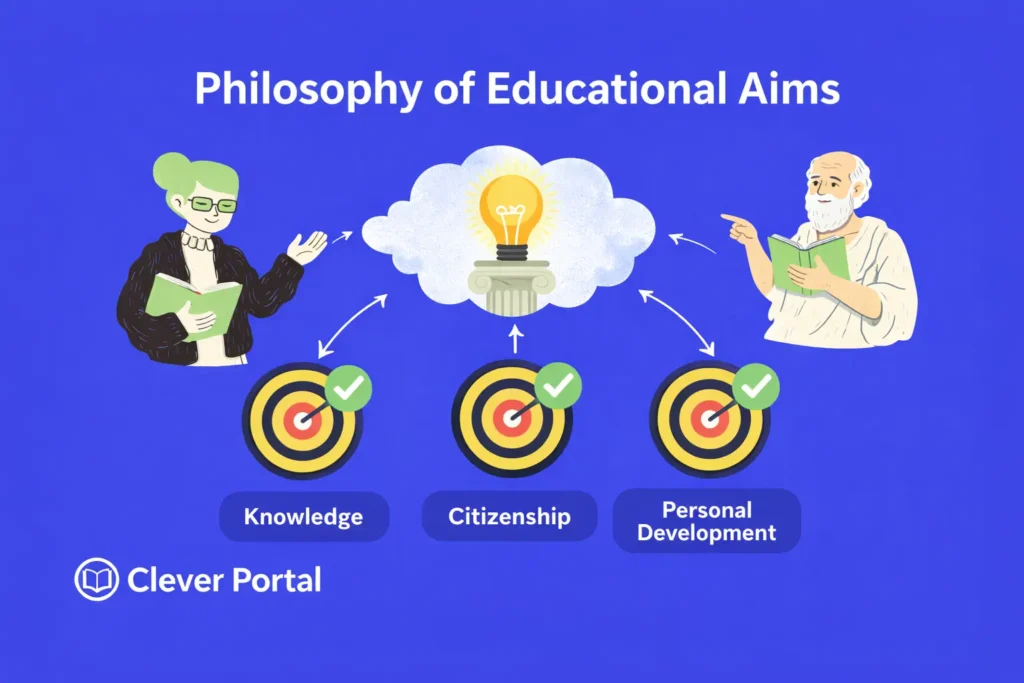
The philosophy of educational aims is the study of what education is supposed to achieve and why. It examines the goals that guide every educational decision, from curriculum design to teaching method to assessment practice.
Aims of education are broad, long-term goals that define the direction of the whole educational process. They differ from objectives, which are specific and measurable targets within a single lesson or unit. Aims are philosophical. Objectives are practical.
According to the Stanford Encyclopedia of Philosophy, theories of educational aims fall into three broad accounts: goods-based (pursuing truth and knowledge), skills-based (developing rationality and critical thinking), and character-based (forming moral and civic virtues).
The UNESCO Delors Commission (1996) expressed these accounts as four pillars of education: learning to know, learning to do, learning to live together, and learning to be. Together, they show that no single aim is enough on its own.
For a broader view of how these aims connect to goals in practice, read the guide on educational goals and their importance.
What Are the Types of Aims of Education?
Education has seven major types of aims. Each one reflects a different view of what human beings need and what society requires from its schools.
Based on our review of B.Ed curricula across South Asia and the UK, these seven aim types appear in almost every foundation of education module taught at the undergraduate level.
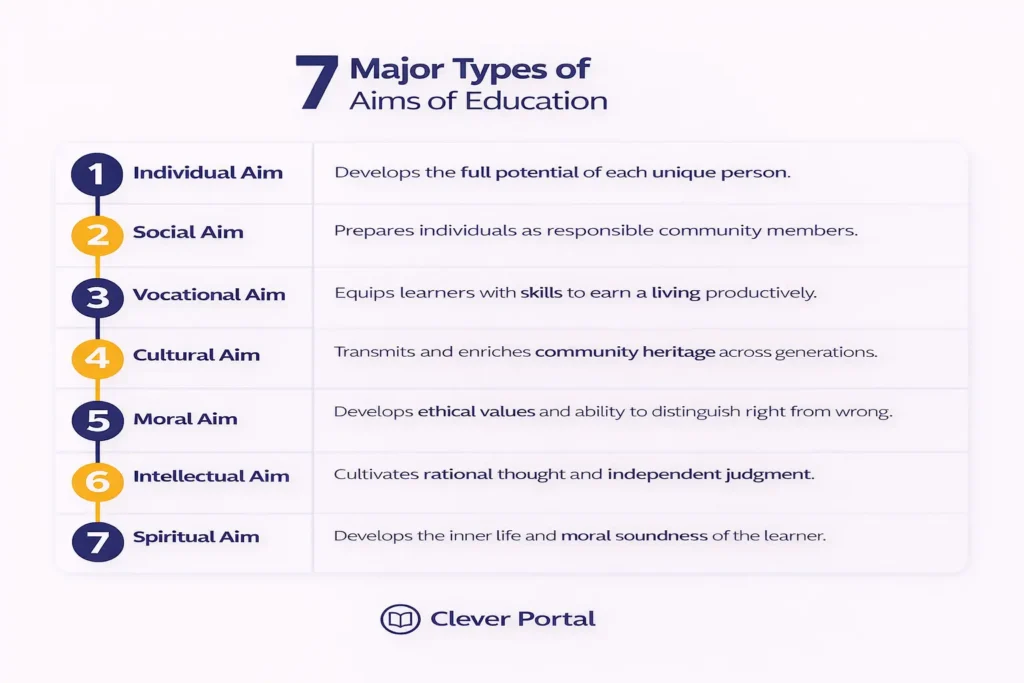
7 major types of aims of education are listed below.
- Individual aim — develops the full potential of each unique person according to their own interests and capacities
- Social aim — prepares individuals to function as responsible, contributing members of their communities and society
- Vocational aim — equips learners with the skills and knowledge needed to earn a living and contribute productively
- Cultural aim — transmits, preserves, and enriches the cultural heritage of a community across generations
- Moral aim — develops ethical values, good character, and the ability to distinguish right from wrong
- Intellectual aim — cultivates the capacity for rational thought, critical inquiry, and independent judgment
- Spiritual aim — develops the inner life, moral soundness, and spiritual awareness of the learner
What Is the Individual Aim of Education?
The individual aim of education holds that education should develop each person according to their own unique interests, capacities, and inner potential. It places the learner, not society, at the center of the educational process.
T.P. Nunn was one of the clearest voices for this aim. He argued that “nothing good enters into the human world except in and through the free activities of individual men and women.” This statement became the philosophical foundation of child-centered education.
Philosophers Who Supported the Individual Aim
Rousseau, Pestalozzi, and Froebel all placed the individual child at the heart of their educational thinking. Rousseau argued that nature educates the child best. Pestalozzi built on this by developing hands-on, experience-based learning for children. Froebel introduced the kindergarten as a space for natural, free development.
The philosophical traditions that support this aim are Naturalism and Existentialism. Both traditions view the individual as the primary unit of educational value.
4 Key Features of the Individual Aim
4 key features of the individual aim of education are listed below.
- Freedom for each learner to develop according to their own nature and pace
- A curriculum tailored to individual interests and personal abilities
- A focus on self-realization, self-expression, and personal growth
- Child-centered teaching methods that follow the learner’s own developmental stage
One limitation of this aim is that it can, when taken to an extreme, produce individuals who lack a sense of social duty or responsibility to others around them.
What Is the Social Aim of Education?
The social aim of education holds that education’s primary purpose is to prepare individuals to serve, strengthen, and improve their society. It places the community, not the individual alone, at the center of educational value.
Plato stated in The Republic that “education is not putting knowledge into souls that lack it, but the art of orientation.” For Plato, orientation meant turning citizens toward the good of the whole community, not just personal gain.
Philosophers Who Supported the Social Aim
Aristotle, Plato, and John Dewey all argued that education serves the community at least as much as it serves the individual. Aristotle believed education shapes character through repeated habit and civic participation. Dewey argued that school is a miniature society and that education prepares learners to think and act as democratic citizens.
The philosophical traditions behind this aim are functionalism and social reconstructionism. Both traditions see schools as the primary institution through which society reproduces and improves itself across generations.
4 Key Features of the Social Aim
4 key features of the social aim of education are listed below.
- Citizenship education — developing civic responsibility and democratic values in learners
- Cultural transmission — passing shared values, history, and traditions to the next generation
- Social cohesion — reducing inequality and building bonds between members of a community
- Preparation for cooperative, productive social life in a community, workplace, and wider society
The limitation here is that an excessive focus on the social aim can suppress individual creativity and personal freedom in favor of conformity to group norms.
Individual vs Social Aims of Education
Individual and social aims represent the two oldest competing visions of what education is for. Yet most educational philosophers did not see them as opposites. They saw them as two sides of the same goal.
T.P. Nunn and the philosopher Ross both argued that self-realization and social contribution are naturally connected. A person who fully develops their own potential, they suggested, naturally becomes a more capable and generous member of their community.
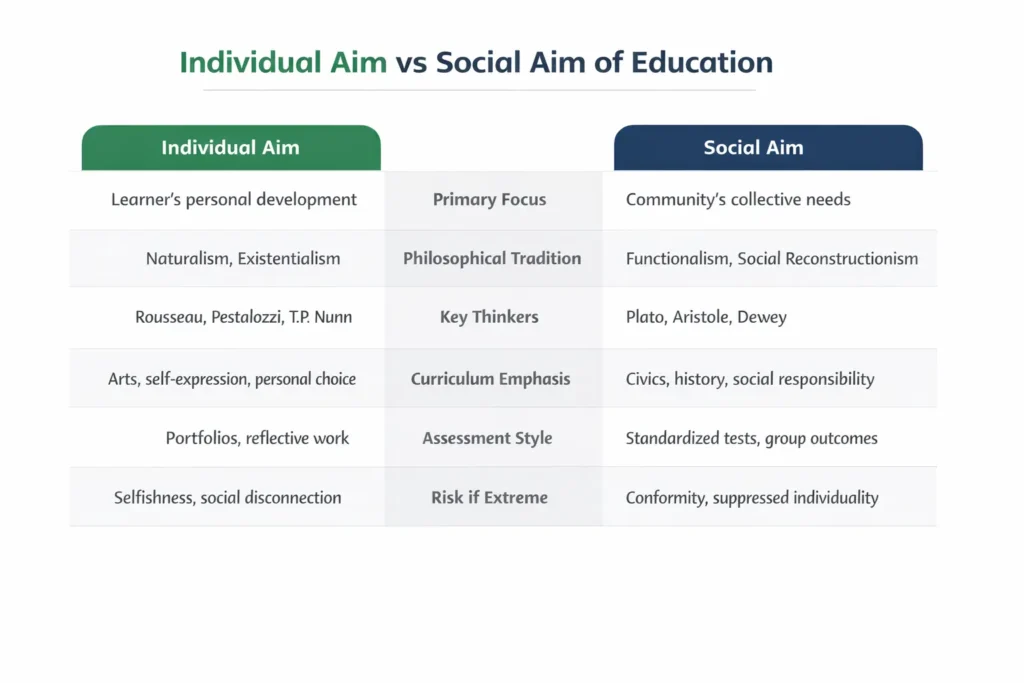
The table below compares both aims across six key dimensions.
| Aspect | Individual Aim | Social Aim |
|---|---|---|
| Primary focus | The learner’s personal development | The community’s collective needs |
| Philosophical tradition | Naturalism, Existentialism | Functionalism, Social Reconstructionism |
| Key thinkers | Rousseau, Pestalozzi, T.P. Nunn | Plato, Aristotle, Dewey |
| Curriculum emphasis | Arts, self-expression, personal choice | Civics, history, social responsibility |
| Assessment style | Portfolios, reflective personal work | Standardized tests, group outcomes |
| Risk if taken to an extreme | Selfishness, social disconnection | Conformity, suppressed individuality |
For a deeper look at all the formal categories of educational aims and their definitions, read the full article on aims of education.
What Are the Vocational, Cultural, Moral, and Intellectual Aims?
Beyond individual and social aims, the philosophy of educational aims includes four more types. Each one focuses on a specific dimension of human development that neither the individual nor the social aim fully captures on its own.

Vocational Aim
The vocational aim holds that education must prepare learners to earn a living and contribute productively to the economy. It focuses on practical skills, technical knowledge, and occupational readiness.
John Dewey’s pragmatist tradition supports this aim. Dewey believed that education should connect learning to real-world work. He argued that doing and thinking cannot be separated in a meaningful curriculum.
Cultural Aim
The cultural aim holds that education must transmit, preserve, and enrich the cultural heritage of a community. Language, arts, literature, traditions, and shared values all form part of what education passes from one generation to the next.
The idealist tradition supports this aim. Idealists believe that culture represents the highest achievements of human civilization and that schools exist partly to protect and carry that legacy forward.
Moral Aim
The moral aim holds that education must develop ethical character, good values, and the ability to distinguish right from wrong. It is one of the oldest aims in educational history.
Aristotle supported this aim through his doctrine of habit formation. Kant approached it through rational moral duty. Both agreed that moral development is central to what education is supposed to produce.
Intellectual Aim
The intellectual aim holds that education must cultivate rational thought, critical inquiry, and independent judgment. It focuses on the mind’s capacity to reason rather than simply to memorize facts.
Plato placed this aim at the heart of his entire educational philosophy. Dewey called reflective thinking the highest outcome of any education. According to the Stanford Encyclopedia of Philosophy, skills-based accounts of educational aims prioritize rationality and critical thinking as core disciplinary goals.
How Does Philosophy Shape the Aims of Education?
Each major philosophical tradition produces a different set of educational aims. Philosophy is not separate from what happens in schools. It directly determines what schools teach, how they teach it, and what they measure as success.
According to IJCRT (2025), “Different philosophies conceptualize the roles of learners, teachers, and society, influencing curriculum development, pedagogy, and policy”. This means that a change in philosophy produces a change in curriculum, not just in abstract theory.
In our analysis of how B.Ed syllabi connect philosophical traditions to classroom practice, each tradition maps clearly to a set of aims and a set of teaching methods.
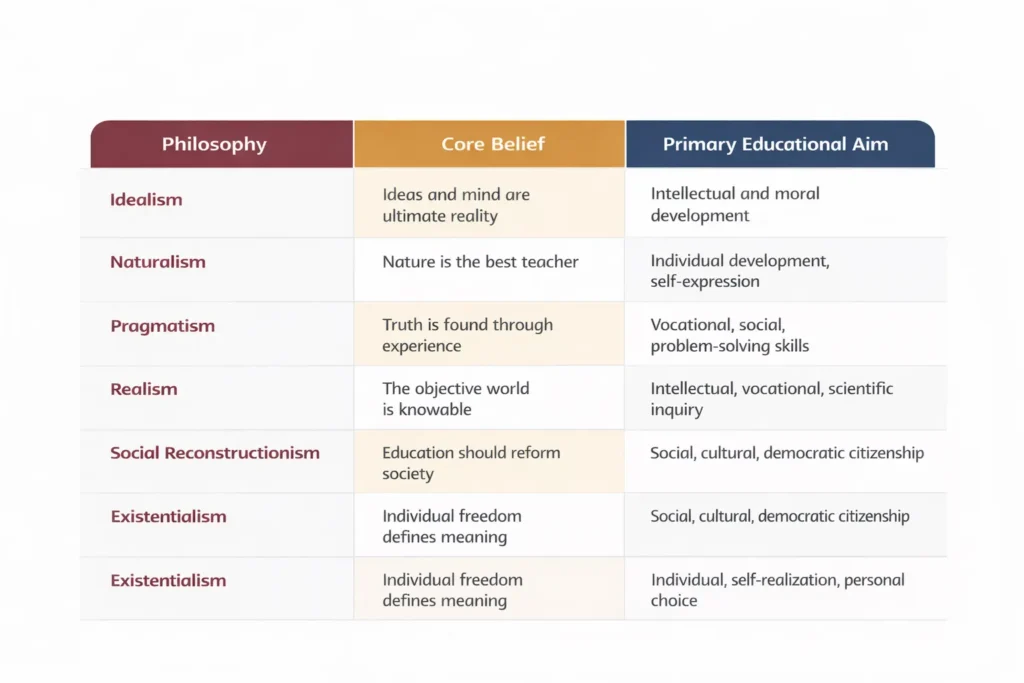
The table below shows how each major philosophy connects to a primary educational aim.
| Philosophy | Core Belief | Primary Educational Aim |
|---|---|---|
| Idealism | Ideas and mind are ultimate reality | Intellectual and moral development |
| Naturalism | Nature is the best teacher | Individual development, self-expression |
| Pragmatism | Truth is found through experience | Vocational, social, problem-solving skills |
| Realism | The objective world is knowable | Intellectual, vocational, scientific inquiry |
| Social Reconstructionism | Education should reform society | Social, cultural, democratic citizenship |
| Existentialism | Individual freedom defines meaning | Individual, self-realization, personal choice |
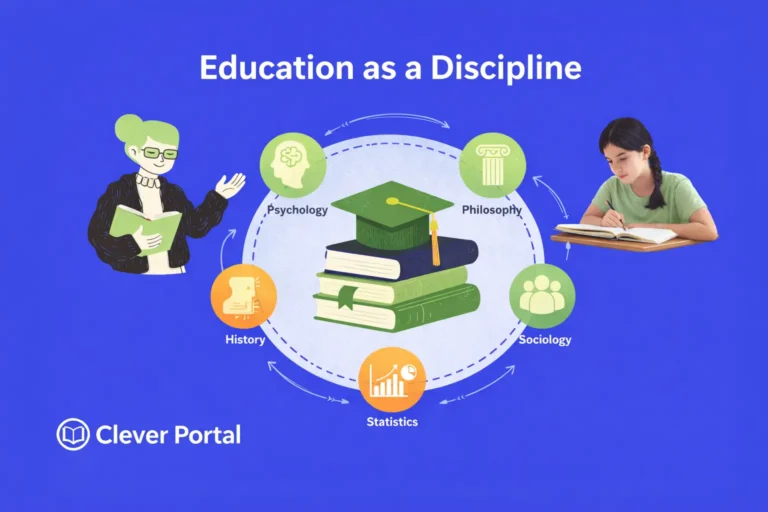
To understand how these philosophical traditions connect to education studied as a formal academic subject, read the article on education as a formal discipline.
How Do Philosophical Aims Connect to Changes in Educational Practice?
Education’s aims do not stay fixed. They shift as social conditions, research, and philosophical thinking change over time. Understanding how aims shift helps educators recognize why curriculum content changes and what philosophical reasoning drives those changes. For a detailed look at how shifts in educational thought affect practice, read the guide on transition in education and its meaning.
Conclusion
The philosophy of educational aims does not offer one final answer to what education is for. It offers seven carefully reasoned answers, each grounded in a different tradition of thinking about human beings and society.
Three key takeaways from this article:
- Education has seven major types of aims: individual, social, vocational, cultural, moral, intellectual, and spiritual
- Individual and social aims are the central debate, yet they are complementary rather than opposing forces
- Each philosophical tradition — from idealism to pragmatism to naturalism, produces a different primary aim that still shapes curriculum design today
To understand how these aims fit into the broader meaning of education as a concept and a practice, read the full guide on what education means as a concept and see how philosophy connects to the purpose of schools from the ground up.