NEP 2020 Education Policy: What It Is, What Changed, and Where India Stands Today
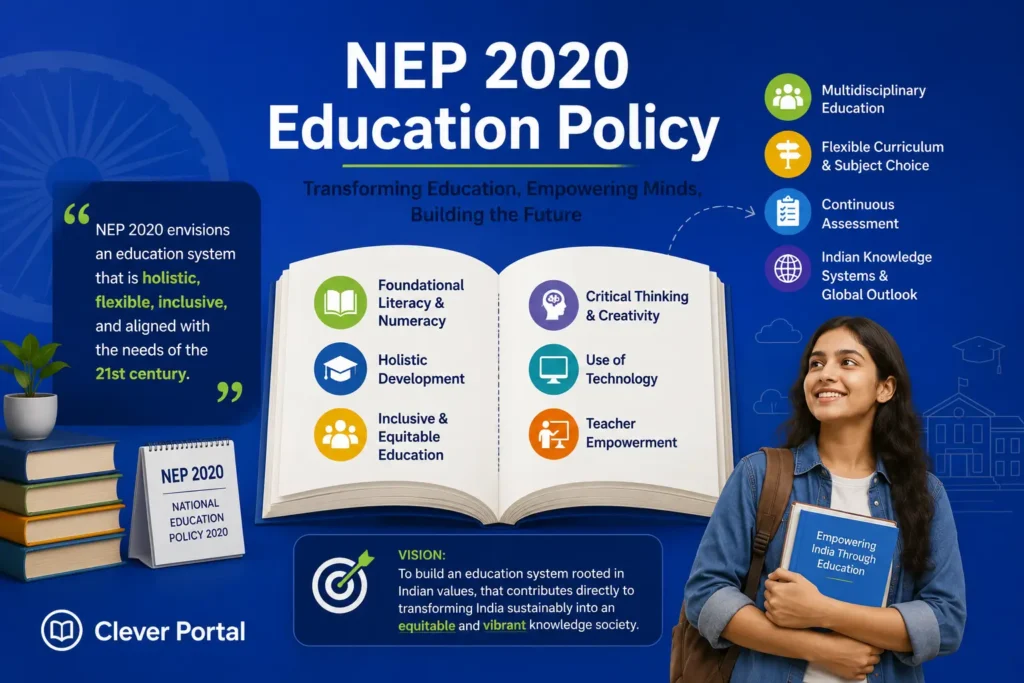
The NEP 2020 (National Education Policy 2020) is India’s landmark education reform approved on July 29, 2020. It replaces the 34-year-old 1986 policy and restructures schooling into a new 5+3+3+4 model. It promotes mother tongue instruction, integrates vocational education from Grade 6, and overhauls higher education with flexible degrees and credit transfer. Implementation is underway across India, with strong progress in some areas and real challenges still to overcome.
India has one of the largest student populations on Earth. Yet for 34 years, its national education framework stayed the same. The last major policy update was in 1986. That changed on July 29, 2020, when India’s Union Cabinet approved the new education policy India had been waiting for. The NEP 2020 education policy is not just a small update. It is a full reset of how India thinks about learning, from preschool all the way through university.
This guide explains exactly what NEP 2020 is, how the 5+3+3+4 structure works, what key features it introduces, and what is actually happening on the ground in 2025 and 2026. It also covers what critics get right about the challenges. By the end, you will have a clear and honest picture of India’s most ambitious education reform in a generation.
What Is the NEP 2020 Education Policy?
NEP 2020, or the National Education Policy 2020, is India’s updated national framework for transforming education at every level. It was approved by the Union Cabinet on July 29, 2020, and it replaces the National Policy on Education 1986. The policy covers everything from early childhood care all the way to higher education and teacher training.
The idea behind the new education policy India needed was simple. The world had changed dramatically since 1986. Jobs, technology, and the skills students needed had all shifted. Yet the school and university system had barely moved. NEP 2020 was designed to fix that gap.
The policy was drafted by a committee chaired by Dr. K. Kasturirangan, a former chairman of ISRO. Before the final version was published, the Ministry of Education consulted with communities across 2 lakh villages and gathered feedback from over 15 lakh stakeholders. This made it one of the most widely consulted education policies in Indian history.
NEP 2020 is built on five foundational pillars: Access, Equity, Quality, Affordability, and Accountability. These five pillars guide every reform in the policy and keep it aligned with the 2030 Agenda for Sustainable Development.
What Is the 5+3+3+4 Structure in NEP 2020?
The 5+3+3+4 model is one of the biggest changes NEP 2020 brings to school education. It replaces the old 10+2 system that India had used for decades. The new structure divides school education into four stages, each built around how children actually grow and learn at different ages.
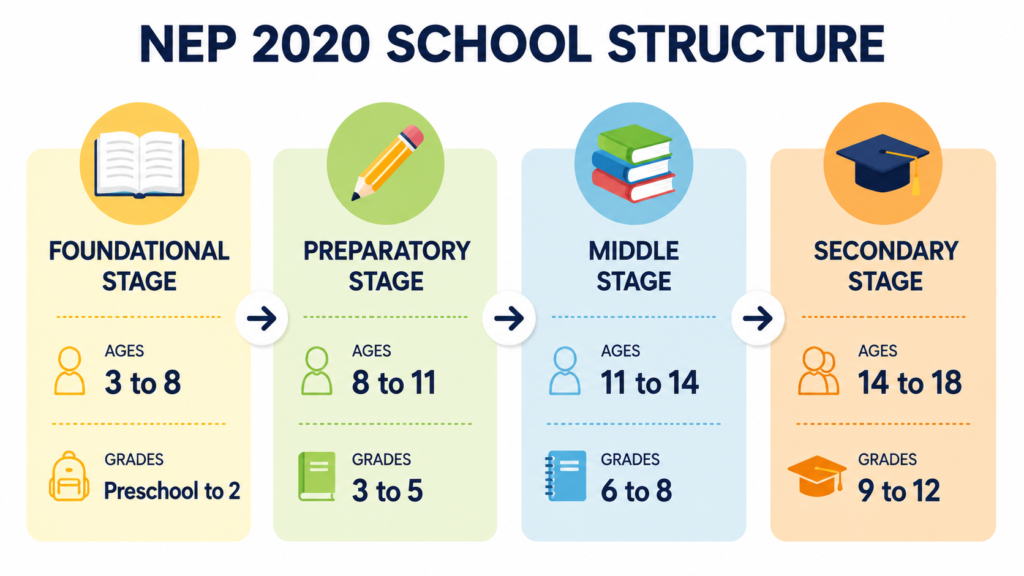
Here is how the four stages break down:
| Stage | Grades | Age Group | Teaching Approach |
| Foundational Stage | Preschool to Grade 2 | Ages 3 to 8 | Play-based, activity-driven learning; Early Childhood Care and Education (ECCE) |
| Preparatory Stage | Grades 3 to 5 | Ages 8 to 11 | Light textbooks, discovery-based learning, regional language focus |
| Middle Stage | Grades 6 to 8 | Ages 11 to 14 | Subject teachers introduced; vocational exposure begins |
| Secondary Stage | Grades 9 to 12 | Ages 14 to 18 | Multidisciplinary subjects, flexible course selection, competency-based assessment |
Each stage uses teaching methods that match where children are in their development. The Foundational Stage focuses on play and story-based learning. By the time students reach the Secondary Stage, they get more freedom to choose subjects across arts, science, and social science education.
One important thing to understand: this model does not remove Class 10 or Class 12 board exams. It reforms how those assessments work by giving students multiple chances to attempt them and moving away from single high-stakes testing. The shift is from rote learning to real understanding.
What Are the Key Features of NEP 2020?
School Education Features
NEP 2020 introduces several major changes at the school level that affect how students learn every single day.
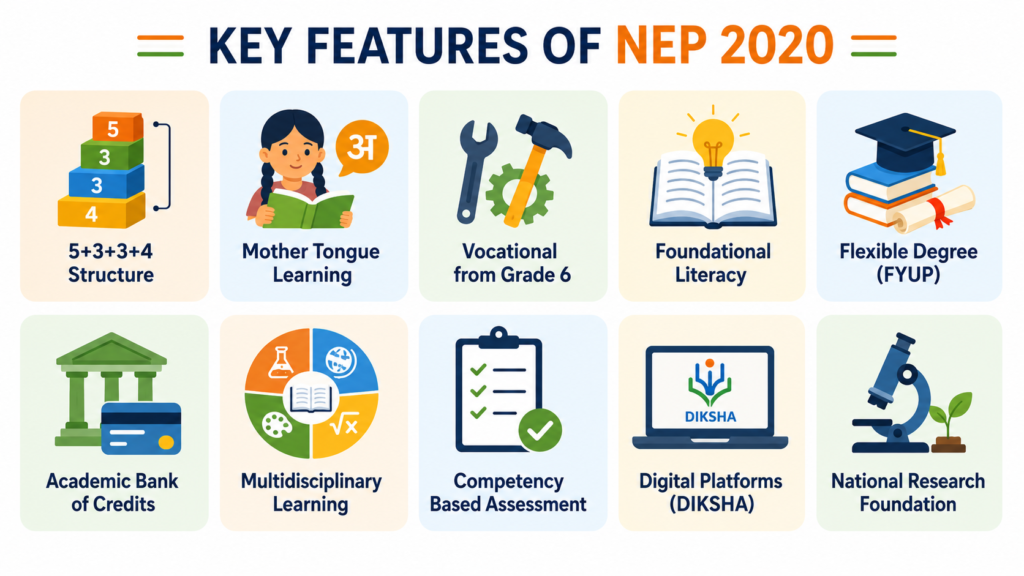
- New 5+3+3+4 school structure replaces the 10+2 model and aligns learning stages with child development.
- Foundational Literacy and Numeracy (FLN) must be achieved by all students by Grade 3. This is a top national priority.
- Mother tongue instruction is recommended as the medium of learning until at least Grade 5. This supports better understanding and keeps children connected to their culture.
- Vocational education integration starts from Grade 6. Students get hands-on skill training alongside their academic subjects. You can learn more about how this fits into India’s broader approach in this guide on technical and vocational education.
- No rigid separation between streams. Arts, science, commerce, and vocational subjects can be mixed freely. This supports multidisciplinary education and removes the pressure to choose too early.
- Assessment reform through PARAKH, a national body that sets assessment standards to ensure fair and consistent evaluation across all Indian states.
- Inclusive education for socio-economically disadvantaged groups (SEDGs) through additional support systems, free school meals, and targeted policies.
- Values-based learning that integrates Indian cultural heritage, ethics, and a spirit of social responsibility. This connects closely to the goals of peace education in building empathetic, thoughtful citizens.
Higher Education Features
NEP 2020 makes equally bold changes at the university level.
- Four-Year Undergraduate Program (FYUP) gives students flexible entry and exit points. Students can leave after one year with a certificate, after two years with a diploma, after three years with a degree, or complete four years for a research-focused honors degree.
- Academic Bank of Credits (ABC) is a digital system where students can store, transfer, and accumulate academic credits across different universities. This makes switching institutions or pausing studies far easier.
- Higher Education Commission of India (HECI) is planned as a single unified regulator to replace the current fragmented system of UGC, AICTE, and other bodies.
- National Research Foundation (NRF) will fund and promote high-quality research across all disciplines to raise India’s research output, which stood at just 0.7% of GDP in 2023 compared to 3.5% in the US.
How Does NEP 2020 Reform Higher Education?
Before NEP 2020, India’s higher education system was rigid. A student who had to drop out after two years left with nothing official to show for it. Switching universities meant starting over. Research funding was low and scattered.
The new education policy India introduced changes all of that through a set of connected reforms. The FYUP system with multiple exit and entry points means students are not trapped in a single path. The Academic Bank of Credits allows credit transfers between universities, which opens up genuine learning mobility across India and even internationally.
The Gross Enrolment Ratio (GER) for higher education was 26.3% in 2018 when planning for NEP began. NEP 2020 sets a target of 50% GER by 2035. To help reach that goal, platforms like SWAYAM and PM eVIDYA expand online learning access so students in remote areas can access quality university courses.
The National Research Foundation (NRF) is another major piece. India’s research spending has been historically low. The NRF is designed to connect researchers with funding, industry partnerships, and government priorities. Alongside the HECI, which will bring regulatory clarity across India’s more than 1,000 universities and 42,000 colleges, these reforms aim to make Indian higher education more competitive globally.
The NEP also promotes internationalization. Foreign universities can now offer online degree programs to Indian students. Indian institutions are encouraged to forge global partnerships. Multidisciplinary social science education, arts programs, and STEM fields are all meant to be offered side by side, eliminating the old academic silos. You can explore how social science education fits into this new multidisciplinary vision.
How Is NEP 2020 Being Implemented Across India?
NEP 2020 is a policy framework, not a law. This means the central government sets the direction, but each state government decides how and how fast to adopt it. Implementation has been uneven but real progress has happened since 2020.
What Has Been Achieved So Far
Several major NEP 2020 milestones have already been reached as of 2025 and 2026:
- The National Curriculum Framework (NCF 2023) was released by NCERT to guide updated school textbooks and teaching approaches.
- The FYUP was rolled out at central universities, and the CUET (Common University Entrance Test) now provides a standardized admission pathway.
- PM SHRI Schools were launched as model schools showcasing NEP 2020 implementation across the country.
- DIKSHA (the national digital platform for teachers and students) was expanded significantly across states.
- The Gross Enrolment Ratio for higher education rose from 27.9% in 2020-21 to 29.2% in 2022-23, showing steady upward movement.
- In January 2025, plans for the National Digital University were set in motion to expand online degree access.
- In October 2025, Kerala joined the PM SHRI project, signaling broader state-level adoption.
What Still Needs to Happen
Not everything is on track. The HECI legislation, which would create the single higher education regulator, is still pending as of 2025. Teacher training reform is moving slowly at scale. Many states are in early stages of implementation, and the National Curriculum Framework adoption is still incomplete in several regions.
The alignment of NEP 2020 with religious education and values-based learning is also still developing, as states balance India’s diverse cultural traditions with the policy’s call for a shared national ethos.
What Are the Challenges and Criticisms of NEP 2020?
NEP 2020’s vision is widely praised. But researchers and educators are honest about the gap between that vision and on-the-ground reality. Understanding these challenges is just as important as knowing what the policy promises.
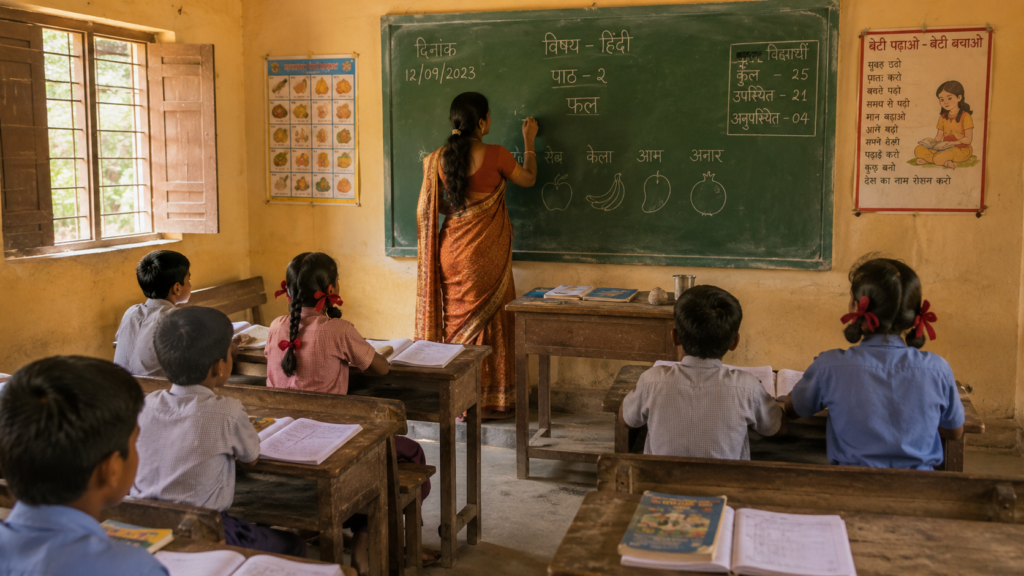
Funding shortfall. NEP 2020 targets raising education spending from roughly 3% of GDP to 6%. That target has not been met. A 2026 peer-reviewed study published in Frontiers in Education found that 45 out of 50 research studies identified inadequate funding as the most critical barrier to successful implementation.
Digital divide. NEP 2020 relies heavily on technology, platforms like DIKSHA, SWAYAM, and PM eVIDYA. But according to UDISE+ data, only 57.2% of Indian schools have functional computers and only 53.9% have internet access. Roughly 30% of India’s population had reliable smartphone access during the early rollout years. This creates a serious gap between urban and rural students.
Teacher training gaps. NEP 2020 requires teachers to shift from rote-based instruction to competency-based, activity-driven teaching. This requires large-scale retraining. Research shows that institutional readiness for this shift varies enormously across states. Teachers in rural and under-resourced schools often lack the support they need to make this change.
State-level inconsistency. Because NEP is a policy and not a law, implementation quality varies widely. Some states have moved quickly. Others have barely started. This risks creating a two-tier education system where students in better-resourced states benefit while others fall further behind.
Equity concerns. NEP 2020 makes strong commitments to socio-economically disadvantaged groups. But critics point out that without real funding and ground-level infrastructure, these commitments remain aspirational. The policy’s ambitions for inclusion are real. The mechanisms to deliver them are still being built.
NEP 2020 vs. Old Education Policy: What Really Changed
To understand just how big a shift NEP 2020 represents, it helps to compare it side by side with the National Policy on Education 1986 it replaced.
| Dimension | National Policy on Education 1986 | NEP 2020 |
| School structure | 10+2 model | 5+3+3+4 model |
| Medium of instruction | English-focused | Mother tongue until Grade 5 |
| Higher education model | Rigid degree structure, single exit | FYUP with multiple entry and exit points |
| Vocational education | Separate from mainstream | Integrated from Grade 6 |
| Assessment style | Rote and exam-heavy | Competency-based, multiple attempts |
| Education spending target | No GDP % target | 6% of GDP |
| Technology focus | Minimal | Core pillar (DIKSHA, SWAYAM, PM eVIDYA, NETF) |
| Research focus | Low priority | National Research Foundation (NRF) established |
The shift from the 1986 policy to NEP 2020 is not just an update. It is a structural transformation of how India defines, delivers, and assesses learning at every level. The old system served an era before smartphones, global job markets, and the knowledge economy. NEP 2020 is designed for the world students will actually live and work in.
Final Thoughts: Is NEP 2020 the Change India Needs?
NEP 2020 is the most ambitious education reform India has attempted in a generation. The 5+3+3+4 school structure, the Academic Bank of Credits, the National Research Foundation, the push for Foundational Literacy and Numeracy by Grade 3, and the integration of vocational education all point toward a genuinely modern, flexible, and inclusive system.
The honest answer to whether it is working is: partially, and it depends where you look. GER is rising. FYUP is live. NCF 2023 is in classrooms. PM SHRI Schools are operating. These are real wins.
But the funding gap is real. The digital divide is real. Teacher readiness is uneven. HECI is still pending. And for the millions of students in rural India, the gap between NEP’s vision and daily classroom reality is still large.
The path forward requires sustained investment, state-level commitment, and a willingness to honestly measure what is working and what is not. NEP 2020 gives India a clear direction. Whether the country fully walks that road will shape the futures of hundreds of millions of students.
Understanding how different types of education systems work together is key to making sense of reforms like NEP 2020. Explore the full picture in this guide on different types of education frameworks on CleverPortalUS. The more context you have, the better you can understand where India’s education journey is headed next.