Etymology of Education: Latin Roots, Origin, and Meaning
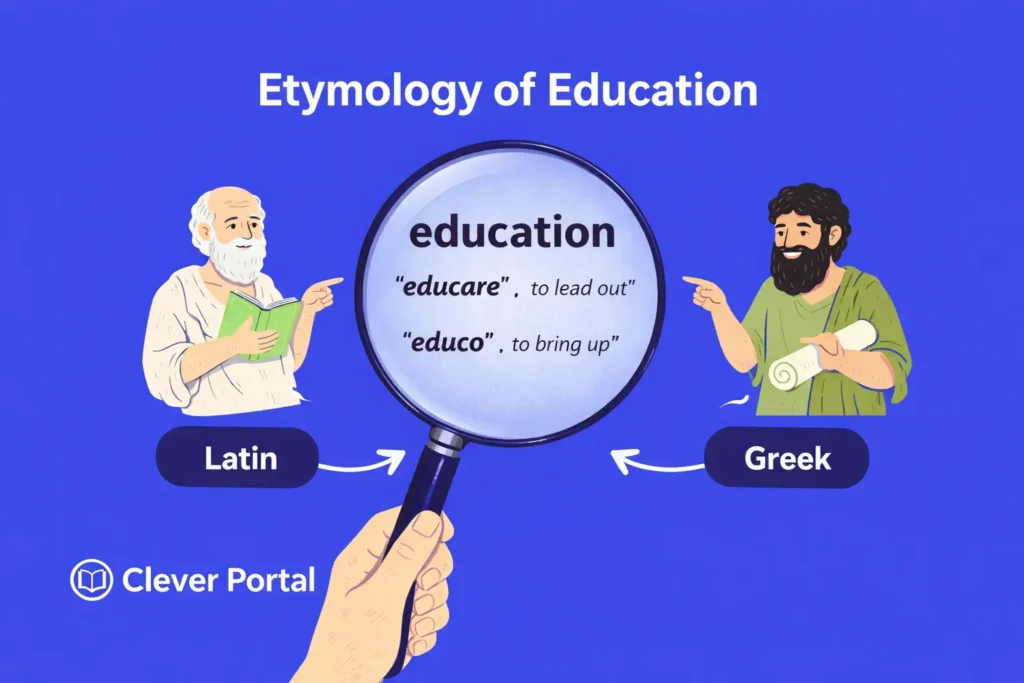
The etymology of education reaches back to ancient Latin, where two distinct root words gave the term its meaning. Educare means “to bring up or nourish.” Educere means “to lead out or draw forth.” Both roots shaped how people have understood education for over two thousand years. The word entered English in the 1530s, first meaning “child-rearing,” then later shifting to mean formal schooling. These two roots do more than explain the word. They represent two opposing philosophies of teaching that still divide classrooms today.
This article breaks down each root, traces the word’s journey into English, explains the Greek connection, and shows what the etymology tells us about the purpose of education itself.
What Are the Latin Roots of Education?
The Latin roots of education come from the noun educationem, the nominative form of which is educatio, meaning “a rearing or training.” The word derives from the verb educare, which means “to bring up, rear, nourish, or train.”
According to Etymonline, the verb “educate” entered English in the mid-15th century from the Latin educatus, the past participle of educare. The full noun “education” followed in the 1530s, first carrying the meaning of rearing children or training animals.
Based on our review of B.Ed foundation texts, these four Latin roots appear together in almost every introductory education philosophy module taught across South Asia and the UK.
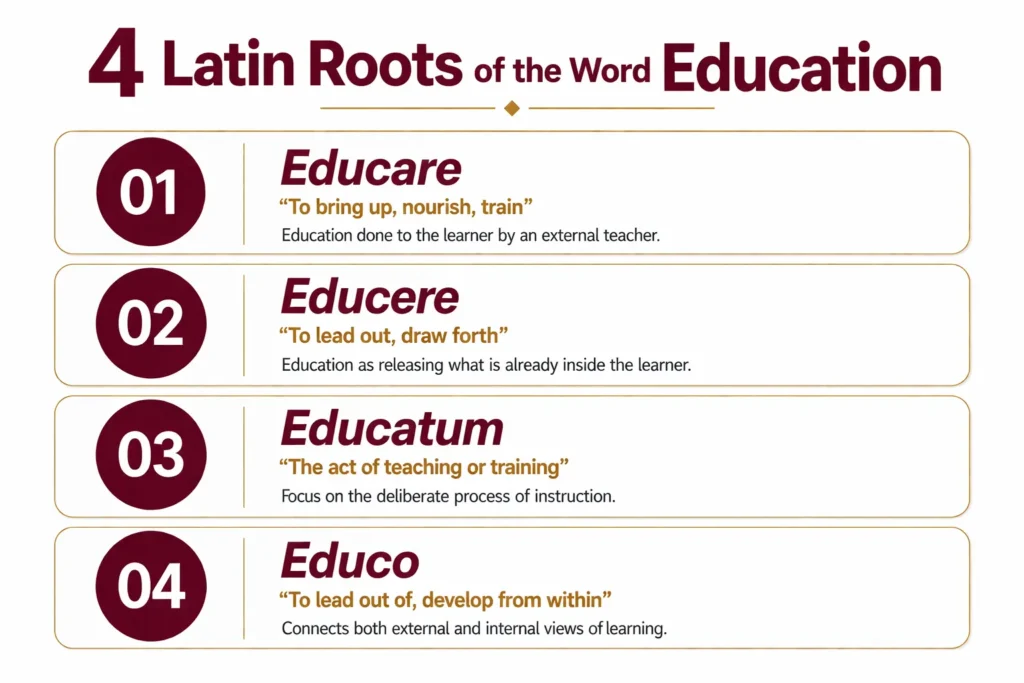
4 core Latin roots of the word education are listed below.
- Educare — “To bring up, rear, nourish, or train.” This root treats education as something done to the learner by an external guide or teacher.
- Educere — “To lead out or draw forth.” Built from ex- (out) and ducere (to lead), this root treats education as releasing what is already inside the learner.
- Educatum — “The act of teaching or training.” This root focuses on the deliberate process of instruction rather than the result it produces in the learner.
- Educo — “To lead out of” or “to develop from within.” This root connects both the external and internal views of how learning actually takes place.
What Is the Difference Between Educare and Educere?
Educare and educere are the two most cited Latin roots of education, yet they point in very different directions. Understanding the gap between them is the key insight behind the etymology of education.
Educare places the teacher at the center. The teacher shapes, trains, and molds the learner according to a set standard. Educere places the learner at the center. The teacher guides and draws out the potential that already exists inside the student.
According to a study published via ERIC (Craft, 1984), these two Latin roots represent fundamentally different educational philosophies, not just different word meanings.
Etymonline also cites the Century Dictionary for an important clarification: the distinction is not always drawn correctly. The educere root refers more to bodily nurture, while educare relates more to mental and character training. This corrects the popular but oversimplified claim that education primarily means “drawing out the mind.”
Educare vs Educere: Side-by-Side
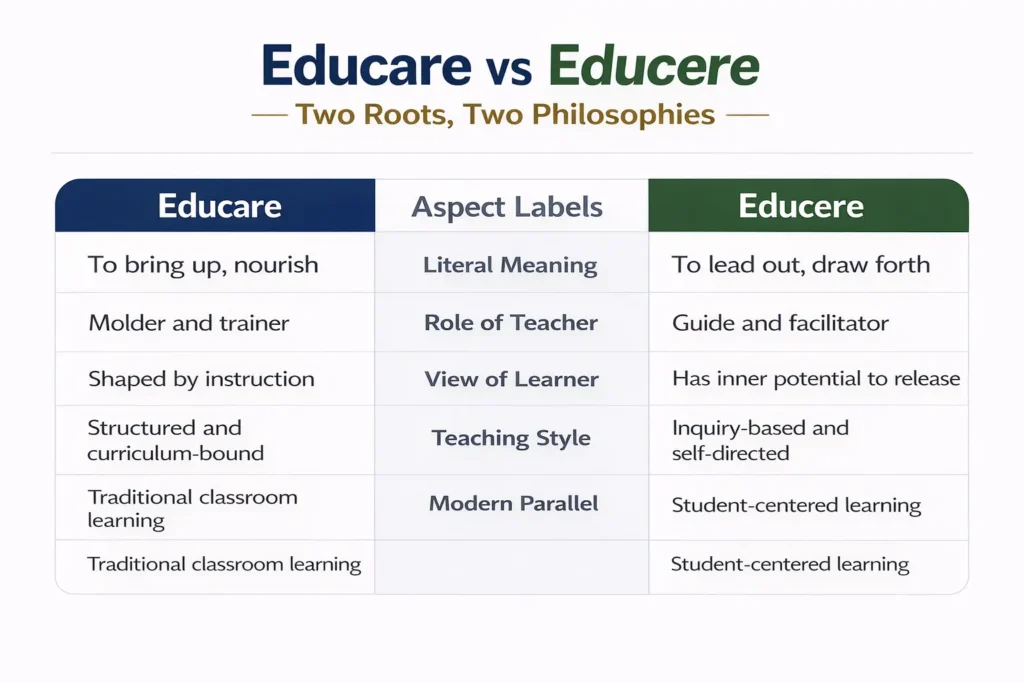
The table below shows the key differences between the two roots.
| Aspect | Educare | Educere |
|---|---|---|
| Literal meaning | To bring up, nourish | To lead out, draw forth |
| Role of teacher | Molder and trainer | Guide and facilitator |
| View of the learner | Shaped by instruction | Has inner potential to release |
| Teaching style | Structured, curriculum-bound | Inquiry-based, self-directed |
| Modern parallel | Traditional classroom learning | Student-centered learning |
Why This Contrast Still Matters
The educare vs educere debate is not just an academic exercise. It is the oldest unresolved question in education: are teachers here to shape students, or to set them free?
Educare-aligned education produces standardized tests and fixed curricula. Educere-aligned education produces project-based learning and Socratic questioning. Most modern school systems combine both, yet lean more heavily toward educare in their assessment structures.
To see how this connects to actual teaching practice, the guide on philosophy of educational aims explains how each tradition shaped formal curriculum design over centuries.
What Is the Greek Origin of Education?
The Greek root of education is paideia (παιδεία), formed from pais (child) and agein (to lead or guide). Paideia described the complete upbringing and education of the ideal Greek citizen.
It covered physical, intellectual, moral, and civic development together as one unified goal. This holistic concept influenced how Roman educators later built educatio as a formal term for the rearing and training of the young.
The word paidagogos also comes from this Greek root. A paidagogos was literally the slave who led the child to school each day. That word became the root of the modern term “pedagogy,” meaning the method and practice of teaching.

So the Greek paideia gave education its ambition. The Latin roots gave it its method. Both traditions traveled into Western educational thought and shaped what the word means today.
How Did the Word Education Enter English?
The word “education” did not move directly from Latin into English. It traveled through French first, then entered English writing in the 1530s.
According to Etymonline, the Old French form education appeared in the 14th century before the English adoption of the term. The word arrived in English carrying a meaning closer to “child-rearing” than to classroom instruction.
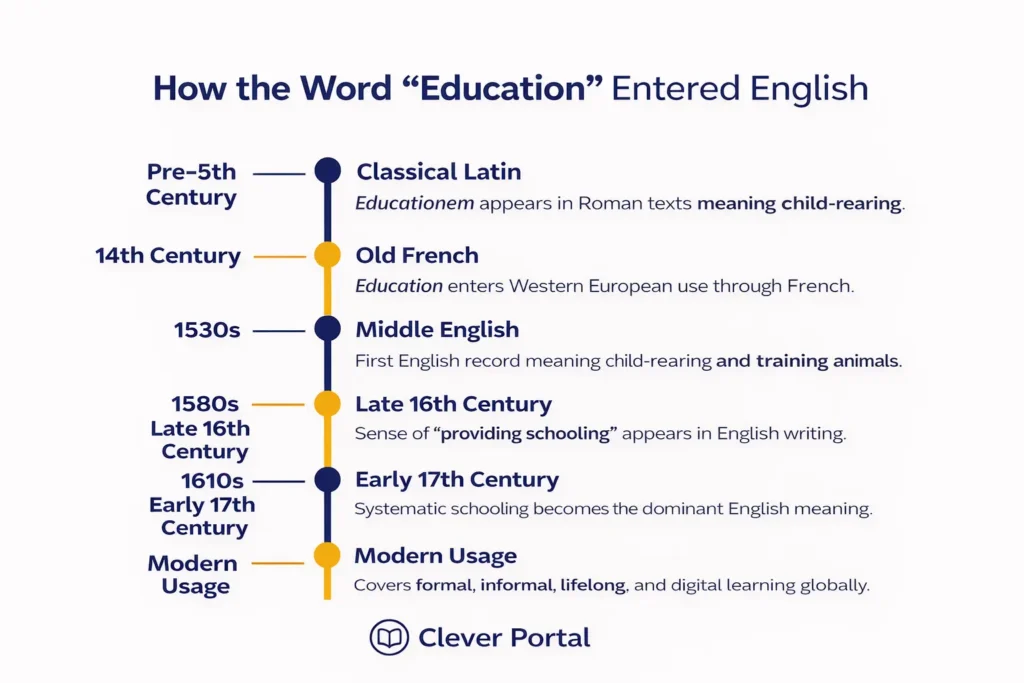
The historical timeline of the word education is outlined below.
- Classical Latin (pre-5th century) — Educationem and educare appear in Roman texts referring to the physical rearing and training of children and animals.
- Old French (14th century) — The French form education carries the word into Western European use, still tied to the nurturing and upbringing of children.
- Middle English (1530s) — First written record in English, meaning “child-rearing” and “training of young animals” (Etymonline).
- Late 16th century (1580s) — The sense of “providing schooling” appears in written English for the first time, expanding the word beyond child-rearing.
- Early 17th century (1610s) — “Systematic schooling and training for work” becomes the dominant meaning in English, per Etymonline.
- Modern usage — Education now covers formal schooling, informal learning, lifelong development, and digital learning across every stage of life.
What Does Etymology Tell Us About the Purpose of Education?
The etymology of education carries a built-in philosophical argument. Two Latin roots in the same word point in opposite directions. This tells us that even the Romans could not fully agree on what education was supposed to do.
Educare says the purpose of education is to shape a person into what society needs. Educere says the purpose is to bring out what a person already has inside them. Both views are present in every school system ever built.
In our analysis of how these roots appear across educational philosophy literature, one pattern is clear: systems that emphasize educare tend to produce measurable academic results. Systems that favor educere tend to produce more independent thinkers.
The poet and philosopher William Godwin wrote in 1797: “All education is despotism.” His statement reflects the educare concern: that shaping a person to fit a mold takes away their freedom to become who they truly are.
For a broader look at how the purpose of education developed from these roots, the full guide on the origin and meaning of education traces this debate from ancient civilizations through to modern school systems.
What Did Philosophers Say About the Roots of Education?
Philosophers across centuries connected their views directly to one of these two Latin roots. Each thinker either emphasized shaping the learner or drawing out the learner’s inner potential.
Based on our review of educational philosophy literature, almost every major philosopher of education falls clearly into one of these two camps. Their positions still appear in teacher training programs around the world.

5 major philosophers and their views on the roots of education are listed below.
- Plato — Aligned with educere. He believed education draws the soul from darkness toward truth and goodness, not that it fills the mind with external facts.
- Aristotle — Aligned with educare. He argued that education shapes character through repeated habit and deliberate practice under the guidance of a skilled teacher.
- Rousseau — A pure educere thinker. He wrote that nature educates the child best and that society’s attempt to mold children corrupts their natural goodness.
- John Dewey — Stated that “education is life itself,” rejecting the educare model of filling students with pre-selected content and pushing them toward set outcomes.
- Rabindranath Tagore — Believed that “the highest education is that which makes our life in harmony with all existence,” placing him firmly in the educere tradition of drawing out human wholeness.
How Does Etymology Connect to the Broad and Narrow Meaning of Education?
The educare root maps directly to the narrow meaning of education: formal, school-based, teacher-led, and measurable. The educere root maps to the broad meaning: lifelong, experiential, and beyond any classroom. The etymology therefore explains why both meanings exist and why neither one alone fully captures what education really is. For a full breakdown of both meanings, read the guide on the broad and narrow meaning of education.
How Does the Etymology of Education Relate to Its Definition?
The word’s roots reveal that education has always meant more than school attendance. The full definition of education as a concept reflects both educare and educere working together across every setting a person lives through. To understand how those roots connect to a complete working definition, read the detailed article on what education means as a concept.
How Does Etymology Connect to Education as a Discipline?
Knowing the word’s origin helps students understand why education is studied as its own academic field. The dual roots explain the full breadth of what the discipline must cover: structured instruction, personal growth, social development, and philosophical inquiry all at once. For more on this, read the article on education as a formal discipline.
How Does the Etymology Inform the Role and Definition of Education?
The Latin roots show that the role of education has always carried two directions at once: toward the learner and from the learner. That duality explains why defining education’s role is still debated today. The guide on the definition and role of education explores how this dual role plays out in practice across social and individual contexts.
Conclusion
The etymology of education carries two thousand years of debate inside a single word. Educare shaped the model of structured schools and trained teachers delivering set content to students. Educere shaped the model of teachers as guides who draw out what each learner already carries within them. Neither root replaced the other. Both survived because education genuinely needs both.
Three key takeaways from this article:
- The word “education” has four Latin roots, with educare and educere representing two different teaching philosophies
- The word entered English in the 1530s meaning “child-rearing” and shifted to mean “systematic schooling” by the 1610s
- The Greek root paideia added the concept of holistic development, shaping what Western education aimed to become
To see how these roots developed into the full history of education as a practice and a social force, read the complete guide on the origin and meaning of education.