
Education as a Discipline: Meaning, Scope, Nature and Branches
Education as a discipline is an academic subject with a defined body of knowledge, its own research methods, and a clear theoretical structure. Scholars have debated for decades whether it truly counts as a discipline or whether it is simply a broad field of study.
The answer is clear: education meets every major criterion that defines a full academic discipline. It studies teaching, learning, curriculum design, philosophy, and the social forces that shape schooling at every level. Its foundations draw from psychology, philosophy, sociology, history, and political science.
This article explains what education as a discipline means, outlines its scope and nature, lists its key characteristics and branches, examines its multidisciplinary foundations, and resolves the discipline-versus-field debate with evidence from the academic literature.
To build a fuller foundation before this article, read the comprehensive guide on what education means as a concept.
What Is Education as a Discipline?
Education as a discipline is the organized academic study of how teaching and learning happen, why they matter, and how they can be improved. It covers formal schooling, curriculum design, educational philosophy, child development, and social influences on learning.
A discipline is a branch of knowledge with its own verified concepts, theories, and methods of inquiry. Education fits this definition fully.
Dumvile described education as a process that “begins from the cradle and ends to the grave.” This captures why education as a discipline covers the full range of human development, not just classroom activity within school buildings.
According to BERA and researcher Wyse (2020), education meets all six criteria for a legitimate academic discipline as established by Krishnan (2009). Those criteria include a clear research focus, a body of specialist knowledge, organizing theories, specific terminology, defined research methods, and institutional presence in universities worldwide.
For a full picture of how education’s disciplinary function connects to its social role, read the guide on the definition and role of education.
What Is the Scope of Education as a Discipline?
The scope of education as a discipline is wide. It covers every aspect of how teaching and learning operate across different settings, ages, and social contexts.
Scope refers to the range of subjects a discipline is interested in studying. For education, that range is broad because learning affects every dimension of human life.
Based on our review of B.Ed curricula across South Asia and the UK, 7 major areas consistently fall within the scope of education as a discipline.
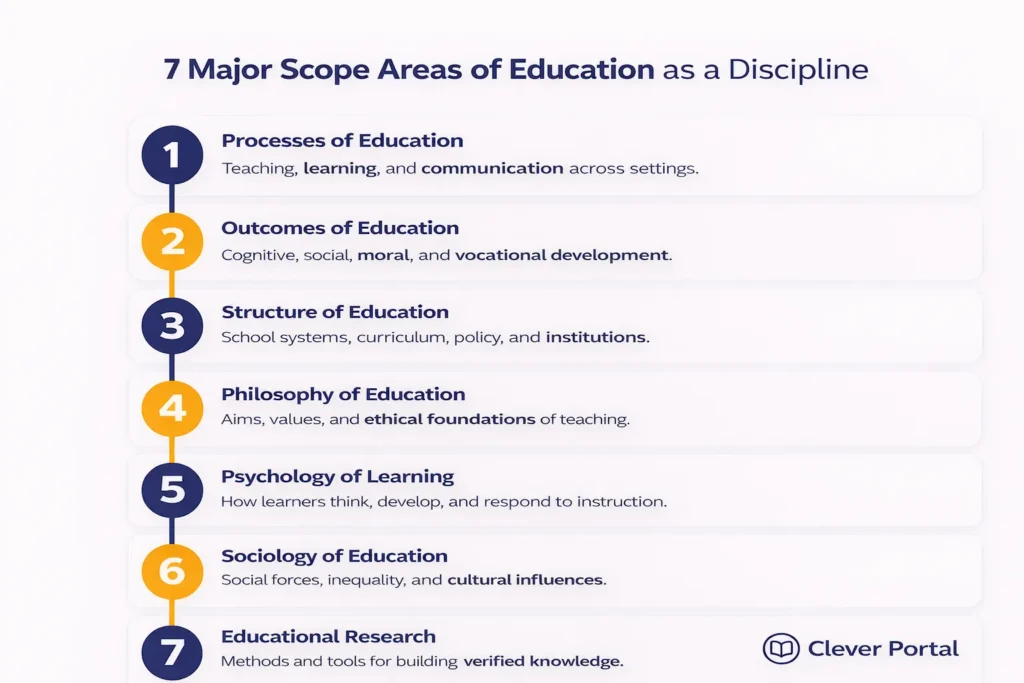
- Processes of education — teaching, learning, instruction, and communication between educators and learners across formal and informal settings
- Outcomes of education — cognitive development, social skills, moral formation, and vocational preparation as measurable products of the educational process
- Structure of education — school systems, curriculum frameworks, educational policy, and institutional design at local, national, and international levels
- Philosophy of education — the aims, values, and ethical foundations that determine what education is for and how it should be carried out
- Psychology of learning — how learners develop, think, remember, and respond to different forms of instruction across different stages of life
- Sociology of education — how social forces, inequality, culture, and community shape access to and outcomes from education at every level
- Educational research — the methods and tools used to build verified knowledge about how education works and how it can be improved
Education’s wide scope comes from the fact that learning itself is multidimensional. No single parent discipline can capture it alone, which is why education draws from several at once.
What Is the Nature of Education as a Discipline?
Education as a discipline has both a theoretical and a practical nature. This dual nature sets it apart from purely abstract disciplines and from purely applied fields.
On the theoretical side, education draws from philosophy, psychology, sociology, and history to build its knowledge base. On the practical side, that knowledge shapes curriculum design, teaching methods, student assessment, and educational policy in real schools.

Theoretical and Normative
Education is a normative discipline. It does not only describe what is happening in classrooms. It also prescribes what should happen, based on values, evidence, and social need.
For example, educational philosophy asks not just “how do teachers teach?” but “how should teachers teach, and toward what ends?” This normative quality makes education both an empirical science and a values-driven academic field. The article on philosophy of educational aims examines how this normative tradition shaped the goals of schooling across different historical periods.
Dynamic and Applied
Education is a dynamic discipline. Its content shifts as society, research, technology, and cultural values change over time.
It is also applied. Theoretical findings in educational psychology, for example, move directly into teacher training programs and classroom practice. Theory and practice in education are never fully separate from each other.
What Are the Characteristics of Education as a Discipline?
Education as a discipline has seven key characteristics that confirm its academic status. These characteristics appear consistently across B.Ed syllabi and educational research literature worldwide.
Based on our analysis of how education researchers define discipline criteria, these seven features appear in almost every foundational education philosophy course taught at university level.
7 key characteristics of education as a discipline are listed below.
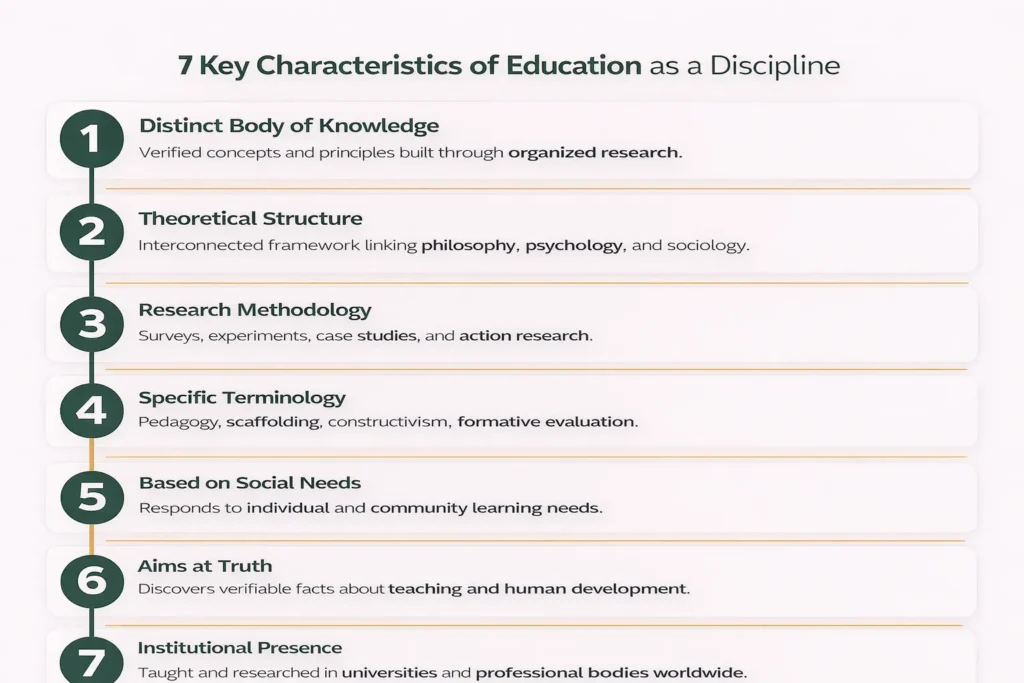
- Distinct body of knowledge — Education has its own verified stock of concepts, principles, and theories about how teaching and learning work, built through decades of organized research.
- Theoretical structure — This knowledge is organized in a logical, interconnected framework that connects philosophy, psychology, sociology, and the history of educational thought.
- Research methodology — Education uses specific research methods, including surveys, experiments, case studies, ethnographies, and action research, to build and test new knowledge.
- Specific terminology — It has its own technical vocabulary: pedagogy, curriculum, scaffolding, assessment, cognition, formative evaluation, constructivism, and many more terms that are specific to the field.
- Based on social needs — Education as a discipline is designed to respond to the actual learning needs of individuals and the broader developmental needs of communities and societies.
- Aims at truth — It seeks to discover and explain verifiable facts about how teaching, learning, and human development actually work, not just to describe existing practice from the outside.
- Institutional presence — It is taught and researched in universities, teacher training colleges, and professional bodies worldwide, which confirms its recognized status as a formal academic discipline.
What Are the Branches of Education as a Discipline?
Education as a discipline divides into several distinct branches. Each branch focuses on a specific aspect of teaching, learning, or the conditions that surround them.
According to eGyanKosh/IGNOU, education encompasses principles from philosophy, sociology, political science, and psychology as core components of its disciplinary structure.
6 major branches of education as a discipline are listed below.
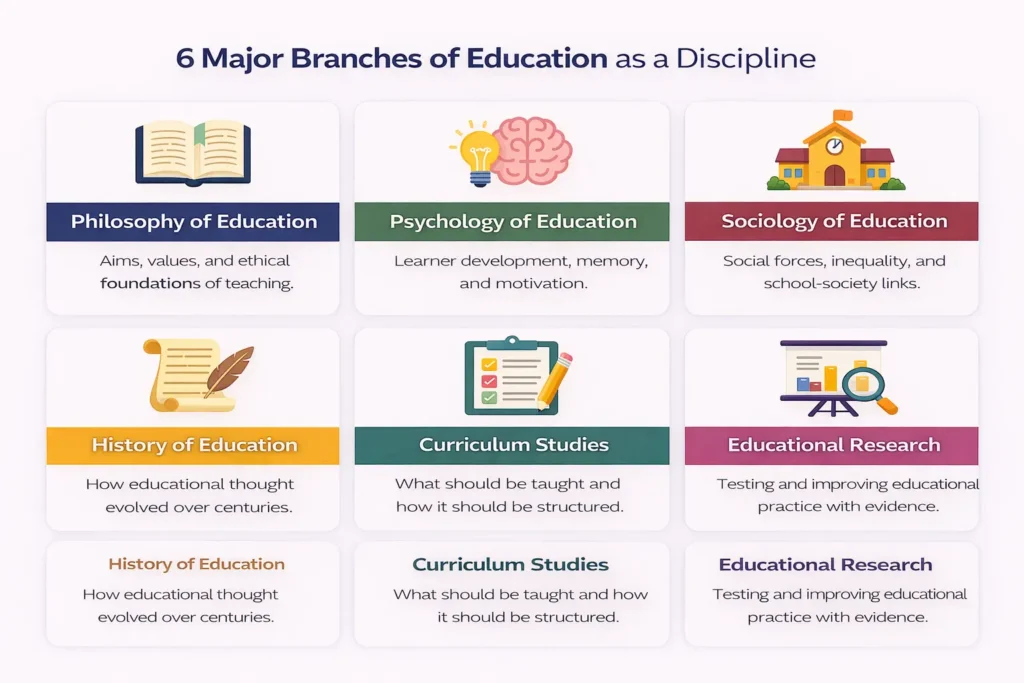
- Philosophy of education — Studies the aims, values, and ethical foundations of teaching and learning. It asks what education is for and what kind of person it should develop.
- Psychology of education — Studies how learners think, develop, and respond to instruction. It covers memory, motivation, cognitive development, emotional growth, and learning differences.
- Sociology of education — Studies how social forces shape educational access, outcomes, and systems. It examines inequality, class, culture, and the relationship between schools and society.
- History of education — Studies how educational thought and practice evolved across time and culture. It shows how current school systems developed from ancient, medieval, and early modern roots.
- Curriculum studies — Studies what should be taught, how it should be structured, and why certain content is selected over other content for inclusion in formal education programs.
- Educational research and measurement — Develops methods for testing, assessing, and improving educational practice. It covers psychometrics, evaluation design, and the standards of evidence-based teaching.
To understand how these branches grew from ancient educational practice over centuries, read the detailed guide on the origin and meaning of education.
What Are the Multidisciplinary Foundations of Education?
Education draws its knowledge base from five main parent disciplines. This multidisciplinary nature is a strength rather than a weakness. It allows education to study human learning from multiple angles at once rather than from a single narrow lens.
According to eGyanKosh/IGNOU, education encompasses the principles of philosophy, sociology, political science, and psychology as its foundational academic framework.
In our analysis of how these parent disciplines appear in B.Ed curricula, each one contributes a distinct and non-overlapping type of knowledge to the field.
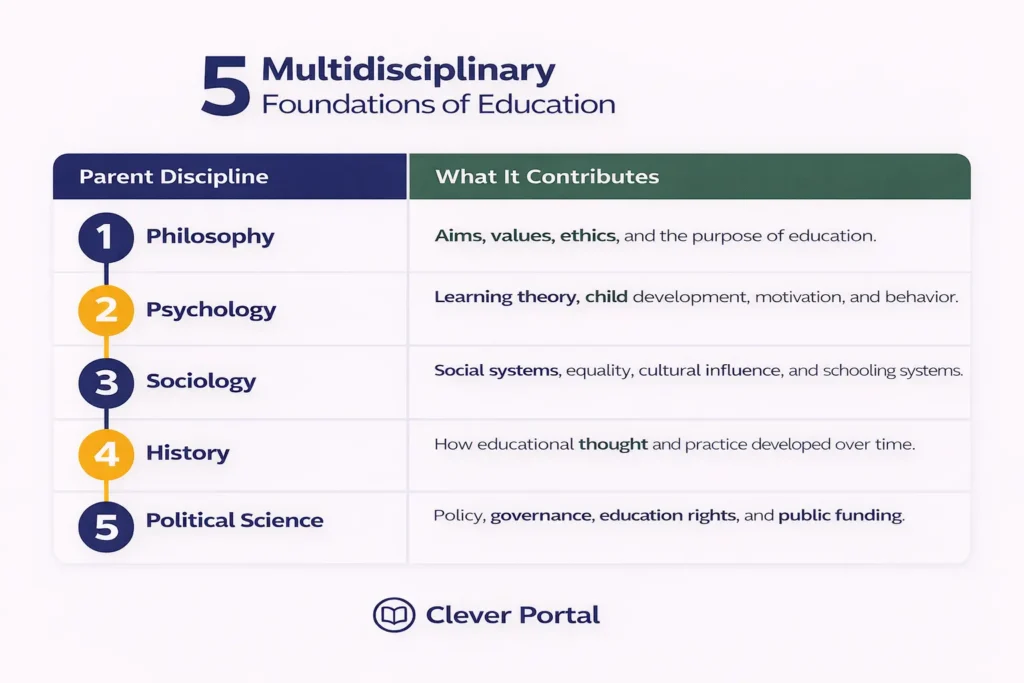
| Parent Discipline | What It Contributes to Education |
|---|---|
| Philosophy | Aims, values, ethics, and the purpose of education |
| Psychology | Learning theory, child development, motivation, and behavior |
| Sociology | Social context, equality, cultural influence, and schooling systems |
| History | How educational thought and practice developed over time |
| Political Science | Policy, governance, education rights, and public funding |
Each parent discipline gives education a different lens. Together, they make education capable of studying learning in its full social, psychological, philosophical, and political complexity.
Is Education a Discipline or a Field of Study?
Education is an academic discipline. Some scholars have described it as a field, but the evidence supports its classification as a full discipline based on widely accepted academic criteria.
The key difference is structural. A field is a broad area of study without necessarily having unified theories, research methods, or academic standards. A discipline is more structured. It has a defined body of knowledge, its own research methods, and clear theoretical frameworks that organize its findings.

The Krishnan (2009) Six Criteria
Krishnan (2009), via the ESRC National Centre for Research Methods, proposed six criteria for judging whether an area of knowledge qualifies as a full academic discipline. Education meets all six of them.
6 Krishnan criteria and how education meets each one are listed below.
- A clear research focus — Education studies the processes, outcomes, and structures of teaching and learning as its defined and bounded area of inquiry.
- A body of specialist knowledge — Education has a substantial, verified stock of theories, principles, and empirical findings built across centuries of organized study.
- Organising theories — Education uses theoretical frameworks such as constructivism, behaviorism, sociocultural theory, and critical pedagogy to organize and connect its knowledge.
- Specific terminology — Education uses a technical vocabulary that requires dedicated study to understand and apply correctly within the field.
- Specific research methods — Education uses surveys, classroom observations, ethnographies, experiments, and systematic reviews as its defined research toolkit.
- Institutional presence — Education is taught, funded, and researched in universities, professional bodies, and research associations in every major country.
BERA’s Clear Position
According to BERA (2024), “Education is the most important discipline for the profession because it provides pedagogical knowledge and techniques.” This directly supports education’s classification as a discipline, not merely a field.
The broad and narrow meaning of education shows how both formal and informal education fall within this disciplinary scope.
Conclusion
Education as a discipline is a structured, evidence-based, and institutionally recognized field of academic study. It is not simply a topic that borrows from other disciplines. It is a discipline in its own right, with its own body of knowledge, research methods, theoretical frameworks, and professional standards.
Three key takeaways from this article:
- Education as a discipline covers seven major scope areas and draws from five parent disciplines
- It has seven defining characteristics that separate it from a simple field of study
- It meets all six of Krishnan’s academic discipline criteria, as confirmed by BERA (2020, 2024)
To understand the full meaning behind what this discipline studies, read the complete guide on what education means as a concept and see how the disciplinary structure connects to education’s broader purpose as a human and social practice.