Definition of Education by Different Authors, Philosophers, and Scholars
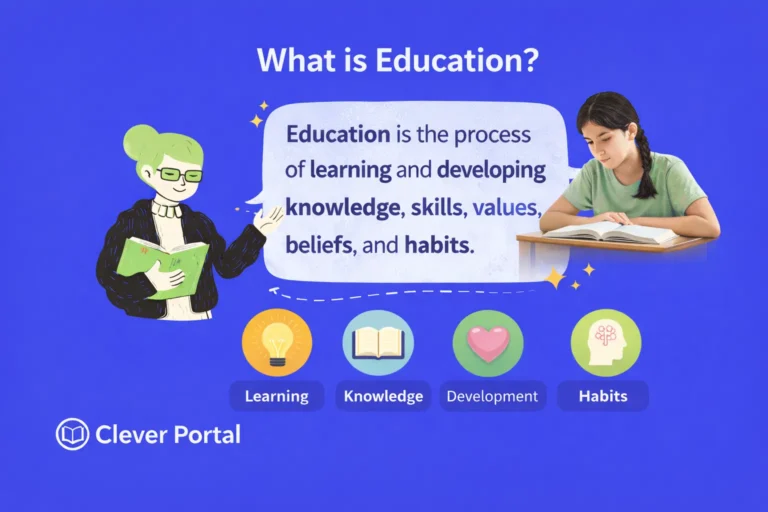
The definition of education is not one fixed statement, it is a collection of views from philosophers, educationists, and scholars stretching across more than 2,000 years. Plato, Aristotle, Dewey, Rousseau, Gandhi, and Tagore each gave a different answer, because each started from a different belief about human nature and the purpose of social life.
In our review of B.Ed foundation course materials, students who learn definitions in organized frameworks, narrow vs broad, teacher-centered vs student-centered, Eastern vs Western, write stronger assignments than those who memorize definitions in isolation.
This article gives you a master definitions table with 12 attributed scholars, three comparison frameworks, and seven FAQ answers. For the full concept behind the term, start with the guide on what education means as a concept.
Why Are There So Many Definitions of Education?
There are many definitions of education because scholars define it from different starting points: individual development, social function, or knowledge transmission. Each starting point leads to a different answer.
Wikipedia’s Definitions of Education (2022) confirms this directly: “There is wide agreement that education is a purposeful activity directed at achieving certain aims. But there are deep disagreements about its exact nature and characteristics.” So the variety is not a problem to fix. It reflects genuine disagreement about what human beings need and what schools are for.
For B.Ed students, the best approach is to treat definitions as a map of philosophical positions. When you know which tradition a definition comes from, you can use it with precision in any essay or exam answer.
Definition of Education by Different Authors and Philosophers
The definitions below come from philosophers, educationists, and institutions across different centuries and traditions. Each definition is attributed to its source and placed in the philosophical tradition it represents.
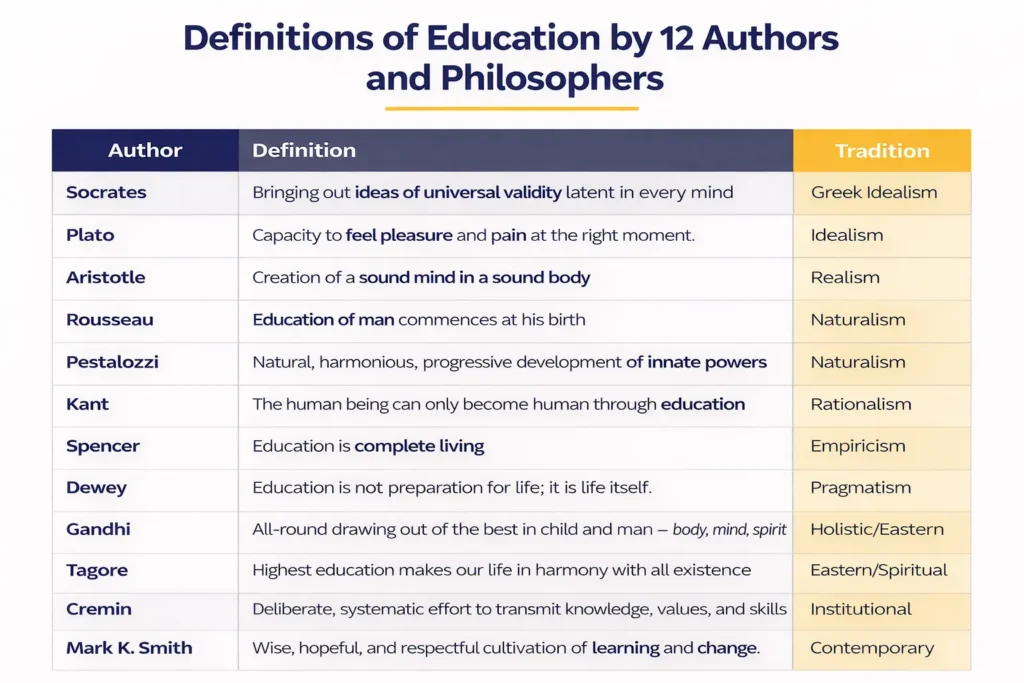
Based on our analysis of B.Ed foundation course materials, these 12 definitions appear most consistently across curricula in South Asia, Africa, and the UK.
The Master Definitions Table
What These Definitions Share
Every definition treats education as deliberate, not accidental. That is the one point of agreement across all traditions. Where they differ is on the goal: truth, virtue, natural growth, social life, or spiritual harmony.
For students writing assignments, the Cremin and Dewey definitions are the most widely cited in academic and institutional contexts. Gandhi and Tagore are most useful when discussing Eastern or holistic views of education.
What Is the Narrow Definition of Education?
In the narrow sense, education refers only to planned, formal instruction given by adults to the young in schools, churches, or recognized institutions.
T. Raymont stated it clearly: “In the narrower and more definite sense, education does not include self-culture and the general influences of one’s surroundings, but only those special influences which are consciously brought to bear upon the young by the adult portion of the community.”
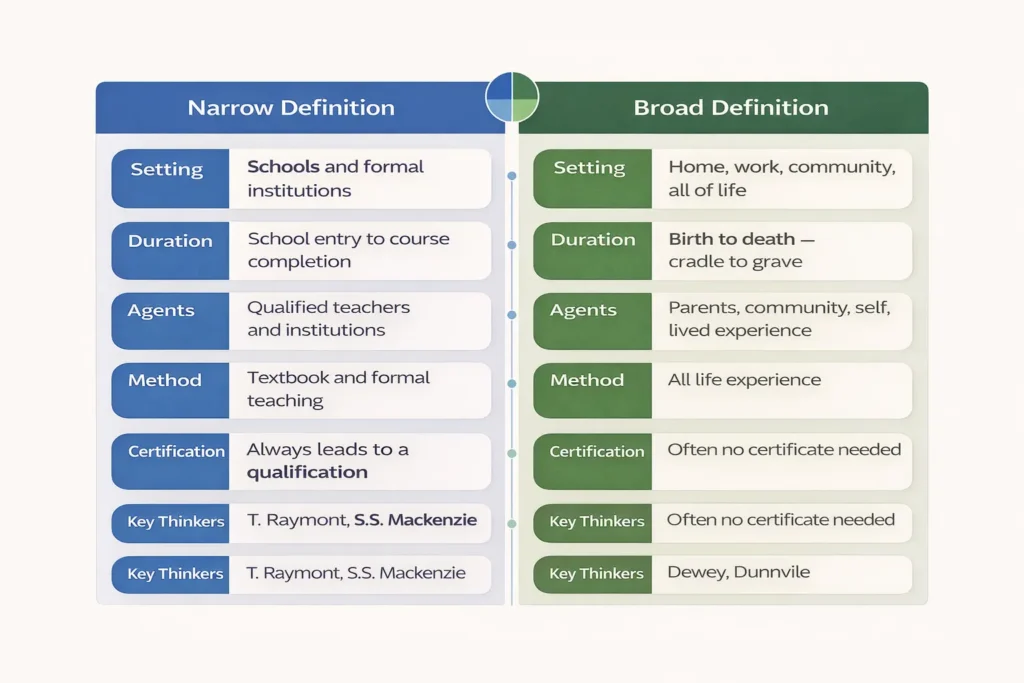
S.S. Mackenzie described the narrow sense as: “Any consciously directed effort to develop and cultivate our powers.” Both definitions share three features: a fixed starting point, a fixed end point, and a deliberate adult agent.
Narrow vs Broad: Key Comparison
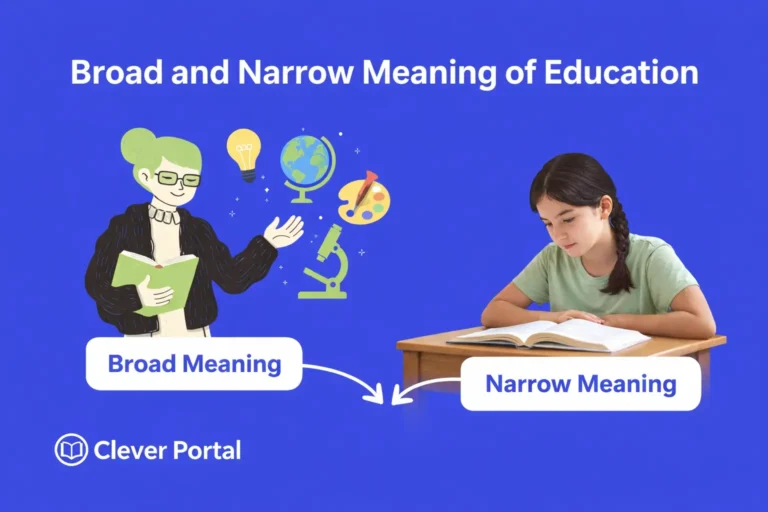
A full side-by-side analysis of these two senses is available in the guide on the broad and narrow meaning of education.
What Is the Broad Definition of Education?
In the broad sense, education is a lifelong process that covers all learning from birth to death, in every setting. It is not limited to schools.
Durnvile expressed this as: “Education in its widest sense includes all the influences which act upon an individual during his passage from cradle to the grave.” Dewey made the same point in social terms: “Education in its broadest sense is the means of the social continuity of life.”
S.S. Mackenzie added: “In the wider sense, education is a process that goes on throughout life and is promoted by almost every experience in life.” For B.Ed students, the broad definition matters because it includes informal learning, cultural transmission, family influence, and self-directed growth, all of which appear in exam questions on the scope of education.
The origin and meaning of education gives useful historical context for why the broad view developed alongside the narrow one.
Teacher-Centered vs Student-Centered Definitions of Education
Definitions of education can also be grouped by where they place the focus: on the teacher’s role, or on the learner’s role.
Teacher-centered definitions put the authority with the adult educator. Student-centered definitions put the potential with the learner. Wikipedia’s Definitions of Education (2022) identifies this as one of the three major ways scholars organize competing definitions.

The Dual-Perspective Definition
Some scholars reject both extremes. They describe education as a shared experience where teacher and learner discover meaning together. Cremin’s definition and Mark K. Smith’s “wise, hopeful cultivation” both try to hold both sides in one frame.
For B.Ed students, understanding all three positions, teacher-centered, student-centered, and dual, is more useful than memorizing only one. Exam questions often ask students to compare these views directly.
Eastern vs Western Definitions of Education
Western and Eastern philosophers asked different questions about education, and their answers produced very different definitions.
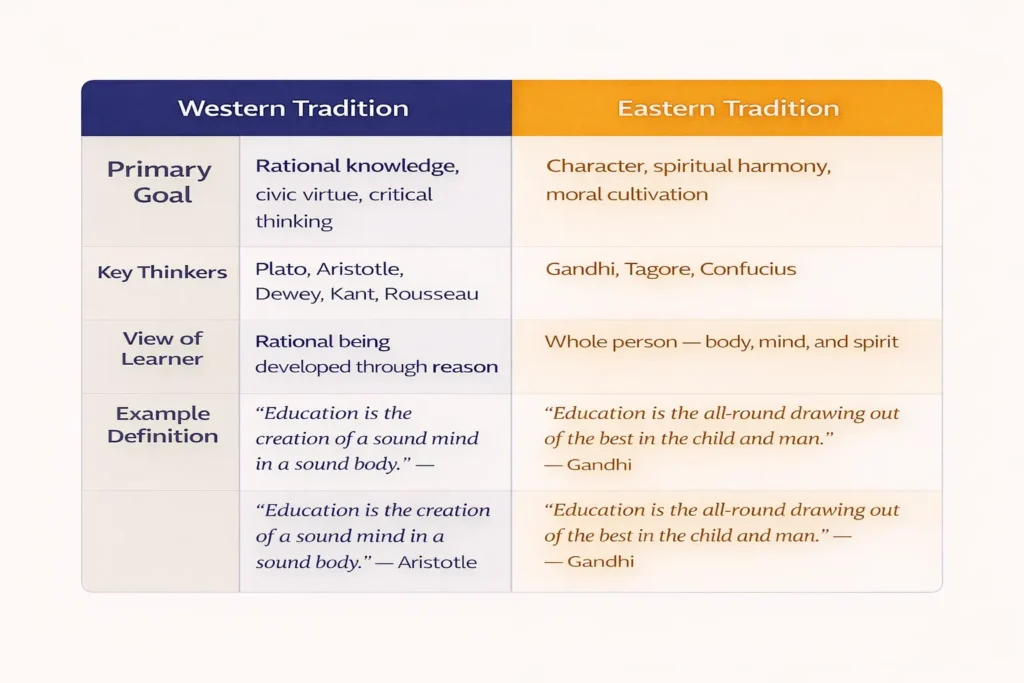
Western thinkers, from Plato to Dewey, tended to define education in terms of reason, virtue, civic life, and knowledge. Eastern thinkers, from Gandhi to Tagore, focused on character, spirit, moral growth, and harmony with existence.
When comparing these traditions in an assignment, the most useful move is to note what each view leaves out. Western definitions often underplay spiritual development. Eastern definitions often underplay critical reasoning. Both views together offer a fuller picture than either alone.
What Is the Real or Ideal Concept of Education?
Beyond narrow and broad, scholars also distinguish between the real and ideal concept of education. This distinction appears often in B.Ed foundation courses and exam papers.

The Real Concept of Education
The real concept of education refers to how education is actually practiced in a given society at a specific time. It is shaped by economic conditions, political goals, cultural values, and available resources.
Real education often falls short of what philosophers describe. For example, a school system focused only on exam results may produce graduates who can pass tests but cannot think critically or solve real-world problems. That gap between what schools do and what education should do is the starting point for most educational reform.
The Ideal Concept of Education
The ideal concept refers to what education should be, the goals and qualities that define excellent education regardless of current conditions.
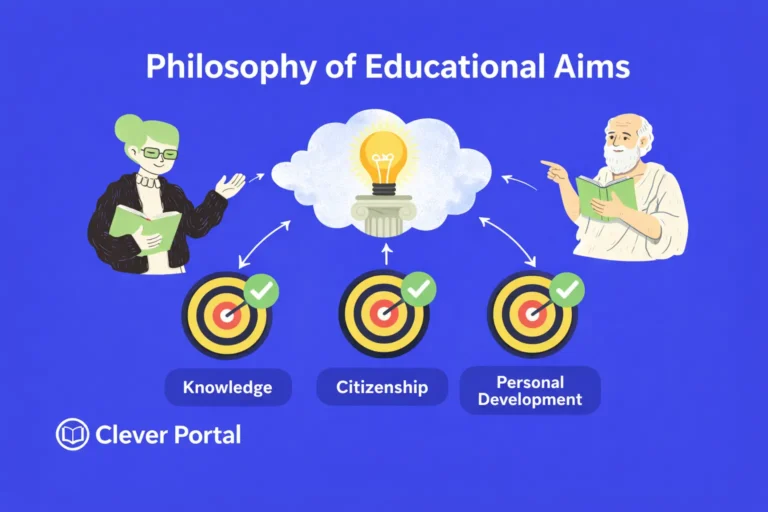
Most philosopher definitions are prescriptive in this sense. Plato, Dewey, Gandhi, and Tagore each described what education ought to achieve, not what it currently does. In B.Ed study, the ideal concept connects directly to the aims of education, where individual, social, moral, and vocational goals set the direction that real education systems should move toward.
How Does the Word “Education” Reflect Its Definitions?
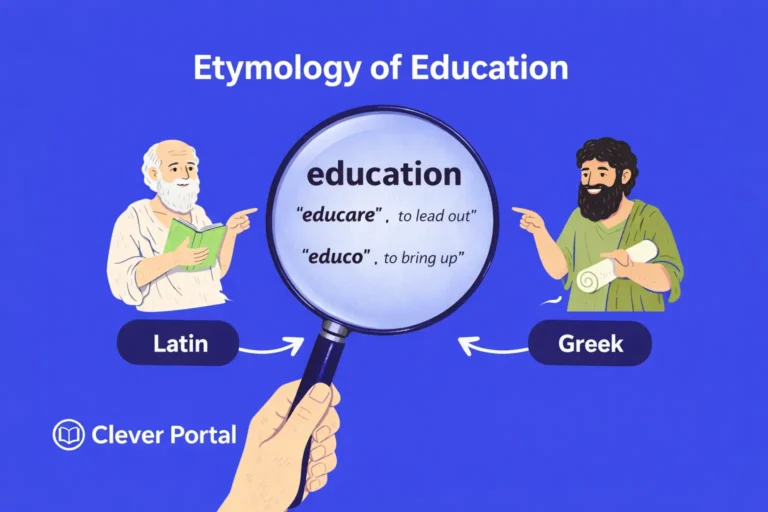
The Latin roots of education, educere (to draw out) and educare (to bring up or train), explain why there are two broad definition streams: one that draws out the learner’s potential and one that fills the learner with knowledge. Both meanings have survived into modern philosophy. For the full word history, read the guide on the etymology and origin of the word education.
How Does Education as a Discipline Analyze These Definitions?
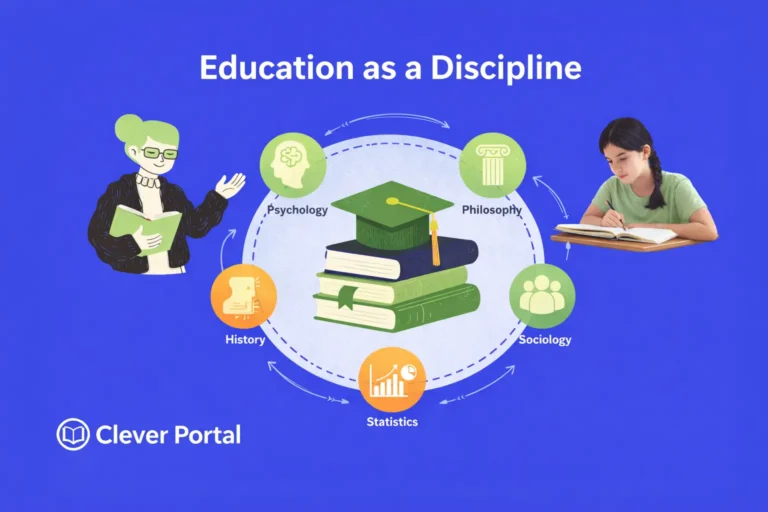
As a formal academic discipline, education uses research methods from philosophy, psychology, and sociology to study and evaluate these definitions critically. Students learn to move from quoting a definition to analyzing it, asking what assumptions it makes and what it leaves out. For that analytical framework, read the article on education as a formal academic discipline.
Frequently Asked Questions
What is the definition of education by different authors?
Different authors define education based on their philosophical tradition. Plato describes it as feeling pleasure and pain at the right moment, Dewey as life itself rather than preparation for life, and Cremin as a deliberate effort to transmit knowledge, values, and skills. Gandhi defines it as drawing out the best in body, mind, and spirit. Each definition reflects a different belief about what human beings need and what education is ultimately for.
What is the difference between the narrow and broad definition of education?
The narrow definition limits education to formal schooling, planned instruction given by qualified teachers to the young in recognized institutions, ending with a certificate. The broad definition covers all learning from birth to death, across every setting, school, home, work, and community, with no age limit and no certificate required. T. Raymont represents the narrow view. Dewey and Durnvile represent the broad view. Most B.Ed courses ask students to explain both and compare them.
How did John Dewey define education?
John Dewey defined education as “a process of living and not a preparation for future living”. He believed that education happens through experience and social interaction, not through passive absorption of information. For Dewey, the school should replicate real life, not prepare students for a future version of it. His definition belongs to the pragmatist tradition and is one of the most cited in both academic and institutional contexts.
What is a teacher-centered definition of education?
A teacher-centered definition places the authority and the purpose of education with the adult educator. The learner receives knowledge, values, and skills from the teacher rather than discovering them through personal experience. Plato’s and Aristotle’s definitions lean toward this view, as both describe education as a process guided by the adult toward correct values and mental development. This view contrasts with student-centered definitions, where the learner’s natural growth and active participation drive the process.
What is the most accepted definition of education?
No single definition is universally accepted, but Lawrence Cremin’s and John Dewey’s are the most widely cited in academic and institutional contexts. Cremin’s definition is favored because it is broad enough to include formal and informal learning, and specific enough to identify education as deliberate. Dewey’s definition is favored because it connects learning to life experience in a way that most modern educators recognize. For B.Ed assignments, using one of these two, with their attribution, carries strong academic weight.
How did Aristotle define education?
Aristotle defined education as “the creation of a sound mind in a sound body”. He believed that education should develop both intellectual and physical capacities together, not one at the expense of the other. His view belongs to the realist tradition, where education equips the learner to deal with the actual world through reason and disciplined habit. Aristotle also believed that education should prepare citizens to participate well in civic life.
What is the difference between the real and ideal concept of education?
The real concept of education refers to how education is actually practiced in a given society, shaped by available resources, political goals, and economic conditions. The ideal concept refers to what education should be according to philosophical principles and goals. Most philosopher definitions are ideal rather than real. They describe what education ought to achieve. The gap between real and ideal education is what drives most educational reform debates and appears regularly in B.Ed exam questions.
Conclusion
The definition of education cannot be reduced to a single statement, because scholars across centuries have approached it from different positions. Three takeaways matter most. First, every major definition treats education as deliberate rather than accidental. Second, definitions organize best into three frameworks: narrow vs broad, teacher-centered vs student-centered, and Eastern vs Western. Third, the Cremin and Dewey definitions are the most widely cited in academic writing, but knowing all 12 definitions in the master table above gives you the range to answer any exam question with precision. To connect these definitions to the full concept of education, read the complete guide on the full meaning and concept of education.