What Is Education? Definition, Types, Importance & More
Education is the process through which people gain the knowledge, skills, and values they need to understand and shape the world around them. It does not begin when you enter a classroom, and it does not end when you graduate.
Most people connect education with schools, teachers, and exams. Yet the concept runs far deeper than any single institution. It shapes who a person becomes, what they can achieve, and how they engage with society. Every experience, conversation, and challenge is part of it.
This guide covers what education is at its core, the three types every learner moves through, its core purpose, importance, and the six stages from early childhood to lifelong learning. You will also see how education is changing fast in 2026, and why that matters for every learner today.
What Is Education?
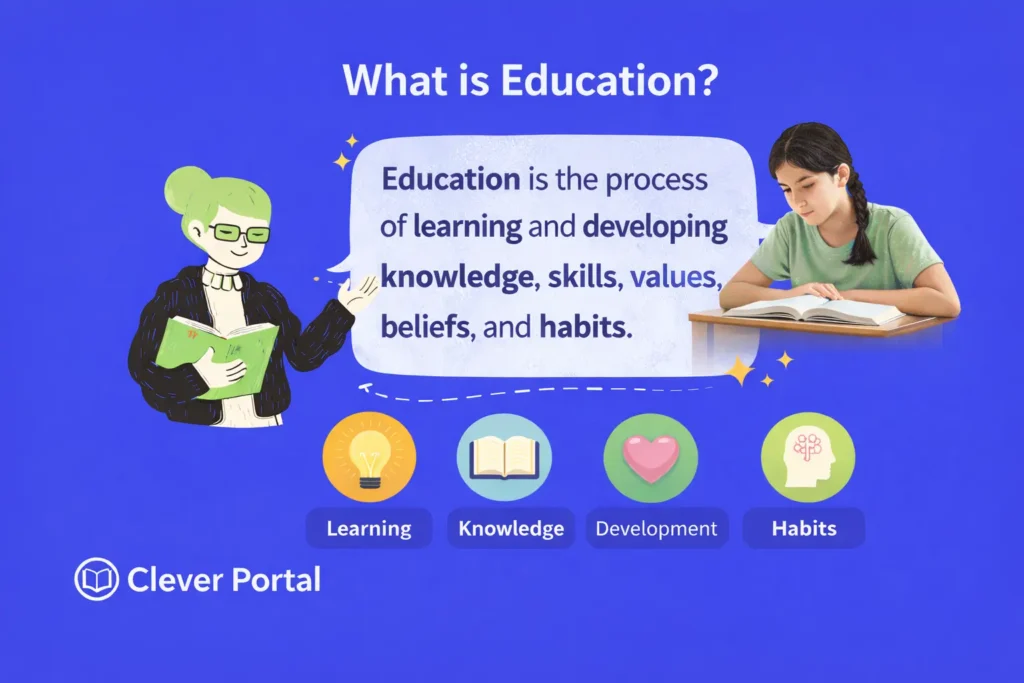
Education is the structured process through which individuals acquire knowledge, skills, values, and the ability to think critically about the world. It shapes who people become, not just what they know.
Different sources define education from different angles. Each one adds something important.
UNESCO: “Education is a fundamental human right and a public good. Every woman, man, and child has the right to receive a quality education.”
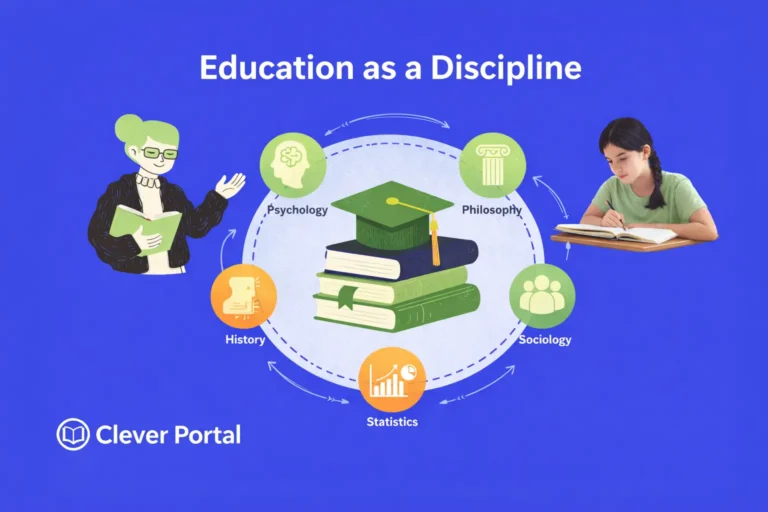
Britannica: Education is the discipline concerned with the methods, processes, and purposes of teaching and learning in society.
John Dewey: “Education is not preparation for life, education is life itself.”
These three definitions cover education as a process, a right, and a system. Together, they show that education is not one single thing.
Education as Process, Right, and System
As a process, education is the ongoing act of learning, acquiring new knowledge, testing ideas, and building skills over time. As a right, it is something every person deserves access to regardless of background or income. As a system, it is the network of institutions, policies, and structures that make organized learning possible at scale.
What all three share is this: education is not passive. Knowledge acquisition, skills development, and values formation all happen through active participation, not by sitting in a room. That distinction matters for every learner, at every stage of life.
What Are the Three Types of Education?
There are three main types of education: formal, non-formal, and informal. All three shape how people learn throughout their lives, and all three overlap far more than most people expect.
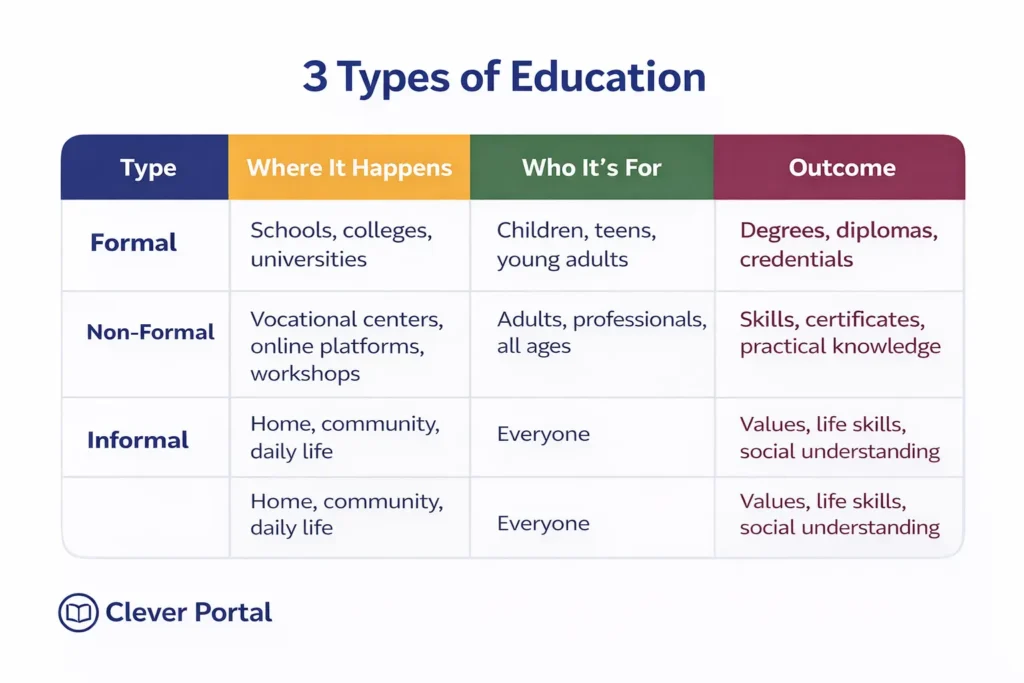
| Type | Where It Happens | Who It’s For | Outcome |
| Formal | Schools, colleges, universities | Children, teens, young adults | Degrees, diplomas, credentials |
| Non-Formal | Vocational centers, online platforms, workshops | Adults, professionals, all ages | Skills, certificates, practical knowledge |
| Informal | Home, community, daily life | Everyone | Values, life skills, social understanding |
Formal Education: Structured Learning With Credentials
Formal education takes place in structured, officially recognized settings. In the US, this means the K–12 school system, community colleges, four-year universities, and post-graduate programs. It follows a set curriculum. Teachers hold professional qualifications. Students earn recognized credentials at each stage, and those credentials carry real weight in careers and further study.
Non-Formal and Informal Education: Learning Beyond the Classroom
Non-formal education is organized but flexible. Vocational training, online certification courses, adult literacy classes, and workplace development programs all qualify. These do not always lead to a traditional academic degree, but they build practical, applicable skills. The rise of online learning has made non-formal education one of the fastest-growing areas in the field.
Informal education is different. It happens without any planned structure. A child learning money management from a parent, a teenager developing empathy through friendship, an adult gaining new skills by solving problems at work, all of this is informal education. It is continuous, unscheduled, and often the most lasting form of learning a person ever experiences.
What Is the Purpose of Education in Society?
The primary purpose of education is to develop individuals intellectually, socially, and economically so they can contribute meaningfully to society. Education does not exist simply to transfer facts. It serves five core purposes that apply across cultures, systems, and generations.
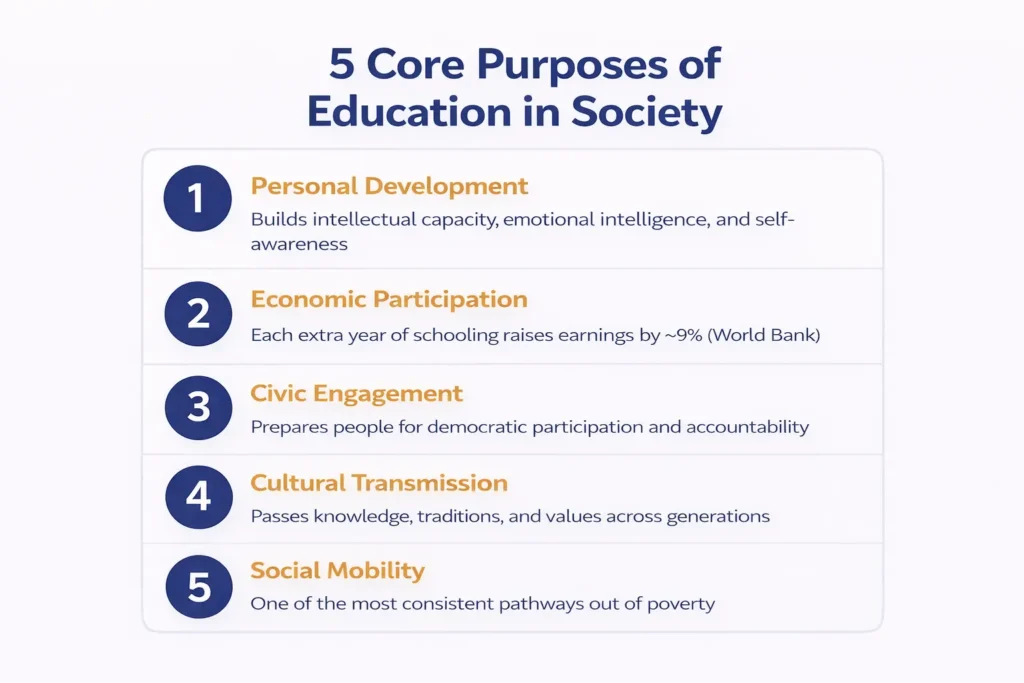
1. Personal Development
Education builds intellectual capacity, emotional intelligence, and self-awareness. It gives people tools to understand themselves and navigate complex situations with confidence.
2. Economic Participation
Educated people participate more fully in the economy. They earn more, contribute more, and generate broader opportunity for their communities. Each additional year of schooling increases individual earnings by approximately 9%, according to World Bank research.
3. Civic Engagement
Education prepares people for democratic participation. It builds awareness of rights, responsibilities, and how public institutions function. Without it, civic life weakens and democratic systems lose their foundations.
4. Cultural Transmission
Every generation passes knowledge, traditions, and values to the next through education. This is how shared history, identity, and culture survive and evolve over time. Schools, families, and communities all play a role in this transfer.
5. Social Mobility
Education is one of the most consistent pathways out of poverty. When quality learning is accessible to all, mobility becomes possible for people who would otherwise remain in cycles of disadvantage.
These five purposes reinforce each other. Personal development builds capacity for civic engagement. Economic participation supports social mobility. Together, they form the educational goals that underpin every learning system worth building.
Why Is Education Important for Personal and Social Growth?
Education directly increases earning potential, reduces inequality, and builds the social fabric of democratic societies. Its importance extends far beyond any single outcome, it touches every dimension of how a person lives and how a society functions.
The data makes the case clearly:
- 📊 Each additional year of schooling increases individual earnings by ~9%, World Bank
- 📊 763 million adults worldwide cannot read or write at a basic level — UNESCO Institute for Statistics
- 📊 300 million children are currently out of school globally — UNESCO
- 📊 Countries with higher education enrollment consistently show stronger economic output, lower crime rates, and better public health outcomes
- 📊 Quality education is UN Sustainable Development Goal #4 — one of 17 global priorities for 2030
The Wider Social Benefits
Education does more than raise wages. It reduces gender inequality by giving women and girls access to economic and civic life on equal terms. It also improves health literacy — educated populations make better health decisions, seek medical care earlier, and live longer on average.
It strengthens democracy. People who understand how civic systems work are better equipped to participate in them, hold institutions accountable, and think independently.
Based on our review of US-based education research, one finding stands out consistently: the benefits of education compound across generations. Educated parents raise children more likely to stay in school. That cycle builds quietly, and its effects show up decades later in communities that chose to invest in learning early.
What Are the Stages of Education From Childhood to Adulthood?
Education is organized into distinct stages, beginning with early childhood and extending through adulthood as lifelong learning. Each stage builds on the last, and the final stage never officially ends.
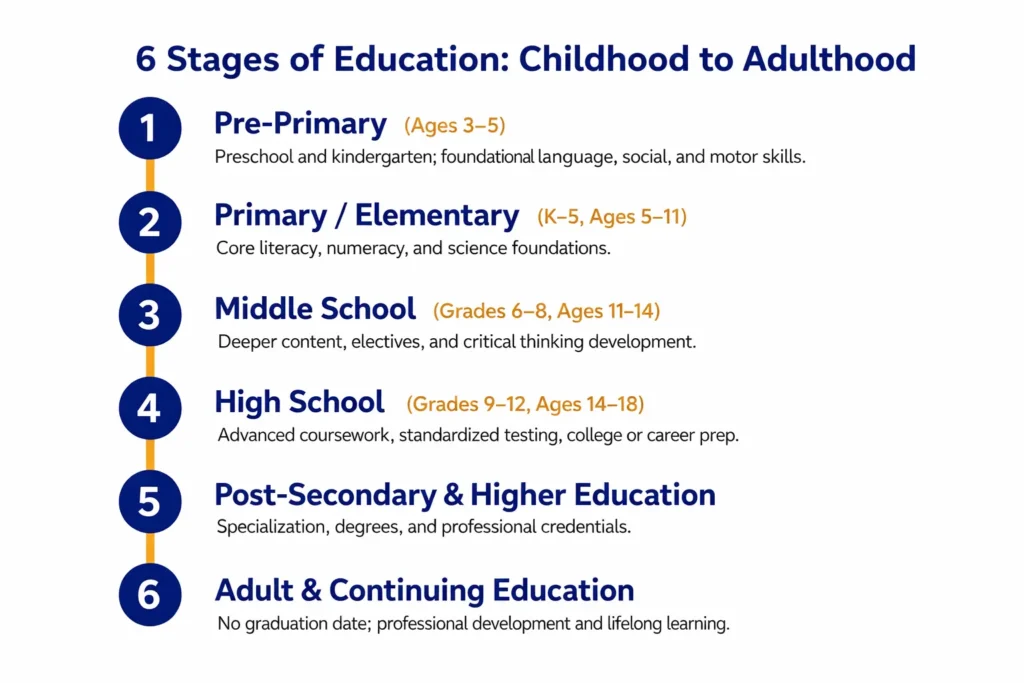
Here are the six main stages in the US education system:
1. Pre-Primary Education (Ages 3–5)
Early childhood education, preschool, and kindergarten. This stage builds foundational language, social, motor, and cognitive skills. The habits of curiosity and attention formed here shape everything that follows.
2. Primary / Elementary School (K–5, Ages 5–11)
Core academic subjects — reading, writing, mathematics, basic sciences, and social studies. Students develop the literacy and numeracy skills that all future learning depends on.
3. Middle School / Junior High (Grades 6–8, Ages 11–14)
Academic content deepens. Students begin choosing elective subjects and develop stronger critical thinking. Social and identity development also accelerates during this stage.
4. High School (Grades 9–12, Ages 14–18)
Advanced coursework, standardized testing, and preparation for college or a career path. Choices made here have real consequences for post-secondary opportunities and early career direction.
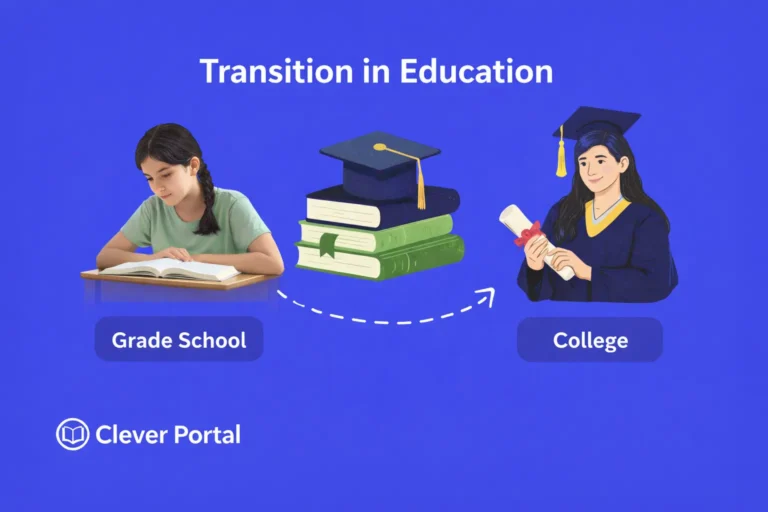
5. Post-Secondary and Higher Education
Community college, four-year universities, technical institutes, and professional degree programs. This stage introduces specialization and the credentials most professional careers require.
6. Adult and Continuing Education
Professional development, certifications, online learning programs, and personal study. This stage has no graduation date. It is the most open-ended and, for most adults, the most continuous form of learning they will ever experience.
Lifelong learning is not a bonus stage. It is a career and personal development necessity in a world where skills shift faster than any single degree can fully anticipate.
Is Education the Same as Schooling?
No, education and schooling are not the same thing. Schooling is a formal, structured subset of education, while education itself is broader, lifelong, and deeply personal.

Schools provide an organized environment for specific kinds of learning. They offer curricula, qualified teachers, and the credentials that open doors in professional life. Those contributions are real and significant. Yet they represent only one channel through which education moves.
John Dewey understood this well. His argument, that education is not preparation for life but life itself, challenged the assumption that learning only counts when it happens inside an institution.
“Education is not preparation for life — education is life itself.”
— John Dewey
Why the Distinction Matters Practically
Think about where most adults actually learn. They learn from mentors, from their own mistakes, from books nobody assigned, from parenting, and from solving unfamiliar problems at work. None of that qualifies as schooling. All of it qualifies as education.
This distinction matters. When people believe learning ends at graduation, they stop growing. When they understand that education is continuous, they stay curious, seek new experiences, and develop skills that no formal program ever taught them.
A person can complete the entire K–12 system and earn a four-year degree without learning how to manage their finances, maintain their health, or navigate a difficult relationship. Informal education and self-study fill those gaps. Schooling matters. It is also incomplete on its own.
How Is Education Changing in 2026 and Beyond?
Education in 2026 is being fundamentally reshaped by artificial intelligence, online platforms, and a growing demand for flexible, lifelong learning pathways. The classroom is no longer the only place where serious, structured learning happens.

Six major shifts are underway right now:
- AI-driven personalized learning: Platforms now adapt in real time to each student’s strengths, gaps, and pace, making individualized instruction accessible at scale
- Hybrid classrooms: Most US schools and universities now offer a mix of in-person and online instruction; students expect flexibility as a baseline
- Micro-credentials and online certificates: Short, skill-specific programs are replacing traditional four-year degrees for many career paths; employers across sectors now accept them
- UNESCO Futures of Education initiative: UNESCO is actively rethinking what education should look like by 2050, with a focus on cooperation, sustainability, and learning as a shared global responsibility
- Digital equity gaps: Access to EdTech tools is not equal; students in under-resourced schools face real barriers that better-resourced peers do not
- UNESCO UIS World Education Statistics 2025: Tracks 11 SDG-aligned education themes — showing real progress in some regions and persistent gaps in others
The direction is clear: education is becoming more personalized, more flexible, more digital, and more urgently unequal. Both sides of that equation deserve attention.
Is Education a Fundamental Human Right?
Yes, education is recognized as a fundamental human right under both the United Nations Universal Declaration of Human Rights and UNESCO’s global mandate. Access to quality learning is not a privilege for those with means. It is a right that every person holds by virtue of being human.
📊 300 million children and youth are currently out of school globally
📊 763 million adults cannot read or write at a basic level
📊 SDG Goal 4 calls for inclusive, equitable, quality education for all by 2030
The UN’s Sustainable Development Goal 4 sets a clear target: every person on earth should have access to quality education and lifelong learning opportunities by 2030. Progress is real in some regions. In others, the gap remains wide.
UNESCO’s mandate reinforces the same principle, education must be inclusive and equitable, not just available. A school without trained teachers, proper materials, or a safe environment does not fulfill the right to education in any meaningful sense. These numbers represent people cut off from economic opportunity, civic participation, and personal growth. When education is inaccessible, nearly every other right becomes harder to exercise.
What Is the Full Definition of Education and Its Role in Development?
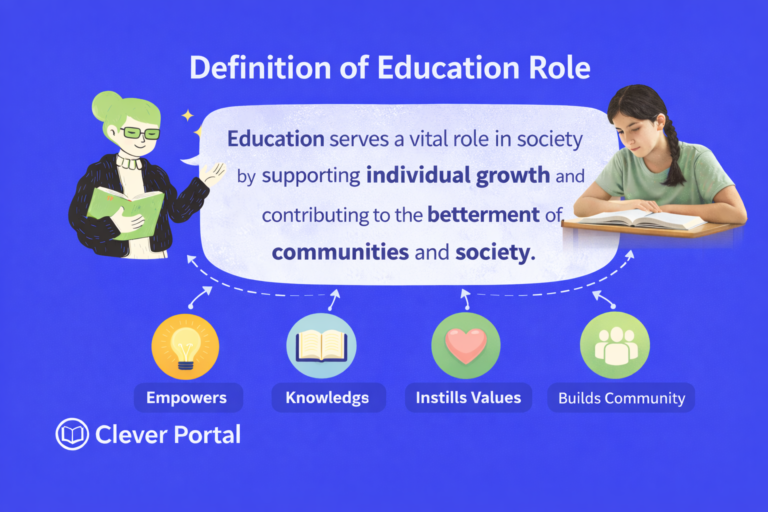
The definition of education covers far more than classroom learning, it includes the full role education plays in personal, social, and economic development across a person’s lifetime. Understanding this full scope changes how we think about what learning is actually for.
For a complete breakdown of the definition and its developmental implications, explore the definition of education and its role in personal and social development.
Where Does the Word “Education” Originally Come From?
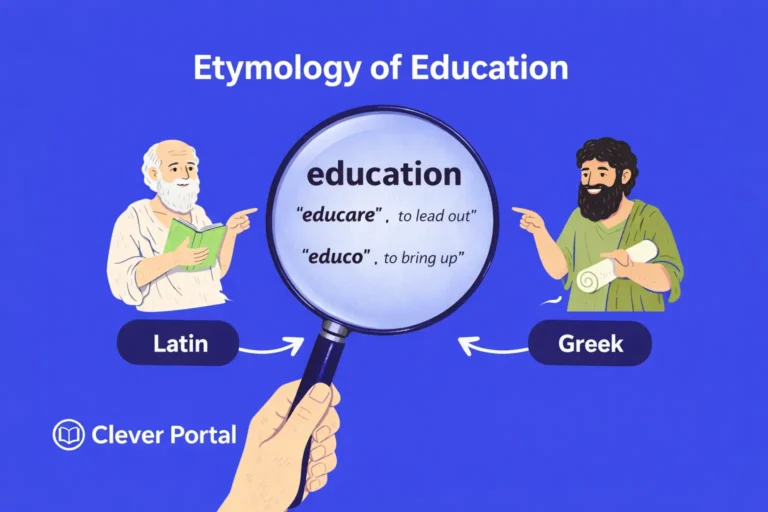
The word “education” traces back to two Latin roots, educare (to raise or nourish) and educere (to lead out). Both roots suggest something important: education was never meant to simply fill a person with information. It was designed to draw out potential that already exists.
That idea still defines the best educational experiences today. For a deeper look at these historical roots, read about the origin and meaning of education.
What Is the Broad vs. Narrow Meaning of Education?
In the narrow sense, education refers to formal schooling, structured instruction inside recognized institutions. In the broad sense, it includes every experience that shapes a person’s understanding, values, and capabilities throughout their life.
Both meanings are valid. Which one applies depends on context. For a full comparison of both frameworks, see the guide on the broad and narrow meaning of education.
What Are All the Types of Education Across Every Setting?
Beyond formal, informal, and non-formal categories, education also includes specialized forms, peace education, vocational training, universal education, religious education, and more. Each serves a specific purpose within the broader ecosystem of learning.
For a complete map of every type and what distinguishes one from another, see the full guide to types of education.
How Do Formal, Informal, and Non-Formal Education Differ in Practice?
Formal education is credentialed, structured, and institution-based. Non-formal education is organized but flexible, without necessarily leading to a traditional degree. Informal education is unstructured, continuous, and woven into daily life.
All three are legitimate. All three shape a person differently. To see the full side-by-side comparison with examples from each, read formal, informal, and non-formal education differences.
What Are the Formal Aims of Education?
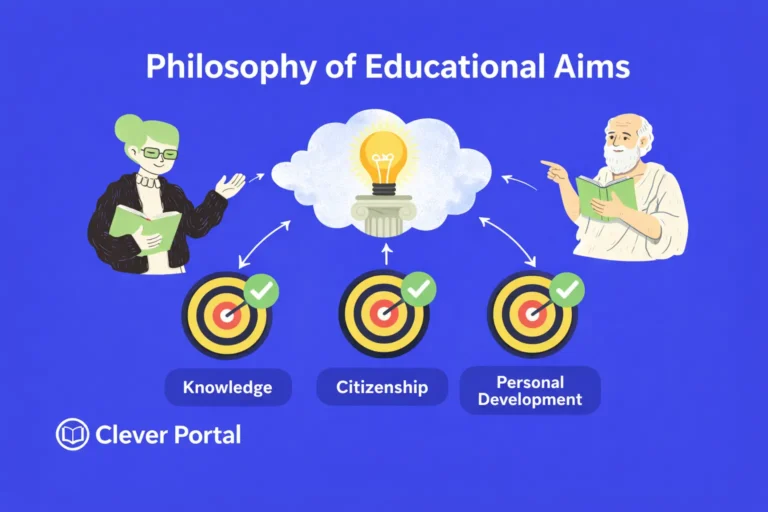
The aims of education are the deliberate goals that societies, institutions, and educators set for the learning process. They go beyond individual subjects, covering intellectual development, civic responsibility, character formation, and social contribution.
These aims vary across educational traditions and philosophies. For the complete breakdown of how educators define and prioritize them, read the aims of education and why they guide every learning system.
How Did Philosophers Shape Our Understanding of Educational Aims?
Philosophers have debated the purpose of education for centuries. Aristotle saw it as the foundation of virtue. Dewey believed genuine learning came from experience and reflection. Paulo Freire argued that education must develop critical consciousness — not just compliance.
Each perspective still shapes how curricula are designed and reformed today. To explore how these ideas connect to formal educational philosophy, see philosophy of educational aims: theories and perspectives.
How Does Education Contribute to Personal Growth?
Education builds more than knowledge, it develops confidence, critical reasoning, emotional intelligence, and the capacity to navigate life’s challenges with greater skill. Personal growth through education is not limited to what a person learns in school. It accumulates across every stage of life.
For a focused look at how learning connects to individual potential, read about education and personal growth: how learning unlocks potential.
What Is Education’s Role in Social Development?
Education is one of the most reliable drivers of social development, reducing crime, narrowing inequality gaps, and strengthening the civic institutions that hold communities together. Societies that invest in education tend to become more stable, more cooperative, and more productive over time.
To explore the specific mechanisms through which learning builds stronger communities, see education and social development: role and importance.
Why Is Lifelong Learning Essential for Adults in 2026?
Lifelong learning, the ongoing, voluntary pursuit of knowledge for personal or professional reasons, is no longer optional in a rapidly changing economy. Skills that were in demand five years ago may already be outdated. Adults who treat learning as a continuous practice adapt faster and perform better across every measure.
For a full breakdown of what lifelong learning looks like in practice, read lifelong learning: concept, importance, and key benefits.
What Is the Role of Schools Within the Broader Education System?
Schools serve as the primary institution for formal education, but their role extends beyond academics. They also function as sites of socialization, civic preparation, cultural transmission, and community development. Understanding what schools do well, and what they cannot do alone, clarifies why education must extend beyond their walls.
For the full picture of what schools contribute to society, read the role of school in society: functions, importance, and impact.
What Digital Solutions Are Reshaping Education Right Now?
From AI tutors to learning management systems, digital tools are transforming how education is delivered, accessed, and personalized. Some solutions are closing access gaps. Others are creating new ones. The technology is moving faster than most institutions can follow.
For a practical overview of the tools and trends driving this shift, see digital solutions in education: tools, trends, and best practices.
What Does Inclusive Education Mean and Why Does It Matter?
Inclusive education means ensuring that every learner, regardless of ability, background, gender, or economic status, has full and equal access to quality learning experiences. Access alone is not enough. Quality, support, and fairness must come with it.
For the complete principles and strategies behind building inclusive learning environments, read the inclusive education guide: definition, principles, and complete guide.
What Is the UN’s Sustainable Development Goal 4 for Education?
The UN’s Sustainable Development Goal 4 (SDG 4) calls for inclusive and equitable quality education and lifelong learning opportunities for all people by 2030. It sets four core targets: universal primary and secondary access, quality early childhood education, affordable technical and vocational training, and equitable access to higher education.
Progress toward SDG 4 has been uneven, with real gains in enrollment in some regions, and persistent shortfalls in teacher quality, school infrastructure, and retention in others. For the full framework and current progress data, visit UN SDG Goal 4: Quality Education for All.
The Bigger Picture
Education is not a building or a certificate. It is a process, one that begins the moment a person starts making sense of the world and continues for the rest of their life. It takes formal shapes in schools and universities. It takes informal shapes in kitchens, workplaces, and conversations with people who genuinely care about learning.
The real power of education is that it compounds. Each thing a person learns opens a door to understanding something else. That accumulation, of knowledge, skill, values, and perspective, is what it truly means to be educated. Whether you are a student, a parent, a professional, or someone returning to learning after years away, one truth holds: education is not a phase. It is a practice.