Lecture Method of Teaching: Definition, Types, Steps, Advantages, and More
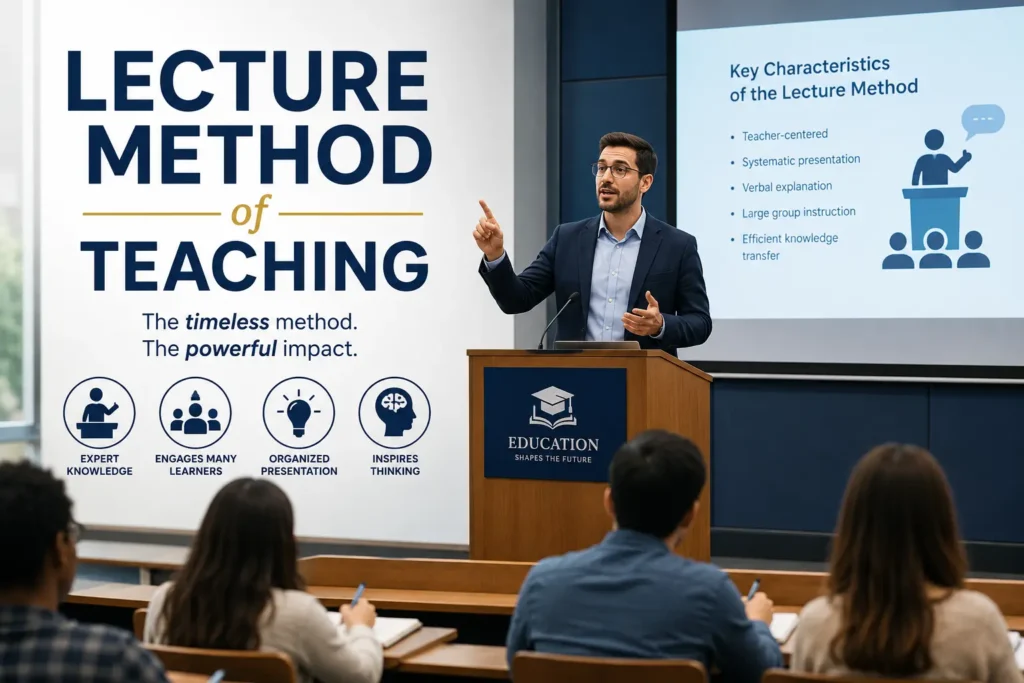
The lecture method is a teacher-centered instructional approach where an instructor delivers structured content verbally to a group of students. It is efficient for covering large volumes of theoretical material and is widely used in higher education. While it ensures consistent knowledge delivery, it can reduce student engagement if not paired with interactive elements. It works best for theory-heavy subjects, large class sizes, and time-constrained curricula.
There is an old saying in education circles: “A lecture is the process where the notes of the teacher become the notes of the student without passing through the minds of either.”
It is a sharp critique. But here is the thing: the lecture method of teaching has survived centuries of criticism because, when used correctly, it works. It remains one of the most widely used teaching and learning methods across schools, colleges, and coaching institutes around the world.
So what exactly is the lecture method? When should you use it, and when should you avoid it? This guide covers everything: the definition, characteristics, types, steps, advantages, disadvantages, and practical tips to make it work in any classroom.
What Is the Lecture Method of Teaching?
The lecture method is a teacher-centered teaching strategy where the instructor delivers structured content verbally to a group of students. The students listen, take notes, and absorb the information being shared.
The teacher controls the topic, the pace, and the direction of the lesson. Students play a mostly passive role during the session, though they may ask questions at the end.
This method of instruction has deep roots in the philosophy of idealism, which places strong emphasis on the transfer of knowledge from an expert teacher to a receptive learner. Research in the field of educational pedagogy consistently identifies the lecture method and the discussion method as the two most prevalent methods of instruction used in classrooms around the world.
In short, the lecture method works like this:
- The teacher prepares a structured set of information
- The teacher delivers that information verbally to the class
- Students listen, observe, and take notes
- Learning happens through hearing, comprehending, and reviewing
It is one of the oldest forms of classroom teaching, and it remains highly relevant in higher education, coaching institutes, and formal academic settings today.
Key Characteristics of the Lecture Method
Understanding the characteristics of the lecture method helps explain why it behaves so differently from student-centered approaches.
Here are the seven defining features:
- Teacher-centered instruction: The teacher plans, controls, and leads the entire session. Students have little say in how the lesson flows.
- One-way communication: Information moves in a single direction, from the teacher to the students. Students rarely interact during the lecture itself.
- Systematic and structured delivery: Content is presented in a logical, organized sequence. Concepts build on one another to help learners understand theoretical knowledge step by step.
- Focus on verbal communication: The teacher’s ability to speak clearly, vary tone, and explain ideas well is central to the success of the lesson.
- Efficient for large groups: One of the standout traits of this method is its ability to reach many learners at the same time without losing consistency.
- Encourages passive learning by default: Without deliberate interaction, students can become passive listeners rather than active learners.
- Supports visual aids: While primarily verbal, the lecture method incorporates tools like PowerPoint slides, blackboards, charts, and videos to make content clearer.
These characteristics make the lecture method highly effective in the right environment, but they also highlight its limitations when misapplied.
What Are the Types of Lecture Method?
There are eight main types of lecture method used in modern educational settings. Each type varies in the level of student interaction, use of technology, and instructional context.
Traditional and Interactive Types
1. Traditional Lecture
This is the most basic form. The teacher speaks, the students listen, and interaction is minimal. It suits large halls, exam preparation sessions, and subjects where consistent content delivery is the priority.
2. Interactive Lecture
Here, the teacher builds in moments for student participation. Questions, short polls, and brief group discussions are added throughout the session. This format turns passive learning into a more active experience and is increasingly recommended by university teaching centers.
3. Demonstration Lecture
The teacher combines verbal explanation with live demonstrations. This type is common in science labs, medical schools, and technical training settings where seeing a process in action supports understanding.
4. Guest Lecture
An external expert or subject specialist delivers the session. Students gain insights from real-world practitioners with deep knowledge of a specific field, such as a tax consultant explaining GST rules to commerce students.
Technology-Enhanced Types
5. Flipped Lecture
Students consume recorded videos or reading materials before class. Class time is then used to clarify, discuss, and apply what they have already learned at home. This format is growing rapidly in universities that are shifting toward hybrid teaching models.
6. Problem-Based Lecture
The teacher presents a real problem or case at the start of the session. Students analyze it during the lecture, and the teacher guides them toward a solution through structured content delivery.
7. Multimedia Lecture
The teacher uses videos, animations, slideshows, and interactive presentations to support verbal delivery. This format caters to diverse learning styles and is especially useful when complex processes need to be visualized.
8. Panel Lecture
Multiple speakers deliver the session together. Each expert covers a portion of the topic, giving students access to multiple perspectives in a single class. This type works well for interdisciplinary subjects or topics that benefit from debate.
What Are the Steps of the Lecture Method?
The lecture method follows three clear steps that make it systematic and effective. Effective teachers treat each step with care rather than treating the session as one long uninterrupted talk.
Step 1: Introduction
The teacher begins by introducing the topic, connecting it to what students already know, and creating curiosity about what is coming. The introduction sets the objectives for the session, signals what students should focus on, and prepares the mind to receive new information.
Step 2: Presentation (Body of the Lecture)
This is the main body of the lecture. The teacher delivers ideas in a logical, step-by-step manner using clear explanations, real-world examples, and visual aids like slides or diagrams. According to the UC Berkeley Center for Teaching and Learning, breaking this section into smaller segments and pausing for quick checks significantly improves how much students retain.
Step 3: Conclusion
The teacher wraps up by summarizing the key points, reinforcing the most important ideas, and checking for understanding. This is also the time when students may ask questions or request clarification. A well-planned conclusion ensures that students leave the class with a clear, organized understanding of the topic.
This structure is also aligned with approaches seen in the explanation method of teaching, which shares a similar three-phase framework for delivering content clearly and systematically.
Advantages of the Lecture Method
The advantages of the lecture method explain why it has remained a dominant form of instruction for so long. Research has even found that in certain educational settings, the lecture method outperformed more modern alternatives in measured learning outcomes.
Here are the six core advantages:
- Efficient content delivery: The teacher can cover a large amount of material in a short time. This makes lectures ideal when syllabi are extensive and time is limited.
- Cost-effective for institutions: One instructor can teach hundreds of students simultaneously. This reduces the need for additional staff, rooms, or resources.
- Consistent knowledge delivery: Every student in the room receives the same information, presented in the same order and level of detail. This standardization is valuable for competitive exam preparation and formal curricula.
- Demonstrates instructor expertise: A well-delivered lecture showcases the teacher’s deep knowledge, which helps build credibility and motivates students to engage with the subject.
- Flexible use of teaching aids: Teachers can incorporate videos, charts, slides, and demonstrations to support verbal delivery and make complex topics more accessible.
- Accessible and recordable: Lectures can be recorded and made available to students who miss class or need to revisit content, giving them a flexible resource for revision.
Disadvantages of the Lecture Method
Honest teaching means acknowledging where the lecture method falls short. Researchers comparing lecture-based instruction with cooperative teaching approaches have found that cooperative learning often produces better outcomes in subjects that require analysis and problem-solving.
Here are the six key limitations:
- Promotes passive learning: When students only listen, they are not actively processing or applying information. Passive learning tends to lead to weaker long-term retention compared to more engaging formats.
- Limited interaction and discussion: There is little room for students to ask questions mid-lesson, share ideas, or explore topics through conversation. This can slow the development of critical thinking skills.
- Does not suit all learning styles: Some students understand better through hands-on activities, group work, or visual demonstrations. A lecture-only approach leaves these learners behind.
- Risk of cognitive overload: Delivering too much information in one session can overwhelm students. Without natural pauses or interaction, learners can quickly reach their processing limit.
- Dependent on instructor skill: A poorly delivered lecture can be confusing, dull, or ineffective. The quality of the session depends almost entirely on the teacher’s communication skills.
- Limited feedback for the teacher: In a one-way communication format, the teacher gets very little information about whether students are actually understanding the material.
Lecture Method vs Discussion Method
The lecture method and the discussion method are two of the most commonly compared instructional strategies in educational pedagogy. Both are effective, but they serve very different goals.
| Feature | Lecture Method | Discussion Method |
| Teaching Style | Teacher-centered | Student-centered |
| Communication | One-way (teacher to students) | Two-way (teacher and students interact) |
| Student Role | Passive listeners | Active participants |
| Best Use Case | Large groups, theory-heavy content | Small groups, critical thinking tasks |
| Control | Teacher holds full control | Shared between teacher and students |
| Feedback | Minimal during the session | Frequent and ongoing |
| Learning Outcome | Knowledge transmission | Deeper understanding and idea generation |
| Best Subjects | Economics, law, history, commerce | Ethics, science inquiry, social studies |
| Interaction Level | Low | High |
When to choose which:
Use the lecture method when you need to deliver structured theoretical knowledge quickly and consistently to a large group. Use the discussion method when your goal is to develop reasoning, exchange ideas, and build deeper understanding in a smaller, more interactive setting.
Both methods are valuable tools in educational practice. A skilled teacher knows when to switch between them depending on the subject, the class size, and the learning objective. You can explore a wider range of approaches in this guide to teaching and learning methods that covers how different strategies work together in a well-rounded curriculum.
When Should Teachers Use the Lecture Method?
Knowing when to use the lecture method is just as important as knowing how to use it. Used in the right context, it is one of the most powerful tools a teacher has. Used in the wrong context, it becomes a source of disengagement and poor results.
| Use the Lecture Method When… | Avoid the Lecture Method When… |
| Class size is large (50+ students) | Students need hands-on practice or skill-building |
| The subject is theory-heavy (economics, law, history) | The goal is to build critical thinking or debate |
| A new topic needs a solid introduction | Class size is small enough for interactive discussion |
| Time is limited and broad coverage is needed | The subject requires experimentation or fieldwork |
| Standardized content delivery is required | Diverse learning styles need to be accommodated |
| Expert knowledge needs to be shared (guest lecture) | Students already know the basics and need deeper exploration |
UC Berkeley’s Center for Teaching and Learning specifically advises teachers to focus lectures on analyzing issues and problems rather than simply conveying factual information. This shifts the lecture from a pure information dump into a guided thinking experience.
Tips for Making the Lecture Method More Effective
A lecture only works as well as the person delivering it. Here are six practical strategies that any teacher can apply to improve the impact of their sessions.
- Break the lecture into 15 to 20 minute segments. Attention spans have natural limits. Adding short pauses, a quick question, or a moment for note review keeps students focused and reduces mental fatigue.
- Use formative assessment checkpoints. UC Berkeley’s teaching center recommends distributing index cards partway through a session and asking students to write down one question they have. This simple technique reveals gaps in understanding and makes students more active in their own learning.
- Incorporate multimedia tools. Slides, short video clips, charts, and diagrams make abstract concepts easier to grasp. Visual content also caters to students who learn better through images than words alone.
- Maintain eye contact and vary your voice. Teachers who speak in a flat monotone lose their audience quickly. Varying tone, pacing, and emphasis keeps students alert and signals which points matter most.
- Use student response tools in large classes. Platforms like iClicker Cloud and Poll Everywhere allow teachers to instantly gauge understanding across a large group. Real-time feedback lets teachers slow down where students are struggling and move faster through content that is already understood.
- Connect content to current real-world examples. An economics lecture on inflation becomes much more engaging when the teacher connects it to a news story the students already know. Real-world relevance gives students a reason to care about the content.
Pairing these techniques with a complementary approach like the description method of teaching can further strengthen content delivery, especially when precise, detailed explanations are needed alongside the main lecture.
Real-World Examples of the Lecture Method
Seeing the lecture method in action makes it easier to understand how and why it works. Here are three common real-world scenarios across different educational levels.
Example 1: Economics Lecture in a University
A college professor teaching macroeconomics uses PowerPoint slides to explain inflation theory to a class of 200 students. The professor controls the pace, uses graphs to illustrate the relationship between supply and money, and pauses at two points to ask quick comprehension questions via Poll Everywhere. Students take notes throughout and submit a short written question at the end of class.
Example 2: Guest Lecture on Tax Law for Commerce Students
A tax consultant visits a commerce college to explain the structure of Goods and Services Tax (GST) to final-year students. The expert speaks for 90 minutes, drawing on real case studies from their practice. Students remain quiet and attentive throughout, taking notes and asking questions during a brief Q&A at the end.
Example 3: History Class on World War II
A school teacher stands at the front of a class and uses a timeline on the whiteboard to walk students through the key events of World War II in chronological order. The teacher uses storytelling to hold attention and checks understanding with a short verbal quiz at the end of the session.
Each of these examples shows how the lecture method is best used when theoretical content needs to be delivered clearly, efficiently, and consistently to a group of learners.
Final Thoughts: Is the Lecture Method Right for Your Classroom?
The lecture method of teaching is not perfect. It has real limitations, and research continues to explore where other instructional strategies outperform it, especially in subjects that require analysis, collaboration, or practical skill-building.
But the lecture method is also not outdated. When teachers use it deliberately, with clear structure, appropriate visual aids, and built-in moments of engagement, it remains one of the most efficient and scalable tools in education. It is the foundation of higher education for a reason.
The smartest approach is not to choose between the lecture method and other strategies. It is to understand what the lecture method does well, match it to the right situation, and combine it with complementary approaches when needed.
If you want to build a complete picture of how different instructional strategies compare and complement each other, explore this full guide to teaching and learning methods. Understanding the full range of options available is what separates a good teacher from a great one.