Steps of the Demonstration Method in Teaching: A Complete Guide
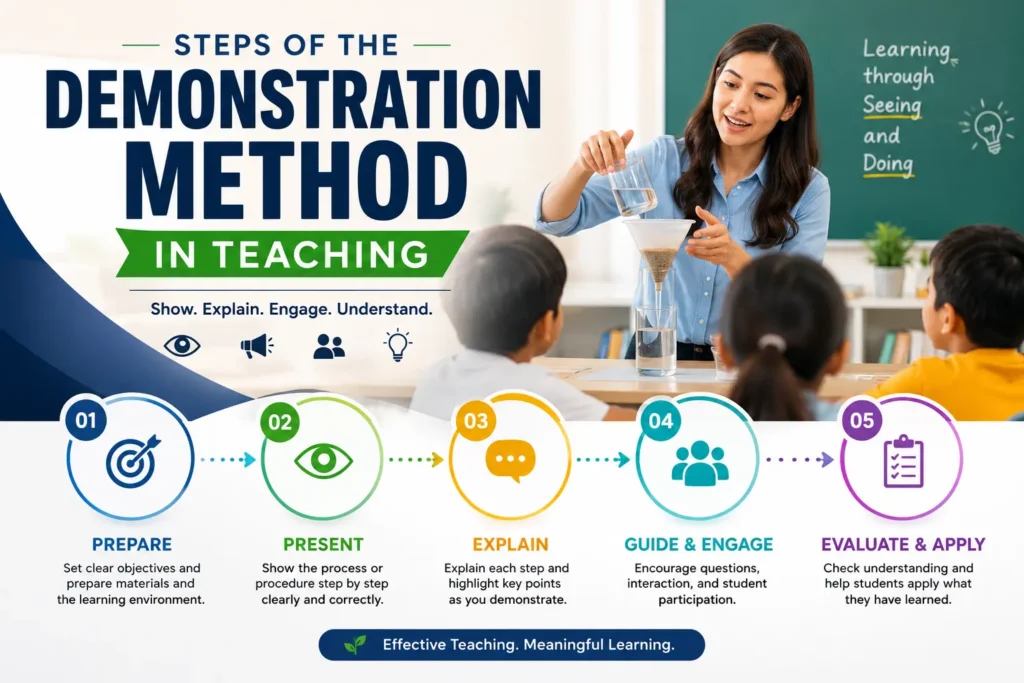
The demonstration method of teaching follows six clear steps: Planning and Preparation, Introducing the Lesson, Presentation of Subject Matter, the Demonstration itself, Use of Teaching Aids, and Evaluation. Each step builds on the previous one to create a structured, skill-based learning experience. Teachers who follow these steps in order help students learn more effectively and retain what they observe. This guide explains each step in plain language with practical classroom context.
What Is the Demonstration Method?
The demonstration method is a teaching approach where a teacher shows students how something is done rather than just talking about it. Instead of only listening to an explanation, students watch a process happen right in front of them.
This method is especially useful for science, mathematics, physical education, home economics, and vocational subjects. It combines visual, auditory, and sometimes hands-on learning, which makes it more effective than lecture-only instruction for skill-based topics.
A well-executed demonstration lesson is not just about performing a task. It is a carefully planned, step-by-step process that guides both the teacher and the students from start to finish.
How Many Steps Are in the Demonstration Method?
Most teacher education programs and B.Ed. curricula describe the demonstration method using one of three frameworks.
| Framework | Number of Steps | Best Used For |
| Classic 6-Step Model | 6 steps | B.Ed. exams, UGC-NET Paper 1, classroom teaching |
| 5-Phase Model | 5 phases | Modern classroom and lesson planning |
| 3-Phase Model (Before/During/After) | 3 phases | Nursing education, skills training, professional development |
The 6-step model is the most widely referenced in teacher education and competitive exams like UGC-NET Paper 1. It provides the most detailed breakdown of what a teacher should do at every stage of the lesson.
🎓 Exam Tip: UGC-NET Paper 1 and most B.Ed. and D.El.Ed. programs test students on the correct sequence of the 6-step model. Know each step by name and purpose.
Steps of the Demonstration Method: Explained in Detail
The following sections break down each of the six steps. Each step plays a specific role in making the lesson work well. Skipping even one step can affect how much students learn.
Step 1: Planning and Preparation
Good planning is the foundation of every successful demonstration. This step happens before the student ever enters the classroom.
During the planning phase, the teacher must:
- Set clear instructional objectives (what students should know or be able to do after the lesson)
- Gather all materials, models, equipment, and visual tools needed
- Arrange the classroom so every student can clearly see the demonstration area
- Check that all equipment is working properly
- Rehearse the demonstration at least once before the actual lesson
- Identify key points to emphasize at each stage
Rehearsal is one of the most important parts of preparation. When a teacher practices the demonstration in advance, they move more smoothly, speak more clearly, and handle unexpected problems with confidence.
A teacher who skips planning often runs out of time, loses the attention of students, or makes procedural errors that confuse the class. Thorough preparation prevents all of these problems.
Step 2: Introducing the Lesson
Once class begins, the teacher does not jump straight into the demonstration. The introduction step sets the mental stage for learning.
In this phase, the teacher:
- Greets students and captures their attention with a motivating opener
- Connects the new topic to prior knowledge that students already have
- States the objective of the lesson clearly (what students will see and learn)
- Explains why the topic matters and where it applies in real life
- Asks a few warm-up questions to activate curiosity
Student engagement starts here. When learners understand the purpose of what they are about to see, they pay closer attention and process the information more deeply.
A weak introduction leads to a distracted classroom. A strong, well-planned introduction sets up the entire lesson for success.
Step 3: Presentation of Subject Matter
Before the actual hands-on demonstration begins, the teacher presents the subject matter in a structured way. This step bridges prior knowledge and new content.
The teacher explains the concept, theory, or process that will be demonstrated. This is done using clear, simple language. The goal is to build a mental framework so students know what to expect and why each part of the demonstration matters.
Key actions in this step include:
- Explaining the core concept in simple terms
- Using reflective thinking to connect new content with what students already know
- Highlighting the main points students should watch for during the demonstration
- Responding to any early questions before the live display begins
This step is often rushed or skipped entirely by less experienced teachers. That is a mistake. Without a proper subject matter presentation, students watch the demonstration without understanding the “why” behind each action.
Step 4: The Demonstration Itself
This is the heart of the lesson. The teacher now performs the procedure, process, or skill in front of the entire class.
A well-conducted classroom demonstration follows these practices:
- Move through each step at a steady, visible pace
- Narrate every action out loud as it happens
- Pause at key moments to check student understanding
- Repeat critical steps if students show signs of confusion
- Encourage students to ask questions during the demonstration
- Maintain eye contact with the class, not just with the materials
- Keep the demonstration area clean and uncluttered so nothing blocks the view
The teacher must avoid deviating from the planned sequence. If something unexpected happens, address it calmly without losing the thread of the lesson.
Observation skills are being developed at this stage. Students are watching closely, connecting the teacher’s actions to the explanation given in the previous step. The teacher’s role is to make that connection as clear as possible.
🎓 Exam Tip: The demonstration step is where psychomotor skills are modeled. Examiners often test whether students can distinguish between the demonstration step and the presentation step.
Step 5: Use of Teaching Aids
Teaching aids support every stage of a demonstration lesson, but they deserve their own focused step. The right aids make abstract ideas visible and easier to understand.
Common teaching aids used in the demonstration method include:
- Blackboards and whiteboards for writing steps and formulas in real time
- Charts and diagrams for showing processes visually
- Models and specimens for subjects like biology or geography
- Flip charts for sequential step displays
- PowerPoint slides for visual summaries and data
- Laboratory equipment for science demonstrations
- Videos for showing demonstrations that cannot be repeated live
In modern classrooms, digital tools are increasingly used alongside traditional aids. Short video clips, simulation software, and interactive whiteboards now extend what a live teacher demonstration can achieve in both physical and blended learning environments.
The key rule for teaching aids is this: every aid must support the lesson objective. An aid that distracts students or confuses the main point should not be used.
Step 6: Evaluation and Feedback
The final step is evaluation. Many teachers overlook this stage, but it is one of the most important. Without evaluation, neither the teacher nor the student knows whether the learning objective was actually achieved.
Evaluation in the demonstration method can be done in three ways:
- Discussion: The teacher asks open questions to check understanding. Students explain what they observed in their own words.
- Written or oral testing: Short questions test whether students can recall the steps, name the materials used, or describe the outcome.
- Return demonstration: Students repeat the teacher’s demonstration themselves. This is the most powerful form of evaluation because it proves mastery, not just memory.
After the evaluation, the teacher reflects on the lesson. What went well? What needs to change? This self-evaluation improves future lessons.
Penn State’s Hybrid Learning resource recommends asking students reflective questions after a demonstration: “Why did something happen?” and “What would change if one step was different?” These questions push students beyond memorization into real understanding.
The 3-Phase Framework: Before, During, and After
Some teacher education programs and professional skills training courses organize the demonstration method into three broader phases. This model is commonly used in nursing education, agricultural extension training, and B.Ed. programs that prefer a simplified overview.
| Phase | Key Teacher Actions | Common Mistake |
| Before Demonstration | Set objectives, prepare materials, rehearse, introduce the topic | Starting the lesson without preparation or student orientation |
| During Demonstration | Show each step clearly, narrate actions, engage students with questions | Moving too fast, blocking the view, skipping interaction |
| After Demonstration | Summarize key points, evaluate understanding, encourage return demonstration | Ending the lesson without checking for learning |
This 3-phase model maps directly onto the 6-step model. Steps 1 and 2 belong to the “Before” phase. Steps 3, 4, and 5 belong to the “During” phase. Step 6 belongs to the “After” phase.
Both frameworks describe the same process. The 6-step version is more detailed and better suited for lesson planning and exam preparation.
What Makes a Demonstration Lesson Successful?
Research confirms that the demonstration method works best when teachers follow a structured, step-by-step approach and actively involve students throughout the process.
A 2024 study published on SSRN found that the demonstration method significantly improved students’ academic achievement when teachers followed a clear procedural sequence rather than delivering a loosely organized live performance. A separate study in the European Journal of Mathematics, Science and Technology Education found that structured teacher demonstrations improved student understanding of science concepts far more effectively than verbal explanation alone.
Here is a quick checklist for a successful demonstration lesson:
- Clear learning objective stated before the demonstration begins
- All materials tested and ready before class
- Demonstration area visible to every student
- Each step narrated and explained out loud
- Students asked questions throughout, not just at the end
- Evaluation conducted before the lesson closes
- Teacher reflects on what to improve for next time
Common Mistakes Teachers Make at Each Step
Even experienced teachers make errors during demonstration lessons. Knowing where mistakes happen most often is the first step toward avoiding them.
| Step | Common Mistake | How to Fix It |
| Planning and Preparation | Skipping the rehearsal | Always do a full practice run before class |
| Introducing the Lesson | Starting the demo without engaging students | Connect to prior knowledge and state the objective first |
| Presentation of Subject Matter | Using technical jargon without explanation | Explain every term before using it during the demo |
| The Demonstration | Moving too fast or blocking student view | Maintain a steady pace; check seating and lighting in advance |
| Teaching Aids | Using too many aids at once | Choose one or two that directly support the lesson goal |
| Evaluation | Skipping evaluation to save time | Always end with at least one assessment activity |
Final Thoughts
The steps of the demonstration method are not just a checklist. They are a complete teaching framework that helps teachers deliver skill-based lessons in a clear, structured, and effective way.
When each step is followed in order, students do not just watch. They observe, think, connect, and understand. The result is stronger retention, better engagement, and real skill development in the classroom.
Whether you are preparing for a B.Ed. exam, planning your next science lesson, or looking to improve your classroom instruction, understanding these steps gives you a reliable foundation to build on.
To deepen your knowledge of how the demonstration method fits into broader classroom instruction, explore the full guide to teaching and learning methods on CleverPortalus. You can also see how these steps apply specifically to science classrooms in our detailed article on demonstration in teaching science.