Education as a Discipline: What It Means and Why It Matters

Education as a discipline has two important meanings. First, it is a formal academic field of study with its own theories, research methods, and knowledge base. Second, in Charlotte Mason’s philosophy, it means forming good habits in learners on purpose. Both meanings point to the same big idea: education is not random. It is structured, intentional, and powerful. Understanding both meanings helps parents, teachers, and students approach learning with more clarity and confidence.
Education is one of those words everyone uses but few people stop to think deeply about. You probably know what school is. You know what a classroom is. But have you ever stopped to ask: is education really a discipline? And if so, what does that even mean?
The phrase “education as a discipline” actually carries two different meanings, and both of them matter. One meaning comes from the world of universities and academic research. The other comes from the teachings of Charlotte Mason, a 19th-century educator whose ideas still shape homeschooling and classroom teaching today. Together, these two meanings reveal something powerful: education is not just something that happens to you. It is something that is built, shaped, and guided with intention.
This article will walk you through both meanings clearly, explain why they matter, and show you how to put these ideas into practice.
What Does “Education as a Discipline” Actually Mean?
When someone searches for “education as a discipline,” they might be thinking about one of two very different things.
The first meaning comes from the academic world. In this sense, a discipline is a branch of knowledge taught and studied at colleges and universities. Think of chemistry, mathematics, or history. Each of these is a discipline because it has its own body of knowledge, its own research methods, and its own experts. Education fits into this same category. It has its own theories, its own processes, and its own community of researchers and scholars.
The second meaning comes from Charlotte Mason’s educational philosophy. In this tradition, “education is a discipline” means that learning happens through the careful and deliberate formation of habits. Discipline here does not mean punishment. It means training. It means helping a child build good mental, moral, and physical habits so that learning becomes natural and automatic.
| Meaning | Where It Comes From | What “Discipline” Means |
| Academic discipline | Universities, research institutions | A structured field of knowledge with its own methods |
| Pedagogical discipline | Charlotte Mason’s philosophy | Deliberate habit formation in learners |
Both meanings share one core idea: structure and intention are at the heart of good education.
Is Education a Recognized Academic Field of Knowledge?
Yes. Education fully qualifies as a formal academic discipline, and here is why that matters.
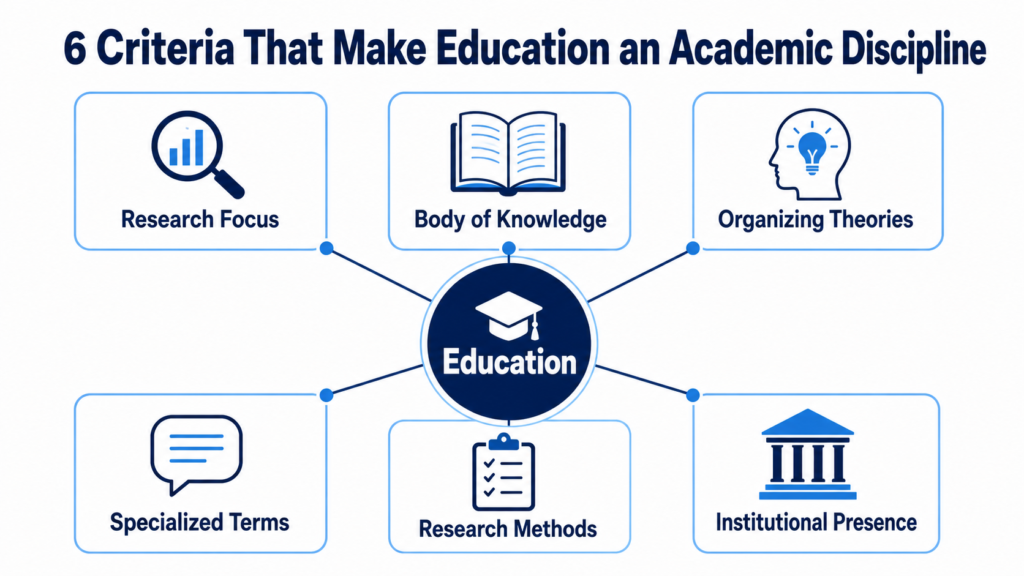
According to researcher Arjun Krishnan (2009), any area of knowledge must meet six criteria to be called a discipline. It needs a specific research focus, a body of accumulated specialist knowledge, organizing theories, specialized terminology, clear research methods, and an institutional presence through universities and journals. Education meets all six.
What Are the Criteria That Education Meets?
Here is a quick look at how education checks each box:
- Research focus: Education studies how people learn, how teaching works, and how educational systems are organized
- Body of knowledge: Centuries of research in pedagogy, curriculum design, and learning theory have built a rich knowledge base
- Organizing theories: Major frameworks include constructivism, behaviorism, and social learning theory
- Specialized terminology: Terms like pedagogy, epistemology, curriculum, and assessment belong specifically to this field
- Research methods: Education uses both qualitative and quantitative research, including classroom observation, surveys, and longitudinal studies
- Institutional presence: Education departments exist in universities worldwide, backed by organizations like BERA (British Educational Research Association) and publications in the British Educational Research Journal
Professor Dominic Wyse of UCL Institute of Education has argued strongly that education must be recognized as a proper academic discipline. He points out that classifying it as a mere “field” or “applied subject” can hurt research funding and reduce the academic status of education faculties. Under the UK Research Excellence Framework (REF), this classification has real consequences for how education researchers are funded and supported.
As Biesta (2011, p. 175) put it, education can be described as “the interdisciplinary study of educational processes and practices.” This definition captures why some scholars hesitate to call it a pure discipline. Education draws from psychology, sociology, philosophy, and history. But drawing from multiple fields does not disqualify a subject. It shows how broad and important educational knowledge really is.
How Charlotte Mason Defined the Discipline of Education
Charlotte Mason lived from 1842 to 1923, but her ideas about education still shape how millions of families and teachers approach learning. Her Principle 7 states: “By education is a discipline, we mean the discipline of habits, formed definitely and thoughtfully, whether habits of mind or body.”
This is a big idea packed into one sentence. Let’s break it down.
Mason believed that the human brain is like a set of railroad tracks. Every time a child repeats a behavior, it is like laying down another rail. Over time, the tracks become permanent. The child no longer has to think about doing the right thing or paying attention or being kind. It becomes automatic. That is the power of habit formation.
This is why Mason’s version of “education is a discipline” is about training, not punishing. You are not forcing a child to behave. You are helping them build a path that makes good behavior easy and natural.

What Are the Four Categories of Habits Charlotte Mason Identified?
Mason grouped habits into four main categories:
- Moral habits: These include self-control, initiative, obedience, and using time well
- Mental habits: These include attention, accuracy, logical thinking, and thoroughness
- Physical habits: These include fortitude, self-restraint, and care for the body
- Religious habits: These include gratitude, regular devotion, and reverence
The Simply Charlotte Mason website explains it this way: “Sow a thought, reap an action. Sow an action, reap a habit. Sow a habit, reap a character.” This saying, often attributed to Charlotte Mason, captures why habit formation matters so much. Small daily choices build the person a child will become.
How the Two Meanings of Discipline Are Connected
At first glance, the academic meaning and the Charlotte Mason meaning of “education as a discipline” look very different. One talks about research journals and university departments. The other talks about morning routines and helping children pay attention at the dinner table.
But look closer and you will see they are built on the same foundation.
Both meanings say that education is not accidental. The academic world says education must be studied in an organized, systematic way with clear methods and standards. Charlotte Mason says children must be trained in an organized, systematic way with clear habits and routines. In both cases, the key word is intentional.
A researcher who follows the epistemology of education is being disciplined in their thinking. A parent who deliberately trains a child’s attention span each morning is being disciplined in their teaching. Both are practicing the same core principle: learning requires structure, consistency, and purpose.
This connection is what makes the phrase “education as a discipline” so rich. It works at the academic level and at the kitchen-table level at the same time.
Why It Matters Whether We Call Education a Discipline
You might wonder: does it really matter what label we put on education? The short answer is yes, and here is why.
In the academic world, being recognized as a discipline versus a field has real consequences. It affects how universities allocate funding, how research grants are awarded, and how education scholars are treated compared to colleagues in fields like medicine or engineering. Professor Wyse and other scholars argue that treating education as a “lesser” field can lead to budget cuts, reduced staffing, and weaker research output.
For parents and teachers, understanding that education is a discipline changes how they approach their role. A discipline has standards. It has methods. It has a history of accumulated knowledge. Knowing this means you do not have to guess. You can draw on a rich tradition of educational theory and philosophy to make better decisions for your students or your children.
The British Educational Research Association (BERA) has actively promoted the idea that education deserves the same institutional respect as any other academic discipline. This is not just about pride. It is about making sure that teachers are well-trained, that educational research is taken seriously, and that the next generation of learners gets the best possible foundation.
How to Apply “Education as a Discipline” in Real Life
Understanding this concept is one thing. Putting it into practice is another. Here are practical steps for both teachers and parents:
- Build attention habits early. Charlotte Mason believed that training a young child to focus for short periods is one of the most valuable things a parent can do. Start with 10 minutes of focused, uninterrupted reading or work. Gradually increase the time as the habit strengthens. This builds the mental habit of attention, which Mason called one of the most important habits a person can develop.
- Treat learning as a structured process. Whether you are a classroom teacher or a homeschooling parent, plan your teaching with intention. Identify what specific knowledge and skills you want your student to gain. Choose methods that match how your student learns best. Review regularly. This is the academic-discipline approach applied at the personal level.
- Use natural consequences to reinforce habits. Rather than forcing compliance through punishment, let the natural results of good and poor habits do the teaching. When a child who develops the habit of accuracy gets better results than one who rushes, the lesson sticks. This is Mason’s “discipline of habits” working in real time.
- Draw from established educational theory. Curriculum design does not have to be invented from scratch. The accumulated knowledge base of educational research offers proven frameworks. Constructivist approaches, project-based learning, and inquiry-based teaching are all products of the academic discipline of education. Use them.
These four steps work whether you are a teacher in a classroom, a parent at home, or a university student studying pedagogy and curriculum for the first time.
Bringing It All Together
Whether you first heard “education as a discipline” in a university lecture or on a homeschooling blog, the core message is the same: education works best when it is taken seriously, structured on purpose, and applied with consistency.
The academic world, through researchers like Gert Biesta, Arjun Krishnan, and Dominic Wyse, has built a strong case that education deserves the same respect and rigor as any other formal field of knowledge. Charlotte Mason built a lasting legacy showing that children thrive when habits of mind, body, and character are cultivated with care and intention. Together, these two perspectives give us a richer, fuller picture of what education really is.
You do not have to choose one meaning over the other. Both are true. Both are useful. And both remind us that good learning is never an accident.
Want to explore more ideas liklike this? Browse our full collection of education guides to find resources that help you apply these principles every day.