Advantages of Question Answer Method of Teaching
The question answer method is a simple but powerful way to teach. In this method, the teacher and students learn through questions and responses. Here you will see the main advantages of question answer method, with clear examples you can use in any classroom, online or offline.
What Is the Question Answer Method in Teaching?
The question answer method is a teaching strategy where the teacher guides a lesson through questions and student answers.
Instead of talking for the whole class, the teacher asks a series of planned questions. Students think, respond, and sometimes ask their own questions. This style of teaching began with the Socratic method, which used questions to help learners think more deeply.
In a classroom, this method can be used to:
- Start a new topic
- Develop ideas step by step
- Check understanding at the end of a lesson
If you want to see how this method fits with other strategies, you can explore the full guide on teaching and learning methods on this site.
This makes the question answer method of teaching a core tool that fits many subjects and grade levels.
Why Do Teachers Use the Question Answer Method?
Teachers use the question answer method because it turns a quiet classroom into an active learning space.
When students answer questions, they do not just listen. They have to think, connect ideas, and explain what they know. At the same time, the teacher can see who is following the lesson and who needs more help. This makes the method important for both teaching and classroom assessment.
In teacher education, this method is also very useful. Trainee teachers learn how to design good questions so they can guide student thinking with clear and simple steps.
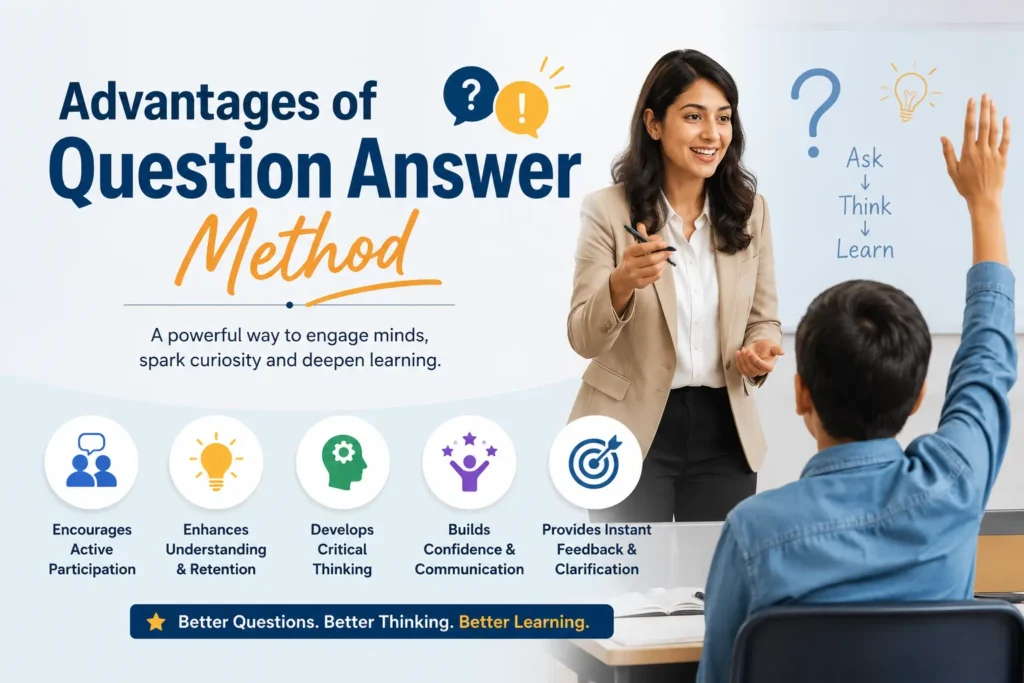
Key Advantages of Question Answer Method
Here is a quick overview of the main advantages of question answer method of teaching:
- Encourages active learning and student participation
- Builds critical thinking and higher order thinking skills
- Supports formative assessment and feedback
- Improves communication skills and power of expression
- Helps include more students and allows differentiation
- Can be used in many subjects and classroom situations
- Works in both face to face and virtual classroom settings
Next, we look at each advantage in more detail.
How Does Question Answer Method Promote Active Learning?
The question answer method is an active learning strategy. Students must think and respond instead of just sitting and listening.
Studies on the question and answer method show that when teachers use questions throughout a lesson, student interaction and engagement increase. In one study, classes using question and answer activities showed higher participation and better achievement than classes that did not use them.
For example, in a science lesson, a teacher might ask:
- What do you think will happen if we heat this liquid
- Why did the temperature go up
- How can we explain this change
As students answer, they pay attention, connect ideas, and stay involved. This is a clear advantage of question answer method in classroom teaching.
How Does Question Answer Method Develop Critical Thinking?
The question answer method can build critical thinking when teachers use more than simple recall questions.
Researchers who studied questioning in education found that higher order questions, such as why and how questions, are strongly linked to deeper understanding and long term learning. When teachers use Socratic questioning, they push students to:
- Explain reasons
- Compare ideas
- Give evidence
- Evaluate choices
For example, in a history lesson, a teacher might ask:
- Why do you think this leader made that choice
- How might the result be different if they chose another way
These kinds of questions develop higher order thinking, not just memory. This is one of the most important merits of question answer method.
How Does Question Answer Method Support Assessment and Feedback?
Another key advantage of question answer method is its role in formative assessment and feedback.
A report on the learning benefits of questions notes that questions in class can help measure learning and check how well teaching methods are working. When a teacher asks questions during a lesson, they can:
- Spot misunderstandings quickly
- See who is ready to move on
- Notice students who need more support
Socratic questioning also lets students find their own knowledge gaps, which can lead them to think more deeply about what they know and what they still need to learn.
For example, in a math class, a teacher might ask a student to explain each step of a solution. If the student gets stuck, the teacher can give targeted help right away. This kind of immediate feedback is a strong benefit of question answer method in teaching.
How Does Question Answer Method Improve Communication and Confidence?
The question answer method gives students many chances to speak, listen, and respond. This helps build communication skills and the power of expression.
A study on teaching speaking found that regular question and answer activities increased student participation and improved speaking ability in language classes. When students answer questions often, they learn to:
- Put ideas into clear sentences
- Use key subject words
- Listen to classmates and respond politely
In a language or social studies classroom, students may first be shy to answer. But over time, this method builds confidence and helps learners who are usually quiet to take part more fully.
Why Is Question Answer Method Flexible and Inclusive?
Question answer method is flexible because teachers can adapt it to different ages, subjects, and ability levels.
In primary school, questions can be short and simple, such as:
- What animal is this
- What color do you see
In higher grades, questions can deal with more complex ideas and critical thinking. Teachers can also change questions for different learners. For a student who struggles, a teacher can ask a simpler question. For a stronger student, the teacher can ask a deeper one.
This makes the method inclusive. More students can join in, especially if teachers spread questions around the room and invite different voices. This is a clear advantage of question answer method in primary school classrooms and in higher grades alike.
What Advantages Does Question Answer Method Offer in Online or Virtual Classrooms?
In online and virtual classroom settings, it is easy for students to lose focus. The question answer method helps keep them engaged.
Research on question and answer method in virtual learning shows that structured questioning can promote deeper learning and keep students active, even behind a screen. Teachers can ask questions through:
- Live video calls
- Chat messages
- Polls and quizzes
Students can respond with voice, text, or reaction tools. For example, in an online science lesson, a teacher might post a question in the chat and ask every student to give a short answer. This keeps the virtual classroom interactive and supports active learning throughout the session.
How Can Teachers Maximize These Advantages in Practice?
The advantages of question answer method do not appear on their own. They depend on how teachers plan and use their questions.
Here are simple steps to get the most from this method:
- Plan a clear sequence of questions
- Start with easy recall questions
- Move to why and how questions
- End with summary questions
- Mix lower and higher order questions
- Use simple questions to build confidence
- Use deeper questions to build critical thinking
- Give wait time
- After asking a question, pause for a few seconds
- Let students think before they answer
- Share questions fairly
- Ask different students, not just the same ones
- Invite volunteers and also gently call on quieter students
- Combine question answer method with other teaching methods
- Use a short lecture for key facts
- Then use questions to explore and check understanding
When teachers follow these steps, the question answer method becomes a strong teaching and learning method that supports active learning, critical thinking, and classroom assessment in every lesson.
Brief Limitations to Keep in Mind
The question answer method also has some limits that teachers should be aware of.
Teaching notes and videos point out that it can be hard to use well. It takes skill and time to design clear questions and keep the discussion on track. If questions are too hard, too fast, or always aimed at the same students, the method may not give the results teachers expect.
Because of this, many teachers combine question answer method with other teaching methods like demonstration or group work. This balance keeps lessons smooth while still using all the advantages of question answer method.
Final Thought
The question answer method is more than just asking random questions. When planned with care, it becomes a powerful teaching strategy that builds active learning, critical thinking, strong communication, and ongoing assessment in both physical and virtual classrooms.
As a next step, review one of your own lessons and rewrite it as a sequence of clear questions. Try it with your students and notice how their engagement and understanding change. Small changes in how you ask questions can make a big difference in how students learn.