Transition in Education: Meaning, Types, Stages and Challenges
Transition in education is the process of moving from one educational stage, setting, or role to another. Every student goes through multiple transitions in their school life. Some are structural, like moving from primary to secondary school. Others are personal, like adjusting to new teachers, new peers, and new academic expectations.
There are three main types: vertical, horizontal, and lateral. Each type creates different challenges. Research from the Education Endowment Foundation (2021) shows that attainment in literacy and numeracy dips at transition points when schools do not provide enough support.
This article covers all three types, the three major school transition stages, the key challenges students face, and practical strategies for educators and parents.
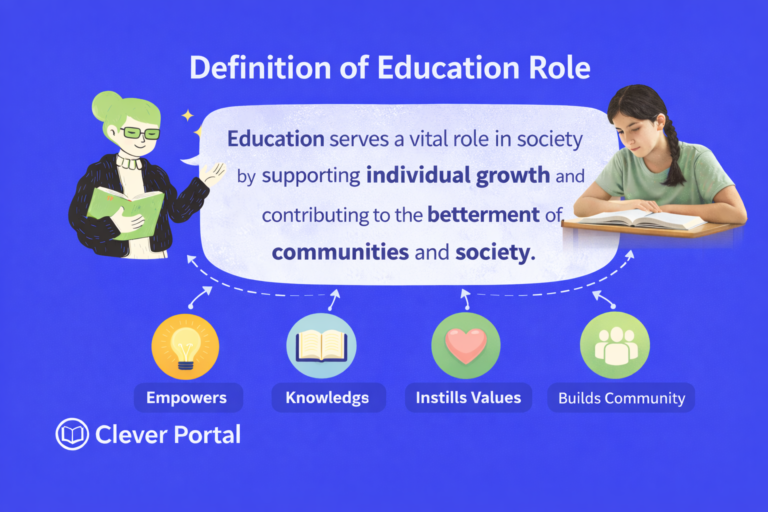
To understand how transitions connect to the broader purpose of schooling, read the full guide on what education means as a concept.
What Is Transition in Education?
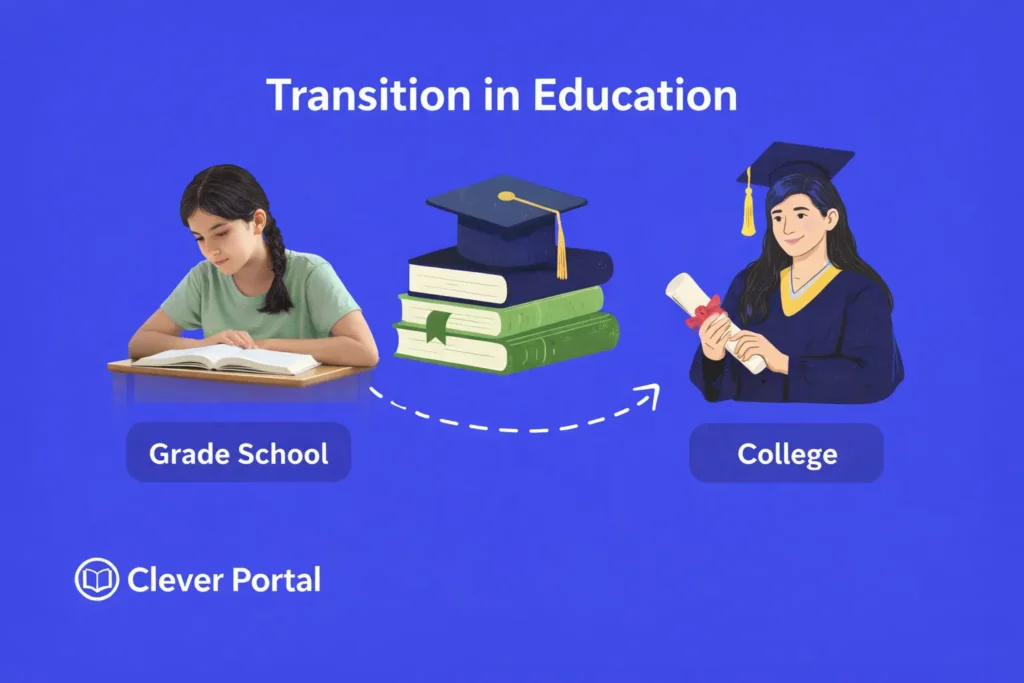
Transition in education is the process of changing from one educational level, setting, or role to another. It covers both the structural change and the personal adjustment that comes with it.
There are two layers to every educational transition. The first is structural: a student moves to a new school, level, or program. The second is personal: the same student adjusts socially, emotionally, and academically to the new setting.
According to the Glossary of Education Reform, transition in education typically refers to three major transitional points in the public school system. These are the moves from elementary to middle school, from middle school to high school, and from high school to college or post-school life.
The stakes are real. The Education Endowment Foundation (2021) found that attainment in literacy and numeracy consistently dips during educational transitions when proper support is not in place. This makes transition planning one of the most practical concerns in education today.
What Are the Types of Transition in Education?
There are three main types of transition in education: vertical, horizontal, and lateral. Each one involves a different direction of change and affects students in different ways.
Based on our analysis of how education courses across South Asia and the UK categorize transitions, these three types appear consistently in B.Ed modules, teacher training programs, and educational research literature.
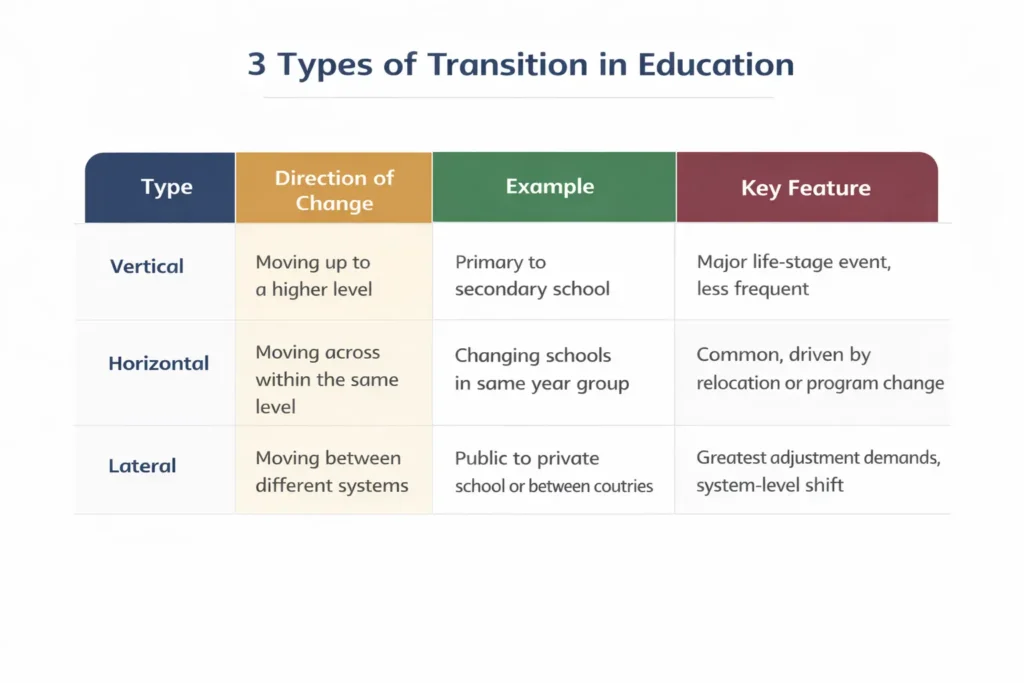
The table below shows how the three types compare across key dimensions.
| Type | Direction of Change | Example | Key Feature |
|---|---|---|---|
| Vertical | Moving up to a higher level | Primary to secondary school | Major life-stage event, less frequent |
| Horizontal | Moving across within the same level | Changing schools in the same year group | Common, driven by relocation or program change |
| Lateral | Moving between different systems | Public to private school, or between countries | Greatest adjustment demands, system-level shift |
This taxonomy builds on the work of Vogler et al. (2008), who distinguished vertical transitions as those linked to major life-stage events from horizontal transitions that occur across contexts within the same level.
Vertical Transition in Education
Vertical transitions are the most significant moves in a student’s school life. They involve moving up to a new educational level with new teachers, new peers, new academic expectations, and a new school culture.
Examples include moving from nursery to primary school, from primary to secondary, and from secondary to higher education. These transitions happen less often, but they carry the greatest risk of attainment dip because the change is so complete. Preparation and support from both schools and families matter most at these points.
Horizontal Transition in Education
Horizontal transitions occur within the same educational level. A student moves from one school to another in the same year group, or transfers between programs within the same institution.
Common causes include family relocation, a change in the student’s learning needs, or placement in a specialized academic program. These transitions are less visible than vertical ones, but they still affect the student’s social confidence and sense of belonging in the new setting.
Lateral Transition in Education
Lateral transitions involve moving between fundamentally different educational systems. A student may move from a public school to a private school, from one country’s curriculum to another, or from mainstream to alternative education.
These transitions carry the greatest adjustment demands. The rules, expectations, teaching culture, and curriculum content may all differ sharply. Students in lateral transitions often need dedicated orientation support to avoid a prolonged period of academic and social difficulty.
What Are the Three Major School Transition Stages?
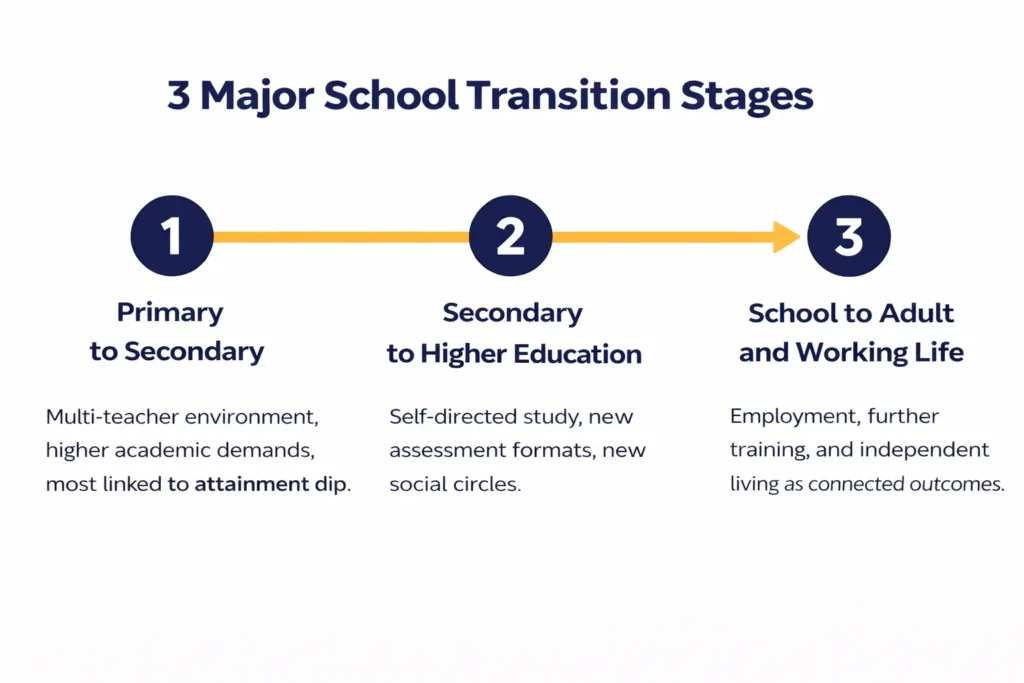
Three major transition stages shape every student’s educational journey. Each one marks a shift not just in school setting but in academic expectations, social structure, and personal independence.
According to the Glossary of Education Reform, these three stages receive the most focus from educational systems worldwide because of their consistent impact on student attainment and engagement.
Stage 1: Primary to Secondary School
This is the most researched school transition. Students leave a single-teacher, familiar classroom and enter a multi-teacher, multi-subject secondary environment.
They face new peers, higher academic demands, more independence, and a larger, less familiar school structure. The EEF (2021) confirmed that the primary-to-secondary transition is most consistently linked to attainment dips in both literacy and numeracy. Early support and orientation programs at this stage directly reduce those dips.
Stage 2: Secondary to Higher Education
At this stage, students move from a structured school environment to the greater independence of college or university. Key adjustments include self-directed study, new assessment formats, and entirely new social circles.
This stage also includes vocational routes and apprenticeships as recognized paths. Students who choose applied or technical routes face their own adjustment demands around professional culture, workplace expectations, and skills-based assessment rather than exam-based learning.
Stage 3: School to Adult and Working Life
This transition takes students from formal education into the workplace, further training programs, or independent adult life. For students with special educational needs, this step often involves a formal Transition Plan that maps their goals, support needs, and next steps.
According to the North Dakota Department of Public Instruction, this transition is “a coordinated set of activities focused on facilitating the student’s movement from school to post-school activities”. It covers employment, continued education, and independent living as connected outcomes rather than separate destinations.
What Challenges Do Students Face During Educational Transitions?
Educational transitions are among the most stressful periods in a student’s school life. The challenges are academic, social, and emotional at the same time.
The Education Endowment Foundation (2021) identified three core challenge categories: lack of curriculum continuity between levels, difficulty adapting to new academic demands, and lack of familiarity with new school systems and expectations. Research from Kenyatta University added further challenges: adjusting to new rules, coping with new teachers, and dealing with reduced parental involvement after the move.
Academic Challenges
Academic challenges are the most measurable consequences of a poorly managed transition. Students often experience a gap between what they learned in their previous setting and what their new school expects.
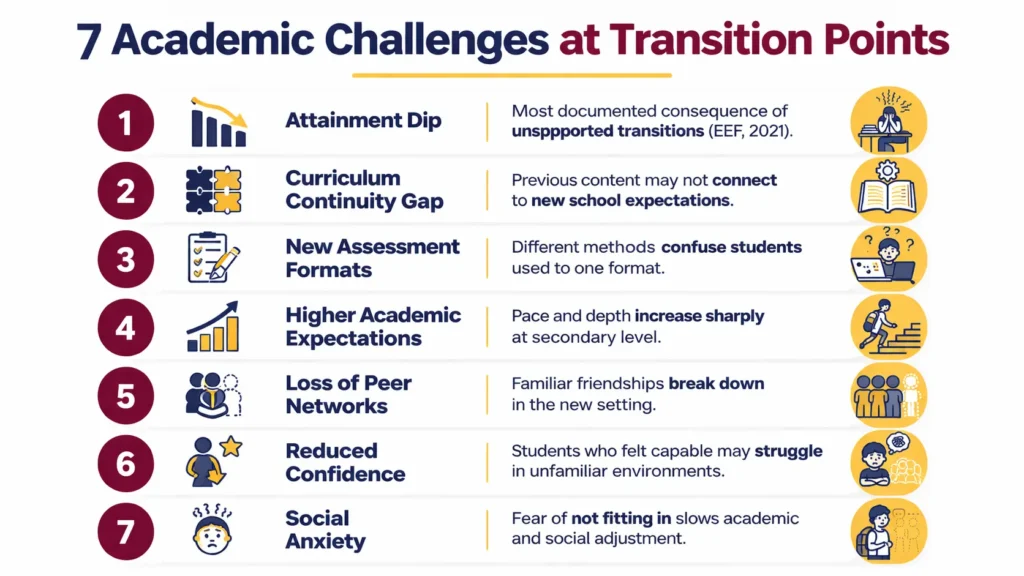
7 key challenges students face during educational transitions are listed below.
- Attainment dip in literacy and numeracy (EEF, 2021): the most well-documented consequence of unsupported transitions
- Curriculum continuity gap: content taught in the previous school may not connect to what the new school builds on
- New assessment formats: different schools and levels use different methods to test learning, which confuses students who are used to one format
- Higher academic expectations: especially at the primary-to-secondary stage, where the pace and depth of learning increase sharply
Social and Emotional Challenges
Social and emotional adjustment is equally significant. Yet it receives less attention than academic performance in most school transition plans.
3 key social and emotional challenges at transition points are listed below.
- Loss of peer networks — familiar friendships break down when students move to a new school or class group
- Reduced confidence and motivation — students who felt settled and capable in their previous setting may struggle in an unfamiliar one
- Social anxiety — fear of not fitting in, not knowing the school’s social codes, or being seen as an outsider slows both social and academic adjustment
How Can Educators and Parents Support Students Through Transitions?
Structured support from both schools and families reduces the attainment dip and helps students settle faster. The key is that support must begin before the transition, not after the student has already fallen behind.
Based on our review of evidence-based practice in B.Ed programs and the EEF’s recommendations, four educator strategies and four parent strategies consistently appear in research on successful transitions.

How Educators Can Support Transitions
4 evidence-based strategies for educators are listed below.
- Orientation programs — give students a structured visit to the new school before they officially start. This reduces anxiety and builds familiarity with the environment, teachers, and daily routines.
- Bridging activities — set curriculum tasks that connect the student’s previous learning to what their new school builds on. This closes the continuity gap before it becomes an attainment dip.
- Peer mentoring — assign more settled students as guides for new arrivals. Peer support reduces social anxiety and helps new students learn unwritten school norms faster than adult guidance alone can achieve.
- Early academic monitoring — assess new students quickly after arrival to identify any attainment dip and respond with targeted support before it becomes a habit of low performance.
How Parents Can Support Transitions
4 practical strategies for parents are listed below.
- Attend transition meetings and open days with their child before the move. Familiarity with the new school environment before day one significantly reduces first-day anxiety.
- Establish stable home routines in the weeks before and after the transition. Predictability at home compensates for the unpredictability of a new school setting.
- Keep conversations open about the child’s concerns. Acknowledging their worries without dismissing them helps children process the change at their own pace.
- Stay in contact with new teachers after the transition to monitor how the child is adjusting socially and academically, not just at parent evening but in the first few weeks.
Why Is Transition in Education Important?
Transition in education matters because it is the moment when the risk of disengagement from learning is highest. A student who does not receive enough support at a transition point may fall behind academically, lose confidence, and disengage from school, sometimes for years.
According to EEF (2021), attainment slippage is especially well evidenced at the primary-to-secondary stage, and it disproportionately affects students from disadvantaged backgrounds.
In our review of how B.Ed curricula frame transitions, the topic appears alongside the aims of education precisely because transitions test whether those aims are being met for all students, not just the most confident ones. For a full picture of how aims connect to transitions, read the guide on the philosophy of educational aims.
3 reasons transitions matter in education are listed below.
- They determine whether students stay engaged or disengage from learning at a critical developmental stage
- They reveal whether schools genuinely meet individual learning needs or only serve students who adapt with ease
- They directly affect long-term academic attainment, especially for students from disadvantaged backgrounds
How Do the Aims of Education Frame the Purpose of Transitions?
Educational transitions are not just practical events. They are moments where the social and individual aims of education are tested at the same time. Schools that manage transitions well show that they take both aims seriously: developing the individual child and preparing them for a functioning role in society. For a full explanation of how these aims connect, read the guide on the aims of education and their types.
How Does Education as a Discipline Study Transitions?
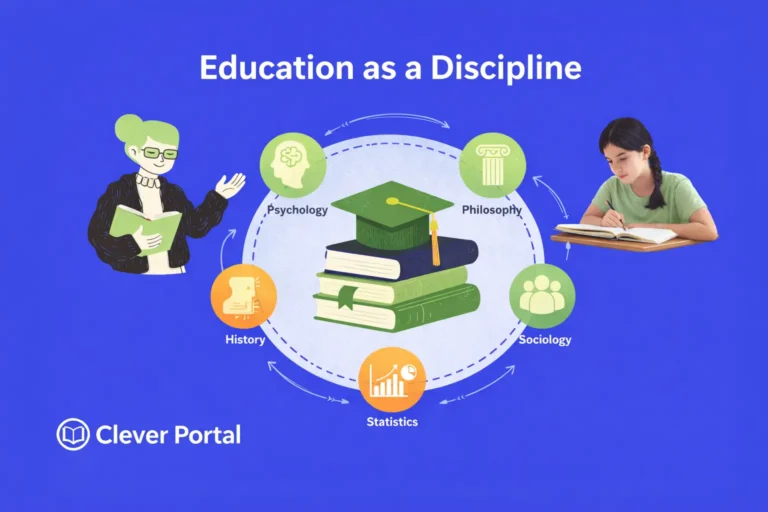
As a formal academic discipline, education uses research methods from psychology, sociology, and curriculum theory to study how transitions work and how schools can manage them better. This research base is what gives transition planning its evidence foundation. To understand how education builds that knowledge base, read the article on education as a formal academic discipline.
Conclusion
Transition in education is one of the most consequential processes in any student’s school life. How schools and families manage it determines whether students arrive at the next stage ready to learn or already behind.
Three key takeaways from this article:
- There are three main types of transition: vertical, horizontal, and lateral — each with different demands on the student
- There are three major school transition stages: primary to secondary, secondary to higher education, and school to adult life
- Attainment dips during transitions are real and preventable with structured orientation programs, bridging activities, and early academic monitoring
To see how transition connects to the fundamental purpose of schooling and what education is ultimately designed to achieve, read the complete guide on what education means as a concept.