What Is Social Science Education? Branches, Goals, and Why It Matters
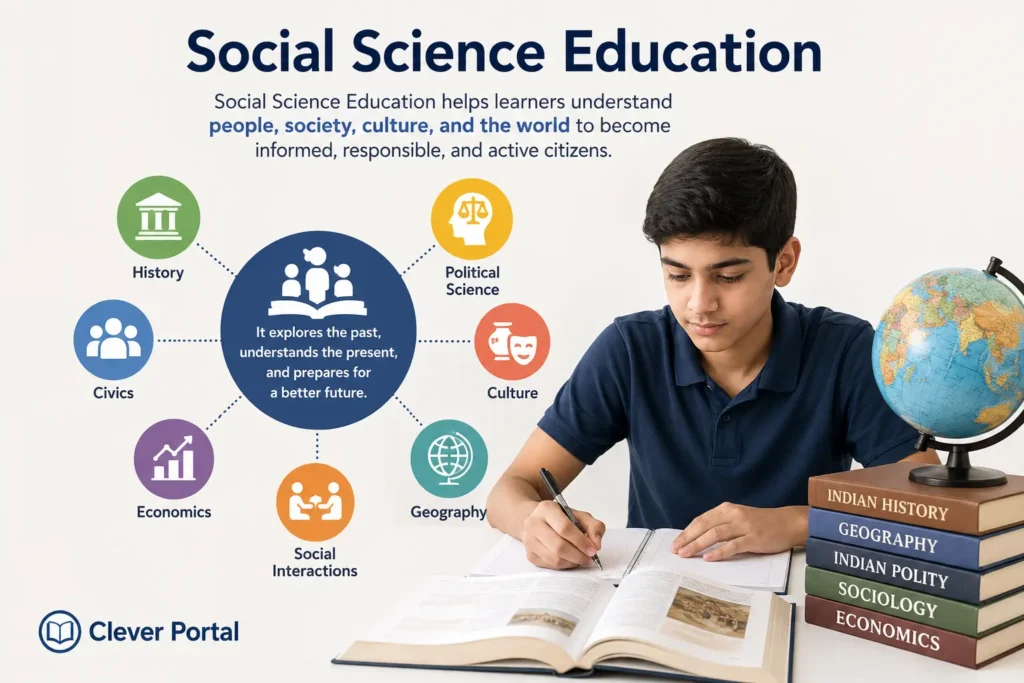
Social science education is the formal study of human society, behavior, and institutions within a school or academic curriculum. It covers subjects like history, geography, economics, political science, and sociology. Its main goals are to build civic competence, critical thinking, and cultural awareness. It is taught from primary school through university and prepares students to become informed, active citizens.
How do students learn to understand the world they live in? How do they come to know about governments, cultures, history, and the way communities work? The answer lies in social science education. This field of study helps students make sense of society and their place within it. Whether you are a student, a parent, or an educator, understanding what social science education covers and why it matters is a great starting point. This article walks you through everything you need to know, from the definition and branches to the goals and real-world importance of this field.
What Is Social Science Education?
Social science education is the structured teaching and learning of subjects that study human society, culture, behavior, and institutions. According to the National Council for the Social Studies (NCSS), social studies is defined as “the integrated study of the social sciences and humanities to promote civic competence.” In simple terms, it is a subject area that teaches students about the world of people, communities, governments, and history.
At the school level, this subject is often called social studies. At the university level, it branches into separate academic disciplines like economics, political science, and sociology. Either way, the goal is the same: to help students understand the society they live in and their role within it.
Social science education is different from natural science. While natural science studies the physical world, social science focuses on the human world. It asks questions like: Why do governments exist? How do economies work? What can history teach us about today?
You can learn more about how this fits into the broader picture by visiting our guide on types of education.
What Are the Branches of Social Science Education?
Social science education is not a single subject. It brings together several disciplines, each of which looks at a different part of human life and society. Here are the main branches:
- History: The study of past events, civilizations, and how they shaped the modern world
- Geography: The study of the Earth’s features, places, and the relationship between people and their environment
- Economics: The study of how goods and services are produced, distributed, and consumed
- Political Science: The study of governments, political systems, power, and public policy
- Sociology: The study of society, social structures, culture, and human behavior in groups
- Civics: The study of citizens’ rights, duties, and how democratic systems function
- Anthropology: The study of human cultures, traditions, and development over time
- Psychology: The study of the human mind and behavior at the individual and social level
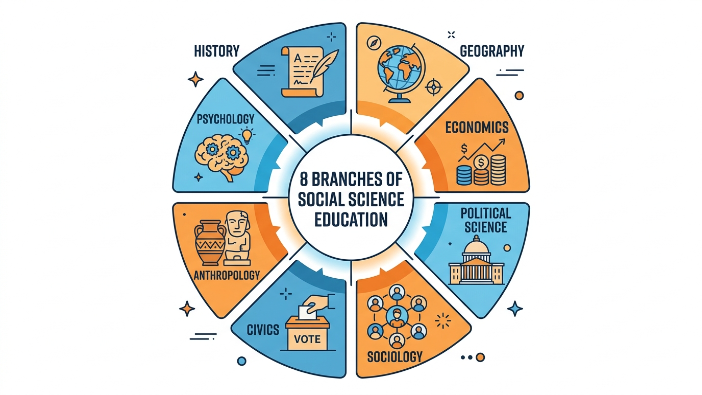
These subjects are often taught in an integrated way at the primary school level. As students move into secondary and higher education, they begin to study each discipline on its own.
Civics and political education connect closely with efforts to build peaceful and cooperative communities. You can explore more in our article on peace education.
What Are the Goals and Aims of Social Science Education?
The aims of social science education go far beyond memorizing facts. The purpose of social science education is to shape how students think, act, and engage with the world around them. The NCSS states that the primary purpose of social studies is “to help young people make informed and reasoned decisions for the public good as citizens of a culturally diverse, democratic society in an interdependent world.”
Here are the core goals of social science education:
- Build civic competence: Help students understand their rights, responsibilities, and role in a democratic society
- Develop critical thinking skills: Teach students to analyze information, question assumptions, and reason through problems
- Promote cultural awareness: Expose students to diverse cultures, traditions, and belief systems so they develop empathy
- Support social understanding: Help students make sense of social structures, institutions, and how communities function
- Encourage global awareness: Connect students to global challenges like climate change, inequality, and international relations
- Prepare for democratic participation: Train students to be active, informed participants in public life
These goals align with UNESCO’s global education target known as SDG 4, which promotes inclusive, quality education and lifelong learning for all.
Social science education also connects with understanding belief systems and values. Read more about how schools approach this in our article on religious education.
Why Is Social Science Education Important?
Social science education plays a vital role in how students grow as people and as members of society. It is not just a school subject. It is a foundation for life.

For Students
Students who study social science education gain a wide range of useful skills. According to Indeed, the nine key benefits of social studies include better spatial awareness, critical thinking skills, citizenship skills, and an understanding of other cultures. Here is what students develop:
- The ability to think critically and analyze different points of view
- Strong communication and problem-solving skills
- An understanding of history and how past events shape the present
- Empathy for people from different backgrounds and cultures
- Knowledge of how governments and economies work
- Preparation for careers in law, education, journalism, government, and international relations
For Society
Social science education does not just benefit individual students. It strengthens entire communities. When students learn about democratic participation, civic responsibility, and social structures, they grow into citizens who can contribute positively to public life. Research has shown that civics education is linked to higher voter turnout and greater civic engagement among young adults.
Furthermore, in a world facing challenges like social inequality, environmental concerns, and rapid technological change, social science education gives students the tools to understand and respond to those issues with empathy and reason.
Arts and creative education often works alongside social science to develop well-rounded learners. See our article on arts and craft education to explore how creativity supports learning.
What Subjects Are Included in Social Science Education?
The subjects taught under social science education depend on the level of schooling and the national curriculum. However, most school systems include the following core subject areas:
| Subject | School Level | What Students Learn |
| History | Primary to Higher | Past events, civilizations, and historical analysis |
| Geography | Primary to Higher | Maps, environments, natural resources, and human settlements |
| Civics | Primary to Secondary | Government, rights, duties, and democratic processes |
| Economics | Secondary to Higher | Markets, budgets, trade, and economic systems |
| Political Science | Secondary to Higher | Government systems, public policy, and international relations |
| Sociology | Secondary to Higher | Social groups, culture, inequality, and social change |
| Anthropology | Mostly Higher | Human culture, evolution, and cross-cultural studies |
| Psychology | Secondary to Higher | Human behavior, the mind, emotions, and decision-making |
At the primary school level, these subjects are usually blended into one integrated course. At the secondary level, they start to separate into distinct subjects. At the university level, students choose a specific discipline to study in depth.
How Is Social Science Education Structured Across School Levels?
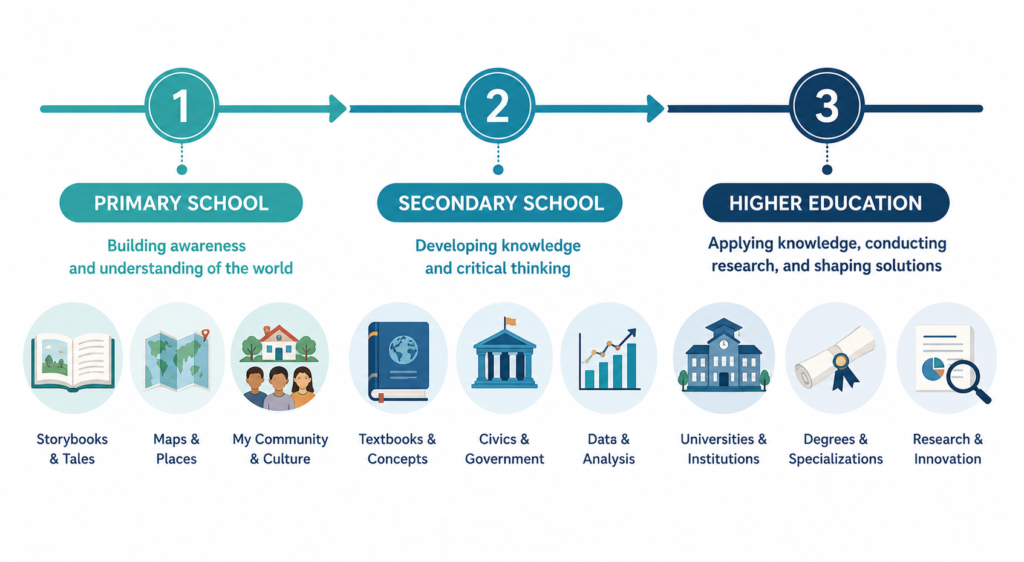
One of the most helpful ways to understand social science education is to see how it changes as students get older. The teaching style, depth, and focus all shift at each level.
Social Science Education in Primary School
In primary school, social science education is broad and exploratory. It is usually taught as a single subject called social studies. Students learn basic concepts about community, family, culture, and local history through stories, activities, and projects. The focus is on building curiosity, empathy, and a sense of belonging. Inquiry-based learning is common at this stage, where students ask questions and explore answers through hands-on activities.
Social Science Education in Secondary School
In secondary school, social science education becomes more structured and disciplinary. Students begin studying history, geography, economics, and political science as separate subjects. The content becomes more analytical. Students are expected to read sources critically, form arguments, and understand complex social structures. The secondary curriculum covers areas like chronological history, human geography, constitutional frameworks, and economic systems. This stage is where students start developing the academic skills needed for higher education.
Social Science Education in Higher Education
At the university level, social science education expands into full academic disciplines. Students choose a specific field such as economics, political science, sociology, or international relations and study it in depth through research, theory, and academic writing. The OECD’s Education at a Glance 2025 report tracks career outcomes for graduates across social science fields, showing strong employment rates in public service, business, education, and policy sectors.
Students interested in applied learning paths can also explore our article on technical vocational education to see how skills-based education compares.
Social Science vs. Social Studies: What Is the Difference?
Many people use these two terms as if they mean the same thing. They do not. Understanding the difference helps students and parents make sense of school curricula.
| Feature | Social Science | Social Studies |
| Level | University and academic | Mostly K-12 school curriculum |
| Format | Separate academic disciplines | Integrated, combined subject |
| Focus | Research and theory | Practical civic and social knowledge |
| Term used by | Academics, researchers | School teachers, curriculum planners |
| Example | Studying economics as a degree | Learning about money and trade in Grade 4 |
In short, social studies is the school version of social science. It takes the broad academic field and makes it accessible and practical for young learners. As students grow, the social studies curriculum gradually introduces them to the individual social science disciplines they may pursue in higher education.
Final Thoughts
Social science education is one of the most important parts of any school curriculum. It teaches students how to think, not just what to think. Through interdisciplinary learning across history, geography, economics, political science, sociology, civics, anthropology, and psychology, students build the knowledge and skills they need to engage with the world responsibly.
The goals of social science education reach far beyond the classroom. They shape informed citizens, empathetic communities, and thoughtful future leaders. Whether a student ends up working in government, teaching, journalism, or any other field, the foundation built by social science education stays with them for life.
Understanding how different types of education fit together is key to building a strong learning journey. If you found this article helpful, explore our full guide on types of education to see how social science education connects with other important areas of learning.