
Technical and Vocational Education: Definition, Types, Benefits, and Career Paths
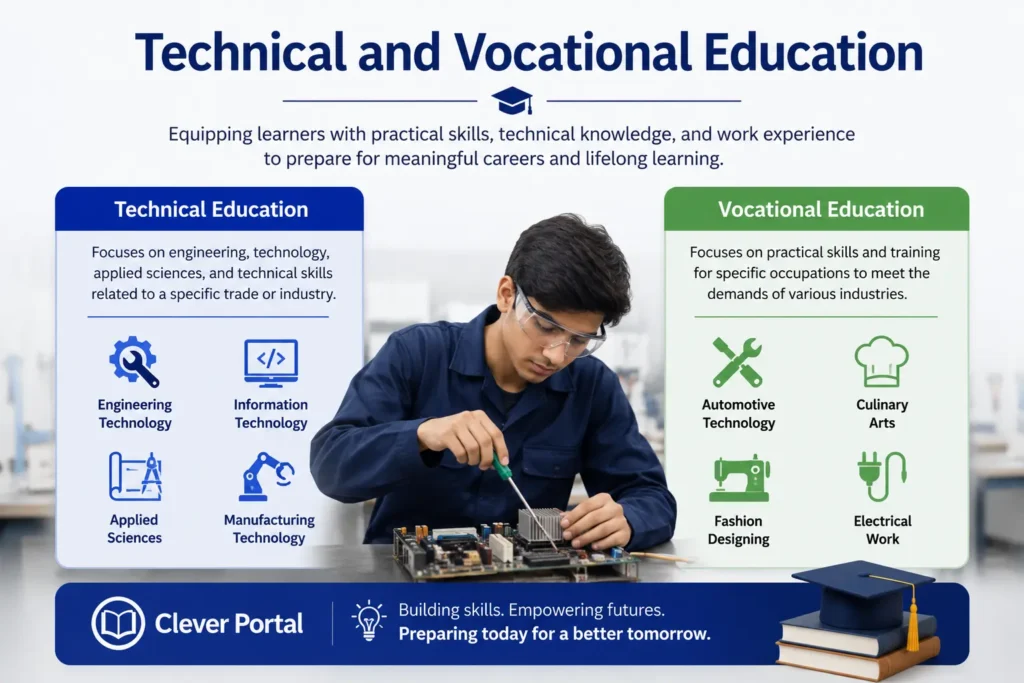
Technical and vocational education (TVET) is a form of education that trains learners with practical, job-specific skills for specific trades and professions. Unlike general academic education, TVET focuses on hands-on learning in fields like healthcare, construction, IT, and culinary arts. It operates at secondary and post-secondary levels and is recognized globally by UNESCO and the ILO as a key pathway to workforce readiness and economic development.
Not everyone learns best by reading textbooks in a classroom. Millions of people want to build real skills, enter the workforce faster, and work with their hands and minds in ways that make a direct impact. Technical and vocational education exists exactly for this reason.
The global skills gap is growing. Employers in healthcare, construction, technology, and manufacturing struggle to find qualified workers every year. Technical and vocational education is one of the most powerful tools available to close that gap. In this guide, you will learn what TVET is, how it works, what types of programs exist, what careers it leads to, and why it matters for students and economies around the world.
What Is Technical and Vocational Education?
Technical and vocational education, widely known as TVET, is a type of education that gives learners the practical skills and knowledge they need to work in specific trades, crafts, and professions.
UNESCO defines TVET as education that covers “the study of technologies and related sciences, and the acquisition of practical skills, attitudes, understanding and knowledge relating to occupations in various sectors of economic and social life.” In simple terms, TVET teaches people how to do a specific job well, using real tools, real equipment, and real workplace settings.
TVET is different from general or academic education, which focuses on broad subjects like history, literature, and mathematics. TVET focuses directly on occupational training. It prepares learners not just to understand a field, but to work in it from day one.
The TVET acronym stands for Technical and Vocational Education and Training. This is the internationally recognized term used by UNESCO, the International Labour Organization (ILO), and the World Bank. In the United States, a similar system is called Career and Technical Education (CTE), which covers education from middle school through post-secondary institutions.
What Is the Difference Between Technical and Vocational Education?
Many people use “technical” and “vocational” as if they mean the same thing. They are closely related, but they have a slight difference in focus.
Technical education focuses on applying scientific and engineering principles to a specific field. It involves understanding how and why something works. For example, an IT technician studying computer hardware learns the principles behind how circuits and processors function.
Vocational education focuses more directly on hands-on skills for a specific job or trade. A student in a vocational welding program spends most of their time actually welding, not studying metallurgy theory.
The table below shows the key differences:
| Feature | Technical Education | Vocational Education |
| Main focus | Applied science and technology principles | Hands-on trade-specific skills |
| Examples | Engineering technology, computer science fundamentals | Welding, plumbing, cosmetology, culinary arts |
| Typical level | Post-secondary, technical institutes | Secondary and post-secondary |
In practice, most modern education systems combine both approaches under the TVET umbrella, because strong workers need both the knowledge of why something works and the skill to do it well.
What Are the Main Types of Technical and Vocational Education Programs?
TVET programs come in many shapes and sizes. They serve teenagers choosing a first career, young adults entering the workforce, and experienced workers who want to switch fields or gain new skills.
Secondary School Level Programs
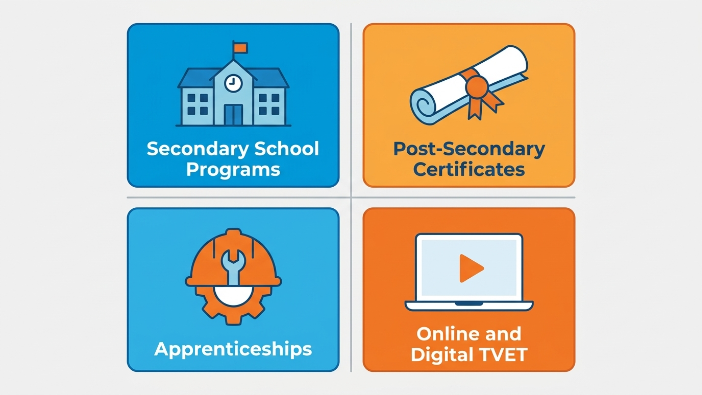
Many TVET programs begin at the high school or secondary school level. In the United States, Career and Technical Education programs are offered in most public high schools. Students can take courses in healthcare, IT, agriculture, construction, and business while still completing their regular academic subjects. In Bangladesh and other developing countries, SSC Vocational programs start at Class IX and combine general education with practical training in trades like electrical work, IT, dressmaking, and automotive repair.
Post-Secondary Certificates and Diplomas
After secondary school, learners can enroll in certificate or diploma programs at trade schools, community colleges, or technical institutes. These programs typically last six months to two years and focus almost entirely on career-specific training. TVET offers four levels in many national systems: short courses, certificate courses, diploma programs, and degree-level qualifications.
Apprenticeship Programs
Apprenticeships combine classroom learning with on-the-job training. A learner works for an employer while also attending courses, earning wages while building real career experience. Apprenticeships are especially common in skilled trades like electrical work, carpentry, and plumbing, and they can last two to four years depending on the trade.
Non-Formal and Adult Training Programs
Not all TVET happens in a school. Non-formal programs serve adults who need to gain new skills quickly. These include short-term workshops, community training centers, employer-sponsored training, and online certification programs. They are especially important in developing regions where access to formal schools is limited.
Digital and Online TVET
A growing trend in 2025 and 2026 is the expansion of digital TVET delivery. Simulation labs, virtual workshops, and e-learning platforms now allow learners to build practical skills online. UNESCO’s BILT project (Bridging Innovation and Learning in TVET) is actively supporting this shift, helping countries modernize their TVET systems using technology.
What Subjects and Fields Does Vocational Education Cover?
One of the biggest surprises for people new to TVET is how wide it is. It is not just about fixing cars or laying bricks. Vocational education covers a broad range of career fields that touch nearly every part of daily life.

Healthcare
Healthcare is one of the fastest-growing areas in TVET. Programs include nursing assistant training, dental hygiene, medical billing and coding, pharmacy technician courses, and emergency medical technician (EMT) certification. These hands-on programs prepare learners for real clinical environments.
Skilled Trades
Skilled trades are the heart of traditional vocational education. Programs cover welding, plumbing, carpentry, electrical work, CNC (Computer Numerical Control) machining, masonry, and HVAC (heating, ventilation, and air conditioning). These trades are in constant high demand across the world.
Information Technology
IT and technology programs prepare learners for careers in cybersecurity, computer networking, software support, robotics, and mechatronics. As industries automate more processes, technical training in these areas has become more valuable than ever.
Culinary Arts and Hospitality
Culinary arts programs teach professional cooking, baking, food safety, and restaurant management. Hospitality programs cover hotel management, event planning, and tourism. Both fields give learners direct, practical skills that are immediately applicable in the workplace.
Agriculture
Agricultural TVET programs train learners in animal science, crop production, forestry, aquaculture, and environmental science. In developing countries, agricultural vocational training plays a critical role in food security and rural economic development.
What Are the Benefits of Technical and Vocational Education?
TVET offers real, tangible advantages for learners, employers, and communities. Here are the most important benefits.
- Faster entry into the workforce. TVET programs are shorter than four-year university degrees. Learners can complete a certificate or diploma in six to twenty-four months and start working right away.
- Lower cost. TVET programs generally cost far less than a traditional college degree. This makes quality career training accessible to people from all income levels.
- Employer-aligned curriculum. TVET programs are designed in collaboration with employers. This means learners gain exactly the skills that businesses need, improving their chances of finding a job immediately after graduation.
- Solving the skills gap. A 2023 report by The Open University found that 68% of UK employers face a skills shortage. TVET directly addresses this by producing workers with the precise, practical skills needed in key sectors from digital technology to healthcare.
- Lifelong learning and reskilling. TVET is not just for young people. Adults can use vocational training to change careers, upgrade skills, or move into entirely new industries at any point in their working life.
- Stronger earning potential. TVET graduates in high-demand trades earn competitive salaries. CNC machinists earn between $50,000 and $60,000 per year. Welders earn $40,000 to $60,000 annually.
Why Is Technical and Vocational Education Important Globally?
Technical and vocational education is not just good for individual learners. It is a key driver of economic growth and national development around the world.
UNESCO, the ILO, and the World Bank have all identified TVET as a central tool for reducing youth unemployment, closing skills gaps, and building resilient economies. Their 2023 joint report projects an exponential increase in TVET enrollment in low-income countries by 2030, driven by population growth and the urgent need for skilled workers.
The numbers from Africa are striking. ILO data from 2025 shows that 84.7% of students across 27 African countries with available data were enrolled in vocational programmes at the secondary level. In countries like Nigeria, Egypt, Tanzania, and Zimbabwe, TVET attainment has crossed 15%.
Bangladesh offers another strong example. The country has set a national target to expand TVET participation from 17.18% in 2021 to 25% by 2025, and to 41% by 2041, reflecting a national commitment to workforce development through vocational training.
The global TVET market also reflects this importance. The global technical and vocational education market was valued at USD 812.3 billion in 2024 and is projected to reach USD 1,432.9 billion by 2030, growing at a rate of 10% per year.
Is Vocational Education Better Than College?
This is one of the most common questions students and parents ask. The honest answer is: neither path is automatically better. The right choice depends on your career goals, learning style, and financial situation.
Vocational education works best for learners who know what career they want, prefer hands-on learning, want to start earning sooner, and want to avoid large student loan debt. Trade schools and technical institutes are a smart, practical choice for these learners.
College and university education works best for careers that require broad academic knowledge, professional licensing (such as medicine or law), or research-based qualifications. A four-year degree opens doors in certain professions that TVET alone cannot.
Many learners today find the best approach is to combine both. Some TVET graduates later pursue degree programs through articulation agreements, where credits earned in vocational programs can count toward a college degree. Others use stackable credentials, building one certificate on top of another to advance their career over time.
The real question is not which path is better. It is which path gets you closest to the career you want in the most effective way.
What Career Opportunities Does Technical and Vocational Education Lead To?
TVET graduates work in some of the most in-demand industries in the world. Here is a snapshot of career paths and approximate earnings by sector.
- Healthcare: Nursing assistant ($35,000 to $45,000/year), dental hygienist ($70,000+/year), pharmacy technician ($38,000 to $50,000/year)
- Skilled trades: CNC machinist ($50,000 to $60,000/year), welder ($40,000 to $60,000/year), electrician ($55,000 to $80,000/year)
- Information technology: IT support specialist ($45,000 to $60,000/year), cybersecurity technician ($60,000 to $90,000/year), network administrator ($65,000+/year)
- Culinary and hospitality: Chef ($45,000 to $70,000/year), pastry specialist ($35,000 to $55,000/year), hospitality manager ($50,000+/year)
- Agriculture: Animal science technician ($38,000 to $55,000/year), forestry technician ($40,000 to $58,000/year), aquaculture specialist ($35,000 to $50,000/year)
Beyond starting salaries, TVET graduates often advance quickly. Because their training is highly specific and employer-focused, they enter the workforce with a competitive advantage. Many go on to take leadership roles within their industries, start their own businesses, or continue their education through advanced technical qualifications.
The integration of digital skills, green energy practices, and advanced manufacturing into TVET programs means that today’s vocational graduates are also prepared for the jobs of the future, not just the present.
How Is Technical and Vocational Education Changing in 2025 and 2026?
The world of TVET is not standing still. Several major trends are reshaping vocational education and training right now.
Digital transformation is the biggest shift. Virtual reality simulations, e-learning platforms, and digital labs now allow learners to practice skills in safe, technology-driven environments before working in the real world. This makes training safer, more accessible, and more effective.
Green skills are growing rapidly. As industries shift toward renewable energy, sustainable construction, and environmentally responsible practices, TVET programs are adding courses in solar panel installation, energy efficiency auditing, and sustainable agriculture.
Industry partnerships are deepening. More TVET institutions are working directly with companies to co-design curricula, offer internships, and guarantee job placement for graduates. This makes the transition from school to work faster and smoother.
International standardization is improving. Organizations like UNESCO-UNEVOC and the ILO are working to create TVET qualifications that are recognized across borders, making it easier for skilled workers to find employment globally. The ISCED (International Standard Classification of Education) framework helps align TVET levels across different national systems.
Final Thoughts
Technical and vocational education is one of the most important, practical, and rewarding paths a learner can take. It builds real skills. It leads to real jobs. It helps real economies grow.
For too long, TVET has been seen as a backup plan for students who could not make it in traditional academia. That view is changing fast, and the data proves it. From UNESCO’s global TVET programs to the booming demand for skilled workers in healthcare, trades, and technology, TVET is not a second choice. It is a first-rate career strategy.
Whether you are a student exploring your options, a parent researching career paths for your child, or an adult thinking about reskilling, TVET offers a direct, affordable, and proven route to career success.
Curious about how TVET fits into the broader world of learning? Explore our guide to peace education to see how different education types shape communities and individuals in unique ways. You can also learn more about social science education and arts and craft education to understand the full spectrum of educational paths available to learners today.