Maxims of Teaching: A Complete Guide With Examples
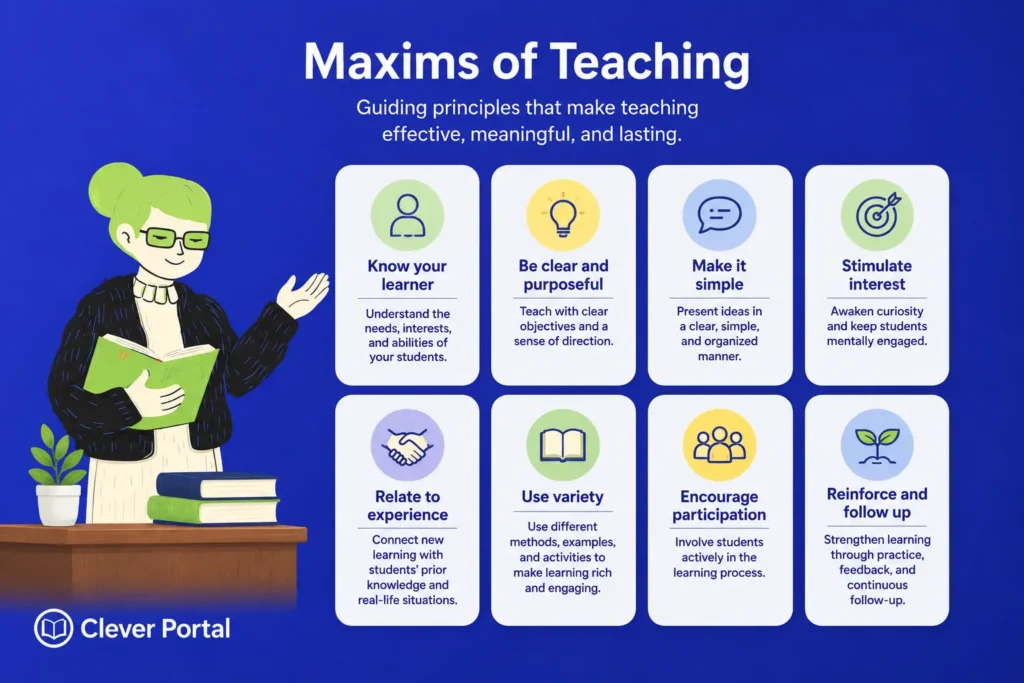
Maxims of teaching are practical, experience-based rules that help teachers organize and deliver lessons in the most effective way. They include well-known guidelines like “known to unknown,” “simple to complex,” and “concrete to abstract.” These principles make learning easier for students and more efficient for teachers. Whether you are a B.Ed student, a teacher trainee, or a classroom educator, understanding these maxims will help you teach with greater confidence and clarity.
Teachers often face one common challenge. How do you explain something new when students have never seen it before? How do you take a complex idea and break it down so that every student in the room can follow along?
The answer lies in a set of time-tested guidelines called the maxims of teaching. These are not rules invented overnight. They come from centuries of real classroom experience. Educators observed what worked, noted what did not, and turned those observations into practical teaching principles that still guide instruction today.
In this guide, you will learn what the maxims of teaching are, explore each one with a real classroom example, understand why they matter, and see how to use them in your lessons. Whether you are preparing for a B.Ed exam or building better daily lessons, this guide covers everything you need.
What Are Maxims of Teaching?
Maxims of teaching are universal, experience-derived principles that guide how teachers should organize and deliver instruction. They are not rigid laws. Think of them as practical rules of thumb, tested over many generations, that help teachers make content more accessible and logical for learners of all levels.
The word “maxim” itself means a general truth or rule of conduct based on experience. In education, these maxims come from observing how human minds naturally learn. They reflect how students process new information, build understanding, and move from confusion to clarity.
A simple definition used in formal teacher education describes maxims as “universal facts found out by the teacher on the basis of experience.” This definition captures their core nature. They are not theoretical guesses. They are practical lessons drawn from real teaching practice.
Maxims of teaching in education are closely tied to the work of educational philosophers like Johann Friedrich Herbart and Johann Heinrich Pestalozzi, whose ideas on instruction shaped many of these principles. Later, thinkers like John Dewey added to this foundation through his emphasis on active, experience-based learning.
These principles are a standard part of B.Ed and D.Ed curricula across South Asia and are tested in teacher eligibility examinations. Understanding them is both a professional and academic requirement for teachers in training.
To understand how these maxims connect to broader classroom behavior, read about the characteristics of good teaching and how they show up in everyday instruction.
How Are Maxims of Teaching Different From Principles?
Many students and teachers use the words “maxims” and “principles” as if they mean the same thing. They are related, but they are not identical.
| Feature | Maxims of Teaching | Principles of Teaching |
|---|---|---|
| Origin | Experience and classroom observation | Educational research and learning theory |
| Nature | Broad, flexible, intuitive guidelines | Structured, theory-based frameworks |
| Application | Practical and immediate | Systematic and curriculum-level |
| Rigidity | Flexible rules of thumb | More formally defined |
| Example | “Go from known to unknown” | Principle of activity, principle of interest |
Maxims are broader and more intuitive. They guide moment-to-moment instructional decisions. Principles of teaching, by contrast, are drawn from formal educational research and cognitive psychology. They tend to be more systematically structured and tied to specific learning theories like Piaget’s developmental stages or Bloom’s Taxonomy.
Both work together in good pedagogical practice. A teacher might follow the principle of student activity (keep learners doing something) while applying the maxim of simple to complex (start with easy tasks before moving to harder ones).
For a deeper look at how formal research-backed guidelines shape instruction, explore the full guide on principles of teaching and how they complement these maxims.
Complete List of Maxims of Teaching With Examples
This section covers all the major maxims recognized in teacher education and B.Ed curriculum. Each one comes with a clear definition and a real classroom example so you can see exactly how it works in practice.
1. From Known to Unknown

Definition: Always begin a lesson by connecting new content to something the student already knows. New knowledge is easier to absorb when it is anchored to existing understanding.
Classroom example: A teacher explaining fractions first asks students what they know about sharing a pizza equally. Once students connect “half a pizza” to the number 1/2, the new concept clicks faster.
This is widely considered the most foundational of all teaching maxims. Cognitive development research consistently shows that prior knowledge acts as a scaffold for new learning.
2. Simple to Complex

Definition: Start with easy, basic content before introducing difficult or layered material. Learning should move in a progression from what is straightforward to what requires more thinking.
Classroom example: In a science lesson on electricity, the teacher starts with the simple idea that electricity flows through wires before introducing concepts like resistance or voltage.
This maxim follows a natural learning sequence that reduces anxiety and builds student confidence step by step.
3. Concrete to Abstract

Definition: Use real, physical, or visible examples before introducing theoretical or abstract concepts. Hands-on experience must come before symbolic thinking.
Classroom example: A math teacher uses physical blocks to show addition before introducing the written equation 3 + 4 = 7. Students first see and touch the idea, then represent it in symbols.
In modern and digital learning contexts, this maxim means using visuals, simulations, or real-world demonstrations before asking students to engage with purely written or symbolic content.
4. Particular to General

Definition: Introduce specific cases, instances, or examples first. Then guide students toward broader generalizations or rules.
Classroom example: A language teacher shows students three different sentences that all use commas after introductory phrases. After examining each sentence, students discover the general comma rule themselves.
This approach supports active learning because students construct the general rule from evidence rather than being told it upfront.
5. Whole to Part

Definition: Present the complete picture or big idea first, then break it into smaller components. Context helps learners understand why each part matters.
Classroom example: Before teaching the parts of a plant cell, the teacher first shows a full diagram of the cell and explains what it does as a whole. Then each part is examined individually.
Research in educational psychology supports this maxim. When learners understand the whole first, individual parts carry more meaning.
6. Psychological to Logical

Definition: Start teaching from the learner’s point of interest, emotional engagement, and personal relevance before moving to the formal, logical structure of a subject.
Classroom example: A social studies teacher begins a unit on trade by asking students what they buy and where it comes from, tapping into personal curiosity before introducing trade routes and economics.
This maxim is closely linked to John Dewey’s belief that learning must begin with the learner’s experience. It takes into account pupil interests, abilities, aptitudes, and developmental level before formal content organization begins.
For a useful look at how these factors shape classroom decisions, see the complete guide on factors of teaching and how they interact with instructional planning.
7. Indefinite to Definite

Definition: Move from vague, general impressions toward precise, well-defined understanding. Students should first grasp a fuzzy idea of something before learning its exact definition or technical details.
Classroom example: Students first discuss what they think “democracy” means using their own words. After the discussion, the teacher provides the formal, textbook definition.
This maxim prevents cognitive overload. Students are not asked to memorize precision before they have any sense of what the concept means.
8. Near to Far

Definition: Begin instruction with familiar, local, or immediate contexts before expanding to distant, global, or unfamiliar ones.
Classroom example: A geography teacher starts with the student’s own neighborhood and town before studying other countries and continents.
This approach respects the natural development of spatial and social understanding. Students relate better to what they already experience.
9. Empirical to Rational

Definition: Start with observed, real-world facts and evidence before moving to theoretical explanations or rational frameworks.
Classroom example: Students observe that ice melts when left at room temperature (empirical observation) before the teacher explains the theory of heat transfer and molecular movement.
This maxim has strong roots in the scientific method and is especially relevant in science and mathematics instruction.
10. Analysis to Synthesis

Definition: Teach students to break a topic into its parts (analysis) before asking them to combine those parts into something new or unified (synthesis).
Classroom example: Students analyze several short stories to identify narrative elements (character, setting, conflict). Then they write their own short story combining those elements.
This maxim aligns with the upper levels of Bloom’s Taxonomy, where analysis and synthesis represent higher-order thinking skills.
Why Are Maxims of Teaching Important?
Maxims of teaching matter because they give educators a reliable framework for sequencing content in the way human minds naturally learn. When teachers follow these maxims, lessons become more logical, easier to follow, and more engaging for students.
Here is why they are important in the teaching-learning process:
- They reduce student confusion by ensuring new content always connects to what is familiar
- They improve student engagement because content is introduced at the right level of difficulty
- They support economies of effort for both the teacher and the learner
- They provide professional growth guidance for new and trainee teachers
- They ensure that instructional design is learner-centered, not just content-centered
- They help teachers create effective lessons without relying on guesswork
For teachers in training, maxims of teaching are a core part of the B.Ed curriculum and are regularly tested in teacher eligibility examinations across South Asia. Understanding them is not just academic. It is a practical skill that shapes every lesson plan.
How to Apply Maxims of Teaching in the Classroom
Knowing the maxims is one thing. Applying them in daily instruction is another. Here is a step-by-step approach to using these maxims effectively, whether in a traditional classroom or a digital learning environment.
In Traditional Classrooms
- Start each lesson with a warm-up review of what students already know. This activates prior knowledge and sets the stage for the “known to unknown” maxim.
- Sequence your content from easy to hard. Introduce basic vocabulary or simple ideas first. Add complexity only after students show they understand the basics.
- Use physical objects, diagrams, or real examples before introducing written definitions or formulas. This applies the “concrete to abstract” principle directly.
- Connect content to students’ lives before moving to textbook explanations. Ask about local examples, personal experiences, or familiar situations.
- Present the big picture first. Show the full map before zooming into individual regions. Show the complete story arc before analyzing individual chapters.
Digital and Blended Classrooms
The maxims of teaching apply just as strongly in online and blended learning environments. Digital tools make some maxims even easier to apply.
- Use interactive polls or discussion prompts at the start of a lesson to activate prior knowledge (known to unknown)
- Show video demonstrations or simulations before asking students to read abstract theory (concrete to abstract)
- Use local or culturally relevant content in digital materials before expanding to global topics (near to far)
- Begin with real-world data or case studies before introducing theoretical models (empirical to rational)
For a full understanding of how these maxims fit into different stages of a lesson, read about the phases of teaching and how each phase connects to specific instructional decisions.
Quick Reference: All Maxims of Teaching at a Glance
Use this table as a study reference or a quick lesson-planning tool.
| Maxim | Core Idea | One Classroom Example |
|---|---|---|
| Known to Unknown | Build on what students already know | Connect fractions to pizza slices |
| Simple to Complex | Start easy, increase difficulty gradually | Teach addition before algebra |
| Concrete to Abstract | Real examples before theory | Use blocks before written equations |
| Particular to General | Specific cases lead to general rules | Observe sentences before stating the grammar rule |
| Whole to Part | Show the full picture before the details | Introduce the whole cell before its organelles |
| Psychological to Logical | Engage interest before imposing structure | Start with a student’s curiosity before the textbook definition |
| Indefinite to Definite | Vague impressions before precise definitions | Discuss a concept freely before giving the formal definition |
| Near to Far | Local context before global context | Study your neighborhood before studying other countries |
| Empirical to Rational | Observed facts before theory | Observe ice melting before explaining heat transfer |
| Analysis to Synthesis | Break apart before combining | Analyze stories before writing your own |
How Maxims Connect to Broader Teaching Practice
Maxims of teaching do not work in isolation. They are part of a larger set of guidelines that shape good classroom instruction. When combined with clear functions of teaching and proper lesson structure, they become even more powerful.
Every effective teacher uses these maxims naturally, even if they have never named them. The teacher who starts a math lesson with a real-life problem before introducing the formula is using “concrete to abstract.” The teacher who begins a history lesson by asking what students already know about a period is using “known to unknown.”
Naming these maxims and understanding them formally gives teachers the awareness to apply them deliberately. That deliberate application is what separates instinct from true pedagogical skill.
Learner-centered teaching is not just a modern trend. It is what these maxims have always pointed toward. Every maxim listed here puts the learner’s existing knowledge, interest, and developmental stage at the starting point of instruction.
Final Thoughts
Maxims of teaching are some of the most practical tools in any teacher’s toolkit. They are not complicated theories. They are clear, direct guidelines built from generations of real classroom experience.
When you apply these maxims, every lesson becomes more logical, more engaging, and easier for students to follow. You are not guessing about how to sequence content. You are following a proven path that matches how human minds actually learn.
If you are a B.Ed student, use this guide as your study companion for exams and teaching practice assignments. If you are an active classroom teacher, revisit these maxims whenever a lesson feels disconnected or too difficult for students to follow.
To build an even stronger foundation for your teaching practice, explore the complete guide on the functions of teaching and discover how every function connects back to these core instructional principles.