Religious Education: What It Is, Why It Matters, and What Students Learn
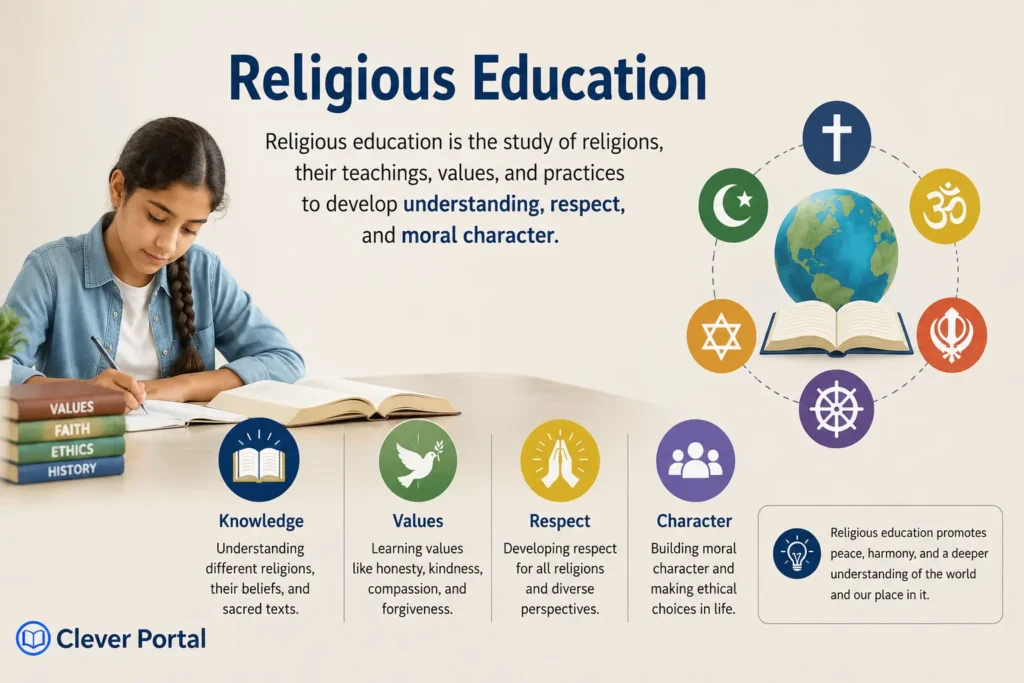
Religious education is the study of religion, faith traditions, and their role in human life and society. It covers the beliefs, practices, sacred texts, and moral values of major world religions such as Christianity, Islam, Judaism, Hinduism, Buddhism, and Sikhism. Taught in schools worldwide, it helps students build cultural literacy, develop critical thinking, and understand diverse worldviews. Research shows it also leads to better academic and social outcomes for students.
Religious education is one of the oldest and most meaningful subjects a student can study. Around the world, roughly 84% of all people identify with a religious group, according to Pew Research Center. That means understanding religion is not just a classroom exercise. It is a life skill.
But what exactly is religious education? What does it teach? And why does it still matter in today’s schools? This guide answers all of those questions in simple, clear language. Whether you are a student, a parent, or a teacher, you will walk away with a solid understanding of this important subject.
What Is Religious Education?
Religious education is the study of religion and its many parts. This includes beliefs, doctrines, rituals, customs, and the role that faith plays in individual lives and in society as a whole.
In academic settings, the subject is non-devotional. That means it focuses on helping students understand religion, not on asking them to believe in or practice any specific faith. This is a key difference between religious education and religious instruction. Religious instruction teaches students the beliefs of one particular religion. Religious education, on the other hand, introduces students to many different religions and worldviews so they can think critically and understand the world around them.
It is also important to note that modern religious education does not just cover traditional faiths. Many RE curricula also include non-religious worldviews such as secular humanism and atheism. This broader approach reflects the reality of today’s diverse societies.
Religious education is recognized as one of the many types of education that shape how students think, relate to others, and engage with the wider world.
What Are the Main Approaches to Religious Education?
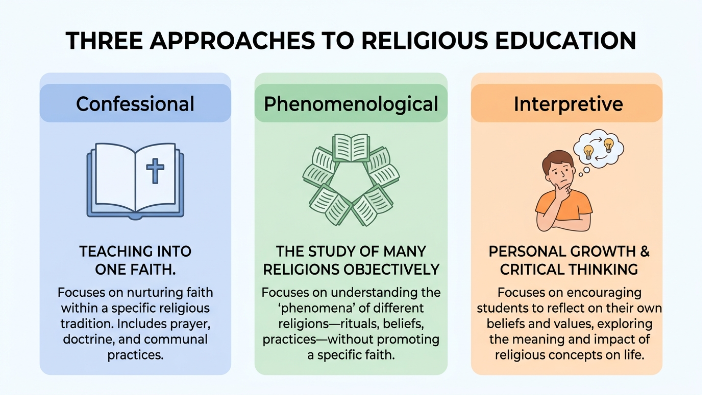
Not all religious education is taught in the same way. Educators and researchers have identified three main academic models for how RE is delivered in schools. Understanding these models helps explain why RE looks so different from one school to another.
The Confessional Approach
The confessional model, sometimes called catechetical education, teaches students into a specific religion. The goal is to help students grow in their own faith tradition. This model is most common in faith schools, such as Catholic schools, Islamic schools, or Jewish schools. It focuses on forming believers and passing on the values of one tradition.
The Phenomenological Approach
The phenomenological model teaches students about religion from a neutral, academic standpoint. Students learn about the beliefs, values, rituals, sacred texts, and community practices of different faith traditions without the school promoting any one of them. This is the approach most commonly used in public or state-funded schools in Europe, North America, and Australia.
The Interpretive Approach
The interpretive model teaches students from religion. Rather than just learning facts about faith traditions, students are encouraged to explore religious and moral questions and develop their own views. This model is student-centered and focuses on personal growth, ethical reasoning, and critical thinking. It asks students to consider how different religious traditions answer life’s biggest questions.
What Does Religious Education Cover?
The content of a religious education curriculum can vary from country to country and school to school. However, most RE programs cover a similar set of core topics.
Major world religions typically studied include:
- Christianity (the world’s largest religion)
- Islam
- Judaism
- Hinduism
- Buddhism
- Sikhism
- Non-religious worldviews such as secular humanism
Beyond just naming religions, RE helps students explore the following within each tradition:
- Key beliefs and theological concepts
- Sacred texts (such as the Bible, Quran, Torah, and Bhagavad Gita)
- Rituals, rites of passage, festivals, and places of worship
- Moral and ethical codes
- The role of religion in history and society
- Community and identity
One of the most interesting parts of RE is how it connects to other subjects. Religion has had a powerful influence on art, architecture, music, and literature throughout human history. Students who understand faith traditions are better equipped to appreciate arts and craft education and the creative works inspired by spiritual belief across cultures.
What Are the Aims of Religious Education?
Every school subject has goals. Religious education is no different. Most national and local RE syllabuses share a common set of aims that guide how the subject is taught.
- Spiritual development: helping students reflect on their own beliefs, identity, and sense of meaning
- Moral and ethical formation: exploring values like honesty, justice, compassion, and fairness through the lens of different faith traditions
- Cultural literacy: building an understanding of the beliefs and practices that shape communities around the world
- Interfaith understanding: encouraging respect for people of different faiths and none
- Critical thinking: helping students ask deeper questions about life, existence, and society
These aims connect closely to the goals of peace education, which also seeks to build respect, tolerance, and understanding across communities. When students learn to appreciate different worldviews, they are better prepared for life in a diverse and interconnected world.
Why Is Religious Education Important in Schools?
Some people wonder whether religious education still belongs in modern schools. The research gives a clear answer: yes, it does.
The National Council for the Social Studies in the United States states that studying about religions “is not only a characteristic of an educated person but is necessary for effective and engaged citizenship in an interconnected and diverse nation and world”.
Religious education helps students in several important ways:
- It builds cultural literacy. Understanding what different people believe helps students relate to classmates, neighbors, and colleagues from different backgrounds.
- It reduces religious discrimination. Studies show that RE helps combat religious illiteracy, which is a leading cause of prejudice and misunderstanding.
- It strengthens ethical standards. Students who study ethics and values through religion develop a stronger personal moral framework.
- It promotes community cohesion. By learning about different faith traditions, students are better equipped to contribute to and build inclusive communities.
- It has long-term social effects. A study published by CEPR found that exposure to compulsory religious education in school significantly influences adult religiosity, community participation, and social values later in life.
These benefits overlap with the goals of social science education, which also aims to help students understand culture, society, and human behavior.
What Are the Benefits of Religious Education for Students?
The benefits of religious education are not just social and cultural. Research shows that students who receive quality RE also show measurable improvements in academic and behavioral outcomes.

Academic Benefits
A meta-analysis of 90 independent studies, reviewed by the CAPE Network, found that students in faith-based educational settings show a positive academic effect size even after controlling for factors like income, race, and gender. In one assessment of national economic literacy, 62% of private and religious school students scored at or above proficiency, compared to 41% of students in public schools.
Social and Behavioral Benefits
The benefits of religious education go beyond test scores. Research from the University of Notre Dame, cited by ReadLion, found that students with religious education backgrounds are:
- Less likely to experience family breakdown in later life
- More likely to volunteer in their communities
- More civically engaged and involved in public life
These findings suggest that religious education helps build character alongside academic knowledge. The combination of ethical reasoning, moral education, and spiritual development creates students who are not only more informed but also more empathetic and engaged citizens.
How Is Religious Education Taught in Schools?
The way religious education is delivered depends largely on the type of school and the national or regional curriculum in place.
In most state-funded or public schools, RE is taught using a non-confessional, comparative approach. Teachers present multiple faith traditions fairly and objectively. Students are encouraged to ask questions, engage in discussion, and think critically about what they are learning.
In faith schools, RE often follows the confessional model aligned with the school’s founding tradition. For example, Catholic schools may follow a syllabus developed by their diocese, while Muslim schools may place greater emphasis on Islamic beliefs and practice.
In England and Wales, RE is a compulsory part of the curriculum in all state-funded schools, though parents do have the right to withdraw their children from RE classes. In Northern Ireland, RE is also a statutory requirement, with a strong emphasis on Christianity alongside the study of other world religions. In Scotland, the subject is called Religious and Moral Education (RME), and in Wales it is now called Religion, Values and Ethics (RVE).
NATRE, the National Association of Teachers of RE in the UK, reports that GCSE Religious Studies entries remain steady at approximately 240,000 per year, showing that RE continues to hold a strong place in secondary education.
Religious Education in a Global Context
Religious education is not unique to any one country or culture. It is taught in schools across Europe, North America, Asia, Africa, and the Middle East, though the approach and content vary widely.
In much of Western Europe, countries shifted from confessional to non-confessional RE models during the latter half of the 20th century. This shift reflected growing religious diversity in European societies and a desire to prepare students for life in a pluralistic world.
In the United States, public schools do not promote or practice religion, but they are permitted to teach about religion from an academic perspective.
At a global level, the scale of religious affiliation makes the subject even more relevant. According to Sage Journals and the World Christianity 2025 report, the Global South is now home to approximately 69% of all Christians worldwide, a proportion expected to reach 78% by 2050. This demographic shift means that understanding world religions and their cultural contexts is increasingly important for students everywhere.
The Religious Education Journal, which has been publishing academic research on this subject since 1906, continues to be a key resource for teachers, researchers, and policymakers working to improve RE standards globally.
Final Thoughts
Religious education is much more than a class about churches or prayers. It is a rigorous academic subject that helps students understand the world’s cultures, values, and histories. It builds critical thinkers, empathetic individuals, and informed citizens.
From the three core models of RE to the real-world academic and social benefits it produces, the evidence is clear: studying religion in school helps students grow both intellectually and personally. Whether taught in a faith school or a public classroom, RE gives students the tools to understand and respect the diverse world they live in.
Want to explore more subjects that shape how students think and learn? Check out the complete guide to the types of education to discover every major area of study from technical and vocational education to arts, peace, and beyond.