Supervised Study Method of Teaching: Definition, Steps, Types, Advantages and Disadvantages
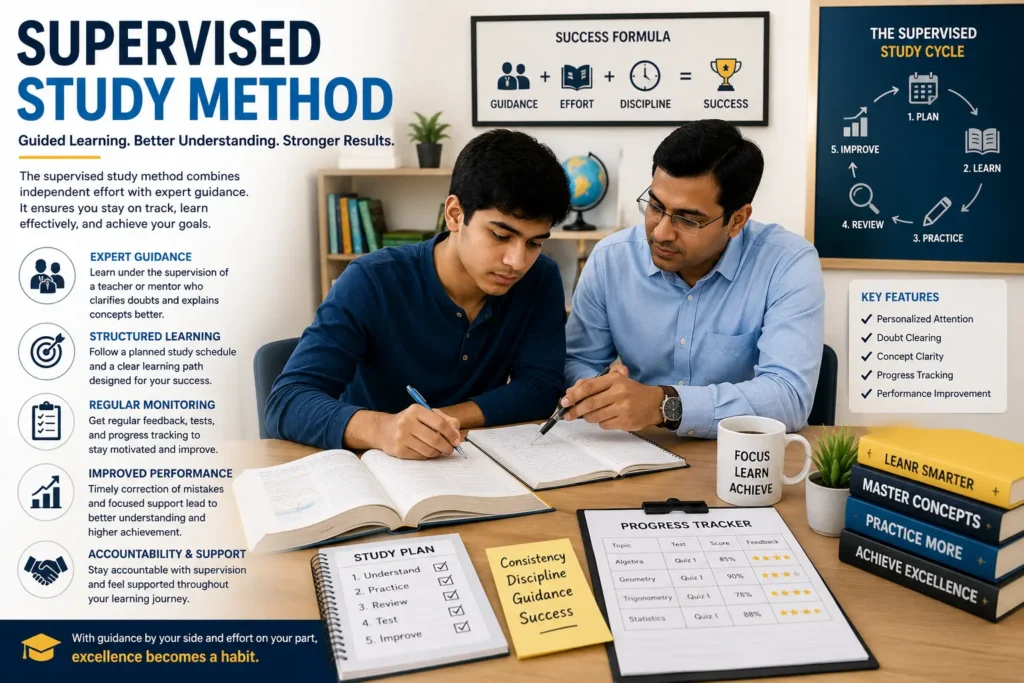
The supervised study method is a classroom teaching approach where students work on assigned tasks individually or in small groups while the teacher actively observes, guides, and provides real-time feedback. It focuses on individual learning differences rather than mass instruction. The teacher acts as a director of study, not just a lecturer. This method builds independent study habits, helps weaker students, and creates a structured learning environment. It is widely used in science, mathematics, and social studies classrooms.
Most classroom teaching is designed for the whole group at once. A teacher delivers a lesson, and every student is expected to keep up at the same pace. But students are not all the same. Some learn quickly. Others need more time and personal attention. The supervised study method of teaching was designed to solve exactly this problem.
This article covers everything you need to know about the supervised study method, including what it means, how it works step by step, its different types, its advantages, its limitations, and when teachers should use it.
What Is the Supervised Study Method?
The supervised study method is a teaching approach in which students work on assigned tasks individually or in small groups while the teacher observes, guides, and supports each learner in real time. Unlike a traditional lecture, the teacher does not stand at the front and talk. Instead, the teacher moves around the classroom, watches students work, answers questions, and helps students who are struggling.
This method is also called the directed study method because the teacher gives direction throughout the study period. The University of Chicago defines it as “studying in the classroom under the direction of the teacher, under physical and psychological conditions most favorable for study”.
The core idea behind this approach is simple. Students learn better when they receive personal attention and immediate feedback rather than waiting until the next class to get their questions answered.
This is one of several structured approaches explored in teaching and learning methods, and it stands out because of how actively the teacher stays involved during the actual study period.
What Are the Key Principles Behind Supervised Study?
The supervised study method is built on two foundational principles in education.
The first is the principle of activity. Students learn best when they are doing something, not just listening. In supervised study, every student is working on a task for the entire period.
The second is the principle of individual differences. No two students learn at the same speed or in the same way. Some students need more time with a concept. Others may need a different explanation. Supervised study allows the teacher to address each student’s unique needs within a single class session.
These two principles connect directly to Vygotsky’s Zone of Proximal Development. This educational concept states that students learn best when they work on tasks just slightly beyond their current level, with the support of a more knowledgeable guide. The teacher in supervised study plays exactly that role through active scaffolding and differentiated instruction.
Steps in the Supervised Study Method
The supervised study method follows a clear four-step structure. Each step has a specific purpose, and together they create a complete learning cycle.
Step 1: Introduction and Preparation
The teacher begins by introducing the topic to the class. This means explaining what students will study, what they are expected to accomplish, and why it matters. The teacher also shares any background information students will need before they begin working independently.
This step is short but important. Without a clear introduction, students may spend their study time confused about what they are supposed to do.
Step 2: Instruction and Material Distribution
The teacher provides the learning materials students will use during the study period. This may include textbooks, worksheets, reference charts, or written notes. The teacher gives clear instructions about what students should study, which sections to focus on, and what they should be able to explain or complete by the end of the period.
This step ensures all students begin with the same foundation and a clear sense of direction.
Step 3: Supervision and Active Guidance
This is the most important step in the method. The teacher circulates throughout the classroom, moving from student to student. The teacher watches how each student is working, asks guiding questions, spots errors early, provides quick demonstrations, and offers individual help where needed.
Good supervision means the teacher is fully active during this step. It is not enough to simply sit at the desk and watch. The teacher diagnoses learning gaps in real time and applies formative assessment to adjust guidance for each learner.
This active teacher presence is what makes supervised study different from self-study or homework. Students are not left alone to figure things out. They receive immediate feedback and correction before a misunderstanding becomes a habit.
Step 4: Blackboard Summary and Consolidation
At the end of the study period, the teacher brings the class together and uses the blackboard to summarize the key points. This helps students organize what they learned, correct any remaining errors, and reinforce important concepts before leaving the classroom.
The summary also gives quieter students, who may not have asked for help during supervision, a chance to fill in any gaps.
What Are the Different Types of Supervised Study?
Supervised study is not one fixed arrangement. Teachers and schools can organize it in several ways depending on available time, class size, and subject needs. Six common plans are used in schools.
- Assembly Hall Study Period – Students from multiple classes gather in a large hall for a shared supervised study session. One or more teachers supervise the entire group.
- Conference Plan – Small groups of students meet with the teacher in a conference-style setting. The teacher guides each group through the material with focused discussion and feedback.
- Double Period Plan – Two class periods are combined so students have a longer uninterrupted block of time to work through more complex material under teacher supervision.
- Dividing Period Plan – A single class period is split into two parts. The first part is used for instruction or lecture. The second part is reserved for supervised individual study.
- Daily Extra Period Plan – An additional period is added specifically for supervised study, separate from the regular timetable. This is especially useful for students who need extra academic support.
- Library Study Plan – Students study in the school library under the supervision of a teacher or librarian. This plan encourages the use of reference materials and develops independent research skills.
Each plan serves a slightly different purpose. Schools can choose the format that best matches their resources and the needs of their students.
Advantages of the Supervised Study Method
The supervised study method offers several important benefits for both students and teachers. These advantages make it one of the most practical approaches for classrooms with mixed ability levels.
- Addresses individual differences directly. Because the teacher moves around and interacts with each student, learners at different levels all receive the attention they need. This is one of the clearest examples of differentiated instruction in practice.
- Provides immediate feedback. Students do not have to wait until the next class or until homework is graded to know if they are on the right track. The teacher corrects errors in real time, which prevents incorrect learning habits from forming.
- Builds independent study habits. Regular participation in supervised study teaches students how to manage their own learning. Over time, students develop stronger self-direction and time management skills.
- Helps weaker and struggling students the most. Research published in JSTOR confirmed that weaker students benefit most from supervised study because they receive direct teacher attention during the study period. A University of Illinois study found that students who regularly attended supervised study sessions scored an average of 5.5 points higher on their final exams compared to those who did not attend.
- Allows the teacher to diagnose learning problems early. By watching students work, the teacher can identify specific misunderstandings and address them before they affect exam performance.
- Encourages active learning. Students are engaged and doing something for the entire period rather than passively listening to a lecture. This aligns with active learning research that shows higher retention when students apply knowledge rather than just receive it.
- Supports student accountability. Knowing that a teacher is observing their work motivates students to stay focused and take their study tasks seriously.
Disadvantages and Limitations of the Supervised Study Method
Despite its strengths, the supervised study method also has real limitations that teachers should consider before using it.
- Advanced students may not be sufficiently challenged. Research in JSTOR noted that high-performing students gain less from supervised study compared to weaker students. Bright learners may finish assigned tasks quickly and spend the remaining time idle if the teacher does not provide extension work.
- Requires more teacher time and energy. Circulating the classroom, giving individual feedback, and diagnosing multiple students simultaneously is demanding work. This can be exhausting for teachers managing large classes.
- Increases operational costs. Some schools need to hire additional supervising teachers, especially for the assembly hall plan or daily extra period plan. This adds to school expenses.
- Extending the school day is not always possible. Several supervised study plans require extra class periods beyond the regular timetable. Schools with strict scheduling or limited facilities may find this difficult to arrange.
- Not suited to all subjects equally. Supervised study works best in subjects like mathematics, science, and social studies where students can work through structured tasks. It is less effective in subjects that require extended creative or performance-based work.
Despite these limitations, this method remains a valuable tool when matched to the right students, subjects, and school conditions.
What Is the Role of the Teacher in the Supervised Study Method?
In the supervised study method, the teacher’s role changes completely compared to a traditional lecture class. The teacher becomes a director of study rather than a transmitter of information.
This means the teacher is responsible for planning the study tasks carefully before the session begins. The teacher must choose material that is challenging enough to promote learning but not so difficult that students become frustrated and give up.
During the study period, the teacher circulates continuously. This means moving from desk to desk, noticing which students are stuck, asking probing questions to check understanding, offering short demonstrations where needed, and giving encouragement to students who are losing confidence. The teacher must be fully present and observant throughout.
After the study period, the teacher leads the blackboard summary. This requires the teacher to quickly organize the most important points and present them in a clear, visual format that helps all students consolidate their learning.
According to a study published by JSTOR, the supervised study approach gives teachers the specific opportunity to observe students’ study methods and guide them toward more effective habits. This is a unique benefit that traditional lecturing simply cannot provide.
When Should Teachers Use the Supervised Study Method?
The supervised study method works best in specific classroom and subject contexts. Understanding when to use it helps teachers get the most out of this approach.
Best subjects for supervised study include:
- Mathematics, where students work through structured problem sets and need immediate correction of errors
- Science, where laboratory-style written tasks and data analysis require close teacher guidance
- Social studies, where students analyze documents, maps, or case studies independently but benefit from teacher support
Best student profile for this method:
Classrooms with mixed ability levels, sometimes called heterogeneous groups, benefit most from supervised study. When some students are ahead and others are behind, this method allows the teacher to address everyone without leaving any group behind.
Best scheduling contexts include:
The double period plan and daily extra period plan are especially effective for subjects where students need extended practice time. Schools can also use the extra period specifically to support students who are falling behind.
Modern and online application:
The supervised study method is not limited to physical classrooms. In blended learning and hybrid education settings, teachers can run supervised study sessions through video conferencing platforms. The teacher monitors student screens, answers questions in real-time chat, and provides feedback during the session. This makes supervised study a flexible method that works in both traditional and digital learning environments.
How Does Supervised Study Compare to Other Teaching Methods?
Understanding where supervised study fits among other methods helps teachers make better classroom decisions. The table below shows how it compares to the assignment method and the tutorial method.
| Feature | Supervised Study | Assignment Method | Tutorial Method |
| Teacher role | Active supervisor and guide during the session | Sets task, reviews after submission | One-on-one tutor in focused discussion |
| Student role | Works independently with real-time teacher support | Works fully independently | Participates in guided discussion |
| Feedback timing | Immediate, during the session | Delayed, after submission | Immediate |
| Best for | Mixed-ability and heterogeneous classrooms | Advanced and self-directed learners | Individual remediation and enrichment |
| Class size | Medium to large | Any size | Small group or individual |
The tutorial method of teaching offers a deeper one-on-one experience, while supervised study allows the same quality of individual attention to be extended across an entire class at once. Both methods prioritize active learning over passive reception.
For classrooms where teachers want students to work through extended real-world tasks, the project method of teaching can be paired effectively with supervised study sessions to support students during the research and development phases of a project.
Teachers looking to reinforce material after supervised practice sessions may also find the review method of teaching useful for helping students consolidate and recall what they worked through.
For subjects that require repetitive skill-building, combining supervised study with the drill method of teaching helps students practice foundational skills under direct teacher observation before moving to more complex application tasks.
Final Thoughts
The supervised study method of teaching is one of the most practical approaches available for classrooms where students have different learning needs and different levels of ability. It shifts the teacher from the front of the room to the heart of the learning process. Every student gets personal attention. Errors are caught early. Study habits are built with real guidance, not guesswork.
Research confirms what many experienced teachers already know. When students study in a structured, teacher-supervised environment, they perform better. They develop stronger habits, build more confidence, and understand their material more deeply.
If you are a B.Ed. student, a practicing teacher, or an educator exploring more effective classroom methods, the supervised study method deserves a place in your teaching toolkit.
Explore all classroom teaching and learning methods to discover more structured approaches that help students learn more effectively in any subject or grade level.