What Is the Review Method of Teaching, Types, Steps, Student Learning, Advantages And Disadvantages
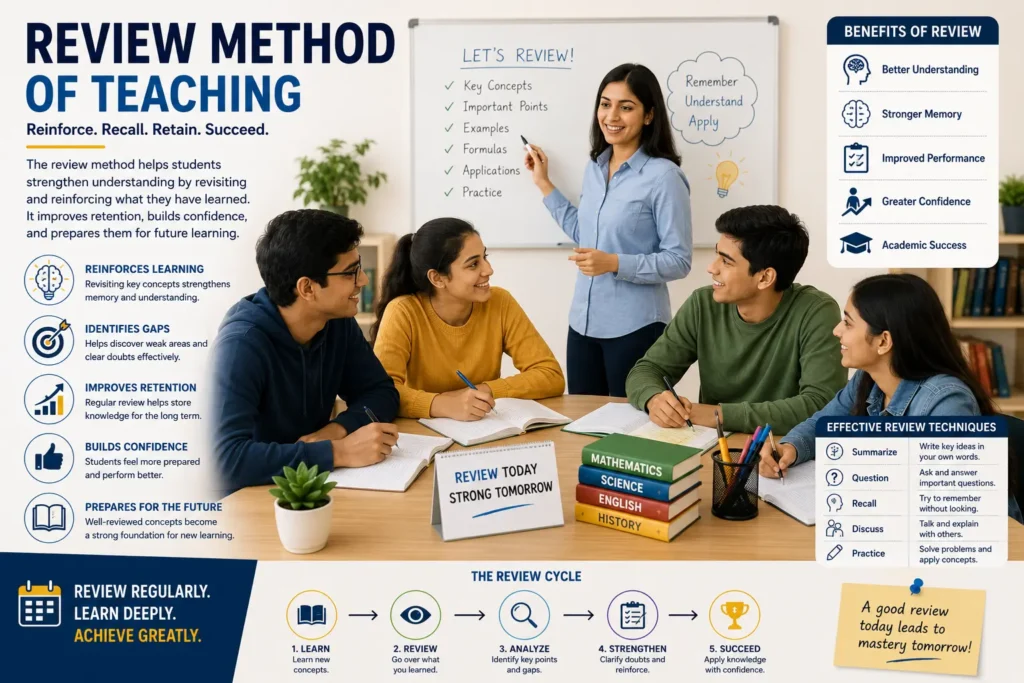
The review method of teaching is a structured instructional strategy where teachers revisit previously taught content to strengthen student recall, close learning gaps, and prepare students for new material. It works in five clear steps: define what to review, gather student evidence, design an activity, run the session, and assess the outcome. Research consistently shows that active review beats passive re-reading for long-term knowledge retention. Teachers should use this method regularly, not just before exams.
Have you ever taught a lesson perfectly on Monday, only to find that by Friday your students seem to have forgotten everything? You are not alone. Most teachers face this challenge every single week. The problem is not always the quality of the lesson. Often, it is the absence of a structured plan to keep earlier learning alive.
That is exactly where the review method of teaching comes in. It is one of the most practical and research-supported strategies any educator can use. In this guide, you will learn what the review method is, how to use it step by step, why it actually works, and how to apply it in a real classroom today.
What Is the Review Method of Teaching?
The review method of teaching is a structured pedagogical strategy where a teacher revisits previously taught content through planned activities that promote student recall, lesson consolidation, and gap identification. Unlike reteaching, which addresses content a student completely failed to understand, the review method builds on partial knowledge and deepens it through active engagement.
Think of it this way. If a student learned about photosynthesis last week, reteaching would mean starting from scratch. The review method means returning to that topic in a fresh, interactive way to strengthen what is already there.
This strategy is recognized in teacher training curricula worldwide, including B.Ed. and M.Ed. programs. It connects directly to Benjamin Bloom’s Taxonomy at the “remembering” and “understanding” levels. According to the ERIC research database, teaching and learning is most effective when it includes purposeful cycles of knowledge transfer and revisitation.
For a broader look at how this fits into the bigger picture, explore the full guide on teaching and learning methods.
What Are the Main Types of Review in Teaching?
Not all review lessons look the same. Teachers use different types of review depending on the timing, the subject, and the students’ needs. Here are the five main types every educator should know.
- Formal Review: A planned, structured session at the end of a unit or term. The teacher prepares specific questions, activities, or tests to assess how well students retained the full topic.
- Informal Review: A short, unplanned check at the start or end of a lesson. This could be a quick oral question, a show-of-hands poll, or a one-minute write activity.
- Cumulative Review: This type spans multiple topics across different units. It connects earlier learning to new content and is especially useful for subjects like mathematics and science where ideas build on each other.
- Peer Review: Students review each other’s work or quiz each other on key content. This is a student-centered form of the review method that activates collaborative learning.
- Self-Review: Students reflect on their own learning through journals, self-quizzes, or metacognitive checklists. This type develops independent learning habits.
Research from LearningFocused shows that dedicating just 3 to 5 minutes each class period to a quick quiz covering both recent material and earlier topics significantly improves retrieval and reduces forgetting over time.
What Are the Steps of the Review Method of Teaching?
The review method of teaching is most effective when it follows a clear, structured process. Here are the five steps a teacher should follow.
Step 1: Define the Scope of Review
Before anything else, the teacher decides what content to revisit. This could be a single lesson, a full unit, or a cross-topic concept. Being specific here is important. A vague review wastes time. A focused review produces results.
Step 2: Gather Student Evidence
The teacher collects data on what students already know. This might include previous quiz results, classroom observations, student notebooks, or exit tickets from earlier lessons. This step guides the entire review design.
Step 3: Design the Review Activity
Based on the evidence gathered, the teacher selects or creates an activity. This could be a structured oral questioning session, a written activity, a group game, or a paired review exercise. The key is that the activity must actively involve students, not just ask them to re-read notes.
Step 4: Conduct the Review Session
The teacher runs the session with clear instructions and active student participation. Good review lessons are interactive. They ask students to recall, explain, compare, and apply knowledge rather than just listen. John Dewey’s principle of experiential learning supports this idea strongly.
Step 5: Evaluate Gaps and Adapt Instruction
After the review session, the teacher identifies which concepts students still struggle with. These gaps then inform the design of the next lesson. The University at Buffalo’s course design framework reinforces this approach: align your teaching method to your learning outcomes, then adjust based on what the evidence shows.
The review lesson in teaching is only complete when the teacher has used what they learned from the session to plan forward.
Why Is the Review Method Effective for Student Learning?
The review method works because of a well-documented cognitive principle called retrieval practice. When students actively recall information from memory, that act of recalling strengthens the memory itself. This is far more effective than simply re-reading a textbook page or watching a lesson video again.
Research published in the Scandinavian Journal of Educational Research identifies that how teachers revisit content is one of the most important factors in student learning outcomes, noting that the quality of review activity matters as much as the frequency. In other words, passive review produces weak results, but active review produces strong ones.
There is also a connection to spaced repetition. When students encounter the same concept across multiple review sessions over time rather than in one concentrated block, their long-term knowledge retention improves significantly. This is why the review method of teaching should be used throughout a term, not only in the final week before an exam.
Lev Vygotsky’s concept of the Zone of Proximal Development also supports this strategy. Structured review helps teachers identify exactly where a student sits in their understanding so that the next lesson can push learning just slightly beyond that point.
What Are the Advantages of the Review Method of Teaching?
The advantages of the review method in teaching are both practical and research-supported. Here is what teachers can expect when they use this strategy consistently.
- Stronger memory retention: Active recall during review sessions reinforces neural pathways, making it easier for students to remember content long-term.
- Early identification of learning gaps: Teachers who use regular review lessons catch misunderstandings before they become entrenched habits of thinking.
- Increased student confidence: When students successfully recall and demonstrate prior knowledge, their confidence in the subject grows naturally.
- Better lesson transitions: Review sessions create a bridge between old and new content, making new material feel less foreign to students.
- Supports differentiated instruction: Teachers can adjust review activities based on individual student needs once they see who is struggling and who is not.
- Flexible across subjects: The review technique in education works in mathematics, science, language arts, history, and every other subject area without needing significant changes to the core structure.
- Improves academic performance: Research on teacher effectiveness consistently links regular formative review to measurable gains in student achievement.
What Are the Disadvantages of the Review Method of Teaching?
Like any teaching strategy, the review method has real limitations. Teachers should be aware of these challenges before using this approach.
- Risk of passive review: If the activity is poorly designed, students may disengage. A worksheet that simply asks students to copy definitions is not a real review session. It is a passive task. Mitigation: always design review activities that require active thinking, not just copying.
- Time pressure: Review sessions take instructional time. In a packed curriculum, teachers may feel they cannot afford this time. Mitigation: short, focused review activities of 3 to 5 minutes can produce strong results without consuming full lesson periods.
- Reinforcing incorrect understanding: If a student has formed a misconception, a review session may strengthen that wrong idea rather than correct it. Mitigation: include a teacher-led correction step where answers are checked and misconceptions are addressed directly.
- Can become repetitive: Students may disengage if every review session looks the same. Mitigation: vary the format by rotating between oral questions, games, written tasks, and peer review activities.
Blending the review method with other instructional approaches, such as experiential learning or collaborative activities, helps address many of these limitations.
How Is the Review Method Different From Other Teaching Methods?
One common question teachers ask is how the review method compares to the drill method and the project method. These three approaches are often used together in a teaching plan, but they serve very different purposes.
| Dimension | Review Method | Drill Method | Project Method |
| Main purpose | Consolidate prior learning | Build skill automaticity through repetition | Apply learning to real-world tasks |
| Focus | Conceptual understanding and recall | Procedural skills and habits | Creative application and problem-solving |
| Student role | Active recall and reflection | Repeated practice | Research, planning, and creation |
| When to use | After a lesson or unit is taught | When a skill needs to become automatic | When students are ready to apply learning |
| Example | Reviewing vocabulary learned last week | Practicing multiplication tables daily | Building a science model over two weeks |
The key distinction is that the review method builds on what students already partially understand, the drill method of teaching uses repetition to make a skill automatic, and the project method of teaching takes students beyond the classroom into real-world application.
All three methods are valuable. A skilled teacher knows when to use each one and how to combine them for the best results.
How Can Teachers Use the Review Method in Today’s Classroom?
Knowing the theory is only half the job. Here is how teachers can put the review lesson in teaching into real practice in a 2025 and 2026 classroom.
1. Daily Warm-Up Questions
Start each class with two or three questions that revisit content from the previous lesson. This activates prior knowledge and prepares students to connect it with new material. Keep this to three to five minutes maximum.
2. Exit Tickets
At the end of a lesson, ask students to write down one thing they learned, one thing they still find confusing, and one question they have. Collect these tickets and use the information to design the next session’s opening review.
3. Gamified Review Sessions
Digital tools like Kahoot and Quizizz turn review activities into competitive, engaging games. Students answer questions on their devices and can see their results in real time. This format is especially effective for vocabulary, formulas, and factual content. These platforms also provide teachers with data on which questions students are getting wrong, making gap identification automatic.
4. Peer Quiz Activities
Pair students together and ask them to quiz each other using their notes or concept maps from previous lessons. This activates collaborative learning and gives students a chance to hear concepts explained in a peer’s language.
5. Cumulative Review Stations
Set up four or five stations around the classroom, each covering a different unit from the term. Students rotate through the stations in small groups, answering questions or completing short tasks at each one. This structure works especially well before end-of-term assessments.
6. Google Forms Quick Quizzes
A short five-question Google Form quiz sent as a warm-up activity takes less than ten minutes but gives the teacher instant data on student understanding. Students get immediate feedback, and teachers get a clear class-level picture of knowledge retention.
Using these strategies, any teacher can make the review technique in education a natural part of the daily classroom routine rather than a stressful event that only happens before tests.
Final Thoughts
The review method of teaching is not complicated. But it is often underused. When teachers build structured review into their everyday lesson planning, students retain more, understand more deeply, and feel more confident walking into assessments.
The key takeaway is simple: do not let learning slip. Use the review method consistently, actively, and purposefully. Whether you use a five-minute warm-up question, a Kahoot game, or a structured cumulative station activity, the principle is the same. Bring students back to what they already know, check how well it has stuck, and use that information to teach forward.
Ready to explore more proven strategies for your classroom? Visit the full library of teaching and learning methods to discover approaches like the project method, drill method, and many more that you can combine with the review method for maximum impact.