Changing Perspectives of Teaching: How the Classroom Has Evolved Over Time
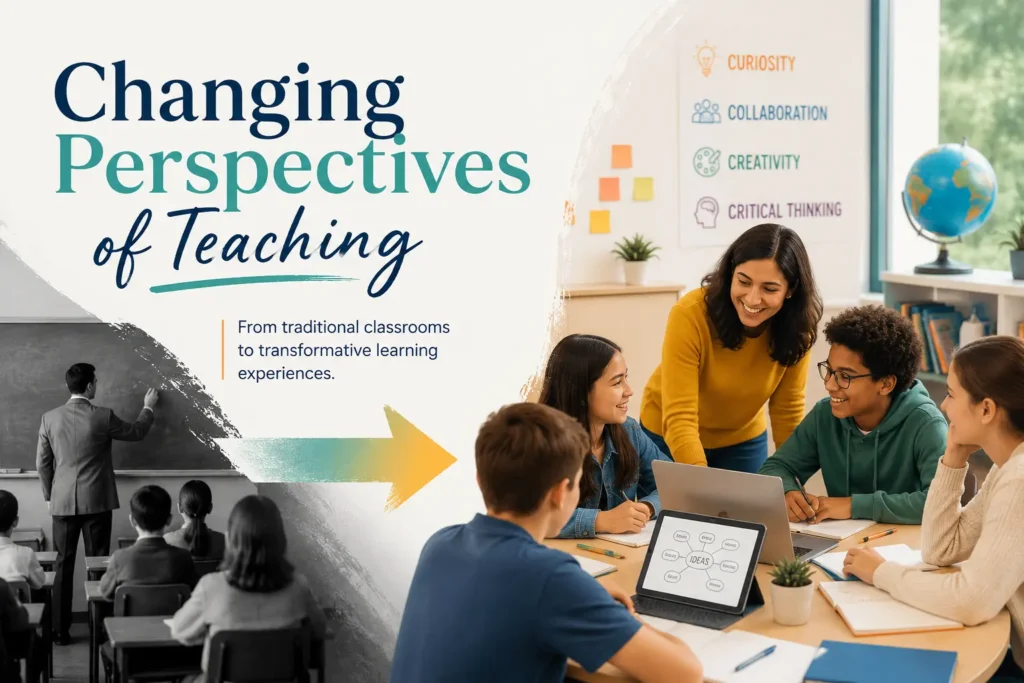
Teaching perspectives have shifted dramatically over the past century. The classroom moved from rigid, teacher-led instruction rooted in behaviorism to flexible, student-centered models built on constructivism. Today, the changing perspectives of teaching include AI-assisted personalization, social-emotional learning, and culturally responsive pedagogy. Understanding these shifts helps educators make smarter, more effective choices in any classroom setting.
Teaching used to mean one thing: a teacher stands at the front, speaks, and students listen. That picture has changed completely. Walk into a modern classroom today, and you might see students working in groups, using digital tools, setting their own learning goals, and directing their own questions. The changing perspectives of teaching reflect something much deeper than new tools or new trends. They reflect a fundamental rethinking of what learning actually is, who drives it, and what the teacher’s role should be.
This article traces the major shifts in teaching philosophy from the early 20th century to 2026. You will learn what caused each shift, how it changed what happens inside classrooms, and why understanding these evolving perspectives matters for every educator working today.
What Does “Perspectives of Teaching” Actually Mean?
A perspective of teaching is a set of beliefs that a teacher holds about how students learn. It shapes everything: how lessons are designed, how classrooms are managed, how students are assessed, and how teachers respond when a student struggles. These beliefs do not always come from formal training. They often develop from personal experience, observation, and cultural expectations.
John Dewey, one of the most influential voices in educational philosophy, argued that teaching should be rooted in real experience and active participation rather than passive absorption. Paulo Freire later described traditional teaching as a “banking model,” where knowledge is deposited into students as if they were empty containers. Both thinkers challenged the idea that the teacher alone holds knowledge worth sharing.
A teaching perspective is not the same as a teaching method. A method is a technique, like using flashcards or group projects. A perspective is the underlying belief system that determines which methods a teacher chooses and why. Two teachers can use the same method for completely different reasons, depending on their perspective.
Understanding the principles of teaching that underpin each perspective helps educators make intentional decisions rather than simply following habit or tradition.
How Have Perspectives of Teaching Changed Over Time?
The evolution of teaching methods did not happen all at once. It unfolded across five major phases, each driven by new discoveries in psychology, shifts in society, and changes in what the world demanded from educated people.
The Behaviorist Era: Teaching as Transmission
From the late 1800s through the mid-20th century, behaviorism dominated educational philosophy. B.F. Skinner’s research on operant conditioning shaped how educators thought about learning. The classroom was built around repetition, reward, and correction. Teachers delivered information; students received it. Assessment meant testing how well students could recall what the teacher had said.
This perspective was orderly and efficient in many ways. It worked well for basic skill-building, like learning multiplication tables or spelling rules. However, it left little room for critical thinking, creativity, or student voice. The teacher was the sole authority, and the student’s job was to comply.
The Cognitive Turn: Learning as Active Thinking
In the 1960s and 1970s, psychologists began questioning whether learning was simply a response to external stimuli. Jean Piaget’s research on child development showed that children actively construct understanding through stages of cognitive growth. He demonstrated that learners are not passive; they are always interpreting new information through what they already know.
Lev Vygotsky added another layer with his concept of the Zone of Proximal Development. He showed that learners grow fastest when working just beyond their current ability, with the support of a more knowledgeable guide. This turned attention toward the learner’s internal processes, not just their visible behavior.
Benjamin Bloom’s Taxonomy, published in 1956, restructured how educators thought about learning goals. Rather than simply testing recall, Bloom’s framework pushed teachers to design instruction that built toward analysis, evaluation, and creation. These ideas marked a major shift in the pedagogical stance of teachers everywhere.
Constructivism: The Learner at the Center
By the 1980s and 1990s, constructivism had become the dominant lens for educational philosophy. Constructivist teaching holds that students do not simply receive knowledge; they build it through experience, reflection, and interaction. This perspective elevated student engagement strategies and placed inquiry-based learning at the center of instructional design.
Project-based learning grew directly from constructivist principles. Teachers were encouraged to design rich, real-world tasks that required students to explore, collaborate, and create rather than memorize and recite. The teacher’s instructional role shifted from lecturer to facilitator. This was not a smaller role; it was a more complex one.
Technology Integration: Tools That Changed the Classroom
The early 2000s brought digital tools into classrooms at scale. Interactive whiteboards, learning management systems, online research tools, and multimedia resources transformed what teaching looked like. The teacher’s role expanded further to include digital literacy facilitation.
This phase was not purely about tools. It represented a deeper pedagogical shift: information was no longer controlled by the teacher. Students could find answers independently. This changed the power dynamic in the classroom and accelerated the move away from lecture-based instruction.
21st-Century Perspectives: Personalization and Purpose
From 2015 onward, education began shifting toward what researchers now call holistic and personalized learning. Universal Design for Learning (UDL) frameworks encouraged teachers to design flexible learning experiences that work for all students, including those with diverse needs. Social-Emotional Learning (SEL) became recognized as a foundational element of academic success, not a soft add-on.
Today, in 2025 and 2026, AI-assisted instruction is accelerating personalization further. Teachers now have access to data-driven tools that can identify each student’s gaps and strengths in real time, allowing truly individualized learning paths. According to UT Permian Basin, AI and machine learning tools are ushering in personalized education at a scale that was previously impossible.
Understanding how these shifts connect can also be seen more clearly through the phases of teaching, which map the structural progression of instruction from planning through evaluation.
What Drove the Shift from Teacher-Centered to Student-Centered Learning?
The move from teacher-centered to learner-centered education was not a trend. It was the result of mounting research evidence that passive students learn less effectively than active ones. When students are invited to question, apply, and reflect, they retain information longer and develop stronger critical thinking skills.
Here is how the two approaches compare across key dimensions:
| Dimension | Teacher-Centered | Student-Centered |
| Role of teacher | Knowledge deliverer, authority figure | Facilitator, learning guide |
| Role of student | Passive listener, note-taker | Active participant, problem solver |
| Assessment focus | Tests and recall-based exams | Projects, portfolios, performance tasks |
| Classroom dynamic | Lecture-based, silent rows | Collaborative, discussion-rich |
| Learning pace | Uniform for all students | Flexible and personalized |
| Goal of instruction | Cover the curriculum | Develop the learner |
Piaget’s research demonstrated that children cannot simply absorb adult explanations unchanged. They filter new information through their existing mental models. Vygotsky’s Zone of Proximal Development showed that the most powerful learning happens in the space between what a student can do alone and what they can do with support. Both frameworks point toward the same conclusion: the student’s mind must be active, not passive.
Student-centered learning does not remove the teacher. It changes the teacher’s job from delivering content to designing the conditions in which meaningful learning can occur. This is more demanding, not less.
You can explore the characteristics of good teaching that define what this more complex, facilitative role looks like in practice.
What Are the Major Theoretical Perspectives That Shaped Modern Teaching?
Four major theories have shaped how educators understand learning and instruction. Most modern teachers draw from all four, even if they do not name them explicitly.
Behaviorism: Reward, Repetition, and Response
Behaviorism, associated with B.F. Skinner and John Watson, holds that learning is a change in observable behavior caused by environmental stimuli. Rewards reinforce desired behaviors; consequences reduce unwanted ones. In the classroom, this looks like structured practice, immediate feedback, and clearly defined expectations. Behaviorist thinking still appears in classroom management systems, grading structures, and skill-based drills.
Cognitivism: Understanding How the Mind Learns
Cognitive theory shifted attention inward, to the mental processes that drive learning. Piaget and Bloom are the central figures here. Cognitivism recognizes that learners organize information into mental frameworks called schemas. Good teaching, from this perspective, means helping students connect new knowledge to existing understanding. Bloom’s Taxonomy remains one of the most widely used tools in curriculum design worldwide.
Constructivism: Building Knowledge Through Experience
Constructivism argues that knowledge is not transferred from teacher to student but is actively built by the learner through experience and reflection. Vygotsky and Dewey are key figures in this tradition. Active learning strategies like inquiry-based learning, project-based learning, and problem-based learning all flow from constructivist principles. This perspective is the most widely applied in contemporary classrooms.
Connectivism: Learning in a Networked World
George Siemens introduced connectivism in 2005 as a theory designed for the digital age. He argued that knowledge no longer resides only in individuals but is distributed across networks of people, tools, and resources. Learning, in this view, means navigating networks effectively. Connectivism explains why digital literacy, collaborative platforms, and AI tools are now central to the changing role of teachers in the 21st century.
Exploring the factors of teaching that shape instructional choices shows how these theoretical foundations play out across real classroom variables.
How Has Technology Changed the Perspective of Teaching?
Technology has not just added new tools to the teacher’s toolkit. It has fundamentally changed the perspective of what the teacher does. The teacher is no longer the primary source of information. Students can access virtually unlimited content through the internet, AI tools, and digital libraries. This shifts the teacher’s most important skill from information delivery to information curation and critical thinking facilitation.
Key technology-driven shifts in teaching perspective include:
- From delivery to design: Teachers now design learning experiences rather than simply presenting content
- From uniformity to personalization: Digital platforms allow teachers to differentiate instruction for individual students at scale
- From passive consumption to active creation: Students use tools like video editors, coding platforms, and design software to demonstrate learning
- From local to global: Classrooms connect with learners and experts across the world through digital communication
- From annual feedback to real-time data: Learning management systems give teachers immediate insight into student progress
According to Marzano Research, hybrid learning is solidifying as a fundamental component of modern education, not simply a temporary response to external disruption. The perspective shift here is significant: teaching is no longer tied to a physical room or a fixed schedule.
What Are the Current Perspectives on Teaching in 2026 and Beyond?
The shifting paradigms in education today reflect both the challenges and the opportunities of a rapidly changing world. Five perspectives are shaping instruction most strongly right now.
1. AI-Assisted Personalized Learning
Artificial intelligence tools now allow teachers to identify each student’s specific learning gaps and tailor instruction accordingly. The teacher’s role becomes one of learning architect, designing AI-supported pathways that respond to individual student data. This is perhaps the most significant change in the evolution of teaching methods in the past decade.
2. Social-Emotional Learning (SEL)
Research consistently shows that students who develop emotional regulation, empathy, and relationship skills learn more effectively. The SEL perspective holds that academic instruction and emotional development are not separate responsibilities. Teachers today are expected to address the whole child, not just their cognitive performance.
3. Culturally Responsive Pedagogy
Modern perspectives on teaching recognize that students bring diverse cultural backgrounds, languages, and life experiences into the classroom. Culturally responsive pedagogy asks teachers to design instruction that reflects and respects those differences, rather than expecting all students to adapt to a single cultural norm.
4. Trauma-Informed Teaching
Growing awareness of adverse childhood experiences (ACEs) has created a new instructional perspective built on safety, predictability, and trust. Trauma-informed teachers understand that behavior is often communication, and they respond with support rather than punishment.
5. Sustainability and Global Citizenship Education
The OECD Trends Shaping Education 2025 report highlights how schools are increasingly tasked with developing students who understand global challenges like climate change, social inequality, and technological disruption. This represents a major expansion of what “teaching” means in the modern era.
What Challenges Come With Changing Teaching Perspectives?
Shifting teaching perspectives is not easy. Even when research clearly supports a new approach, change in education moves slowly. Several real obstacles stand in the way.
- Resistance to change: Many teachers were taught using traditional methods and find it difficult to abandon what feels familiar
- Insufficient professional development: New perspectives require new skills, but teacher training programs do not always keep pace with research or technology
- Resource gaps: Student-centered and technology-integrated approaches often require tools, time, and support that underfunded schools cannot access
- Curriculum pressure: Standardized testing requirements frequently push teachers back toward teacher-centered, coverage-based instruction
- Teacher burnout: The expanding scope of the teacher’s role creates genuine strain, especially when support systems are inadequate
According to the World Bank Education Blog, teachers are most likely to change their practices when they personally observe the benefits on student learning. Mandated top-down change without meaningful professional development rarely produces lasting shifts. Real pedagogical change happens when teachers are given clear goals, doable steps, and rewarding outcomes.
Supporting teachers through this transition requires school leaders who understand the difference between surface-level method changes and deeper perspective shifts. Cambridge International’s research on changing mindsets confirms that professional development must go beyond technique and address the beliefs that drive instructional choices.
Final Thoughts: Why These Shifts Matter for Every Educator Today
The changing perspectives of teaching are not just a topic for education students or researchers. They are directly relevant to every person who works with learners, whether in a K-12 school, a university lecture hall, a corporate training room, or an online learning platform.
Understanding where these perspectives came from helps educators see their own beliefs more clearly. It creates the awareness needed to move beyond habit and toward intentional, evidence-based practice. A teacher who understands constructivism will design differently than one who unconsciously defaults to behaviorism. A teacher who understands connectivism will leverage digital tools as genuine learning resources rather than distractions to be managed.
The evolution from teacher-centered instruction to learner-centered education is not finished. The rise of AI-assisted personalization, the growing emphasis on social-emotional learning, and the expanding demand for culturally responsive pedagogy all signal that the perspective is continuing to evolve. The most effective educators are those who evolve with it.
Education is not what the teacher does. It is what the learner becomes. Every shift in teaching perspective across the past century has moved closer to that truth.
If you are ready to go deeper, explore what great teaching actually looks like in practice. Start with the principles of teaching to understand the foundational beliefs that guide effective instruction at every level.