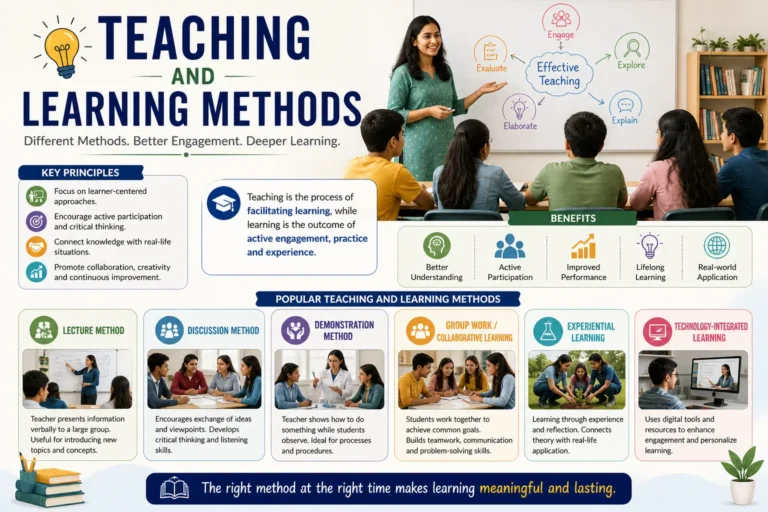
Principles of Teaching: A Complete Guide for Educators and Students
The principles of teaching are evidence-based guidelines that help educators plan and deliver effective instruction. Rooted in educational psychology, from Thorndike’s foundational laws to Merrill’s modern framework, they cover readiness, motivation, active participation, individual differences, and more. Understanding these principles helps teachers build purposeful, learner-centered classrooms that improve student outcomes at every level.
Effective teaching does not happen by chance. It follows a clear set of proven principles that educational psychologists have studied and refined for over a century. Whether you are a B.Ed student preparing for exams, a teacher educator building a curriculum, or a classroom teacher looking to improve your practice, the principles of teaching give you a reliable foundation to work from.
These principles are not vague suggestions. They explain how students learn, what conditions support learning, and how teachers can design instruction that actually works. This guide covers every core principle, traces its roots in educational psychology, and shows how each one applies in real classrooms today.
What Are the Principles of Teaching?
The principles of teaching are theoretically grounded, research-backed guidelines that govern how effective instruction should be designed and delivered. They are drawn from decades of work in educational psychology and cognitive development.
It helps to understand what principles are not, because this is a common point of confusion for B.Ed students. Teaching methods are the specific techniques a teacher uses in the classroom, such as lectures, group work, or demonstrations. Teaching maxims are practical rules of thumb drawn from classroom experience. Principles are different from both. They explain the why behind good instruction, while methods explain the how. You can think of teaching as both a science and a practice, as explored in our article on teaching as both science and practice.
Edward Thorndike was one of the first educators to apply psychology to the classroom. His 1906 work, The Principles of Teaching Based on Psychology, laid the groundwork for much of what we now call instructional principles. Since then, researchers and institutions have built on that foundation, adding new layers that reflect how learning actually works.
Why Are the Principles of Teaching Important?
The principles of teaching give educators a reliable framework to plan lessons, manage classrooms, and respond to diverse learners. Without them, instruction risks becoming inconsistent or ineffective. These principles ensure every teaching decision is grounded in how students actually learn, not just in how teachers prefer to teach.
When teachers follow sound instructional principles, the benefits extend well beyond test scores. Students stay more engaged, retain information longer, and develop stronger problem-solving skills. The core functions of effective teaching, outlined across different levels of education, are all shaped by these underlying principles.
Explore how the core functions of effective teaching connect with these principles to understand how theory translates into classroom impact.
The OECD’s 2025 report, Unlocking High-Quality Teaching, identifies five teaching goals and twenty classroom practices that directly reflect these principles in action. This confirms that principles of teaching remain as relevant today as they were when Thorndike first described them.
What Are the Core Principles of Teaching?
The core principles of teaching include readiness, motivation, active participation, exercise, effect, primacy, recency, intensity, and individual differences. Together, they form a system that ensures instruction is appropriately timed, meaningfully delivered, and personally relevant to each learner.
Each principle below includes a definition and a practical classroom application so you can see theory and practice side by side.
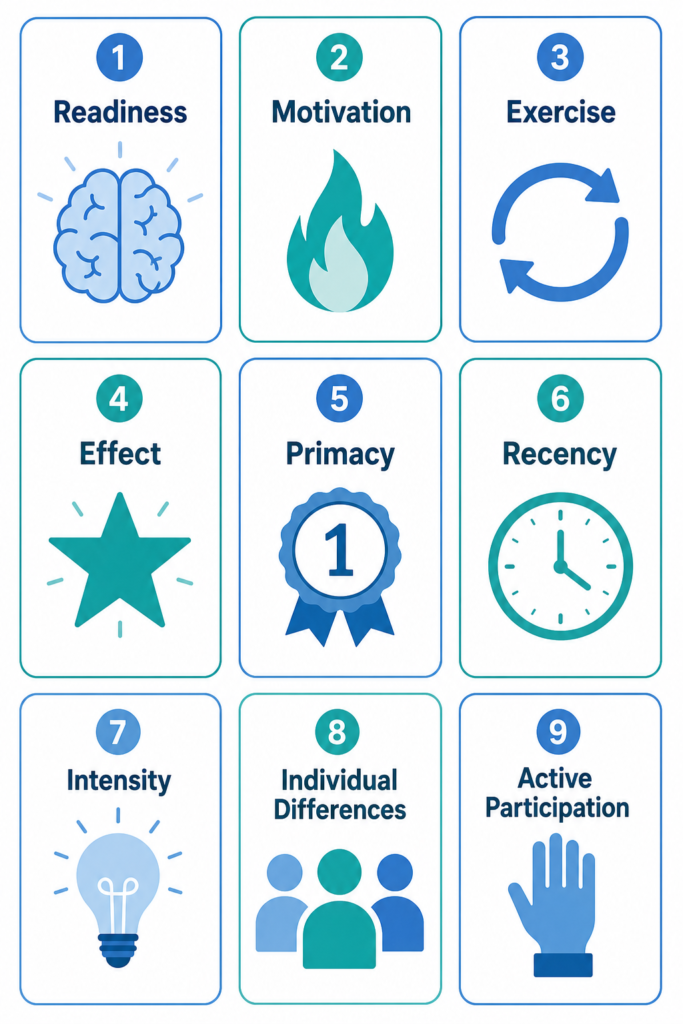
Principle of Readiness
The principle of readiness states that learning is most effective when a learner is mentally, emotionally, and physically prepared to learn. Thorndike’s Law of Readiness established that forcing instruction on an unprepared learner produces frustration rather than understanding.
In the classroom: A teacher who begins a lesson by activating prior knowledge, asking warm-up questions, or reviewing previous material is applying this principle. It sets the stage for everything that follows.
Principle of Motivation
Students engage deeply only when they have a reason to learn. Motivation can be intrinsic (curiosity, personal interest) or extrinsic (grades, rewards, recognition). A teacher who activates student interest before delivering new content is applying this principle directly.
In the classroom: Start lessons with a real-world question, a surprising fact, or a short story that connects the topic to students’ lives. This builds the internal drive that makes learning stick.
Principle of Exercise
The principle of exercise holds that learning is reinforced through repeated, purposeful practice. Simply hearing information once is not enough. Students need multiple opportunities to use what they have learned before it becomes part of long-term memory.
In the classroom: Use spaced repetition, retrieval practice, drills, and review activities. Each repetition strengthens the neural pathways associated with that knowledge.
Principle of Effect
Thorndike’s Law of Effect states that learners tend to repeat behaviors that produce satisfying results and avoid behaviors that lead to frustration. Positive outcomes reinforce learning. Negative ones discourage it.
In the classroom: Provide timely, specific, and encouraging feedback. Praise effort and progress. When students experience success, they are motivated to keep going.
Principle of Primacy
The first correct impression a learner forms is the strongest. If a student learns something incorrectly the first time, that error is harder to correct later. This is why the quality of initial instruction matters so much.
In the classroom: Introduce new concepts carefully and correctly from the start. Use clear examples, check for understanding early, and address misconceptions before they become habits.
Principle of Recency
The most recently learned material is the easiest to recall. Information presented at the end of a lesson tends to stay in working memory longer than information buried in the middle.
In the classroom: Use lesson summaries, exit tickets, and closing reviews to reinforce the key ideas from each session. What you review last is what students remember best.
Principle of Intensity
Vivid, dramatic, and real-world experiences are retained more deeply than abstract symbols or passive explanations. When learning feels meaningful and memorable, the brain stores it more effectively.
In the classroom: Use demonstrations, storytelling, simulations, role-play, and real-world examples. The more concrete and engaging the experience, the deeper the learning.
Principle of Individual Differences
Every learner is unique. Students differ in their learning pace, background knowledge, learning styles, cultural context, and cognitive development. Instruction that ignores these differences will not reach all learners equally.
In the classroom: Use differentiated instruction. Offer varied explanations, flexible grouping, and multiple ways for students to demonstrate understanding. This is also closely tied to what makes up the factors that influence teaching in any given classroom.
Principle of Active Participation
Students learn best by doing, not just listening. Passive instruction produces passive learners. When students are actively involved in the learning process through discussion, problem-solving, or hands-on tasks, comprehension and retention improve significantly.
In the classroom: Build in regular opportunities for student participation. Ask open questions, use group activities, and give students problems to solve rather than answers to memorize.
How Do Principles of Teaching Differ from Methods and Maxims?
Principles of teaching are theoretical guidelines rooted in research. Teaching methods are specific techniques used in the classroom. Maxims of teaching are practical rules of thumb drawn from experience. All three are related, but principles form the foundation from which methods and maxims are naturally derived.
This distinction matters because many B.Ed students use these terms interchangeably, which leads to confusion in both exams and classroom practice.
| Principles | Methods | Maxims | |
| Definition | Research-based guidelines for instruction | Specific techniques used to deliver content | Experience-based practical rules |
| Basis | Educational psychology and theory | Instructional design and pedagogy | Teacher observation and tradition |
| Examples | Readiness, Effect, Primacy | Lecture, Discussion, Project-based learning | Proceed from known to unknown, Simple to complex |
| Scope | Universal and theoretical | Situational and practical | General and experiential |
For a deeper look at how experience shapes classroom guidance, read our article on maxims of teaching. Understanding the distinction helps teachers apply the right framework in the right context.
What Are Merrill’s First Principles of Instruction?
Merrill’s First Principles of Instruction were developed by M. David Merrill at Utah State University and represent one of the most widely cited modern frameworks in instructional design. They synthesize decades of research into five universal principles that apply across all subjects and age groups.
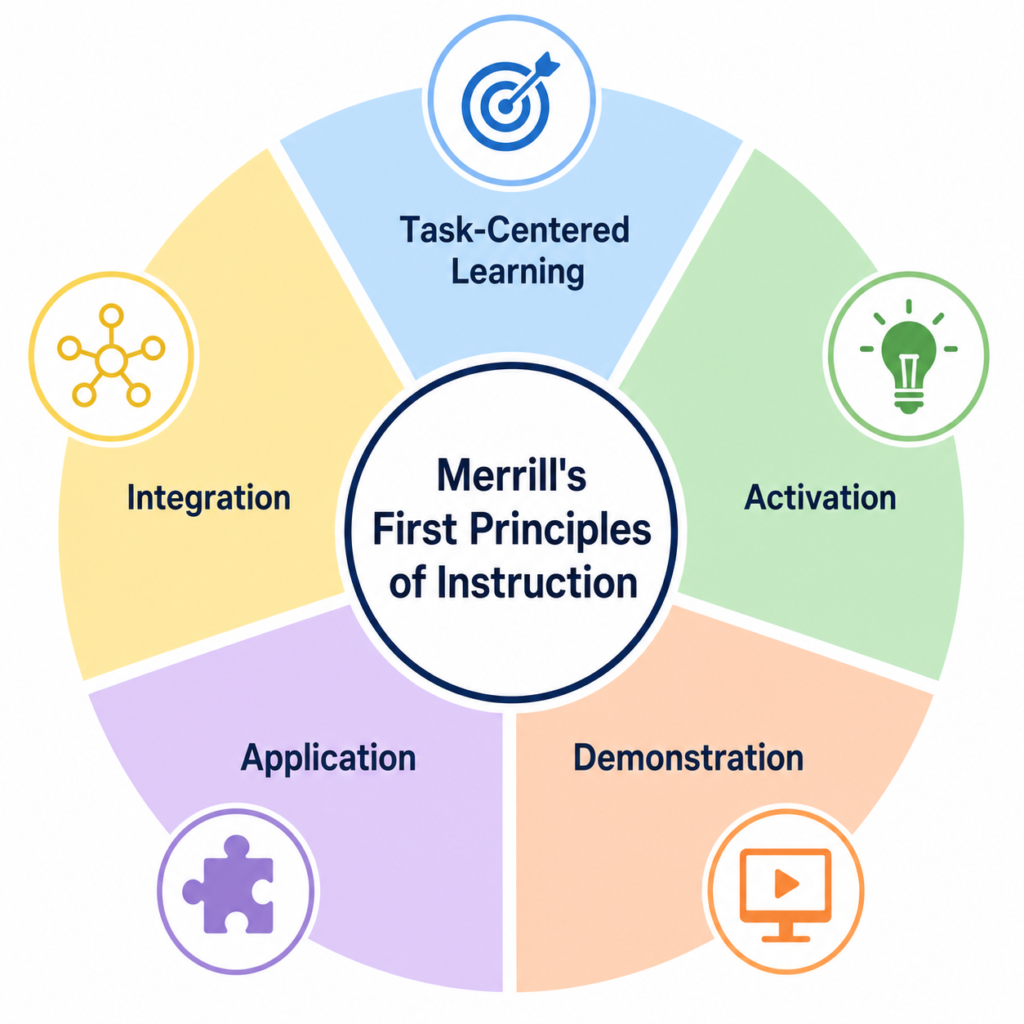
These five principles are:
- Task-Centered Learning: Instruction should be organized around real-world tasks or problems, not isolated facts or skills.
- Activation: New learning must connect to prior knowledge. Students learn better when they can relate new information to something they already know.
- Demonstration: Learners need to see new knowledge in action, not just hear a description of it. Examples, worked problems, and models all serve this principle.
- Application: Students must have the chance to practice using new knowledge with appropriate guidance and feedback.
- Integration: Learners should be encouraged to bring new knowledge into their real lives, reflect on it, and share it with others.
These principles echo the classical teachings of Thorndike and align closely with the constructivism of Jean Piaget, Jerome Bruner, and Lev Vygotsky. Activation mirrors the principle of readiness. Application reflects the principle of exercise. Integration reinforces the principle of effect. The frameworks are different in language but deeply consistent in theory.
To see how these principles connect to the broader qualities of instruction, explore what characteristics of effective instruction look like in a real classroom setting.
How Are Principles of Teaching Applied in the Classroom?
Applying principles of teaching means translating theory into deliberate classroom decisions. A teacher applies the principle of readiness by assessing prior knowledge before a lesson, uses the principle of effect through timely feedback, and honors individual differences by varying instructional approaches across the class.

The table below maps each principle to a practical classroom strategy and an example activity:
| Principle | Classroom Strategy | Example Activity |
| Readiness | Activate prior knowledge before new content | Warm-up questions, brainstorming, quick recap |
| Motivation | Connect content to student interests | Real-world problem opener, current events hook |
| Exercise | Build in repeated practice opportunities | Retrieval quizzes, spaced review sessions |
| Effect | Give specific, timely feedback | Praise effort, written comments on work |
| Primacy | Introduce concepts correctly from the start | Clear definitions, worked examples, immediate comprehension checks |
| Recency | Reinforce key ideas at lesson close | Exit tickets, end-of-lesson summaries |
| Intensity | Use vivid, real examples | Demonstrations, stories, simulations |
| Individual Differences | Adapt instruction to diverse learners | Flexible grouping, varied task formats |
| Active Participation | Involve students in learning actively | Group discussions, project tasks, peer teaching |
These principles operate across all stages of a lesson. Understanding the phases of teaching — pre-active, interactive, and post-active — shows exactly when and how each principle should be applied for maximum effect.
Modern approaches reinforce this even further. Inquiry-based learning, student-led discussions, and project-based learning are all rooted in the principles of active participation, motivation, and individual differences.
What Do Modern Perspectives Add to Traditional Teaching Principles?
Traditional principles gave us the theoretical foundation. Modern research has expanded on that base by showing how brain science, social development, and technology all shape the conditions for effective learning.
The OECD’s 2025 report on high-quality teaching outlines five teaching goals and twenty evidence-based classroom practices, all of which are grounded in the same principles established by Thorndike and later extended by Merrill. The Learning Policy Institute’s 2025 report on teacher preparation similarly highlights five design principles aligned with the Science of Learning and Development (SoLD), emphasizing that instruction must account for cognitive readiness, emotional safety, and active engagement.
Constructivism, developed through the work of Piaget, Bruner, and Vygotsky, reinforced many of these classical principles. Vygotsky’s Zone of Proximal Development, for example, is a direct application of the principle of readiness. Scaffolding, which is the practice of supporting learners just beyond their current ability, reflects both readiness and the principle of exercise working together.
The shift from teacher-centered to student-centered learning models seen across 2025 teacher training programs confirms that active participation and individual differences are now recognized as non-negotiable in quality instruction. These are not new ideas. They are classical principles validated by modern research.
To see how the broader picture of teaching has shifted over time, the article on how perspectives of teaching have evolved provides important context.
Keep Exploring the Teaching Series
Now that you have a solid understanding of the principles of teaching, the next step is to see how they connect to the broader teaching process. Read our guide on the phases of teaching to understand how these principles apply from lesson planning through to post-lesson reflection.
Frequently Asked Questions
What are the principles of teaching?
The principles of teaching are evidence-based guidelines that help educators plan and deliver effective instruction. They include readiness, motivation, exercise, effect, primacy, recency, intensity, active participation, and individual differences. Each principle is derived from educational psychology research and applies across all subjects and age groups.
How many principles of teaching are there?
There is no single fixed number. Classical frameworks, including Thorndike’s laws, list seven to nine core principles. Modern frameworks like Merrill’s First Principles identify five. Most comprehensive lists cover eight to twelve principles depending on the theoretical tradition being referenced.
What is the difference between principles of teaching and teaching methods?
Principles of teaching are theoretical guidelines rooted in research. They explain why certain approaches work. Teaching methods are practical techniques that explain how to deliver instruction. Methods should ideally be chosen based on the underlying principles they reflect.
What are Merrill’s First Principles of Instruction?
Merrill’s First Principles include task-centered learning, activation of prior knowledge, demonstration of new knowledge, application through practice, and integration into real life. Developed by M. David Merrill, they represent a widely accepted modern synthesis of instructional design research.
Why are the principles of teaching important?
Teaching principles provide a consistent, research-backed foundation for instructional decision-making. They ensure that teaching adapts to learner needs, reinforces learning effectively, and produces reliable outcomes rather than relying on habit or guesswork alone.