Phases of Teaching: Pre-Active, Interactive, and Post-Active Phase Explained
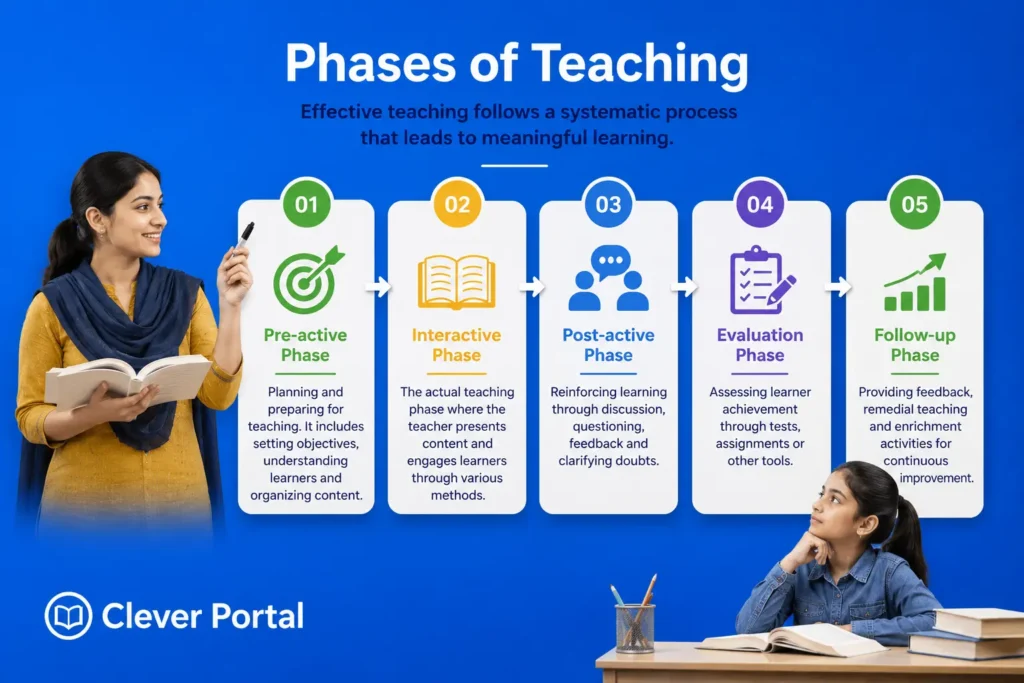
Teaching is a structured process that happens in three stages. These are the pre-active phase (planning before class), the inter-active phase (actual classroom teaching), and the post-active phase (evaluating after class). Each phase has specific activities that help teachers deliver better lessons and improve student learning outcomes. Together, these three phases form a continuous teaching cycle that keeps getting better with every lesson.
Teaching is not something that just happens in the moment. It is a planned, step-by-step process that starts long before a teacher walks into the classroom and continues long after the lesson ends.
Online teaching has grown by more than 300% in recent years, and this growth has made it even more important for teachers to understand the full structure of what they do. Whether teaching in a classroom or online, every good lesson follows the same basic pattern.
This pattern is what we call the phases of teaching. Understanding these phases helps teachers plan with purpose, deliver with confidence, and evaluate with clarity. In this guide, you will learn everything about the three phases of teaching, the variables involved, and how these phases work together as a cycle.
What Are the Phases of Teaching?
The phases of teaching refer to the three stages that make up the complete teaching process. These stages are recognized in B.Ed. curricula and teacher education programs across the world, especially in South Asia.
The three phases are:
- Pre-Active Phase – The planning stage that happens before class
- Inter-Active Phase – The implementation stage that happens during class
- Post-Active Phase – The evaluation stage that happens after class
Each phase builds on the one before it. Together, they form what educators call the teaching-learning process. A teacher who skips any one of these stages is likely to face problems in the classroom. Understanding all three phases is the foundation of good, systematic planning.
These stages of teaching were described by education theorist Philip W. Jackson, who divided the teaching act into three distinct phases based on what teachers actually do at each point in the instructional cycle.
To understand how these phases function, it also helps to know the variables that operate across all of them.
What Are the Variables of Teaching?
Before going into each phase, it is important to understand that teaching involves three key variables. These variables are present in every phase of the teaching process.

The Teacher as Independent Variable
The teacher is the independent variable in the teaching process. This means the teacher drives the process forward. The teacher makes decisions, plans the lesson, delivers instruction, and evaluates outcomes. The quality of teaching depends heavily on the skill, knowledge, and preparation of the teacher.
Content and Methodology as Intervening Variable
Content and instructional methodology form the intervening variable. This is the bridge between the teacher and the student. It includes what is taught and how it is taught. The choice of teaching strategies, learning experiences, and instructional materials all fall under this variable. Poor methodology can block learning even when the teacher is skilled and the student is motivated.
Students as Dependent Variable
Students are the dependent variable in teaching. Their behavioral change, knowledge gain, and skill development are the expected outputs of the teaching process. The factors of teaching that affect the learner, such as interest, attention, and prior knowledge, play a major role in determining how much students benefit from instruction.
Understanding these three variables helps teachers see why every decision they make in each phase matters.
Pre-Active Phase of Teaching: The Planning Stage
The pre-active phase is everything a teacher does before entering the classroom. This is the planning stage, and it is the foundation of good teaching. Without proper planning, the interactive phase becomes disorganized and the post-active phase has nothing solid to evaluate.
According to B.Ed. curriculum frameworks, the pre-active phase involves several key activities that teachers must complete in a specific order.
Determining Goals and Objectives
The first activity in the pre-active phase is setting clear learning objectives. A teacher must ask: What do I want students to know or be able to do after this lesson?
Objectives should describe a measurable behavioral change in students. This idea comes from Robert Mager’s behavioral objectives model, which is widely used in teacher education. Goals must be realistic, specific, and connected to the needs of both students and society.
Objectives generally fall into three categories:
- Cognitive – Knowledge and understanding
- Affective – Attitudes and values
- Psychomotor – Physical skills and actions
Selection and Sequencing of Content
Once goals are set, the teacher selects the content that will help students reach those goals. Content selection must match the student entry behavior, meaning the prior knowledge students already have. Content that is too advanced or too simple will not produce the desired behavioral change.
Sequencing is equally important. Topics should move from simple to complex so that each piece of knowledge builds on the last.
Selection of Instructional Methodology
Choosing the right teaching strategies and tactics is a critical step in the pre-active phase. The teacher must decide which methods best fit the topic, the students, and the available resources. Common choices include:
- Lecture method
- Discussion method
- Group activity
- Demonstration
- Project-based learning
The principles of teaching guide these decisions and help teachers choose methods that are appropriate for the learning environment.
Preparation of Evaluation Tools
Many teachers make the mistake of thinking about evaluation only after teaching. In the pre-active phase, testing devices and evaluation tools should be prepared before the lesson begins. This ensures that evaluation is aligned with objectives from the start, not added as an afterthought.
Inter-Active Phase of Teaching: The Implementation Stage
The inter-active phase is where actual classroom teaching takes place. This is the most visible stage of the teaching process. The teacher puts the pre-active plan into action and responds to students in real time.
The behavior of the teacher during this phase is partly planned and partly spontaneous. Things happen quickly, and the teacher must adapt. This is why a solid pre-active plan is so important.
The inter-active phase involves four main operations.
Perception: Sizing Up the Class
The first operation is perception. The teacher observes the class and reads the room. How many students are present? Are they alert or distracted? What is the general mood?
At the same time, students are also perceiving the teacher. They notice the teacher’s body language, tone of voice, and level of confidence. This mutual perception sets the tone for the entire lesson. Good teachers use this moment to build a positive, engaging classroom atmosphere.
Diagnosis: Assessing Prior Knowledge
After perception, the teacher moves into diagnosis. This means checking what students already know before delivering new content. The teacher may ask introductory questions, conduct a brief oral quiz, or observe student reactions.
Diagnosis helps the teacher adjust the lesson in real time. If students already know a concept, the teacher can move faster. If there are gaps, the teacher can slow down and revisit foundational ideas. The maxims of teaching support this step by reminding teachers to always move from the known to the unknown.
Reaction and Response: Verbal Stimulation in the Classroom
The third operation is action and reaction. This is the heart of the inter-active phase. The teacher delivers instruction through verbal stimulation, questions, explanations, and demonstrations.
Students respond, and the teacher reacts to those responses. This back-and-forth exchange is what creates real learning. Education researcher Ned Flanders developed a tool called Flanders Interaction Analysis to measure the quality of verbal interaction in the classroom. This tool remains one of the most widely cited frameworks in teacher education.
The inter-active phase also includes:
- Selecting the right stimuli to present
- Presenting those stimuli clearly
- Observing student reactions
- Adjusting the teaching approach as needed
Feedback and Reinforcement
The fourth operation is reinforcement. After students respond, the teacher provides feedback. Reinforcement can be:
- Positive reinforcement – Praising correct answers, nodding approval, giving encouraging words
- Negative reinforcement – Correcting mistakes, redirecting attention, providing additional explanation
Reinforcement serves three purposes in the teaching-learning process. It motivates students to stay engaged, confirms correct understanding, and corrects errors before they become habits.
Post-Active Phase of Teaching: The Evaluation Stage
The post-active phase begins after the classroom session ends. This is the evaluation stage, and it is where many teachers unfortunately cut the process short. Skipping this phase means missing the most important opportunity for growth.
The functions of teaching include evaluation and reflection, and both are central to what happens in the post-active phase.
Defining Behavioral Changes (Criterion Behavior)
The first activity in the post-active phase is comparing what students actually learned against what the teacher expected them to learn. This expected learning outcome is called criterion behavior.
The teacher asks: Did students change their behavior, knowledge, or skills in the way the lesson objectives intended? If the answer is yes, the lesson was successful. If the answer is no, the teacher must investigate why.
Selecting Testing Devices
To measure student learning accurately, the teacher selects testing devices that match the lesson objectives. These may include:
- Written tests and quizzes
- Oral questioning sessions
- Observation of student behavior
- Project work or practical demonstrations
- Student self-assessment activities
Good testing devices must be reliable (consistent results) and valid (measuring what they are meant to measure). A mismatch between objectives and testing tools gives an inaccurate picture of student learning.
Modifying Teaching Strategies
The final activity in the post-active phase is reflection and modification. Based on evaluation results, the teacher asks:
- Did my chosen instructional methodology work?
- Were my objectives realistic for this group of students?
- What would I do differently next time?
The answers to these questions become the starting point for the next pre-active phase. This is what makes teaching a continuous improvement cycle, not a one-time event.
The characteristics of good teaching consistently include the ability to reflect, adapt, and improve. The post-active phase is where that improvement is born.
How the Three Phases Work Together as a Teaching Cycle
One of the most important things to understand about the phases of teaching is that they do not work in isolation. They form a continuous teaching cycle.

Here is how the cycle works:
| Phase | When It Happens | Key Activities | Primary Goal |
| Pre-Active | Before class | Goal-setting, content selection, method selection, evaluation prep | Planning |
| Inter-Active | During class | Perception, diagnosis, reaction, reinforcement | Implementation |
| Post-Active | After class | Behavioral evaluation, testing, strategy modification | Improvement |
The post-active phase feeds directly into the pre-active phase of the next lesson. What the teacher learns from evaluating one lesson becomes the plan for the next one. This feedback loop is what separates average teaching from truly effective teaching.
In modern online and hybrid teaching environments, this cycle looks slightly different. The pre-active phase may involve digital lesson planning tools and learning management systems. The inter-active phase may use video conferencing and real-time polling. The post-active phase may rely on automated quiz data and learning analytics. But the core structure remains the same.
Why the Phases of Teaching Are Important
Understanding the phases of teaching matters for every educator, whether they are a new teacher in training or a seasoned classroom professional. Here is why:
- Systematic planning – ensures lessons are purposeful and goal-directed, not random or improvised
- Effective execution – during the inter-active phase is only possible when the pre-active phase has been done properly
- Continuous improvement – happens through the post-active phase, which provides honest feedback on what is working and what is not
- Student behavioral change – the ultimate goal of teaching – depends on all three phases working together
- B.Ed. curriculum alignment – understanding these phases is essential for passing teacher education exams and becoming a certified educator
Good teaching is never accidental. It is always the result of structured thinking, careful planning, and honest evaluation. The three phases of teaching give every teacher a clear framework to follow.
Final Thoughts
The phases of teaching give structure to what can otherwise feel like a very complex job. When a teacher understands the pre-active, inter-active, and post-active phases, they are no longer just “winging it” in the classroom. They are following a tested, proven framework for delivering effective instruction and producing real behavioral change in students.
Each phase depends on the others. Strong planning in the pre-active phase leads to confident delivery in the inter-active phase. Honest evaluation in the post-active phase leads to better planning in the next cycle. This is the teaching-learning process at its best.
If you want to deepen your understanding of how great teachers work, explore how the principles of teaching and the maxims of teaching connect to each of these phases. Together, they give you a complete picture of what excellent, purposeful teaching looks like in practice.