Teaching and Learning Methods: Types, Examples, and How to Choose the Right One
Teaching and learning methods are the structured approaches teachers and students use to deliver, absorb, and apply knowledge in the classroom. They fall into three broad categories: teacher-centered methods (like the lecture method and demonstration method), student-centered methods (like project-based and inquiry-based learning), and technology-enhanced approaches. The most effective educators match the method to their subject, student age group, and learning objective rather than relying on a single approach.
Introduction
With dozens of teaching strategies available, knowing which one to use and when is one of the most practical challenges educators face today. Whether you are a classroom teacher, a student-teacher in training, or an education researcher, having a clear understanding of teaching and learning methods is foundational to effective classroom practice.
This guide breaks down the main categories of teaching and learning methods, explains what makes each one effective, and helps you match the right approach to your classroom goals. You will also find links to in-depth guides on each individual method throughout this article.
What Are Teaching and Learning Methods?
Teaching and learning methods are the structured techniques educators and students use to facilitate knowledge transfer, skill development, and critical thinking in the classroom. The two terms describe different sides of the same process.
| Teaching Methods | Learning Methods |
| What the teacher does to deliver content | What the student does to process and retain it |
| Lecture, demonstration, explanation | Note-taking, self-testing, group discussion |
| Controlled by the instructor | Driven by the learner |
When teachers understand both sides, they can design lessons where their delivery style matches the way their students learn best. According to Discovery Education, the most effective teachers are not just delivering content but are using specific instructional strategies that promote thinking, discussion, practice, and reflection.
Good lesson planning always starts with the learning objective. Once that is clear, selecting the right method becomes much easier.
How Are Teaching Methods Classified?
Teaching methods are most commonly grouped into three categories. Understanding these groups helps teachers build a flexible repertoire rather than relying on only one approach.
| Category | Description | Key Examples |
| Teacher-Centered | Teacher leads and directs the learning | Lecture, explanation, description, drill, demonstration |
| Student-Centered | Students take an active role; teacher facilitates | Project method, Q&A method, independent study, dramatization |
| Technology-Enhanced | Digital tools support or extend both approaches | Flipped classroom, e-learning, adaptive platforms |
Most modern classrooms use a blend of all three categories. The choice depends on the subject, the age group, and the specific learning outcome for that lesson.
For a deeper look at each side of this spectrum, see the full guides on teacher-centered methods and student-centered methods.
What Are Teacher-Centered Teaching Methods?
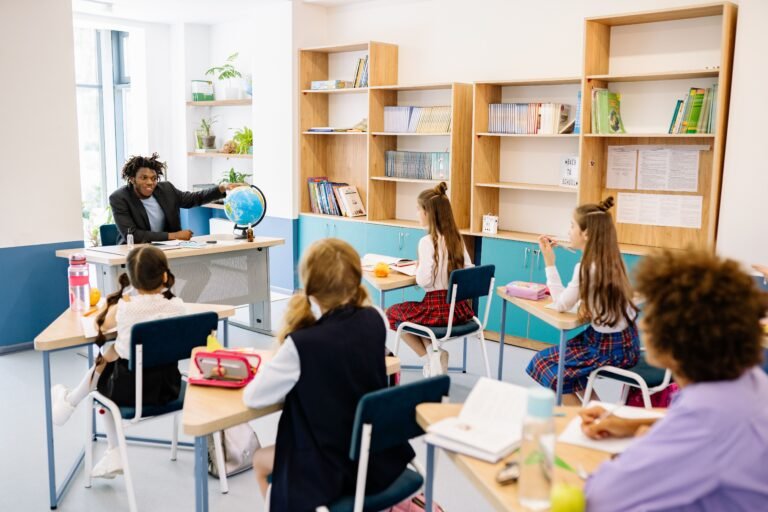
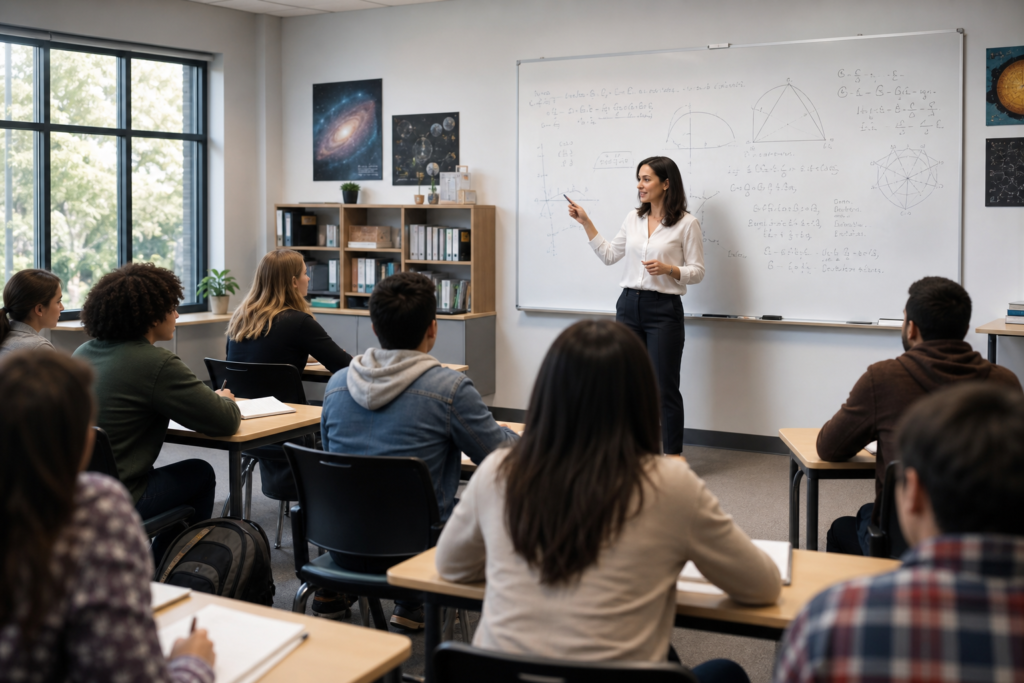
In teacher-centered methods, the educator controls the pace, content, and direction of the lesson. Students primarily receive and absorb information. These methods are efficient for delivering structured content to large groups, especially when introducing a topic for the first time.
The teacher is often described as the “sage on the stage” in this model. While that phrase has a slightly critical tone in modern education circles, these methods remain genuinely effective when used in the right situations.
Here are the core teacher-centered methods:
- Lecture method: The teacher delivers information verbally while students listen and take notes. It is one of the oldest and most widely used approaches in both schools and universities. Read the full lecture method guide for a complete breakdown.
- Explanation method: The teacher breaks down a complex concept into simpler parts, guiding students step by step through difficult material. Explore how the explanation method in teaching works in practice.
- Description method: The teacher uses detailed verbal or visual descriptions to help students form a mental picture of a concept, object, or process. The description method in teaching is especially effective in geography, history, and science.
- Demonstration method: The teacher shows a process in action, allowing students to observe before they attempt it themselves. It is widely used in science, vocational subjects, and physical education.
- Drill method: The teacher leads students through structured repetition of a skill or piece of information until it becomes automatic. According to the British Council, drilling helps students memorize and automatize common language patterns and language chunks.
When Should Teachers Use Teacher-Centered Methods?
Teacher-centered approaches work best in these situations:
- When introducing a completely new topic that students have no prior knowledge of
- When teaching large class groups where individual activity is difficult to manage
- When building foundational skills that need to be correct before students can explore independently
- When there is limited time and the teacher needs to cover specific content efficiently
- When working with younger learners who need clear structure and direct guidance
What Are Student-Centered Teaching Methods?
Student-centered methods shift the primary responsibility for learning to the student. The teacher acts as a guide or facilitator rather than the sole source of knowledge. Stanford University describes this mindset as viewing the learner as the primary and unique agent of learning, engagement, and connection.
These approaches build critical thinking, collaboration, and deeper conceptual understanding because students are actively doing something with the information rather than just receiving it.

Here are the key student-centered methods:
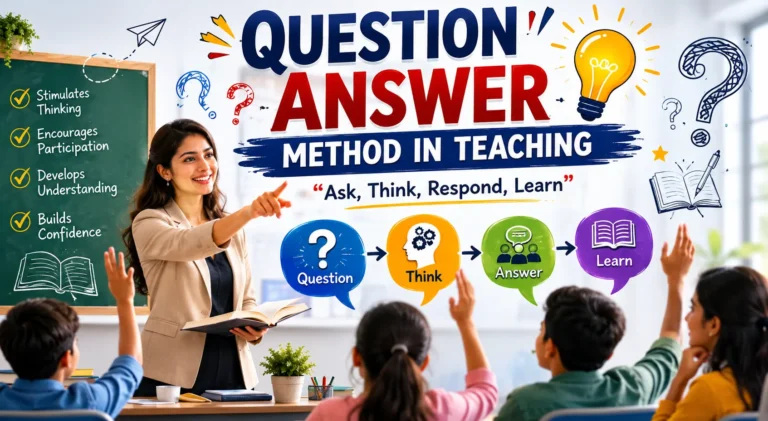
- Question-answer method: The teacher asks structured questions and students respond, creating a dialogue that deepens understanding. This approach traces back to the Socratic method of ancient philosophy. Explore the full question-answer method in teaching guide.
- Dramatization method: Students act out concepts, events, or situations. This brings abstract content to life and is especially powerful in literature, history, and language learning. See the complete dramatization method guide.
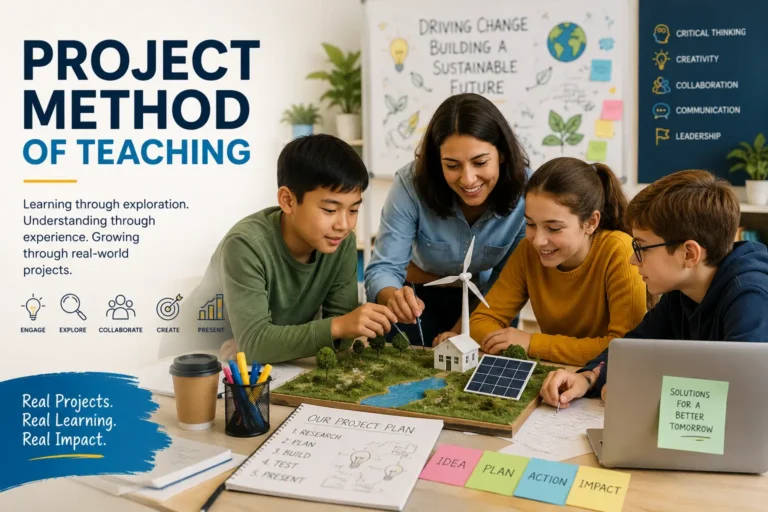
- Project method: Students work on extended, real-world projects that require research, collaboration, and problem-solving. This is closely related to project-based learning (PBL), a model championed by educational thinker John Dewey. Visit the project method in teaching page for more.
- Independent study method: Students take responsibility for planning and completing their own learning tasks. It builds self-regulation and is useful for advanced learners. Learn more about the independent study method.
- Supervised study method: Students study on their own but under teacher supervision, allowing for guidance when needed. The supervised study method bridges independent work and direct instruction.
- Tutorial method: A teacher works with a small group or individual student to address specific learning needs. The tutorial method in teaching is highly personalized and effective for remedial or advanced support.
- Improvisation in teaching: Teachers and students use unscripted, flexible interactions to explore ideas in real time. Discover how improvisation in teaching can make lessons more responsive and creative.
Benefits of Student-Centered Methods
Research consistently supports these benefits of active learning approaches:
- Students develop stronger critical thinking and problem-solving skills
- Engagement and motivation increase when learners have ownership of the process
- Peer-to-peer learning helps students understand concepts from multiple perspectives
- These methods prepare students for real-world collaboration and independent thinking
- Constructivism as a learning theory, associated with Lev Vygotsky’s concept of the zone of proximal development, underpins many student-centered approaches
What Are Experiential and Practice-Based Methods?
Experiential methods place students in hands-on or simulated situations where they learn by doing. Practice-based methods use structured repetition to build accuracy and fluency. Both sit between teacher-centered and student-centered approaches because they involve both direct teacher guidance and active student participation.
John Dewey, the American education philosopher, argued that genuine learning comes from experience rather than passive reception. His ideas form the foundation of most experiential teaching approaches used today.
| Type | Purpose | Best Subjects |
| Experiential (demonstration, dramatization, project) | Build understanding through observation and doing | Science, arts, vocational, history |
| Practice-Based (drill, review) | Build accuracy and automatic recall through repetition | Math, language, music, physical skills |
The demonstration method is one of the most effective experiential approaches. It allows students to watch a process before attempting it, reducing errors and building confidence. Understanding the steps of the demonstration method helps teachers plan these lessons effectively, particularly for science classes. See how demonstration in teaching science works for practical subject-specific examples.
The drill method is one of the most reliable practice-based methods. Examples of drill and practice include spelling tests, choral pronunciation practice, grammar repetition exercises, and math fact recitation. However, the Open University notes that drill is most effective when combined with methods that build understanding, not as a standalone approach.
The review method consolidates learning after instruction has occurred. It reinforces what students have already studied and identifies gaps before moving forward. Learn how the review method in teaching fits into lesson planning.
How Have Teaching and Learning Methods Evolved in 2026?
Teaching methods are not static. What works in a classroom today looks quite different from what worked even ten years ago.
Neuroeducation is one of the most influential forces reshaping modern pedagogy. Researchers studying how the brain learns are now questioning traditional reliance on passive lecture delivery and memorization-based testing as the primary modes of instruction. This does not mean those methods are gone, but it does mean teachers are expected to blend them with more active, engaging approaches.
According to a 2025 to 2026 UK Government Technology in Schools Survey, 81% of teachers were using technology in lessons, and assistive technology use among primary school teachers nearly doubled from 34% to 60% in just two years. This reflects a major shift toward technology-enhanced learning as a standard part of classroom instruction rather than an optional add-on.
The biggest trends shaping instructional methods and strategies in 2025 and 2026 are:
- Personalized learning powered by adaptive platforms and AI tools
- Blended learning that combines face-to-face and digital delivery
- Flipped classroom models where students review content at home and practice in class
- Inclusive instructional design that accounts for diverse learning needs and learning styles
How Do You Choose the Right Teaching Method?
Choosing the right teaching method is where experience, research, and professional judgment come together. Most educators agree that no single method works for every lesson, and the most effective classrooms use a flexible mix of approaches.
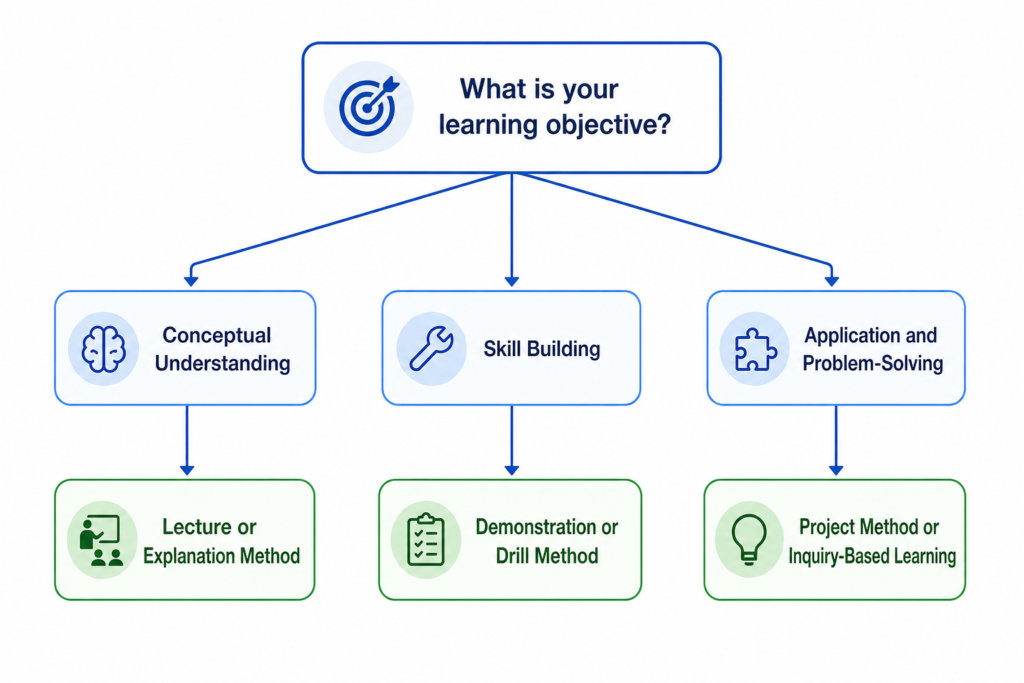
Here is a practical four-step decision framework:
- Define the learning objective. Are students learning a concept, a skill, or how to apply something? Conceptual goals often suit explanation or lecture. Skill-based goals suit demonstration and drill. Application goals suit project or inquiry-based approaches.
- Know your students. Consider their age, prior knowledge, attention span, and learning styles. Younger learners thrive with visual and hands-on methods. Older students can handle more abstract and independent methods.
- Consider the subject matter. Some subjects have strong method matches. See the quick guide below.
- Check your resources. Technology-enhanced methods require devices. Experiential methods need materials or space. Choose what is realistically deliverable in your classroom.
Subject-to-Method Quick Match:
| Subject | Recommended Methods |
| Science | Demonstration method, project-based, inquiry-based |
| Mathematics | Drill method, lecture, direct instruction |
| Language Arts | Question-answer method, dramatization, supervised study |
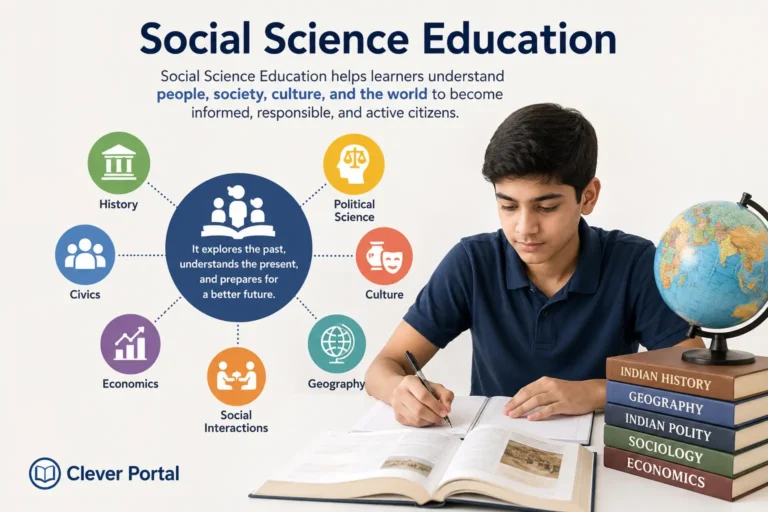
| History/Social Studies | Dramatization, project method, Socratic discussion |
| Physical Education | Demonstration, drill, experiential learning |
| Arts and Music | Improvisation, project method, drill (for technique) |
Understanding the advantages of the question-answer method is especially useful for subjects where discussion drives understanding. Similarly, knowing the benefits of the lecture method helps teachers decide when direct instruction is actually the most efficient choice. For creative subjects, reviewing dramatization method advantages and disadvantages helps teachers weigh the trade-offs honestly.
What Is the Difference Between Teaching Methods and Learning Strategies?
This is a question many educators and students confuse. The distinction is actually straightforward.
Teaching methods are what the instructor does. Learning strategies are what the student does. Both work together, and understanding the difference helps teachers design more complete lessons.
| Teaching Methods | Learning Strategies |
| What the teacher does | What the student does |
| Demonstration, lecture, Q&A | Note-taking, self-testing, summarizing |
| Chosen and planned by the teacher | Practiced and applied by the student |
| Shapes how content is delivered | Shapes how content is processed and retained |
For example, a teacher who uses cooperative learning (teaching method) pairs best with students who practice peer explanation and discussion (learning strategy). A teacher who uses the drill method gets better results when students are also using self-testing strategies to reinforce what they practiced in class.
Research from NCBI shows that student-generated questions, a core learning strategy, significantly improve comprehension and retention compared to passive review. This is why student-centered approaches that encourage questioning, like the Socratic method, are gaining ground in modern classrooms.
Keep Exploring Teaching Methods in Depth
This guide gives you a strong foundation in the major categories of teaching and learning methods. But each method has its own principles, steps, advantages, and classroom applications that deserve a closer look.
On CleverPortalUS, you will find dedicated in-depth guides for every method covered here. Whether you want to understand exactly how the drill method in teaching builds automaticity, explore how the demonstration method fits into structured lesson planning, or learn the full scope of how the lecture method benefits a well-designed classroom session, each page goes deep on one method at a time.
Start with the category that matches your current teaching context, and work your way through the cluster to build a complete, flexible teaching toolkit.
Frequently Asked Questions
What is the most effective teaching method?
There is no single most effective teaching method. Research consistently shows that student-centered approaches like project-based learning improve critical thinking and long-term retention. However, structured teacher-led methods remain effective for introducing new concepts and building foundational skills. The most effective method always depends on the subject, student age group, and specific learning objective.
What are the 4 main types of teaching methods?
The four core types most commonly referenced in instructional design are: direct instruction (lecture-based), inquiry-based learning (question and discovery-driven), cooperative or collaborative learning (group-based), and experiential learning (hands-on, doing-based). These four represent a full spectrum from teacher-directed to student-directed approaches.
What teaching methods work best for primary school students?
Younger students respond best to visual, hands-on, and play-based approaches. Demonstration, dramatization, project activities, and group-based tasks keep primary learners engaged more effectively than extended lecture delivery. Movement, storytelling, and peer interaction are also strong engagement tools at this age group.
Are traditional teaching methods still effective?
Yes, traditional methods like the lecture method, drill, and direct instruction are still effective when used appropriately. They work best for introducing new content, building foundational skills, and managing large class groups. Modern pedagogy recommends blending traditional and student-centered methods rather than abandoning one for the other entirely.
How does the drill method support learning?
The drill method reinforces foundational skills through structured repetition, making it particularly effective for mathematics facts, spelling, pronunciation, and grammar rules. It builds automatic recall and accuracy over time. For best results, it works alongside methods that build deeper understanding rather than as the only approach used.
What is the difference between the lecture method and the demonstration method?
The lecture method delivers information verbally, with students as listeners. The demonstration method shows a process in action, allowing students to observe and then replicate. Demonstration is more effective for procedural and science-based learning, while the lecture method is better suited for theoretical or conceptual content where discussion follows delivery.
What role does technology play in modern teaching methods?
Technology enhances teaching methods by enabling personalized learning, interactive simulations, and real-time assessment feedback. Tools like adaptive learning platforms, multimedia presentations, and AI-assisted instruction supplement traditional methods and help educators reach students with different learning styles more effectively. As of 2026, the vast majority of teachers integrate technology into their regular lessons.